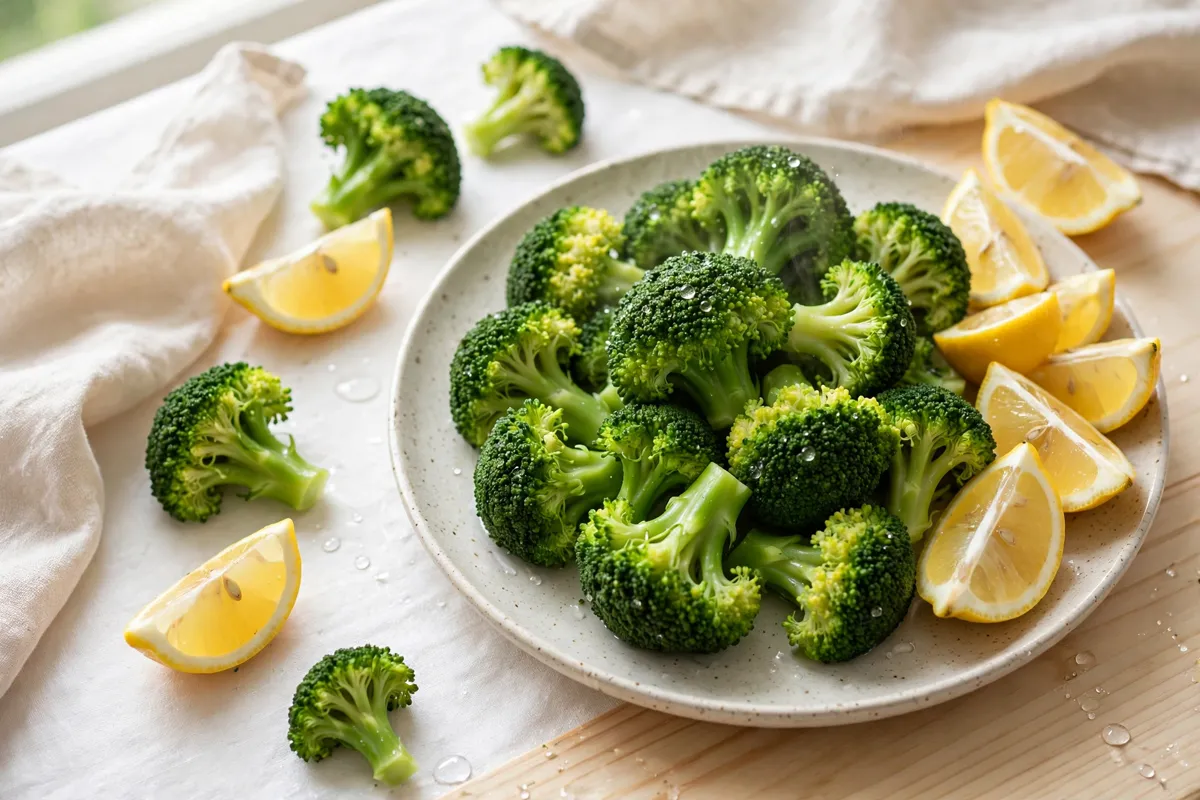
Calorie Counter: The Short Answer
Yes — steamed broccoli is good for you, and the logged numbers show why: a full cup (156 grams) provides about 55 calories, 5.1 grams of fibre, 3.7 grams of protein and about 457 milligrams of potassium, with only about 64 milligrams of sodium when it is cooked without salt. On the verified USDA profile (FDC ID 169967), steamed broccoli delivers fibre, protein and potassium at a calorie cost so low that asking whether steamed broccoli is good for you is really asking what could possibly count against it — and this article examines that side honestly too.
"Good for you" is a phrase that deserves better than a yes. It should mean: nutrient return per calorie, a profile without a hidden liability, and a food that helps the rest of the diet rather than merely failing to harm it. Broccoli passes those tests on the numbers in the USDA log, and it also passes the practical test — it is cheap, fast, filling and tolerant of being cooked by tired people on weeknights. What follows grades it test by test, names the few genuine caveats, and separates the vegetable from the sauces it so often arrives wearing. The calorie counter holds the same profile; this page renders the verdict.
Short Answer
Yes. A cup of steamed broccoli (156g cooked) is about 55 calories with 5.1g fibre, 3.7g protein, 11.2g carbohydrate, 0.6g fat, about 457mg potassium and about 64mg sodium unsalted. Its liabilities are not nutritional — they are culinary: overcooking, and the butter, cheese and creamy sauces added to it.
What Does the Verified Profile Say in Broccoli's Favour?
Start with the exchange rate, because it is the core of the case. Per 100 grams cooked, broccoli carries 35 calories, 2.38 grams of protein, 7.18 grams of carbohydrate, 3.3 grams of fibre, 0.41 grams of fat, 41 milligrams of sodium and 293 milligrams of potassium. Scaled to the 156-gram cup, the fibre reaches 5.1 grams — a meaningful share of a day's target from a side dish — and the potassium reaches about 457 milligrams, more than many foods marketed as potassium sources deliver, at a fraction of their calories.
The fibre figure deserves its emphasis. In the ranking inside which foods have the highest amount of fiber, vegetables rarely trouble the legumes and seeds at the top — but broccoli is among the strongest of the ordinary plate vegetables, and it delivers its fibre inside a food people will actually eat daily, which is where fibre goals are won or lost. Its carbohydrate is slow company, too: of the cup's 11.2 grams, only about 2.2 grams are sugar (1.39g per 100g scaled), with the fibre moderating the rest, as the breakdown in how many carbs are in broccoli shows.
Then there is the sodium line, quietly one of broccoli's best features. Cooked without salt, the cup carries about 64 milligrams — nearly nothing in a dietary pattern where restaurant meals routinely carry well over a thousand. A food you can eat in volume that adds bulk, fibre and potassium while adding essentially no sodium is not merely harmless; it is corrective, diluting the day's average with every bite.
Does Steaming Protect What Is Good About Broccoli?
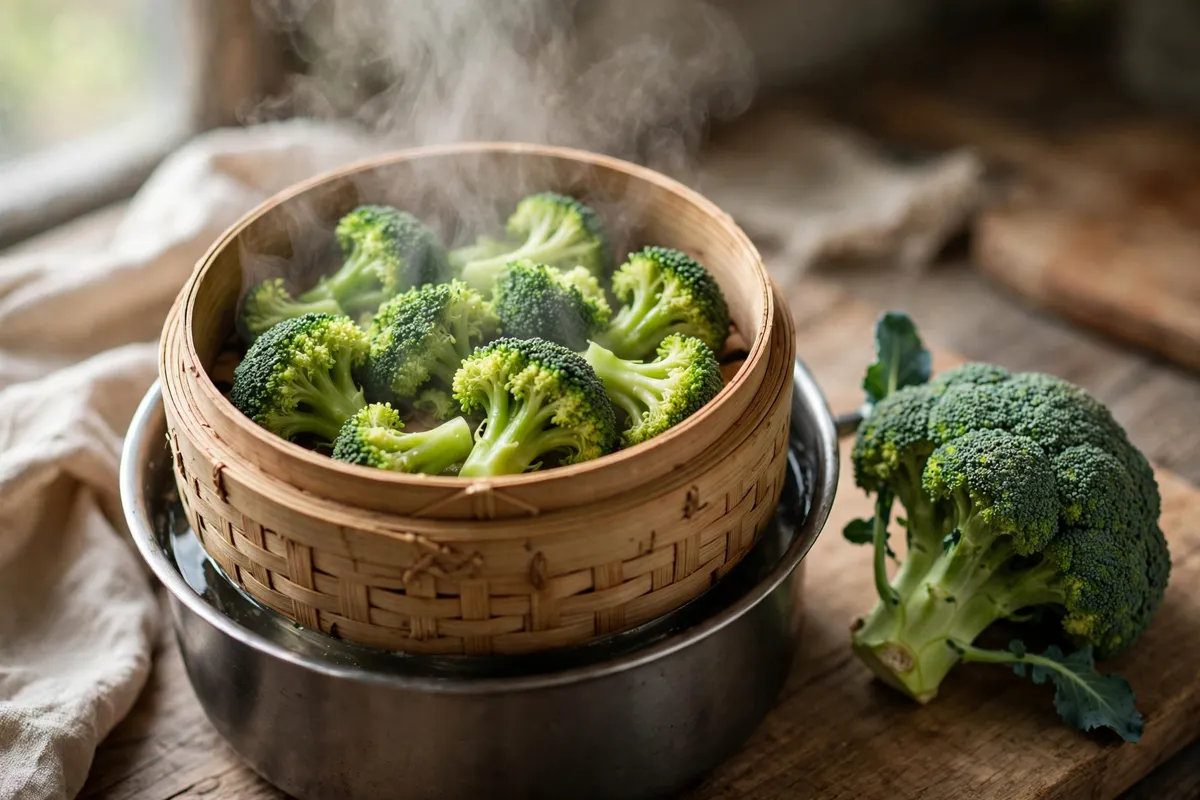
Steaming is the kindest of the common methods, and the reason is simple: the florets sit above the water rather than in it. The verified reference entry for cooked broccoli in this dataset is the boiled, drained entry — FoodData Central publishes no separate steamed entry in SR Legacy — and boiling submerges the vegetable, letting soluble components migrate into water that gets poured away. Steaming keeps that migration minimal. The calorie count does not care either way, since energy stays in the tissue, but the retained share of everything water-soluble is higher off the steam than out of the pot.
Two honest qualifications. First, the advantage is a matter of degree, not kind: boiled broccoli remains an excellent food on every figure in the log, and anyone who prefers it boiled loses little. Second, duration matters more than the method's name. Broccoli steamed to bright green and firm keeps its texture and its appeal; broccoli steamed to olive drab and mush has been punished past the point where the method can help it, and — the practical risk — it becomes the kind of vegetable people stop serving. The best cooking method is the one that keeps broccoli in your rotation, a principle that outranks any laboratory comparison.
What cooking genuinely cannot survive is the topping. The profile above describes plain broccoli. Melt butter over it, blanket it in cheese sauce, or drown it in a creamy dressing and you have built a different dish whose numbers must be logged as such — the cautionary arithmetic lives in how many calories are in broccoli cheese soup. Season aggressively by all means — salt measured, lemon, garlic, chilli, a weighed drizzle of oil — but log what you add.
Are There Any Downsides to Eating Broccoli Regularly?
A few, and they are worth stating plainly because a food with no stated downsides is a food being marketed, not described. The first is digestive: broccoli's fibre and its fermentable carbohydrates can produce gas and bloating, particularly when a low-fibre eater suddenly adopts large portions. The remedy is graduation — start at the half-cup portion in what is a serving size of broccoli and let the gut adapt over a couple of weeks — not avoidance.
The second is thyroid-related in theory: broccoli is a cruciferous vegetable, and crucifers contain goitrogen compounds that can interfere with iodine uptake when eaten raw in very large quantities by someone iodine-deficient. Cooking reduces those compounds substantially, ordinary portions are far below the amounts involved in that research context, and for the general reader this is a footnote, not a warning — but it is the honest footnote, and anyone with a thyroid condition and a truly enormous raw-broccoli habit should raise it with their clinician rather than with a website.
The third is interaction awareness for people on blood-thinning medication, who are generally advised to keep their intake of vitamin-K-rich vegetables consistent rather than swinging between none and lots. Consistency, not avoidance, is the standard advice pattern — again, a matter for the prescribing clinician. None of these caveats touches the ordinary case: a cup of steamed broccoli beside dinner, several times a week, is one of the least complicated good decisions in nutrition.
How Does Broccoli Compare With the Foods It Replaces?
Health judgements are relative, and broccoli's strongest argument is comparative. On the plate, it usually displaces a denser side. Priced per cup from the verified entries used across this site: steamed broccoli is about 55 calories with 5.1 grams of fibre; cooked carrots, its closest cousin in the log, are about 55 calories with about 4.7 grams of fibre per cup of slices; cooked black beans — a genuinely nutritious staple — are about 227 calories per cup, a protein food rather than a light side. Broccoli is not competing with beans; it is competing with the buttered, creamed and fried sides whose fibre is near zero and whose calories run several times higher for the same volume.
It also competes well inside its own family of "virtuous" foods. The survey in how much fiber is in common fruits and vegetables shows how many celebrated vegetables deliver less fibre per cup than their reputations suggest. Broccoli's combination — top-tier fibre for a vegetable, real protein for a vegetable, high potassium, negligible sodium, 35 calories per 100 grams — is not matched by many single foods at any price, and it is matched by almost none at broccoli's price per kilo. Run it through the calorie counter as part of your actual dinner and the comparison stops being abstract.
Common Mistakes to Avoid
- Judging broccoli by its dressed versions — cheese sauce and butter build a different dish with different numbers.
- Overcooking it into mush and then concluding you dislike it; the method failed, not the vegetable.
- Leaping from a low-fibre diet to double portions overnight and blaming broccoli for the predictable bloating.
- Assuming "good for you" means unlimited in every context — people on blood thinners or with thyroid conditions should keep intake consistent and clinician-aware.
- Crediting broccoli with numbers from raw data when you ate it cooked — the cooked cup weighs 156g against the raw cup's 91g.
Final Thoughts
Steamed broccoli is good for you on the evidence of its own verified profile: 55 calories a cup, 5.1 grams of fibre, useful protein and potassium, almost no sodium, and no nutritional liability at ordinary portions for ordinary eaters. Steam it briefly, season it honestly, log the toppings separately, and it earns its place as the default green side — not by halo, but by arithmetic.
People Also Ask
How Many Carrots Are in One Pound?
There are about 7 medium carrots in one pound. The arithmetic is USDA's: FoodData Central's raw carrot entry (FDC ID 170393) lists one medium carrot at 61 grams, and a pound is 453. 6 grams — so 453.
How Many Carrots Are in One Cup?
One cup of chopped carrots contains about 2 medium carrots. The cup itself is a weighed portion in USDA FoodData Central's raw carrot entry (FDC ID 170393) — one cup, chopped, is 128 grams — and a medium carrot is 61 grams, so 128 ÷ 61 ≈ 2. 1: roughly two medium carrots, chopped, fill one cup of carrots, carrying about 52.
Is a Lettuce-Wrapped Sandwich Healthier Than Bread?
It should be — removing the roll removes its calories and carbohydrates — but the Jersey Mike's data tracked on this site cannot prove it, because the data contains no lettuce-wrapped sandwich and no standalone bread or roll figure. Every tracked sub is a complete Regular on its standard bread, from 720 to 1,040 calories, and every tracked wrap is a tortilla wrap, from 610 to 880 calories. So the honest short answer is: a lettuce wrap is healthier in…
What Are Healthy Foods?
Healthy foods are nutrient-dense foods — those that deliver a lot of protein, fibre, vitamins and minerals for their calories — drawn from all five food groups: vegetables, fruits, whole grains, protein foods and dairy. A cup of cooked broccoli, at about 55 calories with 5g of fibre and 4g of protein, is the archetype: a great deal of nutrition in a small energy footprint.