Calorie Counter: The Short Answer
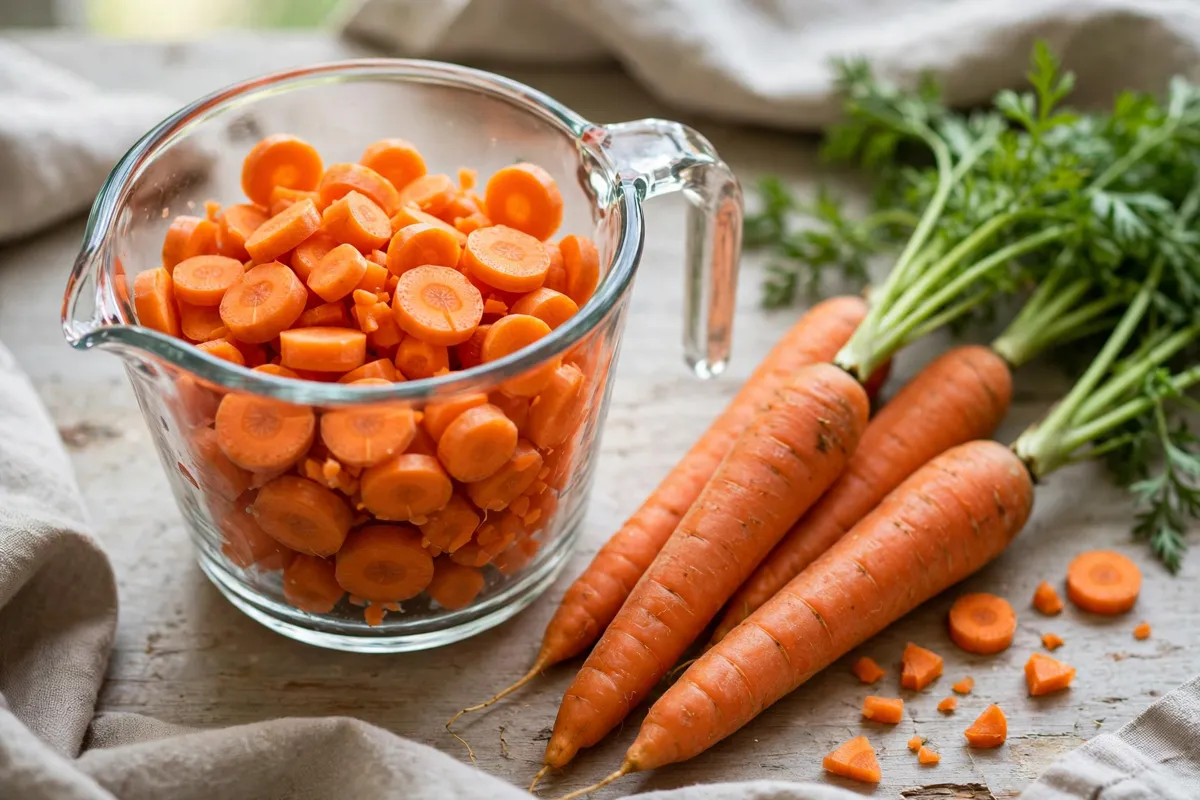
One cup of chopped carrots contains about 2 medium carrots. The cup itself is a weighed portion in USDA FoodData Central's raw carrot entry (FDC ID 170393) — one cup, chopped, is 128 grams — and a medium carrot is 61 grams, so 128 ÷ 61 ≈ 2.1: roughly two medium carrots, chopped, fill one cup of carrots, carrying about 52.5 calories and 12.3 grams of carbohydrate with them.
Ask the question in a kitchen and you will hear answers from one to four, and the spread is not carelessness — it is cut size. A cup is a volume, and how much carrot fits in it depends on whether the pieces are coins, sticks, a fine dice or a coarse chop, and on whether the cook levelled the cup or heaped it. USDA's 128-gram cup assumes chopped pieces, settled and level. This article shows how the count moves with the cut, what the cup weighs in each common form, and how to convert when your recipe and your carrots disagree. Once the weight is settled, the calorie counter does the rest; this page settles the count. The step-by-step method is set out in converting a recipe.
Short Answer
About 2 medium carrots per cup, chopped (128g ÷ 61g ≈ 2.1). In large carrots (72g) it is just under 2; in small carrots (50g) about 2½. A cup of chopped raw carrots weighs 128g and provides about 52.5 calories, 12.3g of carbs and 3.6g of fibre.
What Does USDA's Cup of Carrots Actually Weigh?
The portion table for raw carrots lists the cup directly: one cup, chopped, is 128 grams. That single line does more work than any count, because it converts a volume every recipe uses into a weight every scale and database understands. At the entry's profile of 41 calories and 9.58 grams of carbohydrate per 100 grams, the 128-gram cup holds about 52.5 calories, 12.3 grams of carbs, 3.6 grams of fibre (2.8g per 100g scaled), about 6.1 grams of sugar and 1.2 grams of protein.
The count falls out of the same table. Medium carrot: 61 grams. Divide the cup by the carrot and you get 2.1 — two mediums, chopped, with a sliver of a third if your chop is coarse and your cup is heaped. The large carrot at 72 grams gives 1.8 per cup; the small at 50 grams gives 2.6. Every honest answer to "how many carrots in a cup" is one of those three numbers wearing the word "about," and any answer given without a size attached is only pretending to precision.
Note the form the table assumes: chopped, raw. Coins cut thick, matchsticks and grated carrot all pack differently, and cooked carrots are a different entry with different cup weights — the cooked entry lists half a cup of slices at 78 grams, so a cooked cup of slices is 156 grams, a fact that matters in how many calories are in cooked carrots. State the form when you quote the number and the number stays true.
How Does the Cut Change How Many Carrots Fit in a Cup?
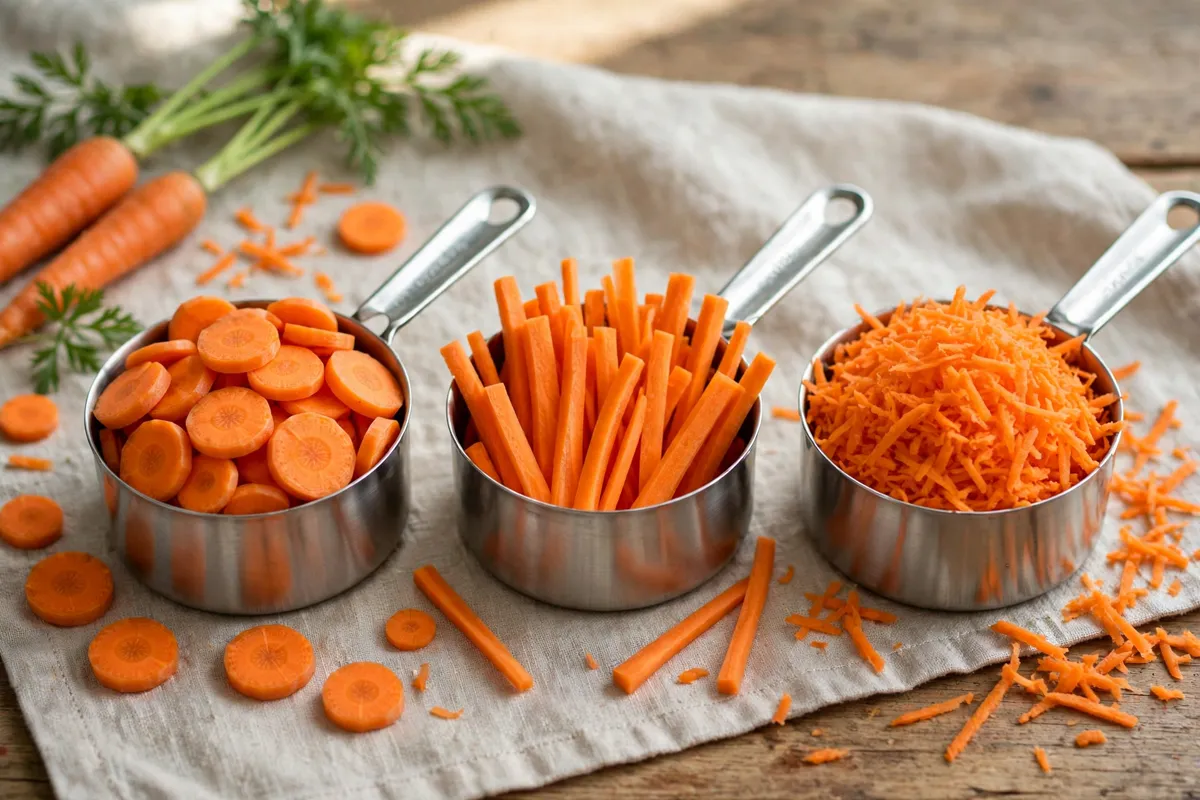
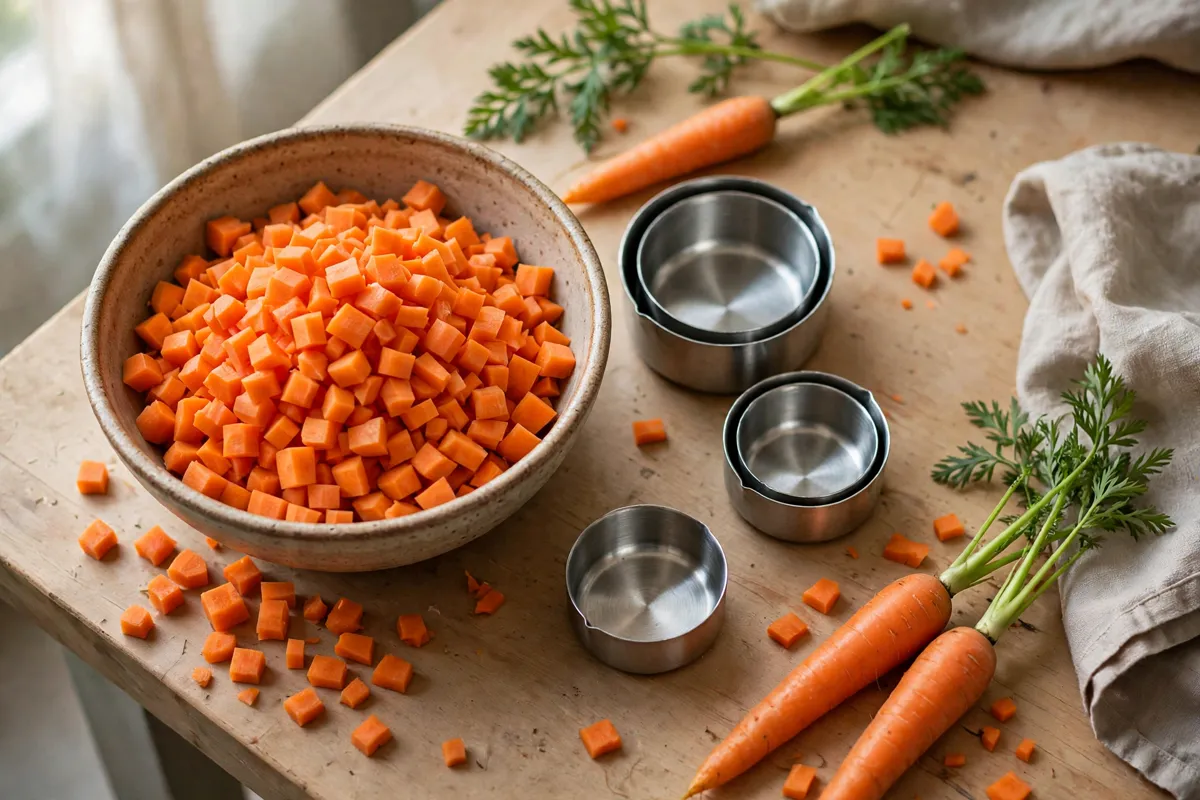
Think of the cup as a box and the pieces as packing material. Fine dice packs tightest: the pieces nest, the air gaps shrink, and a cup of fine dice can hold noticeably more than 128 grams — effectively closer to two and a half mediums. Coins are middling packers, stacking with gaps at their curved edges. Thick batons and chunky rustic chops pack loosest, bridging across each other and trapping air; a cup of those can come in under the reference weight, at perhaps one and three-quarter mediums.
Grated carrot breaks the pattern in the other direction. Grating collapses the carrot's structure into shreds that compress willingly, so a firmly packed cup of grated carrot can exceed the chopped weight substantially, while a fluffy, just-grated cup sits below it. This is why baking recipes that matter — carrot cake above all — are moving to grams, and why following a cup recipe with a different grate than the author's produces a wetter or drier crumb. If a recipe's success depends on the carrot, weigh out 128 grams per cup and grate that weight, whatever your grater produces.
The lesson generalises beyond carrots: for any chopped vegetable, the count-per-cup is a range with a weighed centre. The centre here is 128 grams, and the single-carrot weights behind it are detailed in how much does one carrot weigh.
- Fine dice, levelled: about 2½ mediums' worth may fit — over the 128g reference
- Standard chop, levelled: the reference — about 2 mediums, 128g
- Thick coins: near the reference, slightly under
- Chunky batons, loosely filled: about 1¾ mediums — under the reference
- Grated, packed: over the reference; grated, fluffy: under it
How Many Carrots Do You Need for Recipes Written in Cups?
Work backwards from the cup weight and you will never buy wrong. One cup: 128 grams, about 2 mediums. Two cups: 256 grams, about 4 mediums — just over half a pound, since a pound holds about 7 mediums (the full count is in how many carrots are in one pound). Three cups: 384 grams, about 6 mediums. A recipe wanting four cups of chopped carrot is asking for 512 grams — a little over a pound, about 8 to 9 mediums.
Then adjust for prep. The 61-gram medium is the whole carrot as the database weighed it; your peeled, topped-and-tailed carrot gives back somewhat less — as a working habit, buy one extra carrot per four the recipe needs and the trim is covered. For salads and slaws where carrots are shredded raw, the same weights apply before grating. For soups where the carrots cook in the pot, buy by the raw cup weight and let the cooking happen after measuring; the cooked entry's numbers govern logging the finished dish, not shopping for it.
If you are scaling a recipe, scale the grams, not the count. Doubling "2 carrots" is safe; doubling to "about 4¼ carrots" is where cooks start rounding in both directions and end up a full carrot adrift. Grams do not round badly: 128 becomes 256 becomes 384, and the calorie counter will price any of them exactly.
How Does a Cup of Carrots Compare Nutritionally With Other Cups?
A cup is not a unit of nutrition, only of volume, and carrots make the point vividly. The 128-gram cup of raw chopped carrots carries about 52.5 calories and 12.3 grams of carbohydrate, of which about 6.1 grams are sugar — carrots are a genuinely sweet vegetable, a fact the cooked-carb analysis in how many carbs are in cooked carrots pursues. Set beside it a cup of chopped raw broccoli at 91 grams and about 31 calories, or a cup of raw tomato pieces — the comparison across the produce drawer is why volume-based logging needs the weight attached.
For diet planning, the carrot cup is a useful middle citizen: more substantial than the leafy and cruciferous cups, far lighter than any cup of grains or legumes, and carrying 3.6 grams of fibre that earns its carbs a slower passage — the fibre context across the produce drawer is surveyed in how much fiber is in common fruits and vegetables, and its standing as a vegetable serving is set out in what is the recommended serving size for each food group. It sweetens soups, slaws and snack plates at a cost most budgets absorb without noticing — provided the cup in the log is the 128-gram cup and not an unmeasured heap that was really two.
Common Mistakes to Avoid
- Answering the count without a size: 2 mediums, 1.8 larges and 2.6 smalls are all "the" answer for different carrots.
- Using the cooked cup weight (156g for slices) when the recipe means raw chopped (128g), or the reverse.
- Heaping the cup and logging the level reference weight.
- Assuming grated and chopped cups weigh the same; packing changes both.
- Forgetting the trim: the count buys whole carrots, the recipe uses peeled ones — add roughly one extra per four.
Final Thoughts
A cup of chopped raw carrots is 128 grams — about two medium carrots — with about 52.5 calories and 12.3 grams of carbohydrate. The count shifts honestly with size and cut, the weight does not, and cooks who anchor to the weight get the recipe and the log right at the same time.
People Also Ask
How Many Baby Carrots Are in 3 Ounces?
There are about 8 to 9 baby carrots in 3 ounces. The count comes from USDA FoodData Central's baby carrot entry (FDC ID 168568), which lists one medium baby carrot at 10 grams: 3 ounces is 85 grams, and 85 ÷ 10 = 8. 5, so 3 ounces of baby carrots is eight or nine pieces — a small handful — providing about 29.
How Much Does One Carrot Weigh?
One medium carrot weighs 61 grams. That is USDA FoodData Central's listed portion for a medium carrot in the raw carrot entry (FDC ID 170393), and the same table gives the sizes either side of it: a small carrot weighs 50 grams and a large carrot weighs 72 grams — so how much one carrot weighs has a short, verified answer with a modest range, and a medium carrot at 61 grams also carries about 25 calories and 5. 8…
How to Calculate Macros for Muscle Gain?
To calculate macros for muscle gain, add a small surplus of 250–300 calories to your maintenance, set protein at 1. 6–2. 2 grams per kilogram of body weight, set fat at 0.
How to Adjust Your Macros Based on Your Fitness Goals?
You adjust your macros by moving one lever at a time, in a fixed order: calories first, by the smallest amount that changes the trend, then protein re-anchored to your body weight at the new goal's level, then carbohydrate absorbing the change. For fat loss that means 300–500 fewer calories with protein raised to 2. 0–2.