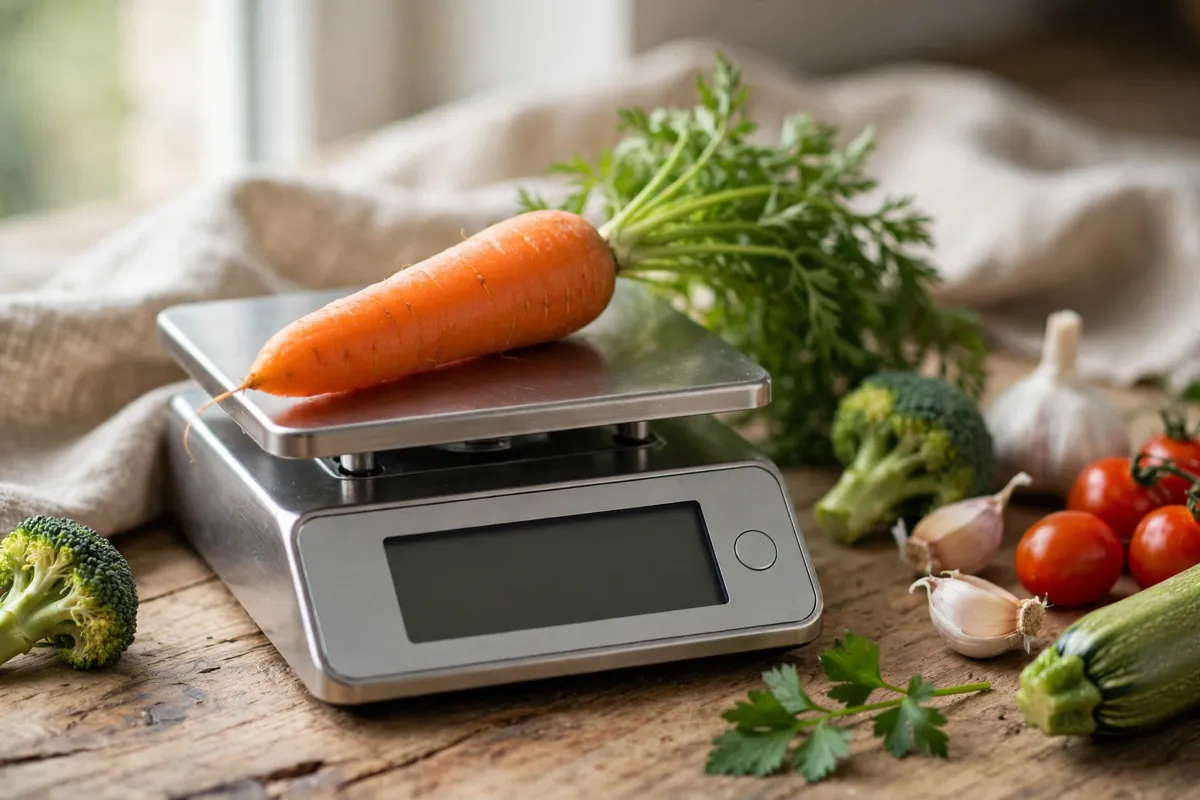
Calorie Counter: The Short Answer
One medium carrot weighs 61 grams. That is USDA FoodData Central's listed portion for a medium carrot in the raw carrot entry (FDC ID 170393), and the same table gives the sizes either side of it: a small carrot weighs 50 grams and a large carrot weighs 72 grams — so how much one carrot weighs has a short, verified answer with a modest range, and a medium carrot at 61 grams also carries about 25 calories and 5.8 grams of carbohydrate.
Sixty-one grams is not a number anyone can use until it is translated, so this article translates it: into ounces, into the sizes you will actually meet in shops, into what peeling does to it, and into the conversions — cups, pounds, recipes — that a single carrot's weight quietly controls. Carrots are one of the most standardised vegetables in the food supply, which is why their portion weights are unusually trustworthy; even so, the range is real, and knowing it is the difference between a log that is right and a log that is merely neat. The calorie counter takes over once the weight is known; this page establishes the weight.
Short Answer
A medium carrot weighs 61g (about 2.2 oz), a small one 50g (about 1.8 oz) and a large one 72g (about 2.5 oz), per USDA's raw carrot entry. A medium baby carrot — a different entry — weighs 10g. At 41 calories per 100g, the medium carrot provides about 25 calories.
How Do the Three USDA Carrot Sizes Compare?
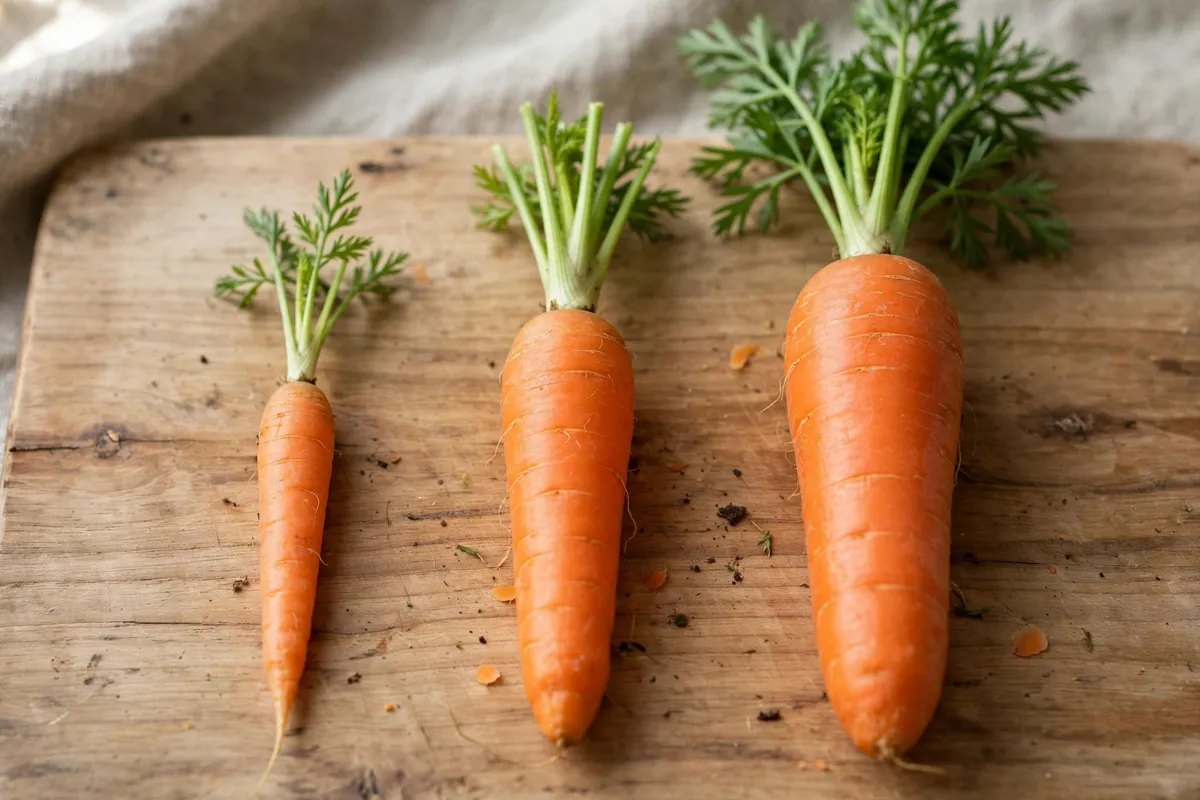
The portion table's trio — 50, 61 and 72 grams — spans the ordinary retail range more completely than the labels suggest. Twenty-two grams separate small from large, which in carrot terms is about a third of a carrot. In ounces, the trio reads 1.8, 2.2 and 2.5 — numbers worth having because American recipes and scales still speak ounces, and because "a two-ounce carrot" is a description you can actually shop against.
Their nutrition scales in a straight line, because it is the same food at three sizes. Per the entry's profile of 41 calories, 9.58 grams of carbohydrate, 2.8 grams of fibre and 4.74 grams of sugar per 100 grams: the small carrot carries about 20.5 calories and 4.8 grams of carbs; the medium about 25 calories and 5.8 grams of carbs; the large about 29.5 calories and 6.9 grams of carbs. The fibre runs 1.4, 1.7 and 2.0 grams respectively. Nothing about the bigger carrot is different except amount — there is no size at which a carrot becomes a different food.
Which size is your bag? Grading sorts carrots by diameter, and the supermarket standard whole carrot — the one in the common two-pound bag — sits closest to the medium. Bunched carrots with tops, and farmers-market carrots, run more variable, with larges common. When a recipe or a log needs one carrot and gives no size, the medium 61 grams is the defensible default, and it is the default used in the conversions throughout this site, including how many carrots are in one pound and how many carrots are in one cup.
What Does Peeling and Trimming Do to the Weight?
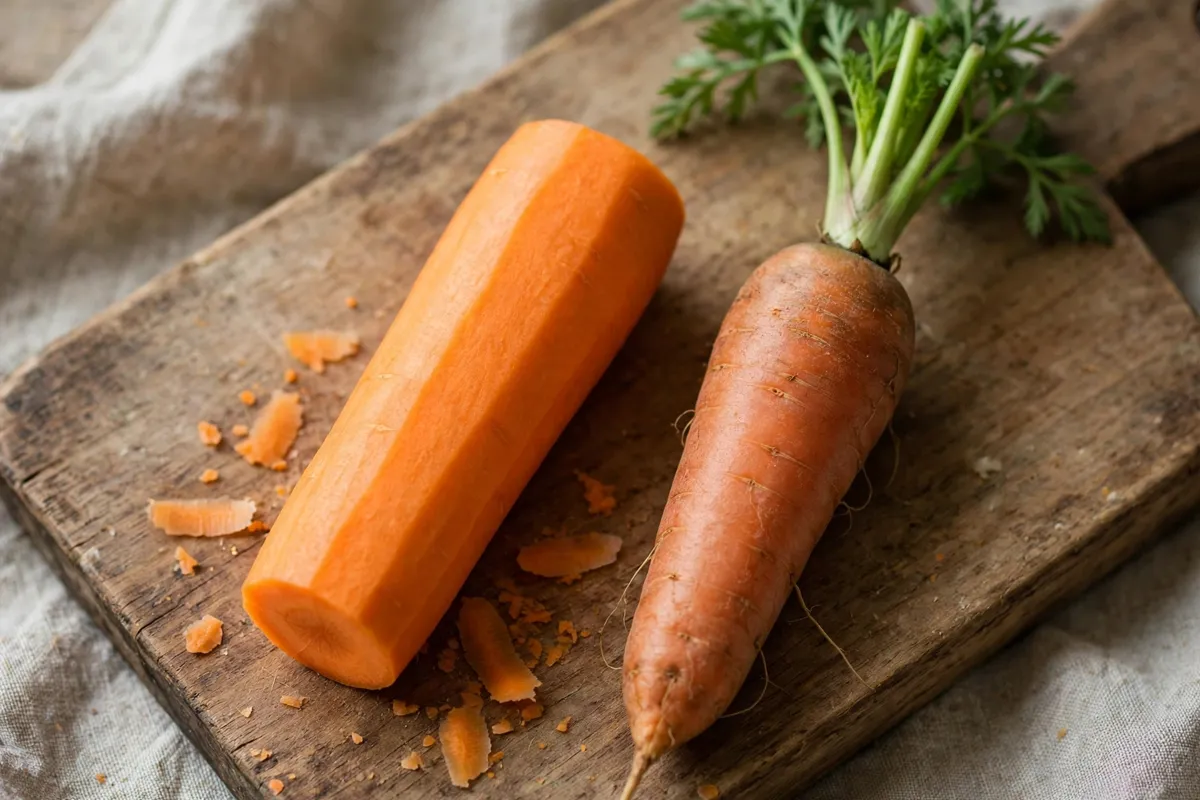
The 61 grams describe the carrot as the database weighed it — the whole vegetable. Your prepared carrot is lighter: the top comes off, the tip comes off, and peeling shaves the surface. The exact loss varies with how thickly you peel and how much top you take, so this site does not publish a single "peeled weight" — USDA's table does not list one, and inventing a standard would be false precision. The practical guidance is directional: expect a prepared medium carrot to land meaningfully below 61 grams, in the low-to-mid 50s for ordinary peeling, and weigh after prep if the dish is one where carrot is the main event by weight — a ferment, a juice, a cake where the carrot is structural.
For logging cooked dishes, the state question matters more than the peel question. The cooked entry weighs its portions after cooking — half a cup of slices at 78 grams — and a raw carrot that goes into a stew should be logged through the raw weight you put in, with the dish built in the calorie counter, rather than by trying to weigh soft slices afterwards. Baby carrots sidestep all of this: they arrive trimmed and polished, and the 10-gram piece in how many baby carrots are in 3 ounces is an as-eaten weight.
One more trim case: carrot sticks for snacking. A medium carrot cut into sticks still weighs what it weighed minus the ends — the cutting itself removes nothing. Sticks feel lighter because the water is suddenly visible on cut surfaces, but the scale disagrees, and the scale is right.
How Can You Estimate a Carrot's Weight Without a Scale?
By comparison to the anchors you already own. A medium carrot at 61 grams is, in the hand, a little heavier than a large egg's worth of heft and noticeably lighter than a typical smartphone — comparisons offered as orientation, not measurement. Length helps within a variety: the medium grade is the familiar hand-length carrot, and a carrot that looks half again as thick through the shoulder is heading for the large weight even at the same length, because carrot weight lives in the diameter more than the length.
The bunch method works at markets: a bunch of six similar carrots that feels like a pound bag is telling you its carrots are larges; a bunch of eight at the same total feel is telling you mediums. And the counting conversions do the rest — if your pound held seven carrots, they were mediums by definition, whatever the sign said.
Estimation has one job here — to pick the right row of the portion table. Once the row is picked, the numbers are exact enough for any ordinary log, and the remaining error is smaller than the error in most packaged-food labels.
- In the hand: medium ≈ 61g, a modest, balanced heft; large ≈ 72g, visibly thicker at the shoulder
- By count-back: 7 to the pound = mediums; 6 to the pound = larges; 9 = smalls
- By cup: 2 mediums chopped ≈ the 128g cup — if your two carrots overflow it coarsely chopped, they were larges
- By baby-carrot equivalence: one medium carrot ≈ six medium baby carrots by weight (61g vs 10g pieces)
Why Does One Carrot's Weight Matter Beyond Curiosity?
Because the single carrot is a unit in hundreds of recipes, diet plans and lunchboxes, and units compound. A soup recipe built on "4 carrots" swings between 200 and 288 grams depending on size — a 44% swing in the ingredient — and while soup forgives it, a carrot cake, a glaze or a ferment keeps score. A meal plan that says "a carrot and hummus" as a snack means 25 calories at medium and nearly 30 at large: trivial once, real across a year of identical logged snacks — the portion-planning habit behind such plans is formalised in how to calculate daily food portions using myplate.
It also matters as calibration. Carrots are one of the few foods whose database weights a home cook can verify easily — weigh three carrots from a bag and you will likely land within a few grams of the table — and that verification builds justified trust in the portion system generally, the same system that prices the foods in how much fiber is in common fruits and vegetables where no home check is possible. A database that is right about carrots, where you can check, earns the benefit of the doubt about the foods where you cannot.
Common Mistakes to Avoid
- Using one weight for every carrot: the verified range is 50g to 72g across small to large, and the medium default is 61g.
- Mixing up whole carrots and baby carrots — a medium baby carrot is 10g, a sixth of a medium whole carrot.
- Logging a peeled, trimmed carrot at the full whole weight in dishes where carrot dominates by weight.
- Judging size by length alone; diameter carries most of the weight difference.
- Converting to ounces wrongly: 61g is about 2.2 oz, not 2 oz flat — the small errors compound in recipes scaled up.
Final Thoughts
One carrot weighs 61 grams at the medium size USDA leads with — 50 small, 72 large — and carries about 25 calories with it. Those three numbers convert carrots into cups, pounds and recipes without further mystery, and they hold up at home: weigh a few from your next bag and watch the table prove itself.
People Also Ask
How Many Carbs Are in Cooked Carrots?
Cooked carrots contain 8. 22 grams of carbs per 100 grams — and 12. 8 grams in a full cup of slices.
How Many Calories Are in Cooked Carrots?
Cooked carrots contain 35 calories per 100 grams — which is 27 calories in a half cup of slices and about 55 calories in a full cup. Those numbers come from USDA FoodData Central's cooked carrot entry (FDC ID 170394, boiled and drained, without salt) and its portion table: half a cup of slices weighs 78 grams, so the cup is 156 grams, and 156 × 0. 35 gives you the calories in cooked carrots at the portion that fills…
How to Calculate Daily Food Portions Using MyPlate?
To calculate your daily food portions with MyPlate, find your calorie level first, then read off that level's five daily amounts. At the 2,000-calorie reference level — the pattern most adults start from — the day is 2½ cups of vegetables, 2 cups of fruit, 6 ounce-equivalents of grains, 5½ ounce-equivalents of protein foods and 3 cups of dairy. Those five numbers are the whole calculation.
How Much of Your Plate Should Be Fruits and Vegetables?
Half of your plate should be fruits and vegetables — and inside that half, vegetables take the larger share. MyPlate divides the produce half into roughly 30% of the plate for vegetables and roughly 20% for fruit, a split that produces the 2,000-calorie pattern's daily amounts of 2½ cups of vegetables and 2 cups of fruit. So the short answer is: fill half the plate with produce, weight it toward vegetables, and across a full day at the reference level…