Calorie Counter: The Short Answer
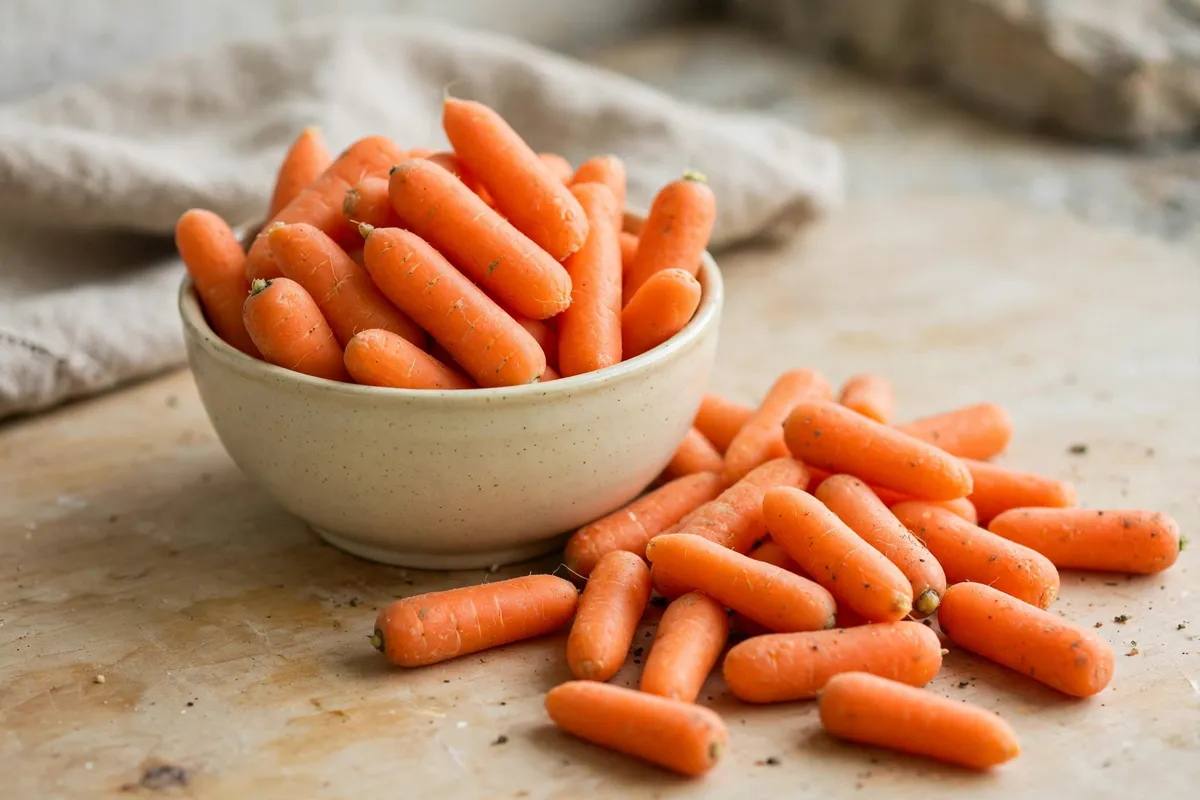
There are about 8 to 9 baby carrots in 3 ounces. The count comes from USDA FoodData Central's baby carrot entry (FDC ID 168568), which lists one medium baby carrot at 10 grams: 3 ounces is 85 grams, and 85 ÷ 10 = 8.5, so 3 ounces of baby carrots is eight or nine pieces — a small handful — providing about 29.8 calories and 7.0 grams of carbohydrate.
Baby carrots invite this kind of question because they are sold, served and snacked by the piece in a way whole carrots never are. They arrive in lunchboxes, on crudité plates and in little snack bags, and "3 ounces" is a portion that turns up on labels and in diet plans precisely because it is a realistic single snack. This article shows where the 8-to-9 count comes from, why the same entry makes 85 grams a doubly convenient number, and what that handful actually delivers. The calorie counter prices the portion in your meal; this page counts the pieces.
Short Answer
About 8–9 medium baby carrots in 3 ounces (85g ÷ 10g each ≈ 8.5). That 85g portion is also USDA's NLEA reference serving for baby carrots, and it provides about 29.8 calories, 7.0g of carbs, 2.5g of fibre and 0.5g of protein.
Why Is 3 Ounces Such a Convenient Number for Baby Carrots?
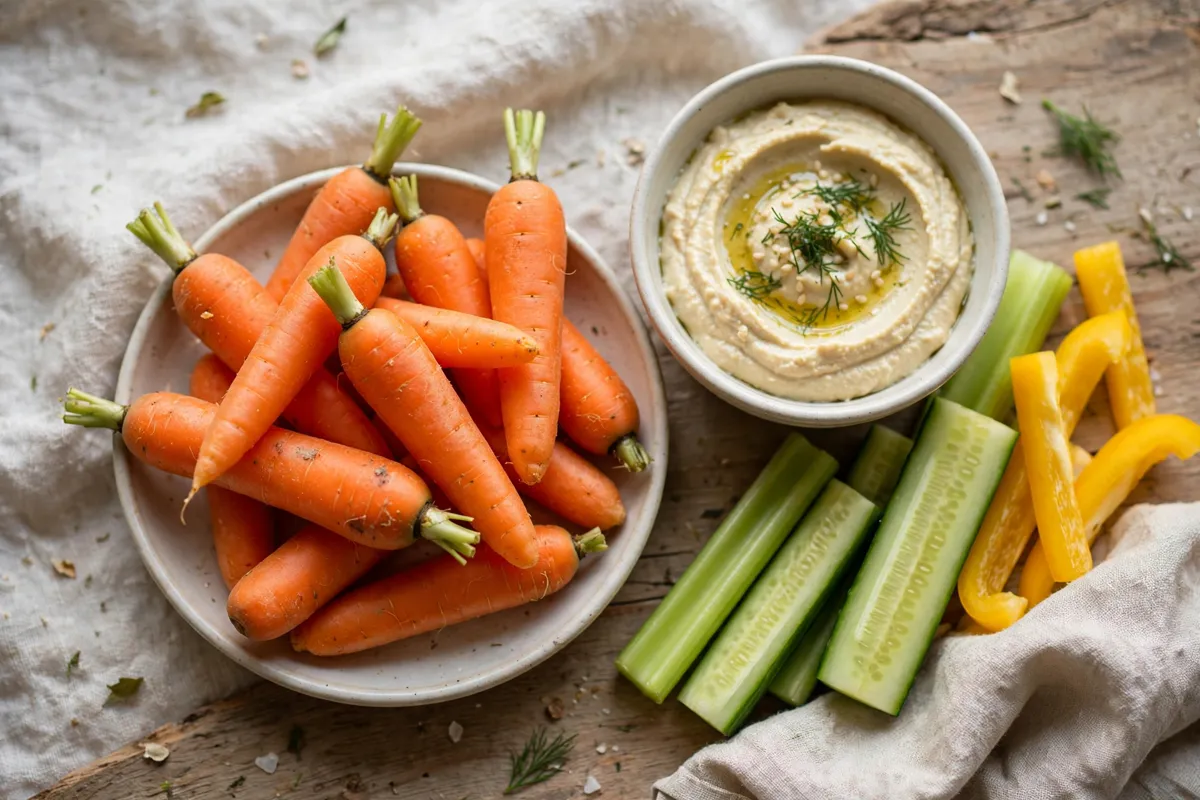
Because two separate reference systems land on the same 85 grams. The first is the ounce itself: 3 ounces converts to 85.05 grams, and nutrition work rounds it to 85. The second is the labelling system: the baby carrot entry's portion table includes an NLEA serving of 85 grams — the reference amount the food-labelling rules use for a serving of this food. When a bag of baby carrots declares a serving, that serving is built on this 85-gram amount, which is why "3 ounces" and "one serving" so often describe the same pile of baby carrots.
The piece weight does the rest. A medium baby carrot is listed at 10 grams, a large one at 15 grams. At 10 grams, 85 grams of them is eight and a half pieces — the honest answer of "about 8 to 9," since nobody serves half a baby carrot. At the large size, the same 85 grams is five to six pieces, which is why any count given without a size is only half an answer.
It is worth being clear about what a baby carrot is, because it explains the uniformity that makes counting work: commercial baby carrots are not harvested young. They are pieces cut and polished from full-size carrots bred and selected for the purpose, which is why they are so consistent in diameter — and why the 10-gram piece weight is unusually reliable for a vegetable. Whole carrots vary enough that how many carrots are in one cup needs three sizes to answer; baby carrots need two, and the medium dominates the bags.
What Does a 3-Ounce Portion of Baby Carrots Provide?
At the entry's profile — 35 calories, 8.24 grams of carbohydrate, 2.9 grams of fibre, 0.64 grams of protein and 0.13 grams of fat per 100 grams — the 85-gram portion scales to about 29.8 calories, 7.0 grams of carbs, 2.5 grams of fibre and about half a gram of protein. Sodium sits at about 66 milligrams (78mg per 100g scaled), a little higher per 100 grams than whole raw carrots, though the absolute amount in a snack portion remains small.
Read as a snack, that is a genuinely good trade: under 30 calories for a portion with real crunch, real fibre and enough pieces — eight or nine — to feel like eating rather than tasting. The 7 grams of carbohydrate include the carrot's natural sugars, which the per-100g profile puts at a moderate level for a sweet vegetable; the 2.5 grams of fibre travelling with them slow the whole package down. This is why baby carrots survive every snack audit, from school standards — the host context for the label questions in this series, checked through the smart-snack-calculator — to the crudité-plate comparisons in how much fiber is in common fruits and vegetables.
The comparison that flatters them most is with their own raw material. Per 100 grams, baby carrots run 35 calories and 8.24 grams of carbs against whole raw carrots at 41 calories and 9.58 grams — the cut pieces are marginally lighter per gram, partly a variety and moisture story. In practice the two are interchangeable in a log at snack portions, and the piece count is what baby carrots add: a built-in portion unit.
How Do You Estimate 3 Ounces Without a Scale?
By count, by hand, or by bag — in that order of reliability for this particular food. By count: eight or nine mediums, five or six larges. The count works because the pieces are manufactured to a grade; if your bag's pieces look notably slender or notably chunky against the 10-gram standard, shift one piece in the appropriate direction. By hand: 85 grams of baby carrots is a modest handful — a single loose grab for most adults, roughly a heaped palm — which is why the portion feels small in the bag and satisfying on the plate beside a dip.
By bag: snack-size bags of baby carrots are portioned around this reference amount, so a single-serve bag is usually close to the 85-gram mark — but "usually" and "close" are doing work in that sentence, and the bag's own label weight overrides every estimate in this paragraph. When the bag declares its grams, use them; the count exists for the unlabelled cases — the bowl at a party, the handful from a sharing bag, the lunchbox you packed by eye.
However you estimate it, log the dip separately and honestly. The carrots are 30 calories; the two tablespoons of a creamy dip beside them can be several times that, and the pair is logged as a pair in the calorie counter.
- Count: 8–9 medium pieces (10g each), 5–6 large pieces (15g each)
- Hand: one loose adult handful, roughly a heaped palm
- Volume: a scant half cup of pieces — pieces pack loosely, so count beats volume here
- Scale check: 85g exactly — worth doing once to calibrate your handful
How Does the 3-Ounce Portion Fit Into a Day of Eating?
As a snack, it fills the hardest slot in most eating patterns: the savoury-crunch slot between meals, where the alternatives are usually energy-dense — and pairing it with a protein-bearing dip or side follows the logic of how much protein should a snack contain. Eight or nine baby carrots with something protein-bearing beside them makes a snack that holds; the carrots alone make a bridge snack of about 30 calories that takes the edge off without touching the meal budget. Meal-prep systems love them for the same reason the count works — they portion by piece into containers with no weighing, no chopping and no wilting.
In children's lunchboxes, 3 ounces is at the generous end; half of it — four or five pieces, about 42 grams, roughly 15 calories — is a realistic child's portion, and the pieces' size makes them a food small hands manage easily. For cooking, baby carrots roast and glaze whole; a 3-ounce portion per person is a modest side, and most cooks planning them as a cooked side will allow roughly double, remembering that the cooked entry's values, covered in how many calories are in cooked carrots, govern once heat is applied.
Across a week, the pattern to notice is how rarely this food needs defending. It is one of the few packaged, convenient, child-accepted vegetables with a profile — 35 calories per 100 grams, fibre attached, sodium modest — that needs no asterisk at snack scale.
Common Mistakes to Avoid
- Quoting a count without a size: 8–9 assumes the 10g medium; large 15g pieces give 5–6 in the same 3 ounces.
- Assuming baby carrots are young carrots; they are cut pieces, which is exactly why their piece weights are so consistent.
- Logging the handful but not the dip — the dip is usually the larger number.
- Using whole-carrot values for baby carrots when precision matters; the entries differ slightly (35 vs 41 calories per 100g).
- Treating a sharing-bag handful as 3 ounces without ever calibrating it once on a scale.
Final Thoughts
Three ounces of baby carrots is about eight or nine medium pieces — 85 grams, roughly 30 calories, 7 grams of carbohydrate and 2.5 grams of fibre. It is a serving by the labelling rules, a handful by the hand, and one of the easiest portions in the produce aisle to get right: count the pieces, and you have weighed them by proxy.
People Also Ask
How Much Does One Carrot Weigh?
One medium carrot weighs 61 grams. That is USDA FoodData Central's listed portion for a medium carrot in the raw carrot entry (FDC ID 170393), and the same table gives the sizes either side of it: a small carrot weighs 50 grams and a large carrot weighs 72 grams — so how much one carrot weighs has a short, verified answer with a modest range, and a medium carrot at 61 grams also carries about 25 calories and 5. 8…
How Many Carbs Are in Cooked Carrots?
Cooked carrots contain 8. 22 grams of carbs per 100 grams — and 12. 8 grams in a full cup of slices.
How to Adjust Your Macros Based on Your Fitness Goals?
You adjust your macros by moving one lever at a time, in a fixed order: calories first, by the smallest amount that changes the trend, then protein re-anchored to your body weight at the new goal's level, then carbohydrate absorbing the change. For fat loss that means 300–500 fewer calories with protein raised to 2. 0–2.
How to Calculate Daily Food Portions Using MyPlate?
To calculate your daily food portions with MyPlate, find your calorie level first, then read off that level's five daily amounts. At the 2,000-calorie reference level — the pattern most adults start from — the day is 2½ cups of vegetables, 2 cups of fruit, 6 ounce-equivalents of grains, 5½ ounce-equivalents of protein foods and 3 cups of dairy. Those five numbers are the whole calculation.