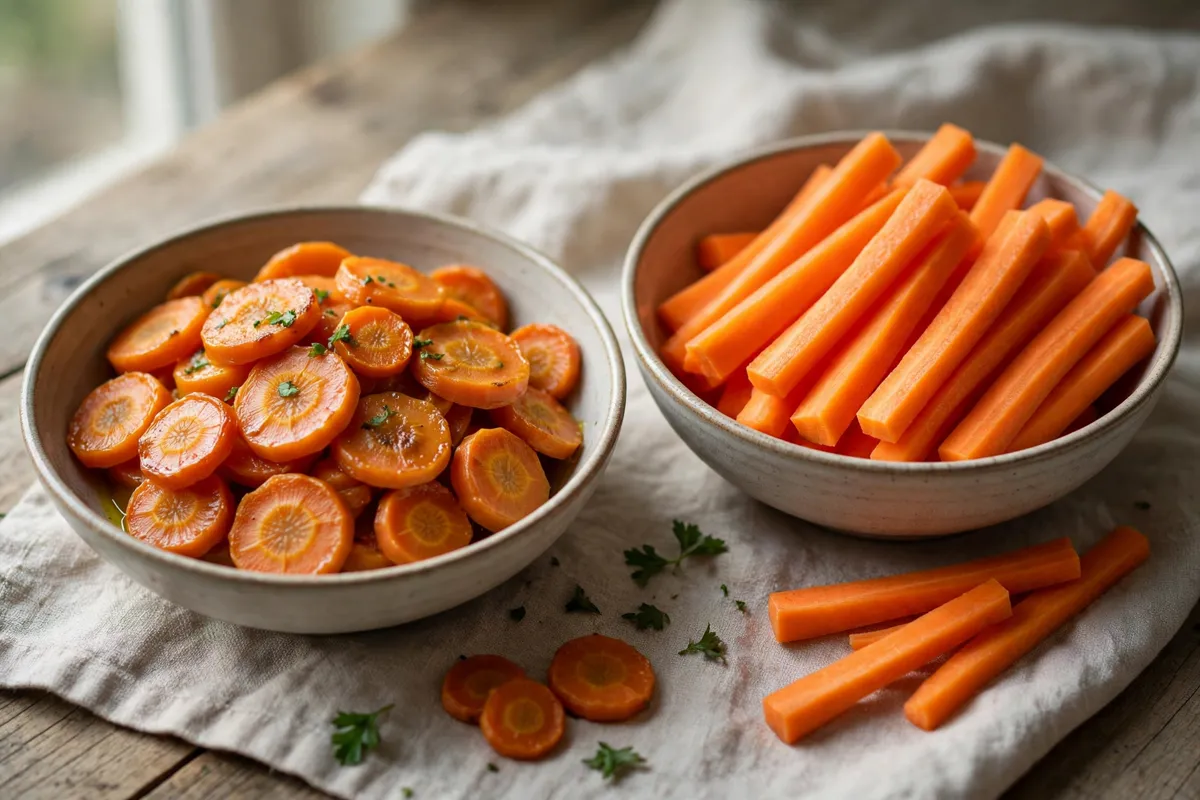
Calorie Counter: The Short Answer
Cooked carrots contain 8.22 grams of carbs per 100 grams — and 12.8 grams in a full cup of slices. Those figures come from USDA FoodData Central's cooked carrot entry (FDC ID 170394, boiled and drained, without salt), whose portion table lists half a cup of slices at 78 grams: double it for the cup, and the carbs in cooked carrots at real portions are 6.4 grams for the half cup and 12.8 grams for the cup, with one cooked carrot (46 grams) carrying 3.8 grams.
Carrots have a reputation problem in low-carb circles that their raw numbers never quite justified and their cooked numbers get blamed for: they are a sweet-tasting vegetable, so they are filed as a sugary one. The logged profile tells a more interesting story — cooking actually lowers the carb concentration per 100 grams compared with raw, while the cooked cup weighs more, and it is the cup weight, not the concentration, that produces the bigger serving figure. This article separates those two effects, breaks the carbohydrate into its fibre and sugar parts, and gives the honest net-carb arithmetic. The calorie counter prices carrots inside your meal; this page prices the carbs themselves.
Short Answer
Cooked carrots have 8.22g of carbohydrate per 100g (USDA FDC ID 170394). That is 6.4g per half cup of slices (78g), 12.8g per cup (156g) and 3.8g per cooked carrot (46g). Of the per-100g total, 3.0g is fibre and 3.45g is sugar, leaving about 5.2g of net carbs per 100g.
Why Do Cooked Carrots Have Fewer Carbs per 100 Grams Than Raw?
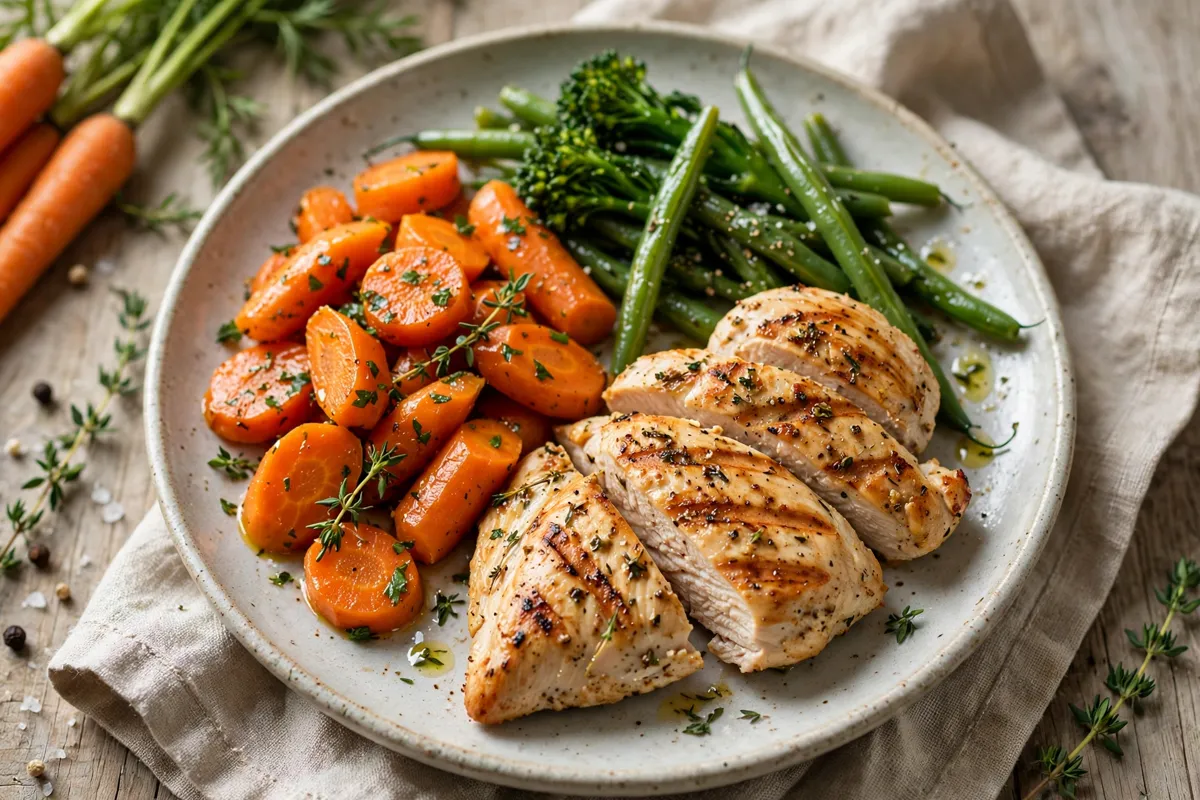
Raw carrots carry 9.58 grams of carbohydrate per 100 grams; cooked carry 8.22. The drop surprises people who assume cooking concentrates everything — and for broccoli, in this same dataset, it does slightly. Carrots go the other way for two mechanical reasons. First, boiling water moves both ways: some of the carrot's soluble sugars leach out into the water (which is drained away), while the tissue takes up a little water in exchange. Second, the carrot's dense, crisp structure softens and hydrates, so each 100 grams of the cooked product holds slightly more water and slightly less carrot solid than 100 grams of the raw root.
The sugar line shows the leaching clearly. Raw carrots list 4.74 grams of sugar per 100 grams; cooked list 3.45 grams. That is the single biggest mover in the profile, and it is why cooked carrots can taste sweeter while containing less sugar per gram — the sweetness is a perception story (softened tissue releases flavour faster on the tongue), not a concentration story. The fibre, meanwhile, holds nearly steady: 2.8 grams per 100 grams raw, 3.0 cooked — fibre does not leach or dissolve in the pot, and its slight proportional rise reflects the sugar that left.
So per 100 grams, cooking is mildly favourable to the carb counter. The catch, as ever, is the portion: the cooked cup of slices weighs 156 grams against the raw chopped cup's 128, so the served cup of cooked carrots still carries more total carbohydrate — 12.8 grams against 12.3 — despite the leaner concentration. Both effects are in the log in how many calories are in cooked carrots, where the same arithmetic governs the calories.
How Do the Carbs in Cooked Carrots Break Down?
Into fibre, sugar and a remainder that is mostly starch and other digestible carbohydrate. Per 100 grams cooked: 8.22 grams total, of which 3.0 grams are fibre and 3.45 grams are sugars, leaving about 1.8 grams of other carbohydrate. Scaled to the cup of slices, that is 12.8 grams total, about 4.7 grams of fibre, about 5.4 grams of sugar. The fibre share — roughly 37% of the total carbohydrate — is high for a root vegetable, and it is the main reason carrots digest more gently than their sugar content alone would predict; the two fibre families inside that share behave differently again, as what is the difference between soluble and insoluble fiber explains.
The breakdown matters because different counting systems treat the parts differently. Total-carb counters log the 12.8. Net-carb counters log about 8.1 for the same cup. Diabetic exchange-style counting historically lands between. None of them is wrong; they are different instruments, and the verified breakdown lets you feed whichever instrument you use — the same service the fibre analysis in how much fiber is in common fruits and vegetables performs across the produce drawer.
- Per 100g cooked: 8.22g carbs = 3.0g fibre + 3.45g sugar + ~1.8g other carbohydrate
- Per half cup slices (78g): 6.4g carbs, 2.3g fibre, 2.7g sugar
- Per cup slices (156g): 12.8g carbs, 4.7g fibre, 5.4g sugar
- Per cooked carrot (46g): 3.8g carbs, 1.4g fibre, 1.6g sugar
- Net carbs (total minus fibre): about 5.2g per 100g; about 8.1g per cup
How Do Cooked Carrots Fit a Low-Carb Eating Pattern?
Better than their reputation, at side-dish portions — and the numbers show exactly where the line sits. A half cup of cooked carrot slices, the database's own portion, is 6.4 grams of total carbohydrate and about 4.1 grams net: a modest line item that most low-carb budgets absorb without negotiation. A full cup doubles it to 12.8 total and about 8.1 net — still workable in a moderate low-carb pattern, a real decision in a strict ketogenic one, where the whole day may run 20 to 50 grams.
Context decides. In a mixed roast or a stew, carrots are usually a fraction of the dish by weight — a cup of stew might hold a quarter cup of carrot, about 3.2 grams of carbs — and logging the dish's carrot share rather than a full portion keeps the count honest without exaggeration in either direction. Where carrots lead — a glazed carrot side, a carrot soup — the full portion figures apply, and the glaze or the soup's other ingredients join the bill; honey-glazed carrots are a sugar dish wearing a vegetable's name, and no entry for plain boiled carrots will save the log.
Compared with the other sweet vegetable in this dataset, cooked broccoli, carrots run about a gram more carbohydrate per 100 grams (8.22 against 7.18) with a little less fibre — the side-by-side is in how many carbs are in broccoli. The two are close enough that choosing between them on carbs alone is a coin toss; choosing on what you will happily eat a full portion of is the better rule, and either choice prices cleanly in the calorie counter.
Does the Cooking Method Change the Carb Count?
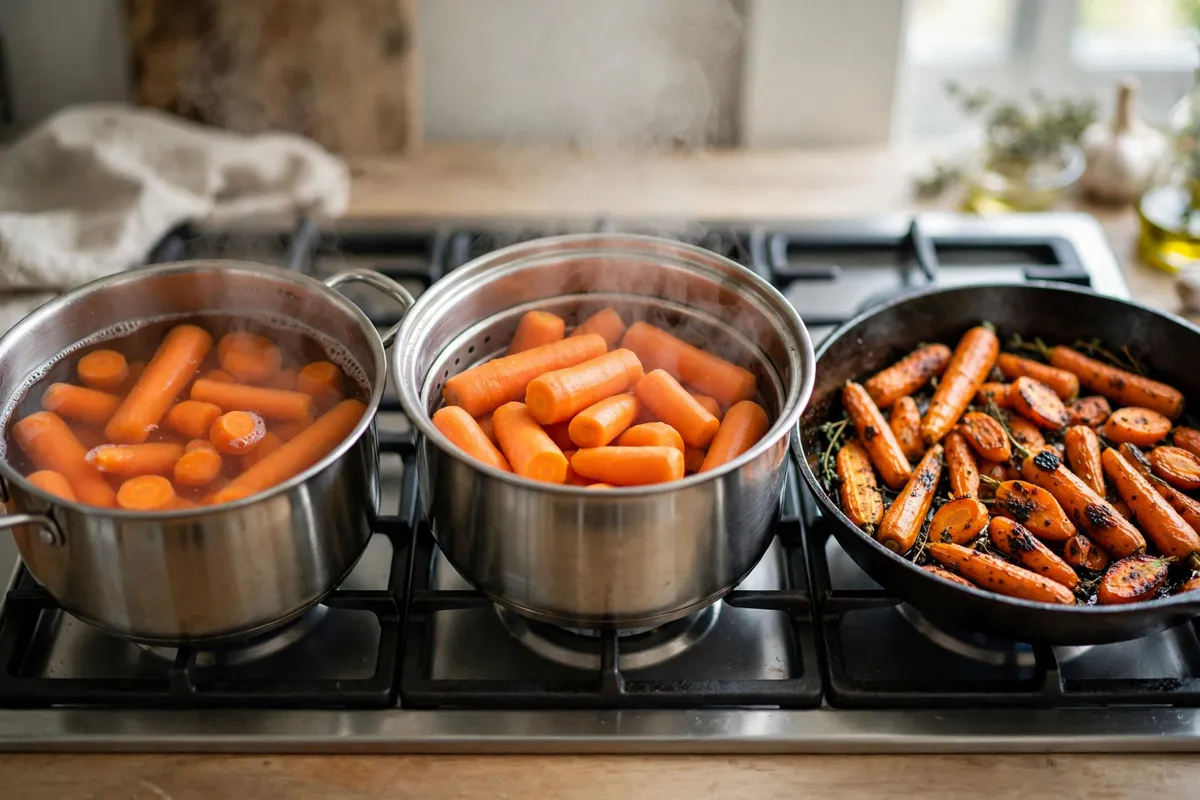
The verified entry is boiled and drained, and boiling is the method that removes the most carbohydrate, because the cooking water carries leached sugars away. Steaming keeps the carrots out of the water, so a steamed portion should sit closer to the raw concentration — between the boiled figure and the raw one — but FoodData Central publishes no separate steamed-carrot entry in this log, so this site does not print a steamed number; it notes the direction and logs the boiled one.
Roasting moves the other way, through water loss rather than leaching: a roasted carrot piece has driven off moisture, so per 100 grams of finished product the carbohydrate is more concentrated than the raw root's — while the total carrot on the tray has the same carbs it started with, minus nothing. Glazing, again, is not a cooking method but an addition: sugar or honey on the surface is new carbohydrate, logged as itself.
The practical summary: for plain carrots in any moist-heat form, the boiled entry's 8.22 grams per 100 grams is the verified anchor, steaming lands a little above it in concentration, roasting concentrates further per gram but adds nothing. The variation between methods is small next to the variation between portions — half a cup versus a heaped cup swings the total more than any method does.
Common Mistakes to Avoid
- Logging cooked carrots at the raw concentration (9.58g per 100g) — the cooked entry is 8.22g, because sugars leach into the cooking water.
- Comparing a cooked cup (156g) with a raw cup (128g) as if the weights matched; the cup, not the concentration, drives the serving total.
- Treating carrot sugar as added sugar; the 3.45g per 100g is intrinsic, arriving packaged with 3.0g of fibre.
- Quoting net carbs without saying so — 8.1g per cup is the fibre-subtracted figure; the total is 12.8g.
- Logging glazed or candied carrots on the plain entry; the glaze is additional sugar and belongs in the log as itself.
Final Thoughts
Cooked carrots carry 8.22 grams of carbohydrate per 100 grams — 12.8 grams in a cup of slices, 6.4 in a half cup — of which a generous share is fibre and a modest share is the natural sugar that survived the pot. They are neither the sugar bomb of low-carb folklore nor a free food; they are a mid-carbohydrate vegetable whose real numbers fit most patterns at real portions.
People Also Ask
How Many Calories Are in Cooked Carrots?
Cooked carrots contain 35 calories per 100 grams — which is 27 calories in a half cup of slices and about 55 calories in a full cup. Those numbers come from USDA FoodData Central's cooked carrot entry (FDC ID 170394, boiled and drained, without salt) and its portion table: half a cup of slices weighs 78 grams, so the cup is 156 grams, and 156 × 0. 35 gives you the calories in cooked carrots at the portion that fills…
Do Tomatoes Contain Salt?
A fresh tomato contains no added salt — but it does contain a small amount of naturally occurring sodium: 5 milligrams per 100 grams, per USDA FoodData Central's raw tomato entry (FDC ID 170457). A whole medium tomato of 123 grams therefore carries about 6. 2 milligrams of sodium, so do tomatoes contain salt?
How Much of Your Plate Should Be Fruits and Vegetables?
Half of your plate should be fruits and vegetables — and inside that half, vegetables take the larger share. MyPlate divides the produce half into roughly 30% of the plate for vegetables and roughly 20% for fruit, a split that produces the 2,000-calorie pattern's daily amounts of 2½ cups of vegetables and 2 cups of fruit. So the short answer is: fill half the plate with produce, weight it toward vegetables, and across a full day at the reference level…
How to Build a Balanced Meal Using the MyPlate Method?
To build a balanced meal with the MyPlate method, build the plate in four moves, in order: fill half the plate with vegetables and fruit, give a quarter to grains, give a quarter to a protein food, and put dairy on the side. A dinner built this way — about 2 cups of vegetables, 1 cup of cooked rice (2 ounce-equivalents of grains), a 4-ounce portion of salmon (4 ounce-equivalents of protein) and a cup of yogurt — delivers roughly…