Calorie Counter: The Short Answer
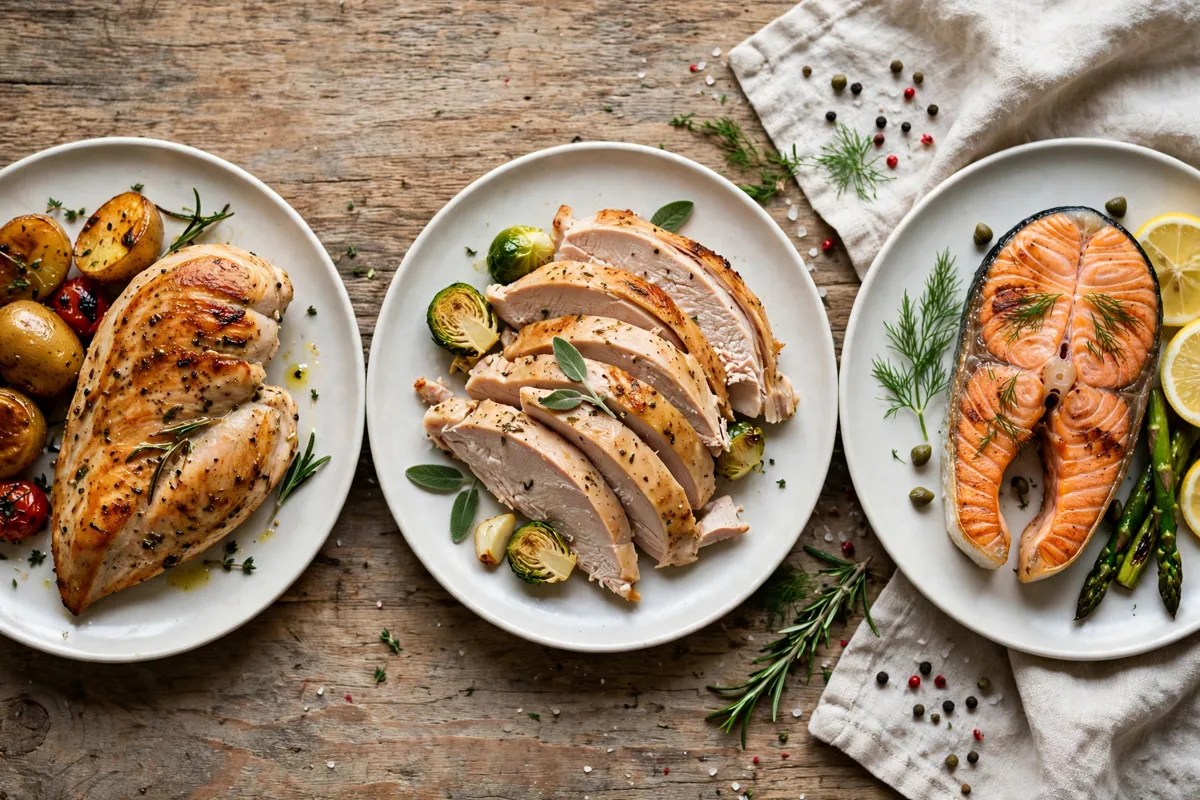
Six ounces of meat looks like two decks of playing cards side by side — a cooked portion of 170.1 grams, roughly the footprint of two smartphone faces or both palms' flats together, deriving for chicken breast to 280.7 calories and 52.8g protein (USDA FDC ID 171477) and for sirloin steak to 311.3 calories and 52.0g protein (FDC ID 168634). This article builds the visual, prices it across meats, and shows why 6 ounces is the portion where estimation matters most.
Six ounces is the generous portion: the restaurant breast, the steakhouse's smaller cut, the athlete's meal anchor. It is also, not coincidentally, almost exactly the USDA's whole reference chicken breast (172g) — the piece many people still log as a modest single serving while it quietly carries two standard servings' worth of protein and calories. Owning its visual corrects that. Once estimated or weighed, any such portion prices through the calorie counter.
Short Answer
6 ounces of cooked meat is 170.1 grams — visually two decks of cards, two phone faces, or a portion covering a small side plate. Priced across meats at that weight: chicken breast 280.7 calories and 52.8g protein; sirloin 311.3 calories and 52.0g protein; turkey breast about 250.0 calories and 51.3g protein (derived from FDC 171496); salmon about 309.6 calories and 43.3g protein (derived from FDC 171998).
What Are the Best Visual Anchors for 6 Ounces?
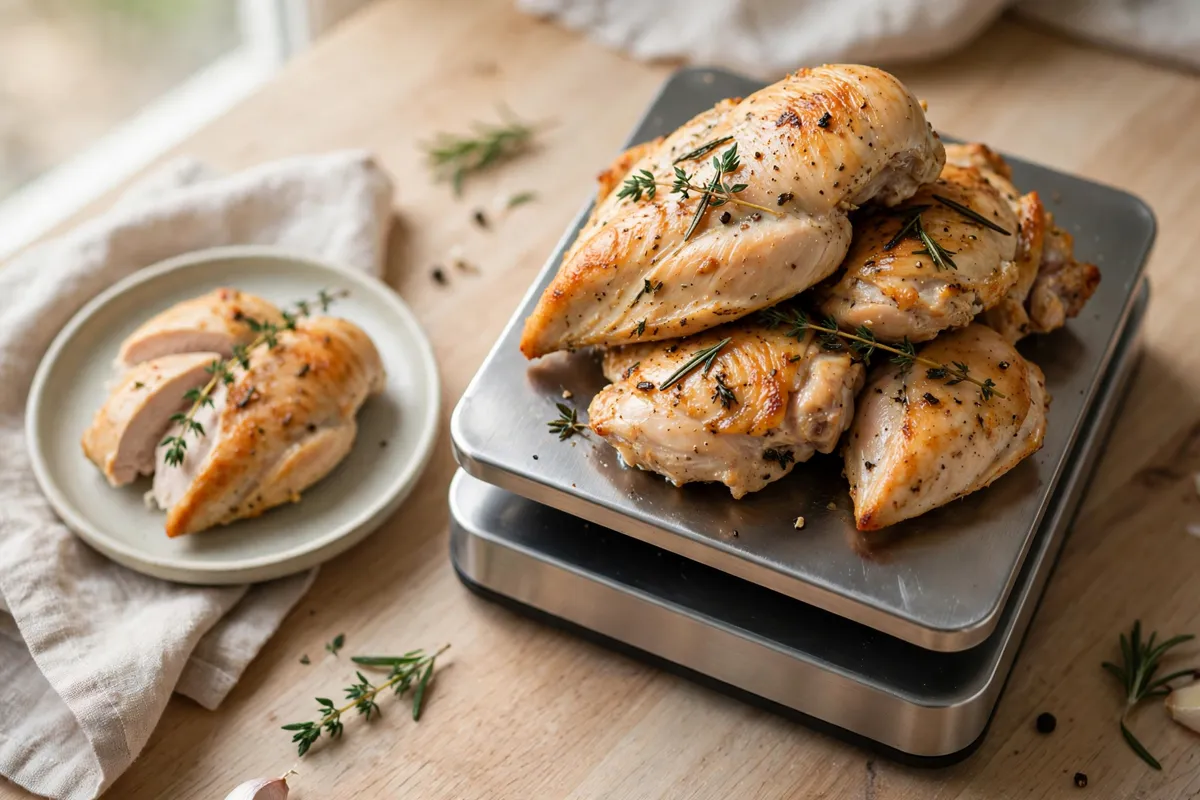
Build from the verified smaller anchors rather than inventing a new one. Three ounces is one deck of cards; six ounces is two decks side by side, or one deck doubled in thickness — both pictures describe 170.1 grams of flat meat, and the second warns you that a single thick piece over one deck's footprint can be the full 6 ounces. Four ounces is a smartphone face; six is that face plus half again — two phones overlapping by half, in the mental picture. The hand anchor scales too: one palm-plus-base is about 4 ounces, so 6 ounces is both palms' flats with fingers excluded, a portion that visibly fills two hands' worth of plate.
In volume forms, the anchors convert: diced cooked breast at the dataset's cup rate (140g per cup) makes 6 ounces about 1.2 cups (170.1 ÷ 140) — a generous heaped cup. Ground meat cooked loosely mounds to about one and a half tennis balls. A whole reference chicken breast (172g) is the portion itself wearing a piece's name, which is the most useful anchor of all for poultry: if the breast on the plate is a full, large fillet, you are looking at roughly 6 ounces until a scale says otherwise. How many calories are in 6 ounces of chicken breast prices the poultry case in full, and why do portion sizes matter shows the cost of calling this portion "one serving" in a log.
What Does 6 Ounces Deliver From Each Meat?
Derived at 170.1 grams from the logged USDA entries. Chicken breast (171477): 280.7 calories, 52.8g protein, about 6.1g fat. Turkey breast (171496): about 250.0 calories (170.1 × 1.47), 51.3g protein (170.1 × 0.3013), about 3.5g fat — the leanest 6 ounces here. Sirloin (168634): 311.3 calories, 52.0g protein, about 9.8g fat, and the set's standout potassium at about 668mg (170.1 × 3.93). Ground beef crumbles, 90% lean (171794): about 391.2 calories, 48.4g protein, about 20.5g fat. Chicken thigh meat (172388): about 304.5 calories, 42.1g protein. Salmon (171998): about 309.6 calories, 43.3g protein. Cod (171956): about 178.6 calories, 38.8g protein — the lightest 6 ounces in the set by a wide margin.
Two lessons organise the table. First, at 6 ounces every meat here clears 38 grams of protein — the portion is past any standard per-meal target (30 to 40 grams) regardless of choice, so the decision among meats is made entirely on the calorie column, which spreads from about 179 (cod) to about 391 (ground beef). Second, the poultry breasts and sirloin converge on protein (51 to 53g) while diverging by about 60 calories — the same near-tie the 100-gram comparisons found, preserved at plate scale. The calorie counter holds the per-100g rates behind every row so any weight between anchors prices exactly.
Run the choice as a week of dinners and the calorie column's spread becomes a budget line. Five 6-ounce chicken-breast dinners total about 1,404 calories of meat (5 × 280.7); the same five dinners in 90%-lean ground beef total about 1,956 (5 × 391.2) — a difference of roughly 552 calories across the week, for about 22 fewer grams of protein in total. At 6 ounces, which meat you choose matters more than whether you chose 5 ounces or 6.
Why Is 6 Ounces the Portion People Most Often Mislog?
Because it wears serving-sized disguises. A whole modern chicken breast fillet is routinely 6 ounces cooked or more, yet it enters logs as "1 breast," a phrase the reference data prices at 172 grams only by coincidence — smaller and larger fillets both hide behind the same words. A restaurant's 8-ounce menu steak is a raw weight that plates at roughly 6 cooked ounces, and gets logged variously as 8 (overstating) or as a generic "steak" serving (understating). A double handful of diced meat at a buffet is 6 ounces at about 1.2 cups, and gets logged as "a cup" — 4.9 ounces — by default.
Each disguise errs by 1 to 2 ounces, and at 6-ounce scale each ounce carries about 47 calories and 8.8g protein of chicken breast — errors of 90-plus calories that repeat daily in meal-prep logs. The defence is the anchor set above plus one calibration: weigh a 170-gram portion of your usual meats at home, plate it on your usual dishes, and fix the two-deck picture in memory. From then on, the disguises stop working, because you have seen the portion undressed.
When Is 6 Ounces the Right Portion?
When the meal must carry a large protein target alone — an athlete's 50-gram anchor, a one-meal-a-day pattern's centrepiece, a post-training plate. When the meat is lean and the day's budget is wide: 6 ounces of turkey breast at about 250 calories is a modest price for 51.3g protein, and 6 ounces of cod at about 178.6 calories is lighter than most 4-ounce portions of richer meats. And when the portion is shared or split across two meals, as a whole breast so often is in practice.
It is the wrong default when it arrives unchosen — the oversized fillet eaten whole because it was one piece, the steakhouse portion finished because it was served. At two standard servings, 6 ounces should be a decision, and the decision is easy to make well with the calorie column in view: the same protein target reached at 4 ounces of breast (35.2g) plus a protein-bearing side often fits a budget better than 6 ounces of meat alone. Portion intention, like portion size, is a planning variable — how many calories should a meal contain sets the meal-level budgets these portions serve.
Common Mistakes to Avoid
- Logging a whole large breast fillet as a standard serving — at about 172g and up, it is the 6-ounce portion itself, near 280.7 calories for breast
- Reading a menu's raw 8-ounce weight as the cooked portion: it plates at roughly 6 ounces
- Logging a heaped cup of diced meat as one cup (140g) when 6 ounces is about 1.2 cups
- Judging a thick steak by the one-deck footprint and missing the doubled thickness that makes it 6 ounces
- Assuming 6 ounces of any meat costs the same: the logged range runs from about 179 calories (cod) to about 391 (ground beef crumbles)
Final Thoughts
Six ounces of meat looks like two decks of playing cards — 170.1 grams covering a small side plate — and delivers about 52 grams of protein from chicken breast, turkey or sirloin, at 250 to 311 calories depending on the meat. It is a deliberate portion, not a default: learn its picture, weigh it once at home, and price any plate that wears its disguises in the calorie counter.
People Also Ask
How Many Carbs Are in Broccoli?
One cup of cooked broccoli contains about 11. 2 grams of carbs. That figure comes from USDA FoodData Central's cooked broccoli entry (FDC ID 169967), which lists 7.
How Many Calories Are in One Cup of Steamed Broccoli?
One cup of steamed broccoli contains about 55 calories. The verified figure behind that answer is USDA FoodData Central's cooked broccoli entry (FDC ID 169967) at 35 calories per 100 grams, applied to a cup of chopped cooked broccoli weighing 156 grams: 156 × 0. 35 = 54.
What Is the Healthiest Food to Order at a Convenience Store?
The healthiest full meal in the Wawa data tracked on this site is the Turkey Hoagie (Shorti) at 460 calories, with 25 grams of protein, 17 grams of fat, 3 grams of fiber, and 1,150 milligrams of sodium. It has the most protein per calorie of any hoagie except the cheesesteak, the lowest fat of any sandwich tracked, and fewer calories than every other complete meal on the list. No other tracked item combines that protein, that calorie level, and…
What Is the Healthiest Mexican Meal to Order?
On the Moe's Southwest Grill menu tracked on this site, the healthiest Mexican meal to order is the Close Talker Salad (Chicken): 650 calories, 34 grams of protein, 52 grams of carbohydrates, 34 grams of fat, 11 grams of fiber, 8 grams of sugar and 1,420 milligrams of sodium. It is the lowest-calorie full entrée in the Moe's data, it keeps a full serving of chicken protein, and it carries the lowest carbohydrate total of any entrée here. If "healthiest"…