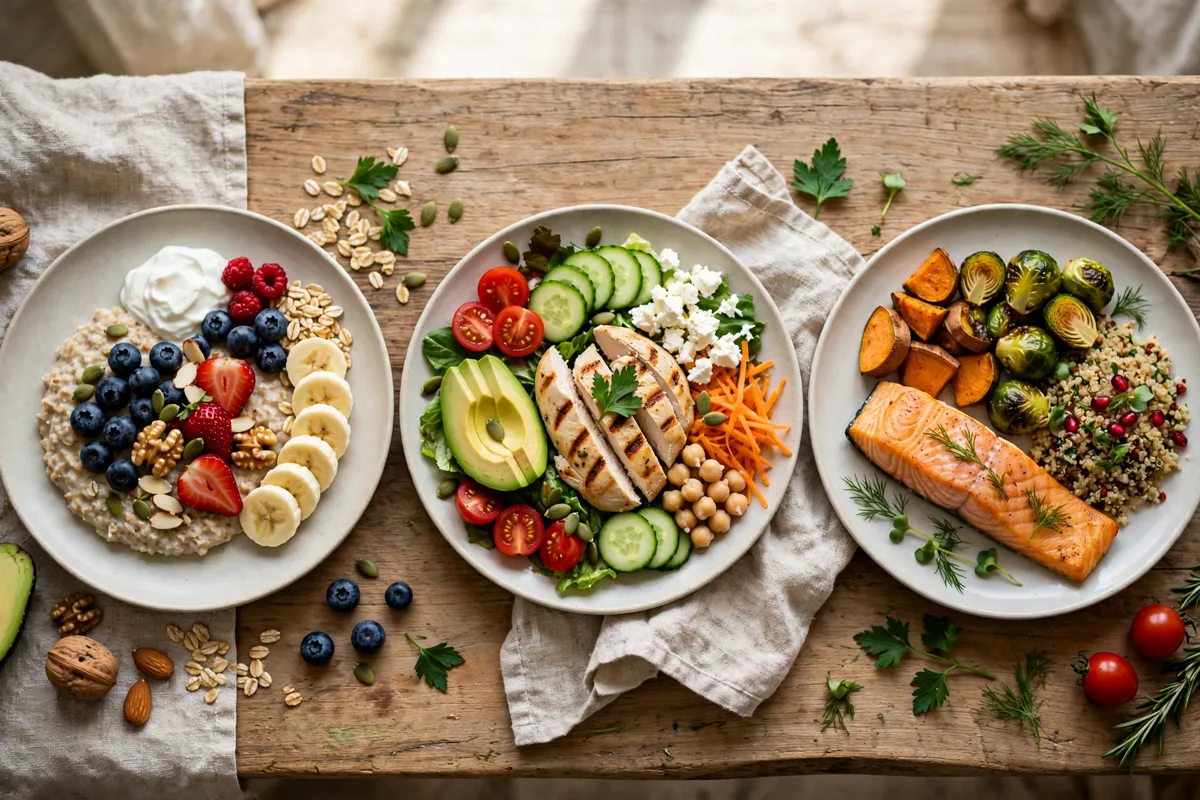
Calorie Counter: The Short Answer
A meal should contain roughly a quarter to a third of your daily calories if you eat three meals a day — about 500 to 650 calories per meal on a 1,800-calorie day and about 600 to 800 on a 2,400-calorie day. The calculation is simply your daily target divided by your meal pattern, with snacks and drinks subtracted first if you have them.
This article is the general rule behind the breakfast and lunch versions: how to divide any daily budget across any eating pattern — three meals, two meals, three meals plus snacks, grazing shift work — and how to know when a meal is too big or too small for the day it belongs to. It differs from the existing meal guide on this site by starting from the division arithmetic itself and stress-testing it against four different budgets. Your daily budget, of course, comes from maintenance: estimate it in the calorie counter before dividing anything.
Short Answer
Meal calories = (daily target − snacks and drinks) ÷ number of meals. Three equal meals and no snacks: one third each — about 533 at 1,600 a day, 667 at 2,000, 800 at 2,400. Unequal splits are fine and usually better: a common pattern is 25% breakfast, 35% lunch, 40% dinner. Meals should rarely drop below about 300 (unsatisfying) or exceed about 40% of the day (they crowd out the rest).
How Does the Division Work on Real Budgets?
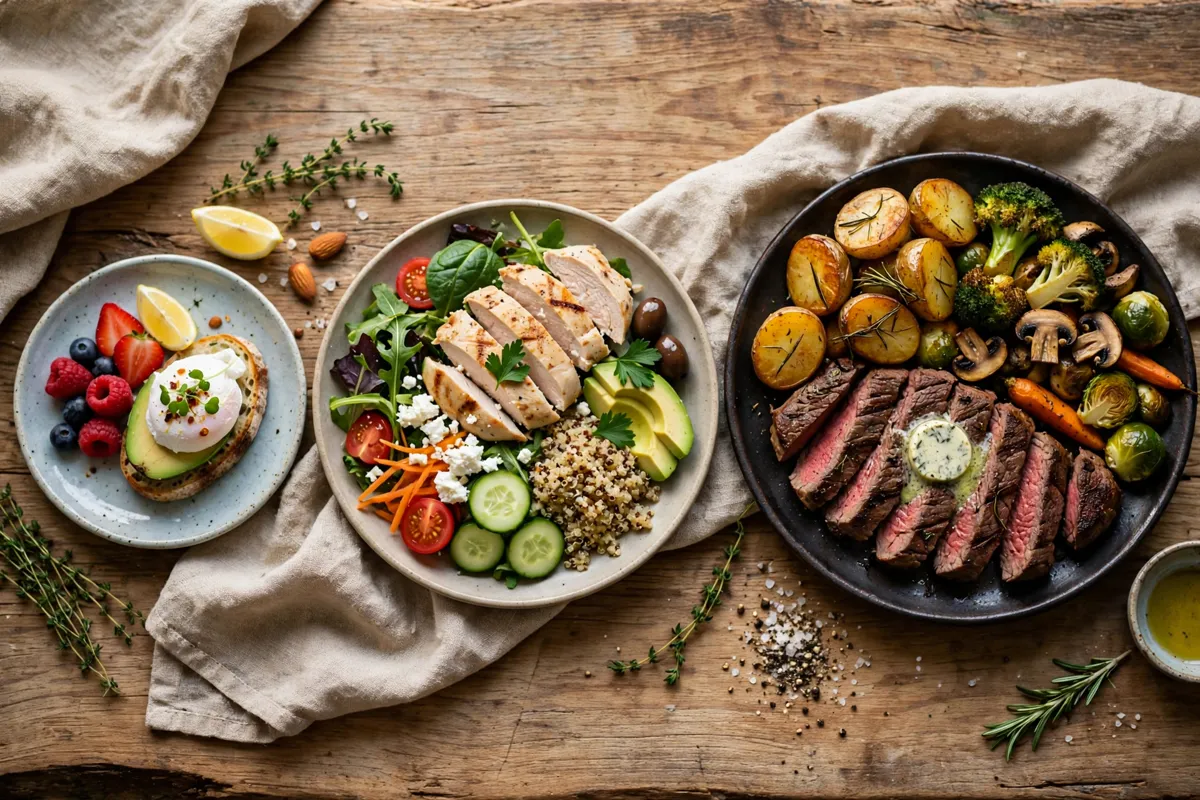
Run the arithmetic on four days. Budget one, 1,600 (a common losing target): with 200 reserved for a snack and drinks, 1,400 remains for three meals — an equal split of about 467 each, or a realistic 350 breakfast, 500 lunch, 550 dinner. Budget two, 1,800: reserving 200 leaves 1,600 — roughly 400 / 550 / 650, or 533 each if you prefer equality. Budget three, 2,000, no snacks: 667 each equally, or 500 / 650 / 850 in a dinner-weighted pattern many families actually live. Budget four, 2,600 (a larger active man maintaining or slowly gaining): 867 each equally, or 600 / 900 / 1,100 weighted. Notice how the same "meal" doubles across budgets — a 550-calorie dinner is generous on budget one and a light course on budget four. This is why meal advice quoted without a daily budget is meaningless, and why restaurant portions, built to a one-size standard, quietly overshoot small budgets: a single 900-calorie restaurant main is 56% of budget one's day. The full framework for setting the budget these divisions come from is in how many calories to eat to lose weight.
Should All Meals Be the Same Size?
No — equality is arithmetic tidiness, not a physiological requirement. Hunger, schedule and social life all argue for unequal meals, and your weight responds to the day's total, not the distribution. Three patterns cover most lives. The dinner-weighted pattern (roughly 20–25% / 30–35% / 40–45%) suits people who eat with family in the evening and are not hungry early. The lunch-weighted pattern (25% / 40% / 35%) suits physical workers and early diners, and often controls evening snacking best because nobody arrives at night ravenous. The even pattern (33% / 33% / 33%) suits grazers-turned-structured and people on medication schedules that need regular food. Two-meal patterns divide differently again — roughly 45% / 55% — and the per-meal numbers get large enough (720–880 on 1,600) to startle people who think a meal "should" be 500. It should be whatever your division says. The site's companion piece, how many calories each meal should contain, approaches the same splits from the plate-composition side. The breakfast share of the day is set out in calories at breakfast.
What Makes a Meal Too Big or Too Small for Its Budget?
Too small has a signature: hunger within two hours, snack-seeking that costs more than the saved calories, and difficulty reaching daily protein — a 250-calorie meal can hold at most about 20–25 g of protein alongside anything else. As a working floor, a main meal under about 300 calories fails most adults unless it is deliberately a light course inside a many-meal day. Too big also has a signature: it displaces the rest of the day — the 1,100-calorie lunch on a 1,800 budget that leaves 700 for breakfast, dinner and life — or it arrives with so much fat and volume that the next meal is skipped and then over-eaten. A working ceiling is about 40–45% of the daily budget in one sitting for most people, beyond which satiety, comfort and the remaining day's structure all suffer. Between roughly 300 and 40% sits the usable band, and your division picks the point. Meals are also where estimation error hides — sauces, oils and restaurant portions push a planned 600 to an actual 800 — so the checking habits in counting calories without a scale are worth more per meal than any refinement of the split itself.
- 1,600/day, 3 meals + 200 snacks → ~467 per meal (e.g. 350 / 500 / 550)
- 1,800/day, 3 meals + 200 snacks → ~533 per meal (e.g. 400 / 550 / 650)
- 2,000/day, 3 meals, no snacks → ~667 per meal (e.g. 500 / 650 / 850)
- 2,400/day, 3 meals, no snacks → 800 per meal (e.g. 600 / 850 / 950)
- Any budget, 2 meals → ~45% and ~55% of the (snack-adjusted) total
How Do Snacks and Drinks Fit Into Meal Maths?
They come off the top before the division, and forgetting them is the classic reason meal plans fail on paper-perfect meals. Price your habitual extras honestly: two milky coffees might be 150–300; a 200-calorie snack bar is 200; a glass of juice is 110; cooking oil across a home-made dinner is easily 120–240 and belongs to that meal's true cost. Suppose a 1,900 budget carries 350 of drinks and snacks: meals divide 1,550, not 1,900, and the equal split is 517, not 633. A plan built on the unadjusted figure overshoots by 350 a day — 2,450 a week, about 0.7 lb of phantom deficit that never appears on the scale. This is also why "my meals are only 500 each" can coexist with weight gain: three 500 meals are 1,500, but the day around them can still total 2,300. Division is a whole-day discipline; the meals are just where most of the number lives.
How Do You Estimate a Meal's Calories When Eating Out?
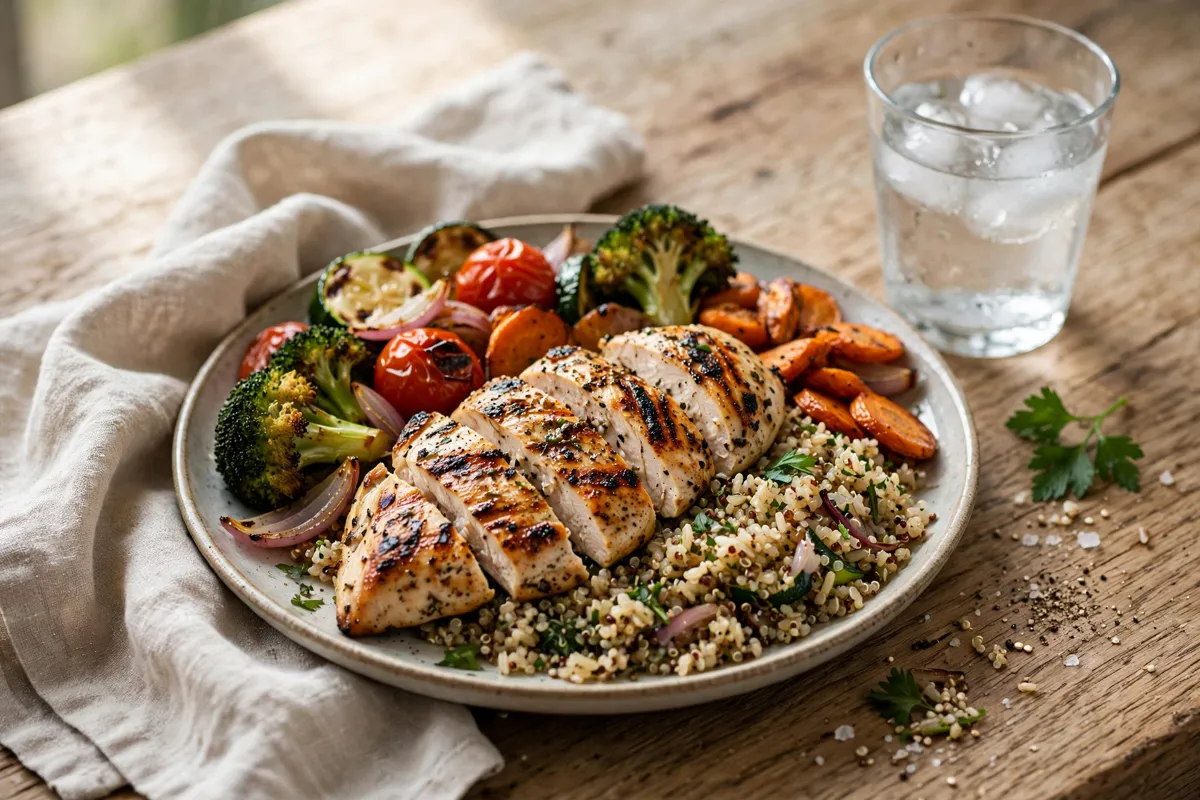
By components, coarsely, and without pretending to laboratory precision. Identify the protein portion (a palm-and-a-half of grilled meat or fish is roughly 250–350), the starch portion (a fist of rice, pasta or potato is roughly 200–300 before sauces), the added fats (each visible tablespoon of oil, butter or creamy dressing is roughly 100–120), and the drink. Sum the parts and add a tenth for kitchen generosity — restaurant food is cooked richer than home food at the same description. A grilled chicken plate might estimate at 350 + 250 + 120 + 0 for water = 720, plus the tenth, about 790. That estimate is good enough to place the meal inside your day honestly, which is all meal maths ever requires of a restaurant visit.
Common Mistakes to Avoid
The first mistake is copying a meal size — "a 600-calorie dinner" — without the budget that gives it meaning. The second is dividing the day before subtracting drinks and snacks, manufacturing a deficit that exists only in the plan. Third, forcing equal meals onto an unequal life and then snacking the difference. Fourth, judging a meal by fullness alone: a 400-calorie protein-and-vegetable meal can satisfy longer than an 800-calorie pastry-and-juice meal, because protein, fibre and volume — not calories — are what satiety is made of. Fifth, applying restaurant portions as the template for home meals; restaurant mains are engineered for occasion eating, and on a small budget one can consume over half the day.
Final Thoughts
A meal should contain your daily budget, minus snacks and drinks, divided by your meals — typically 450–650 calories on a losing budget and 650–900 on a larger maintenance one, weighted toward whichever meal your life centres on. There is no universal meal size, only a universal method. Set the day first in the calorie counter, take the extras off the top, divide honestly, and every meal's right size falls out of the arithmetic.
People Also Ask
How Many Calories Does a Person Burn Per Day?
A person burns roughly 1,400 to 3,200 calories per day in total, depending on body size and activity: basal metabolic rate accounts for about 60 to 70% of it, everyday movement and exercise most of the rest, and digesting food roughly 10%. Your personal total — your TDEE — is calculated by multiplying your Mifflin-St Jeor BMR by an activity factor of 1. 2 to 1.
How Many Calories Should I Burn to Lose Weight?
To lose weight, you need a total daily deficit of 300 to 500 calories — but you do not need to burn all of it through exercise: the deficit is maintenance minus intake, and most people build it mainly by eating less, adding perhaps 150 to 300 calories of extra daily burn from walking and training on top. Burning an extra 500 calories of exercise every single day is a large ask; eating 350 less and walking off 150 achieves…
What Does a Calorie Measure?
A calorie measures energy — specifically heat energy. In its original scientific definition, one small calorie is the heat needed to raise the temperature of one gram of water by one degree Celsius, and the food Calorie (the kilocalorie, 1,000 small calories) is the heat needed to raise one kilogram of water by one degree. Everything a calorie has meant since — on labels, in diet plans, on gym machines — is that same heat measurement, scaled up and put…
How Are Calories in Food Measured?
Calories in food are measured in two stages: the food's total energy is established by burning it in a bomb calorimeter, and then the figure is adjusted for human digestion using the Atwater system — the protein × 4, carbohydrate × 4 and fat × 9 factors that produce the numbers on labels. Almost no product on a shelf today is individually burned; its label is calculated from the measured values of its ingredients, using the method this article walks…