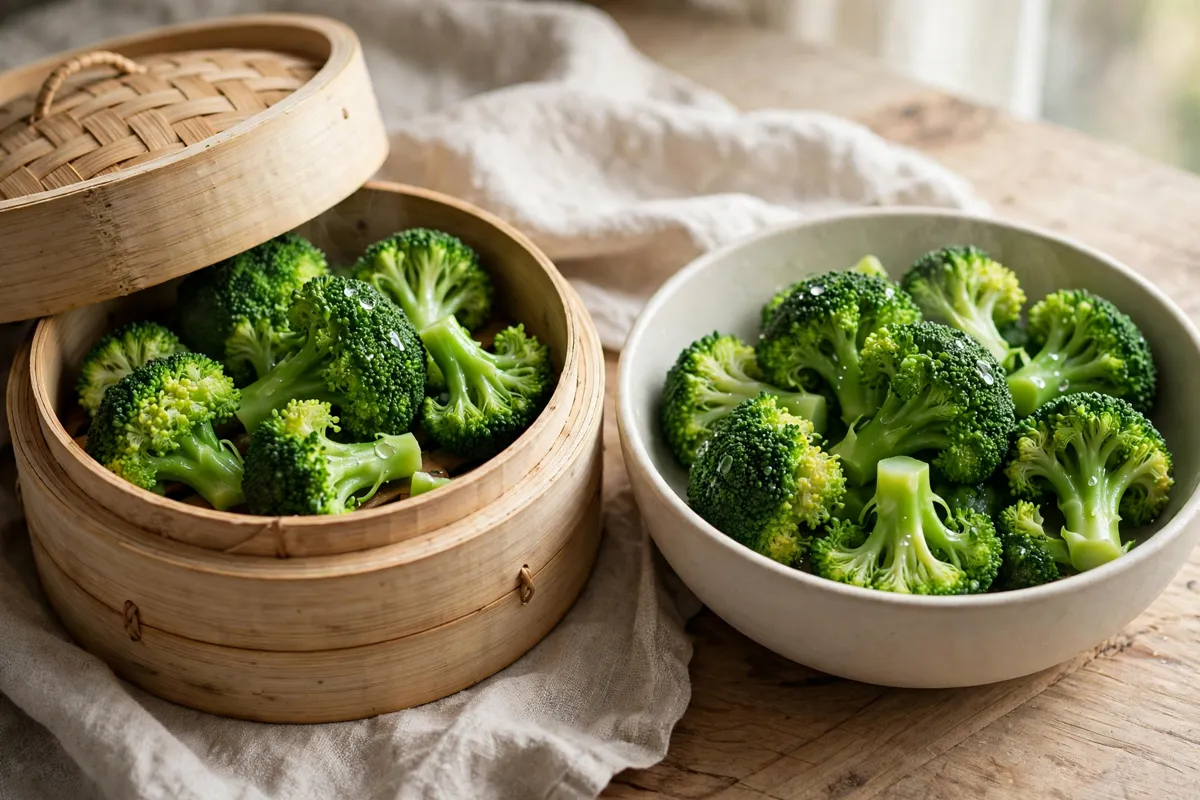
Calorie Counter: The Short Answer
One cup of steamed broccoli contains about 55 calories. The verified figure behind that answer is USDA FoodData Central's cooked broccoli entry (FDC ID 169967) at 35 calories per 100 grams, applied to a cup of chopped cooked broccoli weighing 156 grams: 156 × 0.35 = 54.6 calories in one cup of steamed broccoli, which is why the honest answer to how many calories are in one cup of steamed broccoli is "about 55."
One transparency note belongs up front, because this site does not hide its sources: FoodData Central's SR Legacy dataset publishes a boiled, drained entry for cooked broccoli rather than a separate steamed entry, and that boiled entry is the verified reference used here and by the host calculator. Steaming keeps marginally more of the vegetable's soluble nutrients in the floret instead of the cooking water, but the calorie difference between the two moist-heat methods is negligible — the energy lives in the tissue, not the water. What moves the real-world number is portion weight and whatever you put on top, and both get a full airing below. The calorie counter carries the same 55-calorie cup; this page shows the working.
Short Answer
About 55 calories in one cup of steamed broccoli (156g chopped, cooked), derived from USDA's cooked entry at 35 calories per 100g. A half cup (78g) is about 27 calories. The same cup provides about 3.7g of protein, 11.2g of carbohydrate, 5.1g of fibre and 0.6g of fat.
Where Does the 55-Calorie Figure Come From?
From two published numbers multiplied together, with nothing estimated in between. The first is energy density: USDA's entry for broccoli cooked, boiled and drained, without salt records 35 calories per 100 grams, alongside 2.38g of protein, 7.18g of carbohydrate, 0.41g of fat and 3.3g of fibre. The second is portion weight: the same entry's portion table lists half a cup of chopped broccoli at 78 grams, so a full cup is 156 grams. Multiply 156 grams by 0.35 calories per gram and you land on 54.6 — quoted as about 55, and matching the host calculator's tracked value of 55 calories per cup.
This derivation matters because cup measures of vegetables are notoriously unstable. A cup of raw chopped broccoli weighs only 91 grams, so anyone pricing a steamed cup with raw data understates it by more than a third; anyone pricing it with a generic "vegetables are 25 calories a cup" rule understates it by half. The logged route — entry, portion, multiplication — is the same one used for the carb side of this vegetable in how many carbs are in broccoli, and it is why the two articles agree with each other to the decimal.
It is also worth naming what 55 calories buys. For roughly the energy of two bites of a biscuit, the cup delivers 5.1 grams of fibre, about 3.7 grams of protein — respectable for a vegetable — and about 457mg of potassium (293mg per 100g scaled), with only about 64mg of sodium when cooked without salt. Calorie counting that stops at the calorie line misses the exchange rate, and broccoli's exchange rate is among the best in the produce aisle, as the survey in how much fiber is in common fruits and vegetables shows across the whole category.
How Do Steaming, Boiling and Roasting Change the Calories?
Barely at all — and it is worth understanding why, because the internet is full of confident claims that one method "adds" or "removes" calories from plain vegetables. Calories in broccoli live in its protein, carbohydrate and trace fat. Moist heat — steaming or boiling — neither creates nor destroys those in meaningful amounts; it softens cell walls and moves some water and soluble solids around. Boiling in a large pot leaches a little sugar and mineral content into the water, which is discarded; steaming keeps the florets above the water, so slightly more stays in the food. The verified boiled entry therefore sits, if anything, a hair below a steamed cup — a difference too small to log honestly at the precision of a kitchen scale.
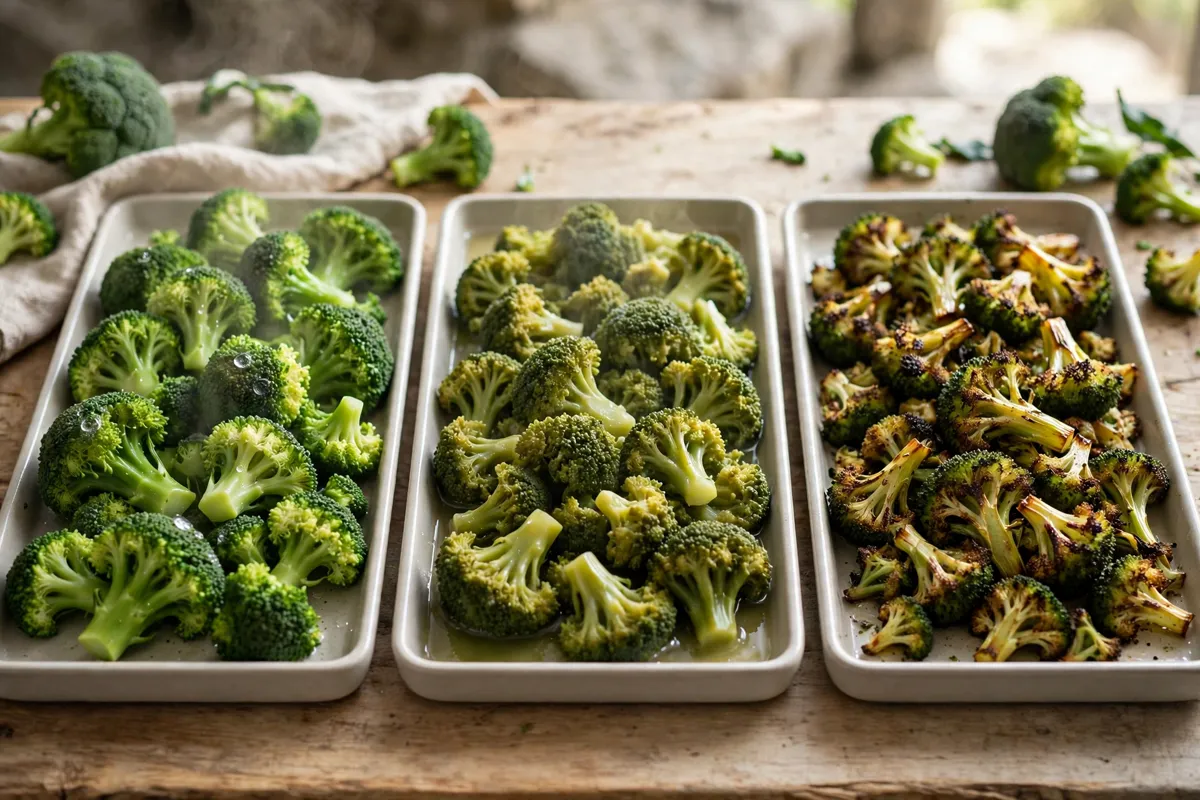
Roasting is the one method that genuinely shifts the number, and it does so through water loss, not magic. A tray of florets roasted until the edges crisp has driven off a noticeable share of its water, so each 100 grams of the finished product is more concentrated — the same total calories in fewer grams. If you roast 156 grams of raw broccoli down to a smaller finished weight, the tray's calories barely change; if you weigh out 156 grams after roasting, you have taken more broccoli than the steamed cup holds. The fix is the usual one: weigh in the state you log, or log the raw weight you started with.
What changes the dish decisively is never the heat — it is the fat applied before or after it. A tablespoon of oil tossed over florets before roasting, or butter melted over a steamed cup, adds more energy than the broccoli itself contains, a trap examined from the dish side in how many calories are in broccoli cheese soup. Plain steamed broccoli is a 55-calorie cup; dressed broccoli is a different entry and deserves a different line in your log.
How Does a Cup of Steamed Broccoli Compare With Other Sides?
Context is where the 55 earns its keep. The cup sits at the light end of the side-dish spectrum while delivering a full cup of actual food volume, which is why it appears in nearly every weight-management pattern that has ever been written down. Its nearest nutritional relatives — the other green vegetables tracked in which foods have the highest amount of fiber — share the pattern: high water, high fibre, modest energy.
The comparison that matters at the table is displacement. A cup of steamed broccoli in the slot where a cup of a starch-heavy side might have sat changes the meal's total by well over a hundred calories while keeping the plate looking — and feeling — equally full. That is the entire strategy of volume eating, and broccoli is its most reliable instrument because it also carries protein, potassium and fibre instead of being nutritionally empty bulk. Price the full plate in the calorie counter and the swap shows up immediately.
- Steamed broccoli, 1 cup chopped (156g): about 55 calories, 5.1g fibre
- Steamed broccoli, half cup (78g): about 27 calories, 2.6g fibre
- Raw broccoli, 1 cup chopped (91g): about 31 calories, 2.4g fibre
- Cooked carrots, 1 cup slices (156g): about 55 calories, 4.7g fibre — the closest swap in this dataset
- Cooked black beans, 1 cup (172g): about 227 calories — a protein staple, not a light side
How Should You Portion Steamed Broccoli for a Meal?
Start from USDA's own portion: half a cup chopped, 78 grams, about 27 calories, is the database's listed serving unit, and it is a modest side — a small mound beside a protein. Most adults eating broccoli as their principal vegetable will serve themselves a full cup or more, and the logged numbers say they can afford to: even a double portion, two full cups, is about 109 calories with over 10 grams of fibre.
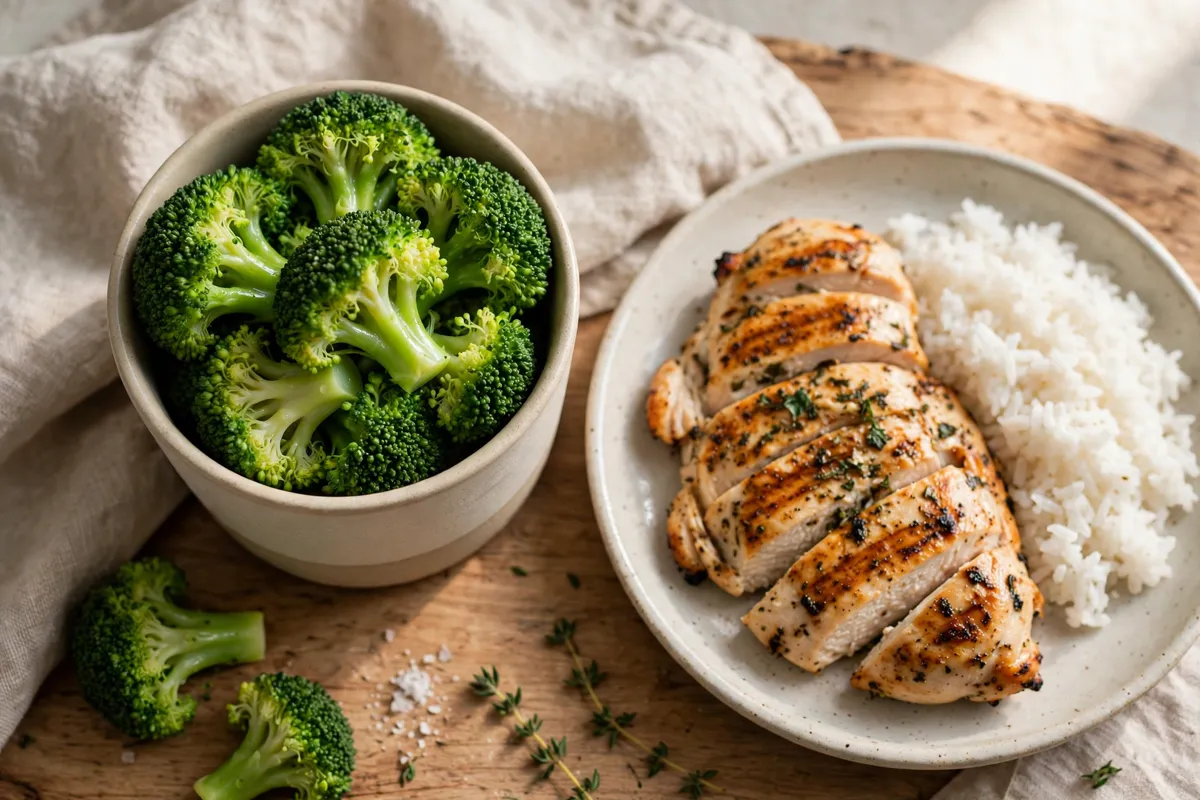
For meal planning, think of the cup as the unit and scale without anxiety. A weeknight dinner plate with a cup of steamed broccoli beside a chicken breast is the canonical light dinner, and the chicken side of that plate is priced from every angle in how many calories are in 100 grams of chicken breast. If you are batch-cooking, florets steam from raw in a few minutes and reheat without the texture collapse that boiling causes; weigh the cooked batch once, divide by portions, and your per-serving figure is set for the week.
Children and smaller appetites map to the half cup naturally, and the database's 78-gram portion keeps that honest too. What does not work is the vague "some broccoli" estimate: a heap that fills half a dinner plate can be two cups, and while 109 calories harms nobody's budget, the habit of underestimating portions transfers to foods where it does matter.
Common Mistakes to Avoid
- Pricing a steamed cup with the raw cup's weight — 91g raw against 156g cooked understates the cup by over a third.
- Assuming steaming "removes" calories; moist heat changes texture and water, not the energy in the tissue.
- Forgetting the oil or butter: a drizzle can double or triple the dish's calories while the log still says "broccoli, 55."
- Treating "about 55" as exact for every cup — chopped size and packing move the weight, so a heaped cup runs above 156g.
- Dismissing the cup as empty calories in reverse — it carries 5.1g fibre, 3.7g protein and about 457mg potassium, which is the point of eating it.
Final Thoughts
One cup of steamed broccoli is about 55 calories — 35 per 100 grams, times a 156-gram cup — with 5.1 grams of fibre and a nutritional payload far beyond its energy cost. Steam it plain, weigh it in the state you eat it, log the toppings separately, and it remains one of the most dependable numbers in the whole vegetable drawer.
People Also Ask
How Many Grams of Broccoli Are in One Cup?
One cup of cooked broccoli weighs 156 grams, while one cup of raw broccoli weighs 91 grams. Both figures come straight from USDA FoodData Central's portion tables — the cooked entry (FDC ID 169967) lists half a cup of chopped broccoli at 78 grams, and the raw entry (FDC ID 170379) lists a cup of chopped broccoli at 91 grams — so the answer to how many grams of broccoli are in one cup depends entirely on whether the broccoli…
What Is a Serving Size of Broccoli?
A serving size of broccoli is one cup raw or half a cup cooked by the database's own portion — USDA lists half a cup of chopped cooked broccoli at 78 grams and a cup of chopped raw broccoli at 91 grams — and in MyPlate terms, one cup of raw or cooked broccoli counts as a full one-cup serving of vegetables. So the serving size of broccoli most people should picture is a cup of florets on the plate,…
How Many Calories Are in a Chicken Bowl?
A classic chicken bowl at Qdoba is 635 calories when you price it from the tracked ingredients — cilantro lime rice, black beans, grilled adobo chicken, pico de gallo and shredded cheese — and Qdoba's own prebuilt Grilled Chicken Bowl is published at 650 calories, so the honest short answer is about 635 to 650 calories for the standard build, with 38 grams of protein by the component count. That is the bowl most people mean by "a chicken bowl":…
How Many Calories Are in a Burrito?
A burrito at Qdoba is 950 calories when it is built the usual way: a flour tortilla wrapped around grilled adobo chicken, cilantro lime rice, black beans, pico de gallo and shredded cheese. That build carries 55 grams of protein, 119 grams of carbohydrates and 24 grams of fat. The same filling served as a bowl, without the tortilla, is 650 calories.