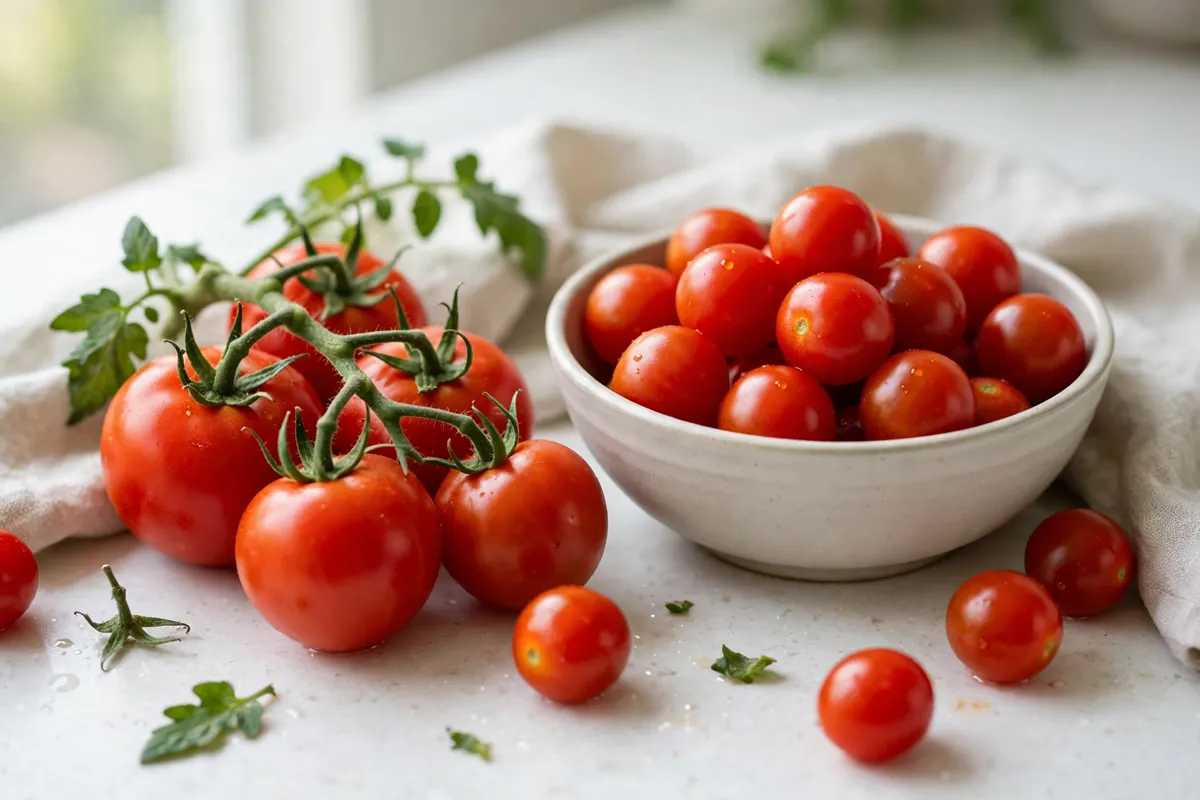
Calorie Counter: The Short Answer
A fresh tomato contains no added salt — but it does contain a small amount of naturally occurring sodium: 5 milligrams per 100 grams, per USDA FoodData Central's raw tomato entry (FDC ID 170457). A whole medium tomato of 123 grams therefore carries about 6.2 milligrams of sodium, so do tomatoes contain salt? Only in the sense that almost every living food contains trace sodium — a fresh tomato has no salt added to it, and the sodium it grows with is a fraction of what processed tomato products can carry.
The question turns on a distinction everyday language blurs: salt and sodium are not the same thing, and "contains sodium" and "contains salt" are different claims. Sodium is an element every plant takes up from soil and water; salt — sodium chloride — is the compound humans add. This article separates the two, gives the tomato's verified numbers, explains why the processed end of the tomato family tells a different story, and puts the fresh tomato's 5 milligrams in the context of a day's eating. The calorie counter tracks sodium across your meals; this page settles the tomato.
Short Answer
Fresh tomatoes contain no added salt and only trace natural sodium — 5mg per 100g (USDA FDC ID 170457), about 6.2mg in a whole medium tomato (123g). That is negligible in dietary terms. Processed tomato products are a separate case: salt is commonly added to them, and their labels, not the fresh entry, state how much.
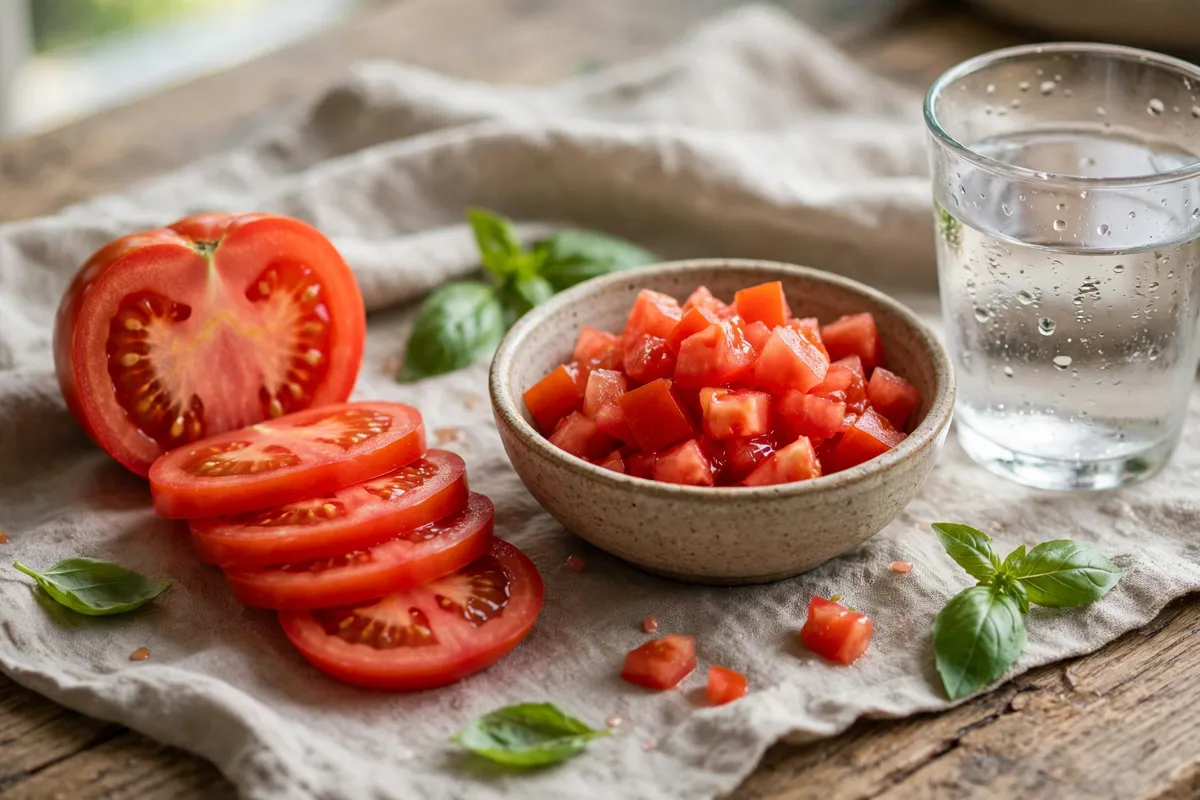
What Is the Difference Between Salt and Sodium in a Tomato?
Sodium is a mineral element, present in soil and water, and plants absorb small amounts of it as they grow — it turns up in the tomato's tissue the way potassium (237mg per 100g in the same entry) and every other mineral does, as part of being a living thing. Salt, properly, is sodium chloride: the crystalline seasoning of roughly 40% sodium joined to chlorine, and it reaches a tomato only when a human adds it — at the table, in a sauce, in a cannery.
USDA's database records sodium, never "salt," because sodium is what analysis measures and what nutrition tracks. So the tomato entry's 5mg is a sodium figure. If you wanted the salt-equivalent of that sodium — the amount of sodium chloride that would contain it — the conversion multiplies sodium by about 2.5, giving roughly 12.5mg of salt-equivalent per 100 grams of tomato: a hundredth of a gram, distributed through the whole fruit, undetectable to the tongue and irrelevant to any sodium budget ever written.
This is why the honest answer to the title question is "no, with a footnote." No salt is in a tomato in the culinary sense — nothing was added, nothing tastes salted — while a trace of sodium is in it in the chemical sense, as it is in carrots (69mg per 100g), broccoli (41mg cooked) and nearly everything else in the produce drawer. Tomatoes sit at the very low end even of that natural range, a point the comparison section quantifies.
How Much Sodium Is in a Tomato at Real Portions?
Portion by portion, from the entry's 5mg per 100 grams: a medium whole tomato (123g, the entry's listed portion) carries about 6.2 milligrams of sodium, alongside about 22 calories, 4.8 grams of carbohydrate and 1.5 grams of fibre. A large slice or a handful of cherry tomatoes lands in the same few-milligram territory. A full cup of chopped tomato — roughly 180 grams by ordinary kitchen measure — still carries only around 9 milligrams, while its fibre and potassium place it comfortably in the whole-food pattern surveyed in how much fiber is in common fruits and vegetables.
Now set that against the frame a sodium-conscious reader actually uses. Packaged-food standards treat 140mg per serving as the ceiling for a "low sodium" claim, and the school-snack gate used by this site's tools sets 230mg — the fresh tomato's whole-fruit 6.2mg is about one-twentieth of the tighter figure. A day's sensible sodium budget is measured in thousands of milligrams; the tomato's contribution does not survive rounding. Someone seasoning a tomato salad adds more sodium with a single pinch of table salt than a basket of tomatoes contains — which is precisely the relationship to keep in mind: with fresh tomatoes, the sodium story is the cook's, not the fruit's.
The rest of the entry flatters the fruit while we are here: 18 calories per 100 grams, 0.88g of protein, 0.2g of fat, 2.63g of natural sugars, and that striking 237mg of potassium — the mineral whose intake generally balances sodium in dietary patterns — at nearly fifty times the sodium figure. As a sodium source, a tomato is a rounding error; as food, it is mostly water, potassium and flavour. The calorie counter will show the same profile inside any meal you build with it.
Why Do Processed Tomato Products Tell a Different Story?
Because processing is where the salt pot lives. A fresh tomato is sold as it grew; a canned tomato, a jarred sauce, a ketchup, a sun-dried tomato packed for shelf life — each passes through human hands that season, preserve and standardise it, and salt is the oldest tool for all three jobs. Manufacturers add it for flavour, and in some products it also supports texture and preservation. The result is that the processed branch of the family routinely carries sodium in a completely different league from the fresh fruit's 5mg per 100 grams.
This site does not print a specific figure for those products, deliberately: the verified log behind this article covers the fresh entry, and processed products vary enormously by brand and recipe — a no-salt-added canned line and a conventional sauce are different foods wearing similar labels. What can be said without inventing numbers is where the truth lives: on those products' own Nutrition Facts panels, in the sodium line, per serving. The reading skill for exactly that line is developed in how to read a nutrition label, and the gate-based screening in what are the usda smart snack calorie and sodium limits shows how quickly a sauce's sodium can fail standards its fresh ingredient would pass a hundred times over.
The home cook's version of the same lesson: a sauce you make from fresh tomatoes contains the sodium you put in it and essentially none you didn't. You are the cannery. Salt it to taste, knowing the baseline you started from was 5 milligrams per 100 grams of fruit — as close to a blank slate as food gets.
Should Anyone Watching Sodium Avoid Tomatoes?
On the fresh evidence, no — fresh tomatoes are one of the safest foods in the entire sodium conversation, and avoiding them on sodium grounds would be a category error that costs real nutrition and pleasure to save single-digit milligrams. The readers who must watch sodium — and their clinicians' guidance governs, not a website's — manage it at the processed end: sauces, canned goods, juices, dried and restaurant preparations, where added salt concentrates and serving sizes grow.
There is one more distinction worth handing to careful readers, because it generates genuine confusion in shops: "no salt added" on a canned tomato label does not mean zero sodium; it means no salt was added in processing, while the tomato's natural few milligrams remain and are declared in the panel. Conversely, a conventional canned product's sodium is mostly the added share. The label's sodium line, read per serving and multiplied by the servings you actually eat, is the only number that matters in either case.
Fresh, the verdict stands simple. A tomato contains the sodium it grew with — 5mg per 100 grams, about 6 in a whole fruit — and no salt at all. Questions about tomato products should be asked of tomato product labels, where the answers are printed and checkable, rather than of the fruit, which has already answered: almost none, none added.
Common Mistakes to Avoid
- Treating "sodium" and "salt" as the same word: the database measures sodium; salt is the added compound, roughly 40% sodium by weight.
- Assuming a tomato's natural 5mg per 100g is a dietary concern — a whole medium tomato carries about 6.2mg, one-twentieth of a "low sodium" serving ceiling.
- Transferring the fresh fruit's innocence to sauces and canned products, where added salt changes the picture entirely and only the label can quantify it.
- Reading "no salt added" as "zero sodium"; the natural trace remains and is declared.
- Crediting the tomato for the sodium in a tomato dish you salted yourself — the baseline is near zero; the seasoning is yours.
Final Thoughts
Do tomatoes contain salt? No added salt, and just 5 milligrams of naturally occurring sodium per 100 grams — about 6 milligrams in a whole medium tomato. It is one of the lowest-sodium foods in the kitchen, and the moment tomatoes are processed, the question transfers to the product's label, where added salt writes a different and much larger number.
People Also Ask
What Are Net Calories?
Net calories are the calories you eat minus the calories you burn through exercise — your intake, netted against your activity. If you eat 2,200 calories and your workout burns 400, your net calories for the day are 1,800, and it is that net figure — measured against what your body needs for basic maintenance — that decides whether the day ran at a surplus, a balance or a deficit. That is the primary meaning of net calories in fitness…
What Does 2 Ounces of Food Look Like?
Two ounces of food is about 57 grams — a portion roughly the size of two matchboxes side by side, a pair of dice for cheese, or a small handful of nuts. For meat, 2 ounces of chicken breast is a piece about half the size of a deck of cards, carrying about 94 calories and 17. 6 grams of protein on USDA's cooked breast values — so what 2 ounces of food looks like is a modest, palm-eclipsing amount:…
What Is the Healthiest Fruit Smoothie?
The healthiest fruit smoothie at Tropical Smoothie Cafe is the Detox Island Green (24 oz): 210 calories, 4 grams of protein, 53 grams of carbohydrates, 0 grams of fat, 5 grams of fibre and 39 grams of sugar, with just 55 milligrams of sodium. It wins on every measure that matters at once — it is less than half the calories of the next smoothie, it carries the lowest sugar of any smoothie on the menu by a wide margin,…
What Is the Healthiest Breakfast to Order at a Restaurant?
The healthiest breakfast to order at Cracker Barrel, on this site's tracked data, is the only breakfast this data tracks — the Grandpa's Country Fried Breakfast at 1,150 calories — and the honest version of that answer is about how you order it, not which plate you pick: eaten whole it is the heaviest item on the entire menu, so the healthiest form of it is a halved portion at 575 calories, with no sweet tea and no added sides.…