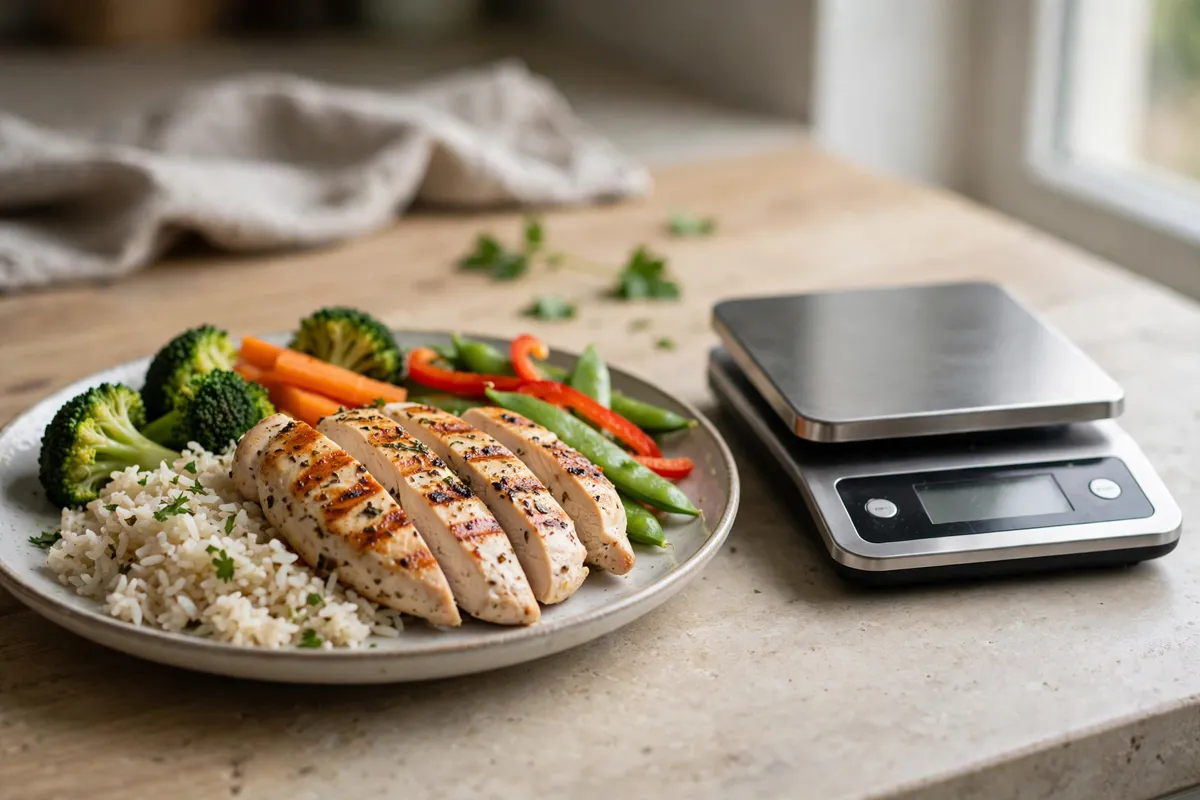
Calorie Counter: The Short Answer
It takes a cumulative deficit or surplus of about 3,500 calories to lose or gain one pound of body fat — the standard approximation used throughout nutrition planning. Eat 500 calories below your maintenance for seven days and you have built 3,500, predicting one pound lost; eat 300 above it for about twelve days (300 × 12 = 3,600) and you have built roughly one pound gained.
That simple rule powers every timeline in this series, so this article examines it properly: where the 3,500 figure comes from, what a pound of body fat actually contains, why the scale rarely shows exactly one pound per 3,500 in any single week, and how to use the rule across months without being misled by it across days. Your maintenance — the baseline every deficit and surplus is measured from — can be calculated in the calorie counter.
Short Answer
About 3,500 calories ≈ 1 lb of body fat, in both directions. Daily deficit of 500 → ~1 lb lost per week. Daily surplus of 500 → ~1 lb gained per week. It is an approximation for fat tissue over weeks and months — accurate enough to plan with, too coarse to judge a single week by, because water, glycogen and gut contents move the scale independently of fat.

Where Does the 3,500-Calorie Figure Come From?
From the composition of a pound of adipose tissue. A pound is about 454 grams. Body fat tissue is not pure fat — it is roughly 85–90% lipid, with water and a small amount of protein and cellular material making up the rest. Pure fat yields about 9 calories per gram, so the energy stored in a pound of adipose works out at approximately 454 × 0.87 × 9 ≈ 3,555 — conventionally rounded to 3,500. That derivation explains both the rule's usefulness and its limits. It is a statement about the energy content of the tissue, not a promise that your body will withdraw or deposit exactly that tissue, in exactly that week, at exactly that rate. When you lose weight, the loss is mostly fat but rarely only fat — some lean tissue and its associated water leave too, and lean tissue carries far fewer calories per pound (muscle is mostly water, at roughly 700–800 calories per pound) — which is why real losses on a given deficit often run slightly faster than the rule predicts early on, then settle toward it. The rule prices fat correctly; bodies are not made of fat alone. One kilogram of body fat gets the same treatment, with its calories counted in full.
How Do You Use the Rule to Plan a Deficit or Surplus?
By division, as the worked cases show. Losing: to lose 12 lb, the total deficit required is 12 × 3,500 = 42,000 calories. At the standard 500 a day that is 42,000 ÷ 500 = 84 days — twelve weeks. At 350 a day it is 120 days — about seventeen weeks. Gaining: to gain 8 lb, the total surplus is 8 × 3,500 = 28,000; at a recommended gaining surplus of 300 a day, 28,000 ÷ 300 ≈ 93 days — about thirteen weeks. Holding a rate against body weight keeps both plans safe: the 500 deficit predicts 1 lb a week, which is 0.5% for a 200 lb person and 0.77% for a 130 lb person — both inside the 0.5–1% band; a 500 surplus predicts the same pound a week gained, which is at the fast edge for gaining composition, since muscle cannot be built as quickly as fat can be stored, and gainers are usually better served by 300. These are the same calculations that size the plans in how many calories to eat to lose weight and in the pound-a-week breakdown in how big a deficit loses a pound a week — one rule, many schedules. The surplus side of the same maths is set out in calories for gaining weight.
Why Does the Scale Disagree With the Rule in a Single Week?
Because the scale weighs at least four things that are not fat. Glycogen: your muscles and liver store roughly 400–500 g of it, bound to about three grams of water per gram — a swing of up to 2 kg (4.4 lb) between full and depleted states, which is why week one of a diet "loses" three pounds on a one-pound deficit and why a high-carb weekend appears to regain them. Gut contents: a day's food and fibre in transit weighs 0.5–1.5 lb and varies with meal size and timing. Sodium and hormones: a salty restaurant meal or the premenstrual phase can retain a litre of water — 2.2 lb — for days. Training inflammation: new or hard exercise holds water in repairing muscle. Fat, meanwhile, changed by exactly what the deficit dictated — about 0.14 lb per day on a 500 deficit, invisible under the noise above. The resolution is timescale: across eight to twelve weeks, water and glycogen average out near their starting levels, gut contents are a rounding error, and the cumulative scale change converges on the rule's prediction within a pound or two. Across seven days, the rule is nearly unmeasurable. Judge it monthly; this is the same conclusion the site reaches about counting calories every day — averages are where the truth lives.
- 1 lb of adipose tissue ≈ 454 g × ~87% fat × 9 kcal/g ≈ 3,500 calories
- Deficit 300/day → 2,100/week → about 0.6 lb/week
- Deficit or surplus 500/day → 3,500/week → about 1 lb/week
- Surplus 300/day → one pound gained in about 11–12 days
- Short-term scale noise: up to ±4 lb from glycogen, water and gut contents
Does the Rule Work the Same for Gaining as for Losing?
Arithmetically yes; compositionally, with a warning. A 3,500 surplus deposits about a pound of tissue, but the tissue's makeup depends on training and protein: a person lifting progressively with adequate protein partitions more of the surplus toward muscle — and since a pound of muscle stores only about 700–800 calories, gaining a pound of it "costs" less stored energy, with the rest of the surplus available for the energy-expensive work of building and carrying the tissue. A sedentary surplus, by contrast, becomes almost entirely adipose, at nearly the full 3,500 per pound. This is why gaining guidance caps the surplus at 300–500: beyond what muscle synthesis can use in a week — a fraction of a pound for most — extra surplus is fat at full price, which a later diet must remove at the same 3,500 per pound, plus interest in the form of the muscle that dieting always threatens. Symmetry in the energy ledger, asymmetry in what the ledger buys: the rule tells you the size of the transaction, and your training decides its quality.
Common Mistakes to Avoid
The first mistake is applying the rule to single weeks and declaring it broken — it is a long-horizon approximation, and water noise of ±2–4 lb dwarfs its 1 lb weekly signal. The second is assuming it stays linear forever: as you lose weight, maintenance falls by roughly 5.5–7.75 calories a day per pound lost, so a fixed intake's deficit — and therefore the loss rate — decays; the rule prices each pound correctly but the daily deficit buying them shrinks, which is why timelines like those for 20 and 30 pounds taper. Third, forgetting the rule describes fat: rapid scale changes in either direction are mostly water and should be neither celebrated nor mourned as fat. Fourth, using it to justify extremes — "a 3,500 deficit in a day" by fasting and exercise — which ignores the floors (1,200 women / 1,500 men) and the rate cap of 0.5–1% of body weight per week; the rule is an average over time, not a daily challenge. Fifth, in gaining, treating any 3,500 surplus as a pound of muscle.
Final Thoughts
About 3,500 calories of cumulative deficit or surplus makes one pound of body fat — a rounded but reliable price, derived from the tissue itself, that plans timelines accurately over months and lies to you only when you demand it perform over days. Use it to size your 300–500 daily deficit or surplus from your maintenance in the calorie counter, weigh in weekly averages, and let a quarter of patient arithmetic do what a week of scale-watching cannot.

People Also Ask
How Many Calories Are in One Kilogram of Body Fat?
One kilogram of body fat stores roughly 7,700 calories. That figure comes from the long-standing estimate that one pound of body fat holds about 3,500 calories: multiply 3,500 by 2. 2046 pounds per kilogram and you get about 7,716, which everyone rounds to 7,700.
Does Water Have Calories?
No — water has zero calories. USDA FoodData Central's entry for drinking water (FDC ID 173647) lists 0 kcal per 100 grams, with 0g protein, 0g carbohydrate and 0g fat, and its standard 8 fl oz serving (237g) is likewise 0 calories. Water is the one thing you can drink in any quantity without adding a single calorie to your day.
How Many Calories Are in 7 Ounces of Chicken Breast?
Seven ounces of chicken breast contain about 327 calories — 327. 4, derived from USDA FoodData Central's roasted breast entry (FDC ID 171477) — with 61. 6 grams of protein.
How Many Calories Are in 8 Ounces of Chicken Breast?
Eight ounces of chicken breast contain about 374 calories — 374. 2, derived from USDA FoodData Central's roasted breast entry (FDC ID 171477) — with 70. 4 grams of protein.