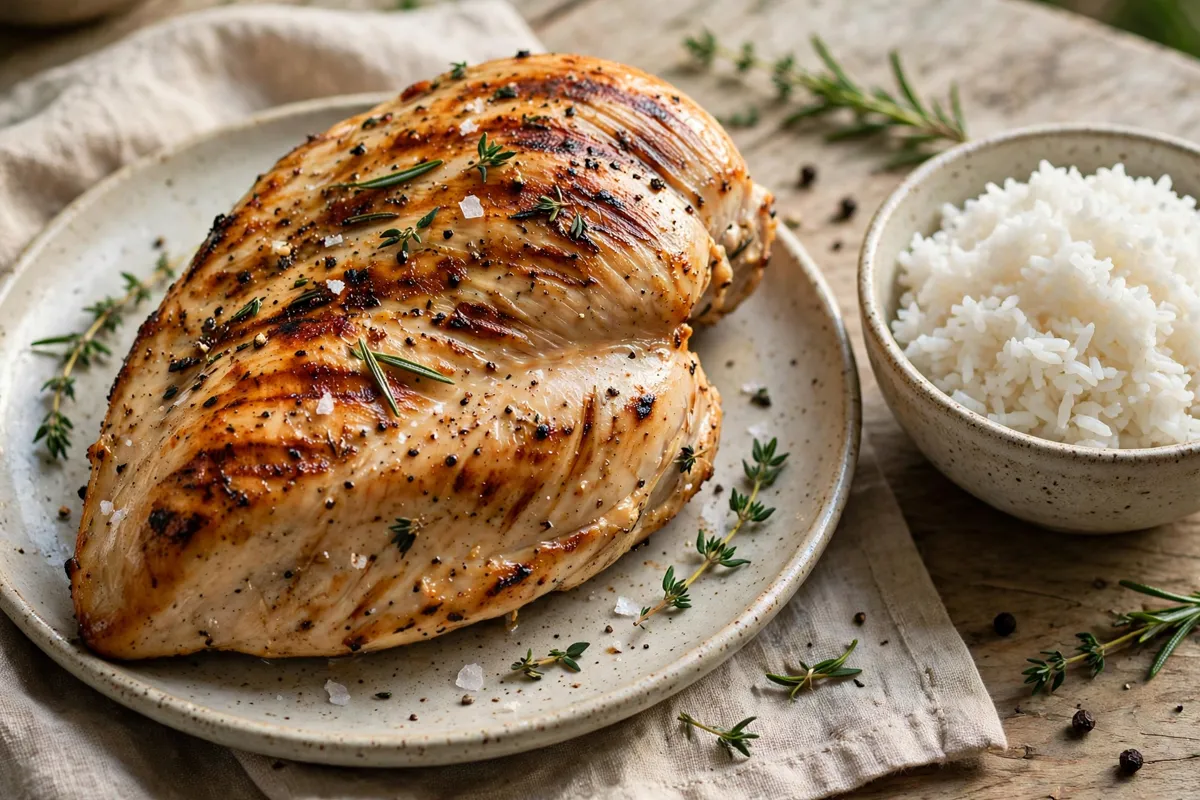
Chicken Protein Calculator: The Short Answer
Seven ounces of chicken breast contain about 327 calories — 327.4, derived from USDA FoodData Central's roasted breast entry (FDC ID 171477) — with 61.6 grams of protein. The entry prices boneless, skinless breast, meat only, cooked roasted, at 165 calories and 31.02g protein per 100g; seven ounces weighs 198.5 grams, and 198.5 × 1.65 gives 327.4.
Seven ounces is the large portion: a big single fillet eaten whole, a bodybuilder's standard serving, or a restaurant breast that makes neighbouring plates look understaffed. This article prices it without judgement — as fuel, as a protein event, and as a plate decision — and shows where it sits between the reference breast and the double portion. The chicken protein calculator trims it back to any target; this page takes the large portion on its own terms.
Short Answer
About 327 calories in 7 ounces of chicken breast (327.4 for 198.5g), with 61.6g protein, 0g carbohydrate and about 7.1g fat (from the entry's 3.57g fat per 100g). That is more protein than a 70kg adult's entire baseline daily need (56g at 0.8g per kilogram), delivered for roughly a sixth of a 2,000-calorie day.
Who Eats Seven Ounces — and Why Is the Portion Legitimate?
Three eaters, mainly. The large-appetite eater served a single big fillet: modern retail breasts frequently reach seven cooked ounces on their own, so the portion exists whether or not anyone planned it. The high-protein dieter compressing protein into fewer meals — two sittings a day, say — for whom a 61.6g portion is not excess but architecture. And the athlete in a gaining phase, whose total targets make ordinary portions arithmetically incapable of reaching the day's protein without a shake at every turn.
For all three, the portion's efficiency is its defence. Chicken breast's protein costs about 5.3 calories per gram at any size, so the seven-ounce portion's 327.4 calories buy protein at the same rate as the three-ounce serving's 140.3 — scale changes the totals, never the deal. Compare the same weight of roasted thigh meat: about 355.3 calories with about 49.1g protein (179 calories and 24.76g protein per 100g scaled to 198.5g). The breast at seven ounces delivers twelve more grams of protein for twenty-eight fewer calories — a gap that was a rounding detail at two ounces and is a structural advantage at seven. Size amplifies the choice of cut, which is why large-portion eaters benefit most from the breast's profile, a theme the chicken protein calculator quantifies across every cut it carries.
What Does 61.6 Grams of Protein in One Portion Mean Practically?
It means one meal can settle a day's protein floor outright. Baseline guidance of 0.8g per kilogram puts a 70kg adult's need at 56g — this portion exceeds it before a single other food is eaten. At a 120g athletic target it supplies just over half; at 160g, a serious gaining target, it supplies a workable two-fifths in the day's largest meal, leaving the rest of the day to be built from ordinary foods rather than constant protein vigilance.
Two honest qualifications keep the picture accurate. Protein distribution has modest evidence behind it — spreading intake across meals may support muscle protein synthesis slightly better than one giant dose — so the seven-ounce portion is a tool, not an optimum for everyone; the same total in two sittings of three and a half ounces (about 30.8g protein each) suits many lifters just as well. And protein beyond need is not stored as protein: the surplus amino acids are deaminated and their energy — already counted in the 327.4 — joins the general pool. The portion is never wasted, but it is not magic either. What it is, demonstrably, is the cheapest way in the whole-food world to move a day's protein total by sixty grams. Portion-to-target translation of exactly this kind is the daily work priced in how much chicken do I need for 100g of protein.
How Big Is Seven Ounces on the Plate?
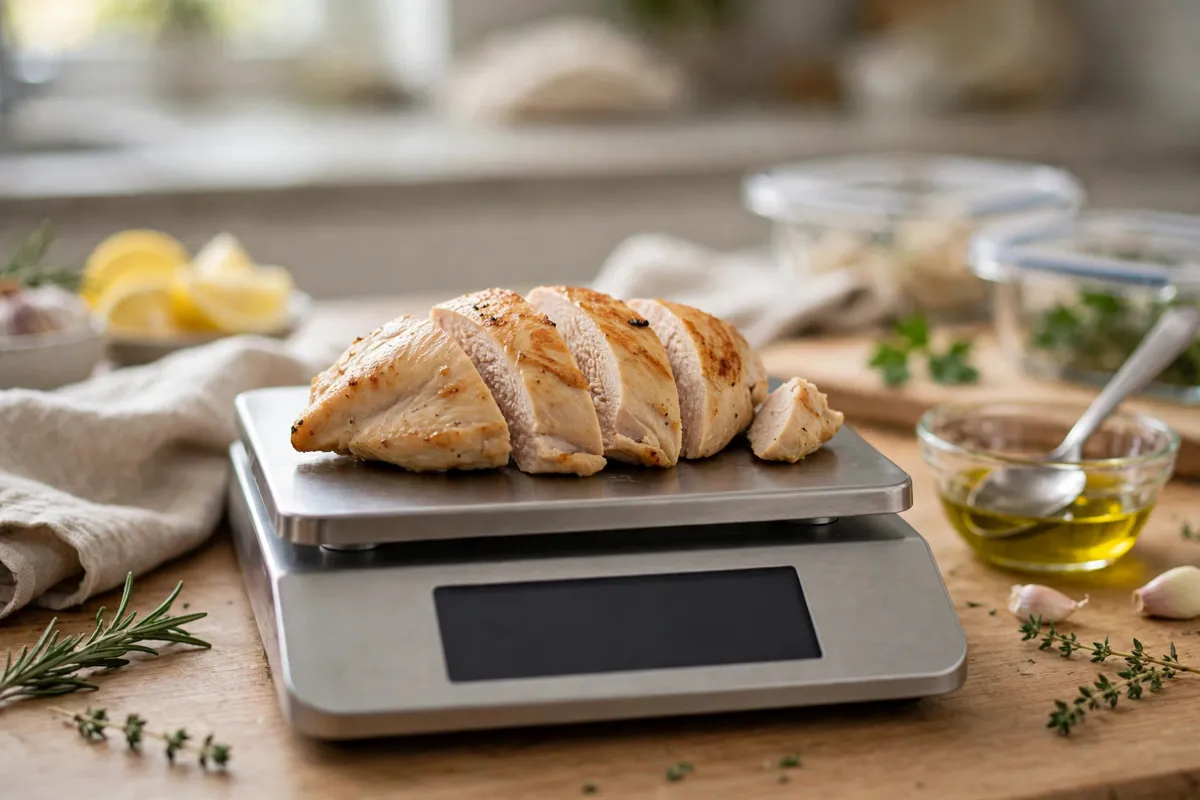
Visually, it is two reference servings laid side by side and then some: about 2.3 of the USDA's 86g half-breast portions, or the reference whole breast (172g) plus another ounce. In kitchen terms it is a large fillet sliced into medallions covering a dinner plate's centre, or roughly a cup and two-fifths of diced breast (the entry's cup is 140g, so 198.5g is about 1.4 cups). Raw, it begins as roughly nine and a third ounces — about 265g — before roasting takes its quarter of the weight in water.
That raw-to-cooked span is where seven-ounce errors breed. A dieter who buys a 265g raw fillet, cooks it, and logs the raw weight against the cooked entry overstates the meal by about a third — recording roughly 437 calories where 327.4 were eaten. The reverse cook, weighing the cooked portion but logging it as if the entry were raw, understates just as badly. The rule that protects every portion in this series is stated once more here because this portion needs it most: weigh the state the entry describes, and the entry describes cooked. The full raw-versus-cooked treatment is in should I weigh chicken raw or cooked.
Where Does a 327-Calorie Portion Fit a Day?
More comfortably than its protein suggests. On a 2,000-calorie budget it claims about 16 percent; on a 2,800-calorie gaining budget, under 12 percent — while settling half to all of the day's protein. The remainder of the plate can then be built for energy and pleasure: grains, vegetables, fats in real quantities, rather than the apologetic sides that accompany protein-poor mains. In a deficit, the portion earns its place by satiety: 61.6g of protein with 198.5g of food mass is one of the most filling 327-calorie investments available, and fullness is the currency deficits are actually paid in.
Hydration deserves one sentence at this size: metabolising large protein loads produces urea the kidneys clear with water, so a day built around portions like this pairs naturally with drinking water freely — water being, conveniently, the zero-calorie, zero-protein constant priced elsewhere on this site. Beyond that, the portion asks nothing special of the eater. It is ordinary food at an ambitious size, priced exactly.
Common Mistakes to Avoid
Do not log seven cooked ounces against a raw weight, or the reverse — at this size the state error is worth about 110 calories, the largest in the series. Do not assume a giant fillet is "about six ounces" because six is the restaurant default; large fillets are precisely the ones that break defaults, and 46.7 calories separate each ounce. Do not price the portion with skin if the skin came off (or without, if it stayed): skin-on at this weight is about 391 calories, not 327.4. Do not treat the 61.6g of protein as exempt from the day's calories — it is inside the 327.4, at 4 per gram, where it belongs. And do not let the portion's size shame it out of a deficit plan where it is actually useful: fullness per calorie is the scarcest resource in dieting, and this portion is rich in it.
Final Thoughts
Seven ounces of chicken breast contain about 327 calories — 327.4 for 198.5 cooked grams on USDA's roasted, skinless basis — with 61.6g protein, about 7.1g fat and no carbohydrate. It is the large portion priced honestly: a full day's baseline protein in one fillet, at the same efficient rate as the smallest serving in the series. Weigh it cooked, choose it deliberately, and split it across the day in the chicken protein calculator whenever appetite prefers two mediums to one large.
People Also Ask
How Many Calories Are in 8 Ounces of Chicken Breast?
Eight ounces of chicken breast contain about 374 calories — 374. 2, derived from USDA FoodData Central's roasted breast entry (FDC ID 171477) — with 70. 4 grams of protein.
How Many Calories Are in 1 Pound of Chicken Breast?
One pound of cooked, boneless, skinless chicken breast has about 748 calories. The exact USDA-derived figure is 748. 4 calories for 453.
How Many Calories Should I Eat to Gain Weight?
To gain weight steadily, eat 300 to 500 calories above your maintenance level every day — the surplus a typical adult needs to add roughly half a pound to a pound a week — with maintenance itself worked out from the Mifflin-St Jeor equation times your activity factor. Gaining is the mirror image of losing: same anchor number, opposite adjustment, and the same need to keep the pace slow enough that most of what you add is muscle and healthy…
How to Find Your Maintenance Calories?
You find your maintenance calories two ways, and the reliable answer uses both: estimate them with the Mifflin-St Jeor equation multiplied by your activity factor, then confirm or correct that estimate by eating at it for two to three weeks and watching your weekly average weight. Maintenance — also called your TDEE, total daily energy expenditure — is the intake at which your weight holds steady, and everything else in calorie control is measured from it.