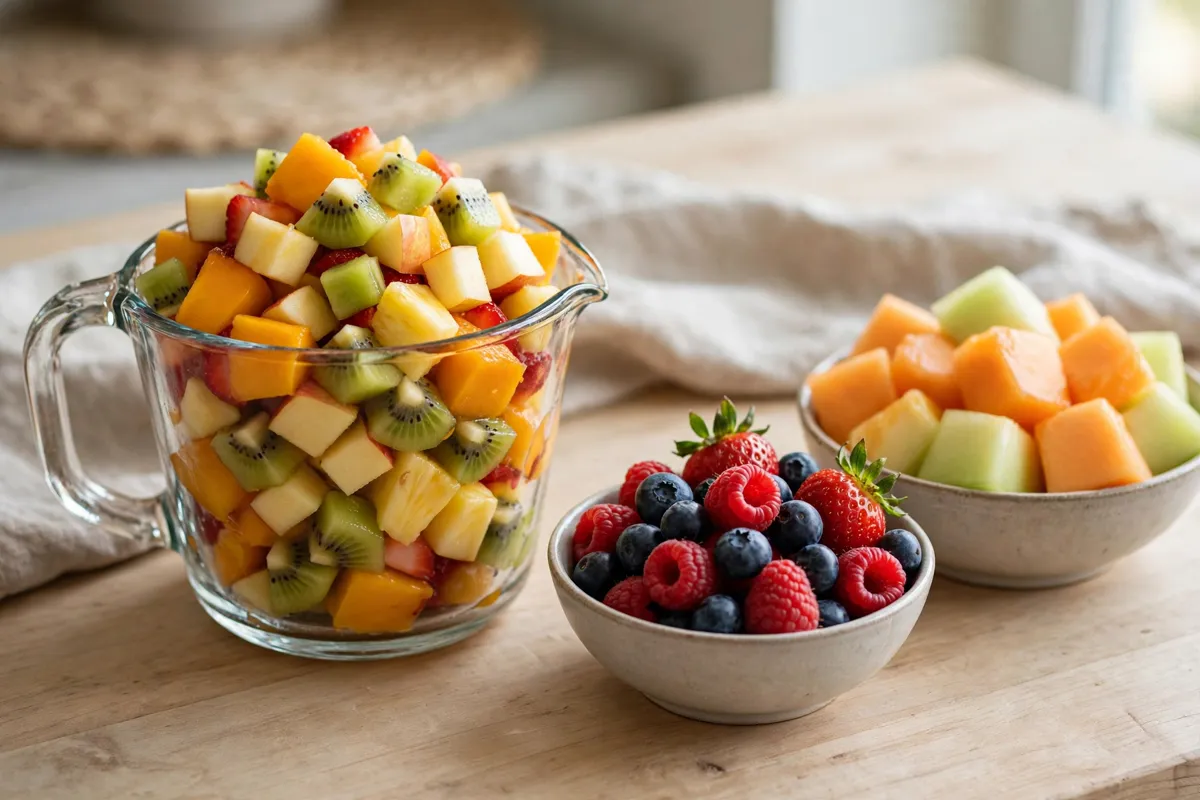
Calorie Counter: The Short Answer
One cup of fruit contains anywhere from about 46 to 134 calories depending on the fruit — watermelon at the light end, banana at the heavy end — and a mixed cup of common fruits averages about 59 calories. All of those figures come from USDA FoodData Central entries, using each fruit's own official cup weight, and the full table is set out below.
"Cup of fruit" sounds like a single food and is actually a family of very different ones, because a cup is a volume and fruits differ in both density and sugar. This article lays out the per-cup values for seven common fruits, explains why they spread so widely, and gives you the mixed-cup average to use when the cup in front of you is a mixture. Log the specific fruit where you can — the calorie counter prices them individually — and use the average only for true mixtures.
Short Answer
About 59 calories for a mixed cup; 46 to 134 for single fruits. By USDA cup portions: watermelon 45.6, strawberries 48.6, cantaloupe 54.4, apple 65.0, orange 80.8, grapes 104.2 and banana 133.5 calories per cup. An equal-parts mix of the five mid-range fruits (watermelon, strawberries, cantaloupe, apple, orange) averages 58.9 calories per cup.
What Does One Cup of Each Fruit Actually Contain?
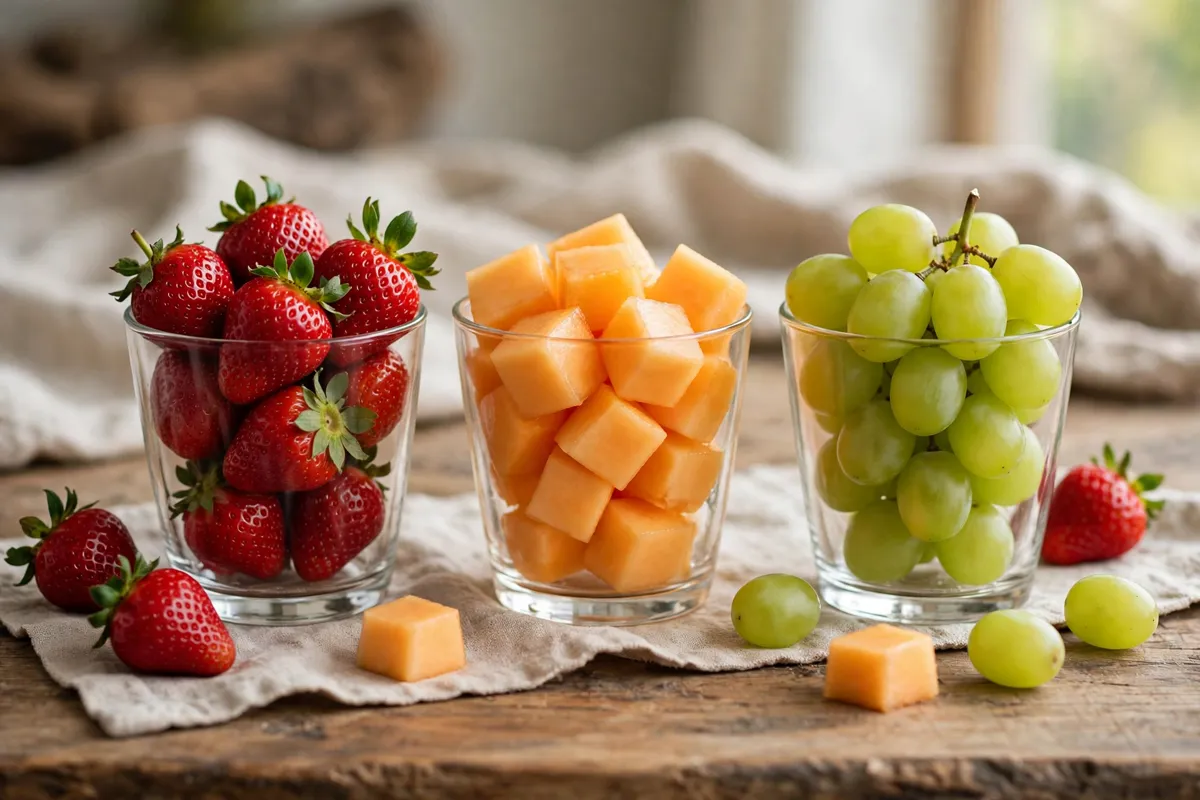
The table below is built the honest way: each fruit's USDA per-100g energy multiplied by that fruit's own cup weight, because a cup of banana slices and a cup of watermelon dice do not weigh the same. Watermelon (FDC 167765) runs 30 calories per 100g and its cup of diced fruit weighs 152g, giving 45.6 per cup. Strawberries (167762) run 32 per 100g with a 152g cup of halves: 48.6. Cantaloupe (169092) runs 34 per 100g with a 160g cup of cubes: 54.4. Apple (171688) runs 52 per 100g with a 125g cup chopped: 65.0. Orange (169917) runs 49 per 100g with a 165g cup of sections: 80.8. Grapes (174683) run 69 per 100g with a 151g cup: 104.2. Banana (173944) runs 89 per 100g with a 150g cup sliced: 133.5.
Two patterns deserve a look. The per-100g ranking and the per-cup ranking are nearly the same, because cup weights cluster between 125g and 165g — the variation in energy density (30 to 89 per 100g) overwhelms the variation in weight. And the spread from top to bottom is almost threefold, which is why "a cup of fruit" as a diary entry is only as good as the fruit you name in it.
- Watermelon, 1 cup diced (152g): 45.6 calories
- Strawberries, 1 cup halves (152g): 48.6 calories
- Cantaloupe, 1 cup cubes (160g): 54.4 calories
- Apple, 1 cup chopped (125g): 65.0 calories
- Orange, 1 cup sections (165g): 80.8 calories
- Grapes, 1 cup (151g): 104.2 calories
- Banana, 1 cup sliced (150g): 133.5 calories
Why Do Fruits Differ So Much per Cup?
Water, mostly — and then sugar. Watermelon is over ninety percent water by weight, so a cup of it is mostly a cup of water with fruit flavour: 30 calories per 100g, with 7.55g of carbohydrate and 6.2g of sugar. Banana sits at the other end because it is a concentrated fruit: 22.84g carbohydrate and 12.23g sugar per 100g, far less water, and starch in the bargain — a cup delivers 133.5 calories, nearly three watermelons' worth. Grapes earn their high place on sugar density (15.48g sugar per 100g) in a small, easy-to-pack fruit.
Between the poles, the berries and melons cluster light (strawberries carry 2.0g of fibre per 100g alongside their 32 calories, cantaloupe 0.9g fibre at 34), and the orchard fruits sit in the middle: apple's 13.81g carbohydrate per 100g comes with 2.4g fibre, orange's 12.54g with 2.2g fibre. Fibre does not change the cup arithmetic materially — the broader fibre picture across produce is surveyed in how much fiber is in common fruits and vegetables — but it changes how filling the cup is — one reason the table should guide substitutions rather than forbid the heavier fruits. A banana's 133.5 calories arrive with about 3.9g of fibre (2.6g per 100g across the 150g cup) and real staying power; the honest comparison is never calories alone.
What Should You Use for a Mixed Cup or a Fruit Salad?
Use the average built for exactly that case. An equal-parts mixture of watermelon, strawberry, cantaloupe, apple and orange cups averages (45.6 + 48.6 + 54.4 + 65.0 + 80.8) ÷ 5 = 58.9 calories per cup — call it 59. That figure assumes the mix leans on the lighter fruits, as most fruit salads do. A mix dominated by banana and grapes will run higher; weight the average toward those entries if your bowl is mostly yellow and purple.
In practice, weigh or eyeball the dominant fruit and price the cup as that fruit if it makes up more than half the mixture. A fruit salad that is mostly melon with berries through it is a 50-calorie cup wearing a costume; a banana-heavy breakfast bowl is a 130-calorie cup doing the same. The calorie counter handles either approach — specific entries for specific fruits, and the 59 average as the honest fallback for a true mixture. What it cannot rescue is the entry "fruit, 1 cup, 60 calories" applied to a cup of banana slices: the mechanism is fine, the input is not, and the gap is 74 calories a day in the wrong direction. Recipes that build fruit into larger dishes, like the smoothies priced in how many calories are in a fruit smoothie, inherit exactly these per-cup values. One cup of 1% milk gets the same treatment, with its calories counted in full.
How Does a Cup of Fruit Fit a Day's Eating?
Gracefully, at almost any point in the range. Even the heaviest cup here — banana at 133.5 — costs less than most single snack bars, and the lightest cups can be eaten almost freely inside any calorie budget while delivering fibre, potassium (banana carries 358mg per 100g, cantaloupe 267mg) and the micronutrients that make fruit a dietary staple rather than a treat. Diet plans that prescribe "a cup of fruit" are banking on this profile: volume and satisfaction out of proportion to the calories, whichever fruit fills the cup.
The one caution is substitution blindness in reverse: treating all cups as the lightest. A daily cup assumed to be 46 calories but actually banana is a 87-calorie daily understatement — over 600 a week — created entirely by vagueness, not by the fruit. Name the fruit, and the cup becomes one of the most reliable entries in a food diary.
Common Mistakes to Avoid
Do not use one generic "fruit" figure for every cup: the real range is 45.6 to 133.5, and the error from guessing the middle is large at both ends. Do not price a cup by another fruit's cup weight — the USDA portions differ (125g for chopped apple, 165g for orange sections), and weight is half the calculation. Do not forget dried fruit is a different universe: water removed concentrates sugar dramatically, and a cup of raisins is over 430 calories, not a fresh-fruit figure at all. Do not write off bananas and grapes as "fattening" on the strength of this table — 104 to 134 calories of fibrous, nutrient-dense fruit is a good trade in almost any diet. And do not let juice impersonate fruit: juicing removes the fibre and concentrates the servings, so a cup of juice carries the calories of several cups of the whole fruit that made it.
Final Thoughts
One cup of fruit contains about 59 calories as a mixture, and 46 to 134 as a single fruit — watermelon lightest, banana heaviest, with strawberries, cantaloupe, apple, orange and grapes ranked between on USDA figures. The variation is water and sugar, nothing more mysterious, and it is fully manageable once you name the fruit in the cup. Log the specific entry in the calorie counter, keep 59 for true mixtures, and fruit becomes what it should be in a diary: easy.
People Also Ask
How Many Calories Are in a Bowl of Fruit?
A bowl of fruit contains about 118 calories if the bowl holds two cups of mixed fruit — the honest way to answer a question whose key word, "bowl," has no standard size. Build the same two-cup bowl from a single fruit and the range runs from about 91 calories for watermelon to about 267 for banana, all on USDA FoodData Central values, so this article defines its bowl before it prices it.
Which Fruit Has the Fewest Calories?
Watermelon has the fewest calories of the common fruits: 30 calories per 100 grams in USDA FoodData Central, and 45. 6 calories per cup diced. Strawberries run it closest at 32 per 100g and 48.
How Many Calories in a Peach Rebel™ Iced?
A medium Peach Rebel Iced at Dutch Bros is 250 calories, as tracked in the Dutch Bros calculator on this site — with 0 grams of protein, 63 grams of carbohydrates, 0 grams of fat, 0 grams of fiber, 60 grams of sugar and 110 milligrams of sodium. That is the complete answer for the standard drink as listed, and it comes with a comparison that reframes it: the Sugar-Free Peach Rebel Iced, the same drink in the same size,…
How Many Calories in a Double-Double® Burger?
A Double-Double® Burger at In-N-Out has 610 calories on its own, with 34 grams of protein, 42 grams of carbohydrates, 34 grams of fat, 3 grams of fiber, 10 grams of sugar and 1,670 milligrams of sodium. That is the burger by itself, before fries and before a drink. Add a standard side and a soda and the same order becomes 610 + 370 + 180 = 1,160 calories, which is why the honest answer to this question is always…