Calorie Counter: The Short Answer
To gain weight steadily, eat 300 to 500 calories above your maintenance level every day — the surplus a typical adult needs to add roughly half a pound to a pound a week — with maintenance itself worked out from the Mifflin-St Jeor equation times your activity factor. Gaining is the mirror image of losing: same anchor number, opposite adjustment, and the same need to keep the pace slow enough that most of what you add is muscle and healthy tissue rather than pure fat.
Undereating is easy to miss because maintenance for a young, active, naturally lean person can be surprisingly high. This article works a lean young man's calculation in full, shows where the extra 300–500 calories can come from without enormous meals, and explains why gaining faster than about 0.5% of body weight per week mostly buys fat. If you are not sure of your maintenance yet, establish it in the calorie counter before adding anything.
Short Answer
Calculate maintenance — Mifflin-St Jeor BMR times 1.2, 1.375, 1.55 or 1.725 for your activity — then add 300–500 calories a day. A 300 surplus totals 2,100 extra calories a week (about 0.6 lb by the 3,500-calories-per-pound approximation); a 500 surplus totals 3,500 (about 1 lb). Train with resistance exercise so the surplus has muscle to build, and weigh weekly to confirm the trend.

What Does the Gaining Calculation Look Like Worked in Full?
Our example is a 22-year-old man, 60 kg and 175 cm, who has always been lean. He plays five-a-side football twice a week and trains in the gym three times — moderate activity is honest. BMR: weight 10 × 60 = 600; height 6.25 × 175 = 1,094; age 5 × 22 = 110; men's constant + 5. So 600 + 1,094 − 110 + 5 = 1,589 calories a day at rest. Maintenance: 1,589 × 1.55 = 2,463, about 2,460 calories a day. That figure alone explains his problem — he habitually eats around 2,200–2,300, which feels like plenty but is actually a small deficit. His gaining target is 2,460 + 300 = 2,760 at the gentle end, or 2,460 + 500 = 2,960 at the faster end. A 400 surplus at about 2,860 a day predicts 400 × 7 = 2,800 calories a week, ÷ 3,500 ≈ 0.8 lb a week. Against 60 kg (132 lb), 0.8 lb is about 0.6% of body weight — the top of the sensible gaining band, so the middle surplus is the right choice, not the maximum.
Why Should the Surplus Stay Small?
Because muscle synthesis has a speed limit that calories cannot override. Once protein and training stimulus are adequate, extra energy beyond a modest surplus is stored the only other way the body stores it — as fat. Doubling the surplus to 1,000 a day does not double muscle gain; it roughly doubles the rate of total gain while worsening its composition, and the dieter who later removes that fat will lose time and some muscle doing it. The mirror logic of weight loss applies: just as loss faster than about 1% of body weight a week costs lean tissue, gain faster than roughly 0.5% a week in a trained person — up to about 0.5–1% for a true beginner or someone regaining lost weight — is increasingly fat. Slow gaining also protects appetite: a 300–500 surplus can be added almost invisibly, while a 1,000 surplus means force-feeding that most people abandon within weeks. Consistency for six months at +350 beats three heroic weeks at +1,000 followed by giving up. The energy behind a pound gained or lost is worked out directly on its own page.
Where Can the Extra 300 to 500 Calories Come From?
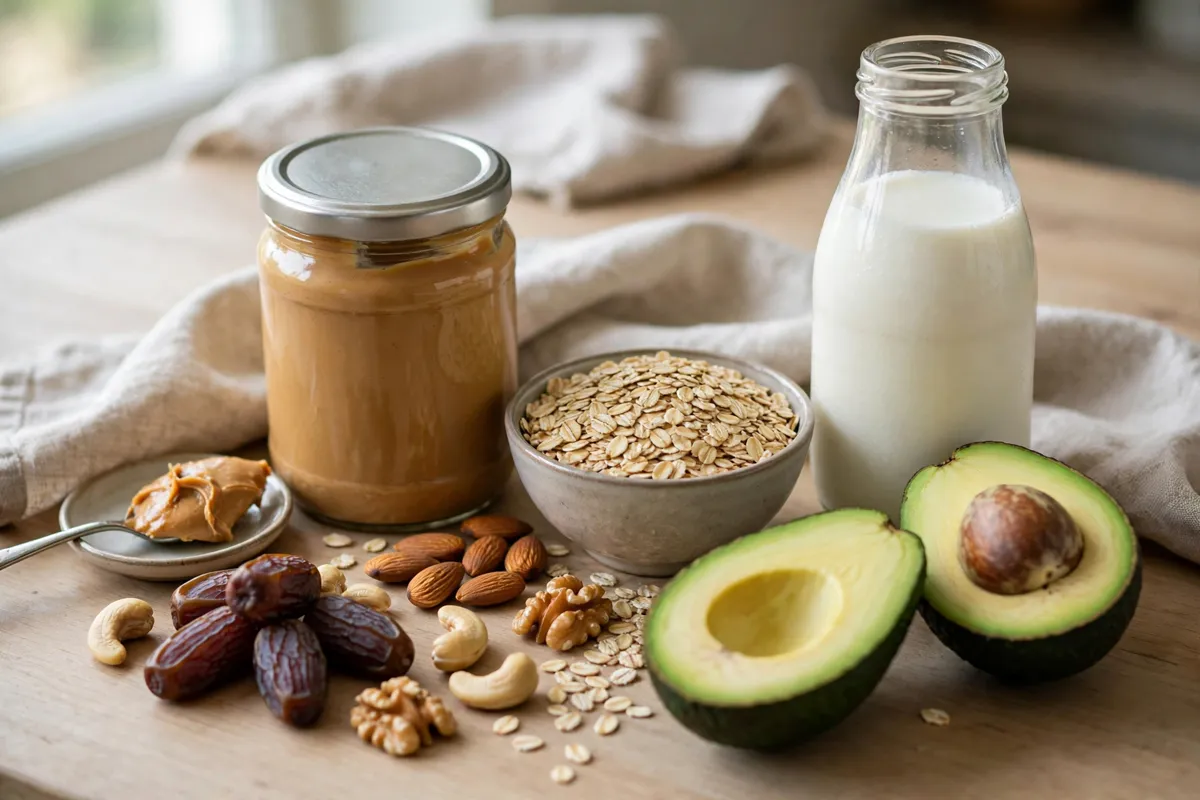
From density, not volume — the stomach of a person who struggles to gain is rarely the place to add bulk. Liquid calories are the easiest lever: a smoothie built on milk, oats, banana and nut butter can carry 500–600 calories in a glass that leaves you far less full than the same energy on a plate. Energy-dense additions to meals you already eat work the same way: olive oil over vegetables and grains (about 120 calories a tablespoon, at 9 calories per gram of fat), cheese grated over eggs and pasta, nut butters on toast, and full-fat dairy where skimmed versions were habit. Eat three solid meals and use snacks as structural surplus rather than grazing randomly, because planned additions survive busy days and unplanned intentions do not. Keep protein steady across the day so the surplus has building material — the training and protein logic parallels the losing advice in how many calories to eat to lose weight, just with the sign reversed.
- A large smoothie with milk, oats, banana and nut butter: roughly +500 calories in one glass
- Two tablespoons of olive oil across the day's cooking: roughly +240 calories
- Nut butter on toast as an evening snack: roughly +200–300 calories
- Switching skimmed milk and yoghurt to whole versions: roughly +100–150 calories a day
How Do You Know the Surplus Is Working?
Weigh yourself two or three mornings a week and compare weekly averages. At a true 300–500 surplus you should see the average climb by roughly 0.25–0.5 kg every one to two weeks — for our 60 kg example, about 0.3–0.5 kg a fortnight at the gentle end. If three weeks pass with a flat average, you are not actually in surplus: either maintenance was underestimated (common in very active young men, whose real activity can exceed the 1.55 factor) or intake is lower than logged — add another 200 calories and retest. If the average climbs faster than about 0.5% of body weight per week for several weeks, trim 200 calories; rapid early jumps in week one are usually gut contents and water, so judge from week two onwards. Recalculate maintenance every 5 kg gained, because a heavier body costs more to run — each kilo adds 10 calories to BMR before the activity multiplier — and yesterday's surplus quietly becomes today's maintenance, the same moving-target problem described in finding your maintenance calories.
How Does Gaining Differ for Women and Older Adults?
The maths is identical — the women's equation subtracts 161 instead of adding 5, so a woman maintaining on 1,950 gains on about 2,250–2,450 — but the emphasis shifts. Women gain muscle more slowly in absolute terms, so the lower end of the surplus band, nearer 300, usually gives the best composition. Older adults face a second consideration: appetite and digestion often limit intake before any calorie target does, making energy-dense, protein-rich foods spread across the day more effective than large meals. At every age, unintentional weight loss is a different matter from a lean build — if weight has fallen without trying, or gaining fails despite a verified surplus, a clinician should be part of the plan.
Common Mistakes to Avoid
The first mistake is guessing maintenance instead of calculating it — most hard-gainers discover they were eating below a genuinely high maintenance all along, so the fix starts with the number, not the appetite. The second is dirty bulking: a 1,000-plus surplus of anything, which adds fat that later dieting must remove. Third, adding the surplus only on training days, which halves the weekly total and stalls progress — gaining, like losing, is a weekly average game, as counting calories every day explains. Fourth, drinking your surplus and skipping meals, leaving protein scattered and low. Fifth, quitting at the first flat week: water and gut contents hide 0.3 kg of real gain easily, so only three-week trends deserve a response.
Final Thoughts
Gain weight the way you would lose it — deliberately, arithmetically and slowly: maintenance from Mifflin-St Jeor times activity, plus 300–500 calories, protein and resistance training in place, and weekly averages as the referee. Our lean example maintains on about 2,460 and gains well on roughly 2,760–2,960, mostly because the calculation revealed he was never in surplus at all. Find your maintenance in the calorie counter, add the smallest surplus that moves your trend, and give it months, not days.

People Also Ask
How to Find Your Maintenance Calories?
You find your maintenance calories two ways, and the reliable answer uses both: estimate them with the Mifflin-St Jeor equation multiplied by your activity factor, then confirm or correct that estimate by eating at it for two to three weeks and watching your weekly average weight. Maintenance — also called your TDEE, total daily energy expenditure — is the intake at which your weight holds steady, and everything else in calorie control is measured from it.
What Is a Calorie Deficit?
A calorie deficit is the state of eating fewer calories than your body burns — your intake sits below your maintenance calories, so your body covers the gap from stored energy, mostly body fat. A typical working deficit is 300 to 500 calories a day: eat 2,000 while burning 2,400 and the 400-calorie daily gap, repeated, is what produces weight loss at roughly 0. 8 pounds a week.
How Many Calories Are in Indian Rice and Curry?
An Indian rice-and-curry plate is about 555 to 565 calories with a vegetable or dal curry and about 815 calories with butter chicken — because the rice is a near-constant at about 315 calories for a typical 1½-cup portion, and the curry is the variable, spanning about 250 to 550 calories a cup. Priced as sums, the light plate is 315 + 240 = 555 with a mixed vegetable curry, the chicken plate is 315 + 400 = 715, and…
How to Calculate Calories in an Indian Thali?
To calculate calories in an Indian thali, list every component on the tray and add them in groups: a typical restaurant thali totals about 1,040 calories — breads and rice at 340 + wet dishes at 480 + extras at 220 = 1,040 — while the same tray built at home, with one roti instead of two, the sweet skipped and the sabzi's oil measured, totals 1,040 − 120 − 150 − 50 = 720 calories. A thali cannot be…