Calorie Counter: The Short Answer
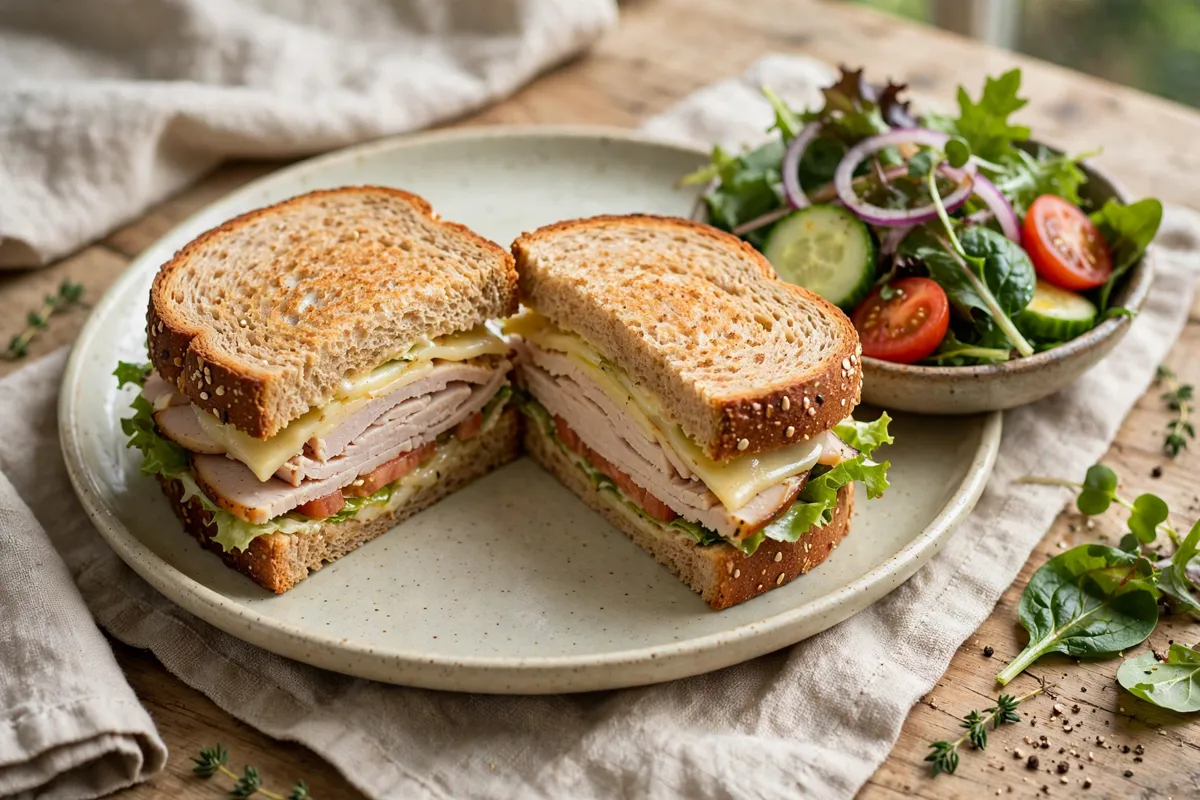
A sandwich has no single calorie count, but it has a well-mapped range: a typical 6-inch sandwich lands between about 270 and 420 calories. Those endpoints come from USDA FoodData Central's submarine sandwich entries — a 6-inch turkey breast sub at 270.5 calories and a heartier 6-inch cold cut sub at 417.5 calories — and a labelled home build below lands at 279.7 calories, squarely in the same territory.
Anyone asking this question is really asking how to price the sandwich in front of them, so this article works three ways: the reference entries, a component build you can repeat with your own fillings, and the levers that push a sandwich from the bottom of the range to the top. The calorie counter is where a build like this gets logged; here is how its numbers are derived.
Short Answer
About 270 to 420 calories for a standard 6-inch sandwich, based on USDA reference entries. A turkey breast sub (184g) is 270.5 calories with 16.8g protein; a cold cut sub (196g) is 417.5 calories with 20.6g protein. A simple homemade build — two slices of white bread, a slice of cheddar and two slices of deli turkey — totals 279.7 calories. Size, cheese and spreads move you within, and beyond, the range.
What Do the USDA Reference Sandwiches Show?
USDA FoodData Central publishes no generic "sandwich" entry — an honest gap that tells you something true about sandwiches — but it does publish submarine sandwiches, and the pair brackets the everyday case. The turkey breast sub on white bread with lettuce and tomato (FDC 170706) runs 147 calories per 100g, and its 6-inch portion of 184g works out to 270.5 calories with 16.8g protein. The cold cut sub on white bread with lettuce and tomato (FDC 170696) runs 213 per 100g, and its 196g portion gives 417.5 calories with 20.6g protein.
Read the two side by side and the lesson is immediate: a 45 percent calorie gap between two sandwiches of nearly the same size, driven almost entirely by the filling's fat content. Turkey breast is lean; mixed cold cuts carry far more fat per gram, and fat at 9 calories per gram moves totals three times faster than the same weight of lean protein at 4. The bread, lettuce and tomato — see whether tomatoes contain salt for what the tomato itself brings — barely differ between the two. When you estimate any sandwich, you are therefore mostly estimating its filling and its spreads — a principle the site's broader work on how many calories are in a sub sandwich confirms across shop menus.
How Do You Build a Sandwich's Calories From Its Parts?
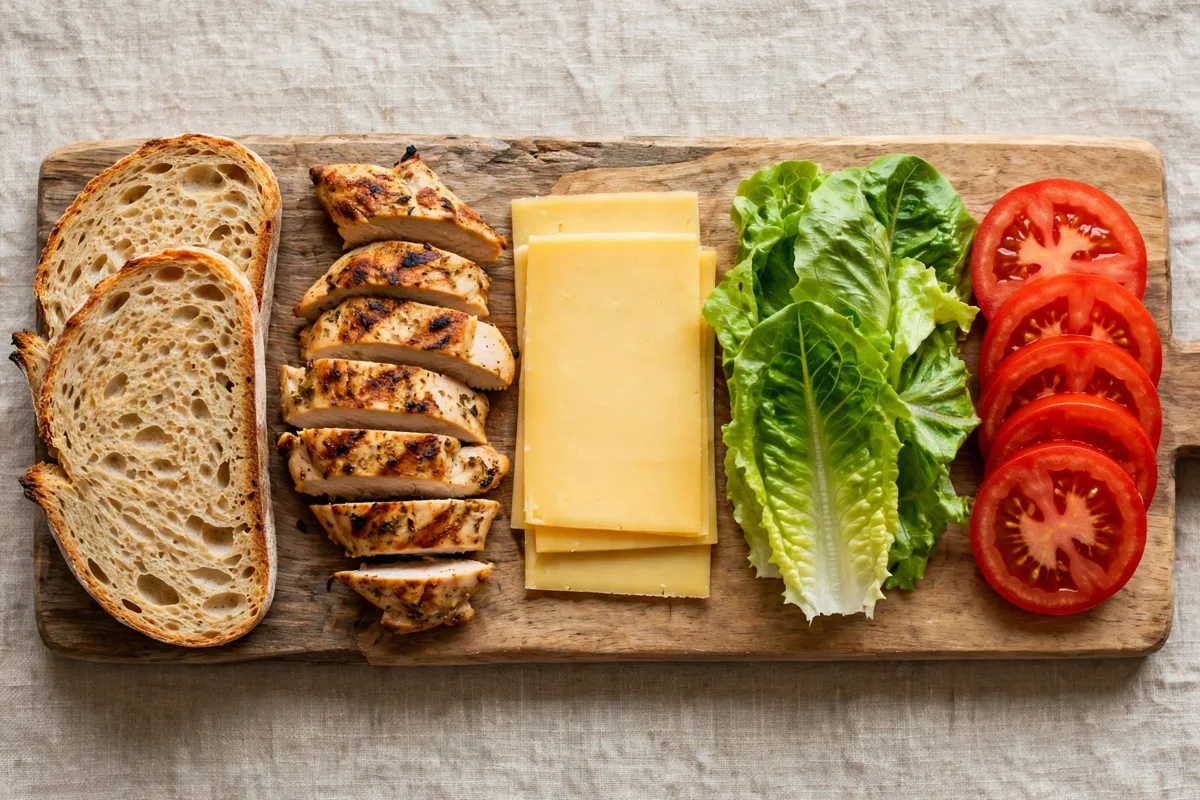
The component method prices a sandwich exactly as it is made — slice by slice — using USDA entries for each part, and it is the method used for the labelled estimate in this section. A slice of white bread (25g, FDC 174924) is 66.5 calories and 2.2g protein, so two slices are 133.0 calories. A slice of cheddar (28g, FDC 173414) is 112.8 calories and 6.4g protein. A slice of prepackaged deli turkey (16g, FDC 172941) is 17.0 calories and 2.4g protein, so two slices are 33.9 calories.
Treat that total as an estimate, not a measurement: it assumes the stated slice weights, and real delis cut thicker and spread heavier. Swap the bread for whole wheat (32g slices at 80.6 calories each) and the same sandwich rises by about 28 calories while gaining fibre. Add a second cheese slice and you add another 112.8. This transparency is the build method's virtue — every change shows its price — and it is why the calorie counter, which totals components the same way, is the right tool once your sandwich leaves the standard pattern. For the shop-bought equivalent, how many calories are in a chicken sandwich prices the most-ordered build of all.
- White bread, 2 slices: 133.0 calories, 4.4g protein
- Cheddar, 1 slice: 112.8 calories, 6.4g protein
- Deli turkey, 2 slices: 33.9 calories, 4.7g protein
- Labelled estimate total: 279.7 calories, 15.5g protein — before spreads and vegetables
What Pushes a Sandwich to the Top of the Range — or Beyond?
Four levers, in descending order of force. Cheese: a single slice at 112.8 calories is the largest single addition most sandwiches receive, and double cheese is the commonest quiet upgrade. Spreads: mayonnaise-style dressings are nearly pure fat, priced at 9 calories per gram, so a heavy hand adds a cheese-slice's worth of calories invisibly. Bread size: a footlong format roughly doubles the 6-inch bread base, and thick bakery rolls outweigh sliced bread substantially. Filling fat: lean turkey at one end, fatty mixed fillings at the other — the reference subs' per-100g figures, 147 against 213 calories for two sandwiches on the same style of bread, show filling choice alone moving the finished sandwich by about 150 calories at the 6-inch size.
Push all four levers the generous way — large roll, double cheese, heavy spread, rich filling — and a sandwich passes 700 calories without any sense of excess at the counter. Pull them the other way — 6-inch, lean turkey, one cheese slice or none, vegetables and a measured spread — and the same meal holds near 270. Neither sandwich is a trick; both are the arithmetic of the parts, which is why "sandwich" is a format, never a food with a fixed value.
How Should You Log a Sandwich You Did Not Make?
Work from the closest anchor and adjust visibly. A café turkey sub resembles the USDA turkey entry: start at about 270 for a 6-inch and scale for size. A deli sandwich with mixed fillings sits nearer 420. Then adjust for what you can see: extra cheese, add roughly 113 per slice; a visibly heavy spread, add a cautious allowance; a much larger roll, scale the bread share up. Restaurant chains publish their own figures, which override these estimates wherever they exist, and shop-specific articles on this site — such as the one pricing a 6-inch sandwich — work the same anchors in more detail.
Record the reasoning, not just the number. A diary entry that says "turkey sub, 270 base + 113 extra cheese" can be corrected tomorrow; a bare "sandwich, 400" cannot. Over weeks, that habit converts sandwich estimation from the least reliable corner of a food diary into one of the most consistent, because sandwiches are built from a short list of repeating parts whose prices you will soon know by heart.
Common Mistakes to Avoid
Do not quote a single figure for "a sandwich" — the honest answer is a range anchored by entries at 270.5 and 417.5, plus your build. Do not forget the spread: invisible fat at 9 calories per gram is the difference between the estimate and the sandwich you actually ate. Do not price a footlong like a 6-inch; doubling the format roughly doubles bread and filling alike. Do not assume brown bread slashes calories — the whole-wheat slice in the USDA build is actually slightly heavier per slice (80.6 vs 66.5) because the slice is bigger, though it repays the difference in fibre. And do not treat the component estimate as a laboratory value: it is a transparent approximation, labelled as such, and its weights are the first thing to check when your sandwich looks larger than the model.
Final Thoughts
A sandwich contains about 270 to 420 calories in its standard 6-inch forms — 270.5 for the USDA turkey sub, 417.5 for its cold cut counterpart, and 279.7 for a labelled home build of bread, cheddar and turkey. Beyond those anchors, the answer is always the sum of the parts: bread, cheese at 112.8 a slice, filling by its fat, and spreads by their grams. Price the parts, log the build in the calorie counter, and no sandwich will ever surprise your diary again.
People Also Ask
How Many Calories Are in One Cup of 1% Milk?
One cup of 1% milk contains about 102 calories — 102. 5, precisely, in the USDA's figures. FoodData Central's entry for 1% low-fat milk (FDC ID 170872) gives 42 calories per 100g, and its standard cup weighs 244g, which works out to 102.
How Many Calories Are in One Cup of Fruit?
One cup of fruit contains anywhere from about 46 to 134 calories depending on the fruit — watermelon at the light end, banana at the heavy end — and a mixed cup of common fruits averages about 59 calories. All of those figures come from USDA FoodData Central entries, using each fruit's own official cup weight, and the full table is set out below.
How Many Calories Are in One Cup of Chicken?
One cup of cooked chicken breast contains 231 calories. That is USDA FoodData Central's own portion doing the work: the roasted chicken breast entry (FDC ID 171477) lists one cup, chopped or diced, at 140 grams, and at 165 calories per 100 grams the cup works out to 231 calories in one cup of chicken — along with 43. 4 grams of protein, which is why this particular cup is a fixture of meal-prep culture.
How Many Calories in a Harissa Honey Chicken?
A portion of Harissa Honey Chicken at CAVA is 260 calories, with 26 grams of protein, 7 grams of carbohydrates, 13 grams of fat, 1 gram of fibre, 3 grams of sugar and 680 milligrams of sodium. That is only 10 calories more than the plain Grilled Chicken portion at 250 — in a grain bowl on Saffron Basmati Rice, the harissa honey version is 290 + 260 = 550 calories against 540 for the plain chicken, and in a…