
Calorie Counter: The Short Answer
No — water has zero calories. USDA FoodData Central's entry for drinking water (FDC ID 173647) lists 0 kcal per 100 grams, with 0g protein, 0g carbohydrate and 0g fat, and its standard 8 fl oz serving (237g) is likewise 0 calories. Water is the one thing you can drink in any quantity without adding a single calorie to your day.
That clean zero makes water the most useful number in calorie counting: it is the baseline every other drink is measured against. This article explains why the zero is real rather than rounding, what the trace minerals in water do and do not contribute, and how the zero changes the moment anything is added to the glass. Your drinks still belong in the day's record even at zero — the calorie counter treats water as the reference point the rest of the drinks list is compared with.
Short Answer
Water has 0 calories — genuinely zero, not a rounded-down figure. It contains no protein, carbohydrate or fat for the body to break down, and calories only ever come from those macronutrients (plus, in other drinks, dissolved sugars and similar additions). Plain water, tap or bottled, still or sparkling, contributes nothing to your energy intake at any volume.

Why Does Water Have Exactly Zero Calories?
A calorie is a unit of energy the body can extract from food, and extraction requires something to break down. Protein provides 4 calories per gram, carbohydrate 4 and fat 9, because the body can oxidise their chemical bonds and capture the energy. Water's molecule — H₂O — is already fully oxidised. It is, chemically, an end product of burning, not a fuel: hydrogen burned with oxygen produces water and releases energy in the process, which means water itself has no further energy to give. You cannot burn ash, and you cannot metabolise the ash of hydrogen.
The body uses water constantly — as the solvent of blood, the medium of every chemical reaction, the coolant of sweat — but using it is not consuming it for energy. It passes through, does its work as a medium, and leaves, having donated no calories at any point. This is also why "negative-calorie water" claims mislead: drinking cold water does make the body spend a small amount of energy warming it to body temperature, but that trivial expenditure is an effect of temperature, not a property of water as food, and it is far too small to plan around. Water's contribution to your calorie ledger is zero on the intake side, permanently, and the expenditure side belongs to your body's ordinary running costs.
What About the Minerals in Water — Do They Add Anything?
Water is not chemically empty. The USDA entry for tap water lists 4mg of sodium per 100g, and natural waters carry varying traces of calcium, magnesium and other minerals picked up from rock and soil. Mineral waters can carry noticeably more sodium and dissolved solids than tap water. None of this touches the calorie figure, because minerals are not macronutrients: the body does not oxidise sodium or calcium for energy, and elements cannot be burned for calories at all. A mineral can matter for nutrition — sodium intake is a real dietary consideration, and heavily mineralised water contributes a small but genuine amount — without mattering for energy.
Think of it as two separate ledgers. The energy ledger for water reads zero in every column: 0g protein, 0g carbohydrate, 0g fat, 0 kcal, per the USDA entry. The micronutrient ledger reads small but non-zero: single-digit milligrams of sodium per glass, traces of hardness minerals depending on source. People watching sodium for medical reasons may sensibly ask about their water's mineral content; people counting calories never need to. Even a litre of mineral water, at the tap-water rate of 4mg sodium per 100g, would carry only about 40mg of sodium — trivial beside a day's food — and still exactly zero calories.
- Protein: 0g per 100g — no calories
- Carbohydrate: 0g per 100g — no calories
- Fat: 0g per 100g — no calories
- Sodium: 4mg per 100g (tap water) — a mineral, not an energy source
When Does a Glass of Water Stop Being Zero Calories?
The moment anything caloric dissolves, infuses or hides in it. Sugar is the obvious addition: a sweetened drink is no longer water with flavour but a carbohydrate solution, priced at 4 calories per gram of sugar, and a 500ml sweetened bottle can carry the sugar load of a small meal. Fruit juices, sweetened teas, flavoured milk drinks and syrup-based drinks all live in this category — real foods in liquid form, logged as such. The site's investigation of how much sugar is in a soft drink shows how quickly those grams accumulate in a single bottle.
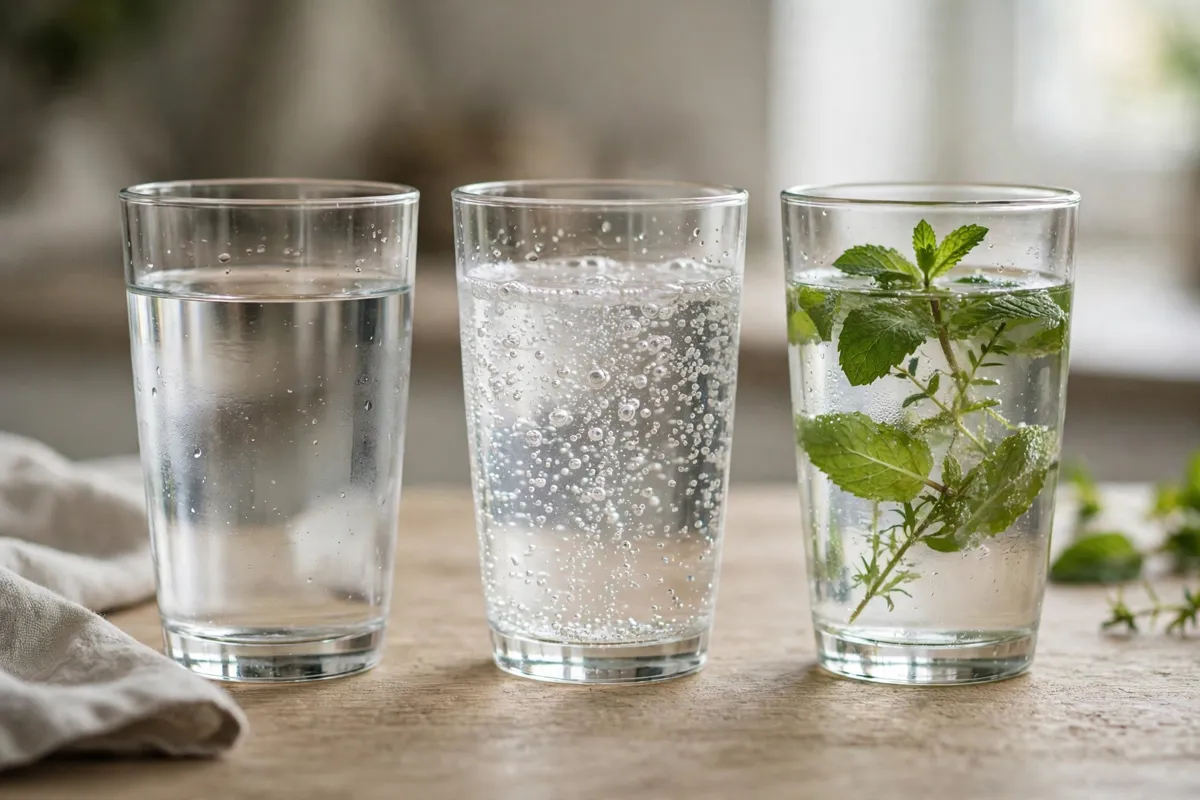
The borderline cases deserve precision. Plain sparkling water is water: carbonation adds gas, not calories. Water infused with fruit slices at home contributes essentially nothing unless you eat the fruit. Black coffee and unsweetened tea sit in the "trace" zone — a few calories per cup at most from dissolved plant compounds, conventionally logged as 0 to 5. Flavoured waters with sweeteners vary by product: those with sugar are soft drinks by another name, those with non-nutritive sweeteners are effectively zero. The rule that survives every case is simple — if the addition contains protein, carbohydrate or fat, it carries calories; if the glass contains only water and minerals, it does not. Questions about what else a drink contributes belong with pieces like does this counter include drinks, which prices the common cups and bottles.
How Does Water's Zero Help in Practice?
First, substitution arithmetic. Every time a calorie-bearing drink is replaced by water, the saving is that drink's entire calorie count, undiluted by effort — one of the few genuinely free reductions in a calorie budget. Second, appetite: a glass of water before a meal occupies stomach volume at zero cost, a modest but real effect many dieters use deliberately. Third, logging hygiene: recording water intake in an app — many people do, via the same calorie counter habits as food — keeps the drinks section of the diary honest, because the glasses that are not water get noticed and entered rather than forgotten between meals.
None of this makes water a weight-loss substance in itself. It removes calories only by displacing things that have them, and it supports a deficit rather than creating one. That is the honest, sufficient case for it: the only drink that is always free, in the one currency this page counts.
Common Mistakes to Avoid
Do not round other clear drinks down to water's zero by resemblance: a clear sweetened drink is sugar water, and its label, not its appearance, decides. Do not credit "negative calorie" claims for ice water — the warming cost is real but trivially small, a rounding error in a day's budget. Do not forget that soup, juice and smoothies are foods with water in them, not water: their calories come from everything dissolved and suspended in the liquid. Do not assume bottled and tap water differ in calories; both are zero, with mineral content the only variable. And do not skip logging sweetened drinks on the grounds that "it was mostly water" — most of a soup is water too, and nobody logs soup as zero.
Final Thoughts
Water has no calories — zero by chemistry, not by rounding. It contains no macronutrient to oxidise, its trace minerals such as sodium at 4mg per 100g are nutrients without energy, and any glass stays at zero until something caloric is added to it. That makes water the anchor of every drinks decision: free in unlimited quantity, and the silent saving every time it replaces a drink that is not free. Build the rest of your day in the calorie counter, and let water hold its perfect zero.
People Also Ask
Does Water Contain Protein?
No — water contains no protein. USDA FoodData Central's entry for drinking water (FDC ID 173647) lists 0g protein per 100g, and the same zero for its standard 8 fl oz serving of 237g. There is no protein in tap water, bottled water or sparkling water, in any quantity that exists or could be measured as nutrition.
How Many Calories Are in a Sandwich?
A sandwich has no single calorie count, but it has a well-mapped range: a typical 6-inch sandwich lands between about 270 and 420 calories. Those endpoints come from USDA FoodData Central's submarine sandwich entries — a 6-inch turkey breast sub at 270. 5 calories and a heartier 6-inch cold cut sub at 417.
How Many Calories Are in a Chicken Leg?
A chicken leg has either about 149 calories or about 346 calories, depending on what you mean by "leg" — and this article will not pretend otherwise. A drumstick alone, the familiar hand-held piece at 96 grams of meat, contains 148. 8 calories; a whole leg — drumstick, thigh and back joined, at 199 grams of meat — contains 346.
How Many Calories Are in a Whole Chicken?
A whole chicken has about 715 calories for the edible meat and skin of a modest bird. That figure is USDA's bone-removed portion — 299 grams of roasted meat and skin — priced from the whole-chicken entry (FDC ID 171450) at 239 calories per 100 grams, which gives 714. 6 calories.