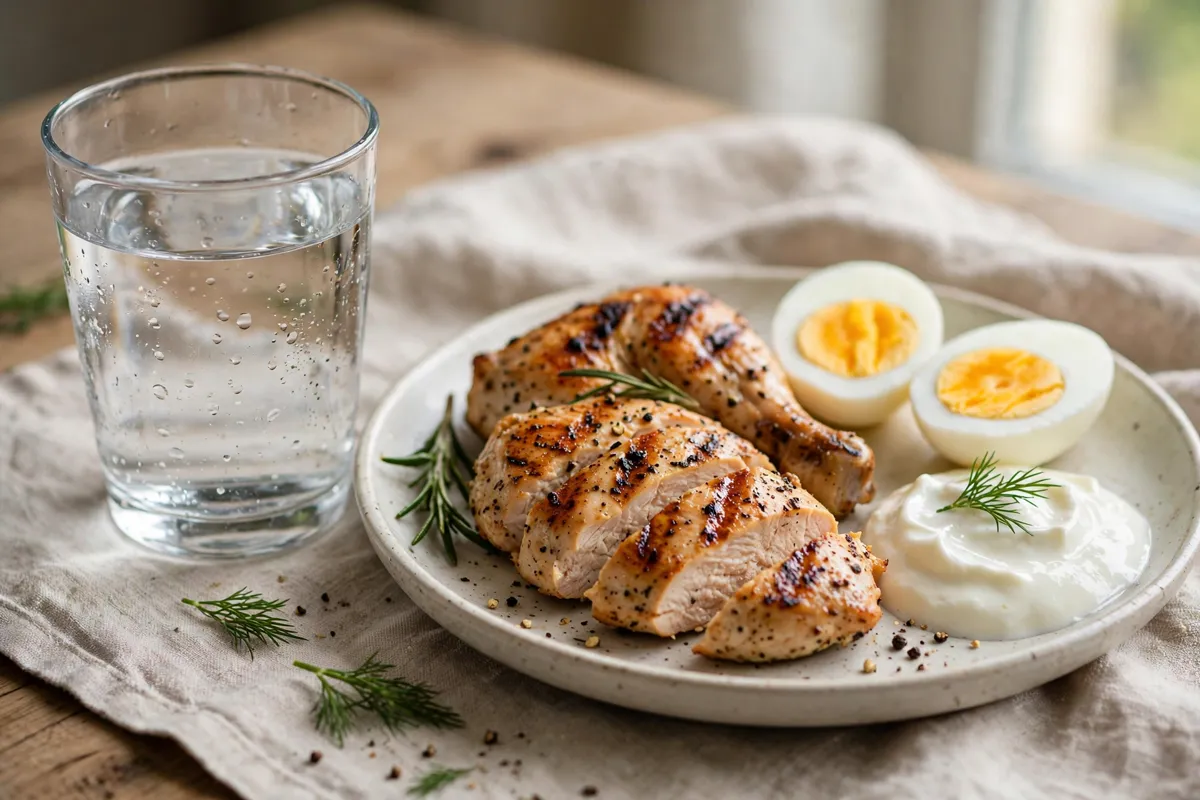
Calorie Counter: The Short Answer
No — water contains no protein. USDA FoodData Central's entry for drinking water (FDC ID 173647) lists 0g protein per 100g, and the same zero for its standard 8 fl oz serving of 237g. There is no protein in tap water, bottled water or sparkling water, in any quantity that exists or could be measured as nutrition.
The question sounds simple, yet it hides a genuinely interesting one: if water has no protein, where does your protein come from, and can drinks contribute to it at all? This article answers the plain question first, then follows the interesting one — through what protein actually is, why water cannot carry it in any meaningful amount, and which liquids do deliver protein. The calorie counter is where those protein-delivering foods and drinks get logged against your daily target.
Short Answer
Water contains 0 grams of protein. Protein is a macronutrient found in foods and in protein-bearing drinks like milk; pure water is H₂O plus trace minerals (the USDA entry shows 4mg sodium per 100g), and none of its components are amino acids or proteins. Drinking water contributes nothing to your daily protein intake.
What Would Protein in Water Even Mean?
Protein is not a vague essence of nourishment; it is a specific class of large molecules — chains of amino acids built by living cells. Fish, eggs, milk, beans and grains contain protein because organisms made those molecules for their own structure and enzymes. Water is not made by an organism building itself. It is a mineral substance, two hydrogen atoms on an oxygen atom, that organisms use. For water to "contain protein," protein molecules would have to be dissolved in it — which happens the moment water becomes a food: the water inside milk carries milk proteins, the water in a stock carries dissolved proteins from simmered ingredients, and the water in your own blood carries thousands of protein species. In each case the protein belongs to the food dissolved in the water, not to the water.
This is why the USDA entry can be so absolute. Its zero is not an average that some special water might beat; it reflects the definition of the substance being measured. A bottled "protein water" on a shop shelf is not a counterexample — it is water with whey or collagen protein deliberately added by a manufacturer, at which point the product is a protein drink whose label lists grams per bottle, typically with calories to match at 4 per gram of protein. The water in it still contributes none of those grams, exactly as the water in milk contributes none of milk's protein.
How Much Protein Do You Need, and Can Drinks Provide It?
Adults generally need protein in proportion to body weight and activity — commonly framed around 0.8 grams per kilogram of body weight as a baseline, with higher intakes, often 1.2 to 2.0 per kilogram, used for muscle building, heavy training or weight loss where protecting muscle matters. For a 70-kilogram adult, that is a range from about 56 grams at the baseline to well over 100 grams at the athletic end. None of it — not one gram — can come from plain water, however much you drink. Hydration and protein are separate errands, and water only runs one of them.
It also helps to know what a gram of protein is worth when you do find it: as how many calories are in one gram of protein sets out, each gram carries 4 calories of energy along with its building material — which is why protein-bearing drinks always have calories, and water, having no protein, has none.
Drinks, though, are a different story: liquids can be serious protein sources when the liquid is a food. Milk provides about 3.37g of protein per 100g in its 1% form — a cup carries about 8.2g — because milk is an emulsion of nutrients in water, not water itself. Drinking yogurts, protein shakes and smoothies built on yogurt or milk similarly deliver double-digit grams per glass. The distinction the whole article rests on is contained in that contrast: water, zero; liquids made of food, whatever their ingredients bring. The site prices the smoothie end of that spectrum in how much protein should you add to a smoothie, and plans the day's total with tools like the calorie counter — while water sits in the diary as the protein-free constant it is.
- Plain water: 0g protein per glass, per litre, per day
- 1% milk: about 3.37g protein per 100g, about 8.2g per cup
- Protein shakes and drinking yogurts: read the label; the protein is an added ingredient
- Broths and stocks: small amounts of dissolved protein from their ingredients, not from the water
Why Do People Ask — and What About "Protein Water"?
Three currents feed the question. The first is marketing: shelves now carry waters fortified with protein, waters with electrolytes, waters with vitamins, and the branding blurs the line between the base substance and what was stirred into it. The second is a reasonable confusion from chemistry class, where students learn the body is mostly water and full of protein, and reasonably wonder whether the water itself carries some. (It does not; the body's water is the medium, its proteins are cargo made by cells.) The third is diet culture's habit of hunting for effortless nutrition — protein from the tap would be the easiest gram ever eaten.
Protein waters deserve a fair verdict rather than scorn: they are legitimate products for people who struggle to reach protein targets, and their labels state the grams honestly. But their protein is an ingredient with calories — roughly 4 calories per gram — whereas the water itself remains what it always was. If you are comparing a protein water against a small glass of milk on cost per gram, the milk usually wins; if you want protein without a milky drink, the fortified water has its niche. Either way, the answer to this page's question stands untouched: the water contributes zero.
Does Anything Else Hide in Water That Matters Nutritionally?
Minerals, in trace amounts, and they are worth one clear paragraph. The USDA tap-water entry lists 4mg sodium per 100g and no potassium, and natural waters add variable traces of calcium and magnesium from the geology they passed through. These are real nutrients — sodium is an essential electrolyte — but they are measured in milligrams and are nutritionally marginal next to food, and none of them is protein, carbohydrate or fat. Hard water's minerals do not make it a food; softened water's slightly higher sodium does not make it a risk at drinking volumes for most people. Fluoride, where added, is a dental-health measure, again not a nutrient in the macronutrient sense. The complete nutritional biography of water is: essential for life, zero for energy, zero for protein, trace for minerals. Everything else anyone attributes to it belongs to things put in it.
Common Mistakes to Avoid
Do not count water toward a protein target, even in apps that let you log it — the entry is zero and always will be. Do not assume a "protein water" gets its protein from the water; it is added whey or collagen, with calories, and the label's grams are the ingredient's. Do not confuse the water inside foods with water itself: milk, soup and fruit are protein- or nutrient-bearing because of their solids, not their water content. Do not chase protein through hydration products when ordinary foods deliver it cheaper and with more nutrition alongside. And do not let the zero discourage drinking water: protein was never water's job. Its job — solvent, coolant, transport medium — is one no protein source can do for you.
Final Thoughts
Water contains no protein: 0 grams per 100g, per glass, per litre, by the USDA's own entry and by the chemistry of what protein is. Your protein must come from foods and food-based drinks — milk at about 8.2g a cup is the everyday example — while water handles hydration at zero calories and zero protein. Keep the two errands separate, log the protein where it actually lives in the calorie counter, and drink water for the work only water does. That question is taken up directly in whether water has calories.
People Also Ask
How Many Calories Are in a Sandwich?
A sandwich has no single calorie count, but it has a well-mapped range: a typical 6-inch sandwich lands between about 270 and 420 calories. Those endpoints come from USDA FoodData Central's submarine sandwich entries — a 6-inch turkey breast sub at 270. 5 calories and a heartier 6-inch cold cut sub at 417.
How Many Calories Are in One Cup of 1% Milk?
One cup of 1% milk contains about 102 calories — 102. 5, precisely, in the USDA's figures. FoodData Central's entry for 1% low-fat milk (FDC ID 170872) gives 42 calories per 100g, and its standard cup weighs 244g, which works out to 102.
Which Mediterranean Bowl Has the Most Protein?
The Mediterranean bowl with the most protein at Mezeh is the Chicken Shawarma Bowl Base with a second protein added: the bowl base alone carries 32 grams of protein at 520 calories, and with a steak shawarma portion on top it totals 520 + 230 = 750 calories and 32 + 21 = 53 grams of protein — the highest protein figure any combination in the tracked Mezeh data can produce. Without doubling up, the bowl base's 32 grams is…
How to Build a High-Protein Mediterranean Bowl?
To build a high-protein Mediterranean bowl at Mezeh, start with the Chicken Shawarma Bowl Base — 520 calories and 32 grams of protein, the highest-protein single item in the tracked data — then add a second protein portion: a chicken kabob portion takes it to 520 + 200 = 720 calories and 32 + 19 = 51 grams of protein, and a steak shawarma portion takes it to 750 calories and 53 grams. Built from parts instead, the strongest light…