Calorie Counter: The Short Answer
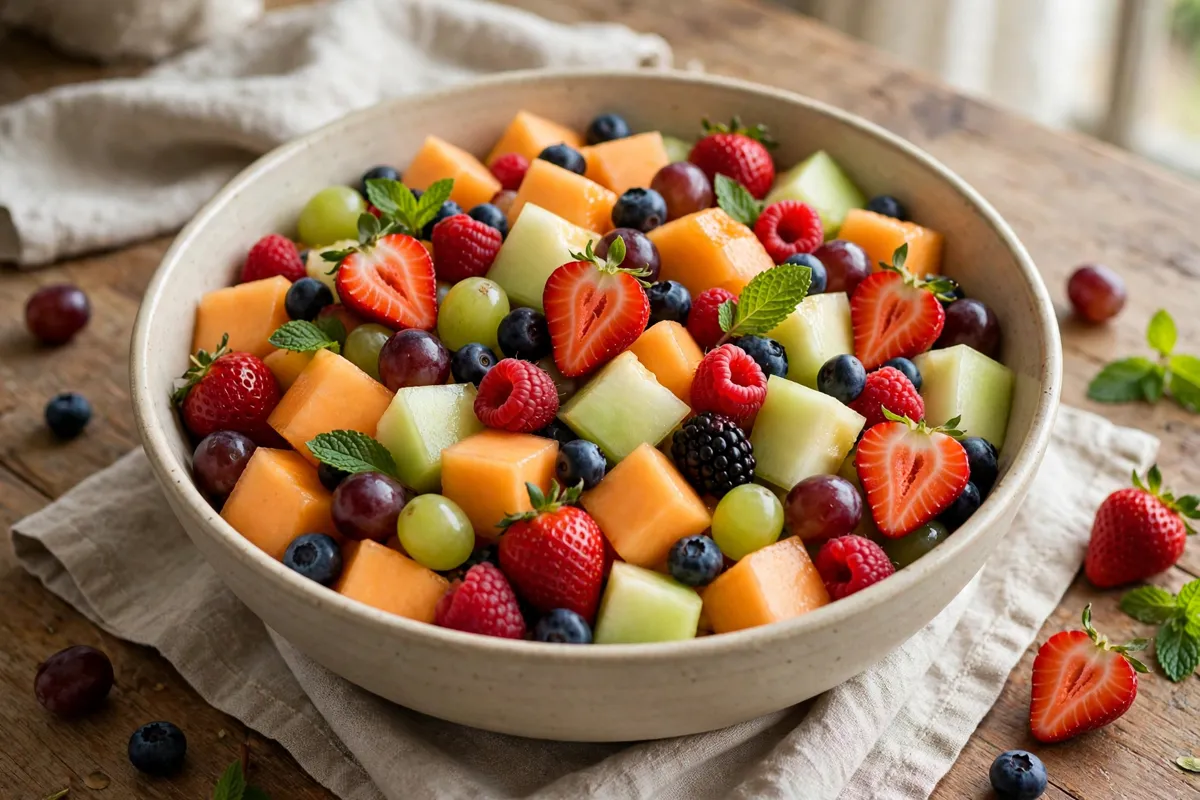
A bowl of fruit contains about 118 calories if the bowl holds two cups of mixed fruit — the honest way to answer a question whose key word, "bowl," has no standard size. Build the same two-cup bowl from a single fruit and the range runs from about 91 calories for watermelon to about 267 for banana, all on USDA FoodData Central values, so this article defines its bowl before it prices it.
That definition-first approach is the whole method. A bowl is a vessel, not a serving, and vessels vary from a small ramekin to a mixing bowl. Below, the bowl is set at two cups — a typical cereal-bowl fill of cut fruit — and priced as a mixture and fruit by fruit, with the scaling rule for any other bowl size. Once you know your bowl's cup count, the calorie counter prices whatever fills it; this page teaches the conversion.
Short Answer
About 118 calories for a two-cup bowl of mixed fruit (2 × the 58.9-calorie mixed cup). Single-fruit two-cup bowls: watermelon about 91, strawberries about 97, cantaloupe about 109, apple about 130, orange about 162, grapes about 208, banana about 267. If your bowl holds a different number of cups, multiply the per-cup figures by that number — the bowl itself has no USDA weight.
Why Must the Bowl Be Defined Before It Is Priced?
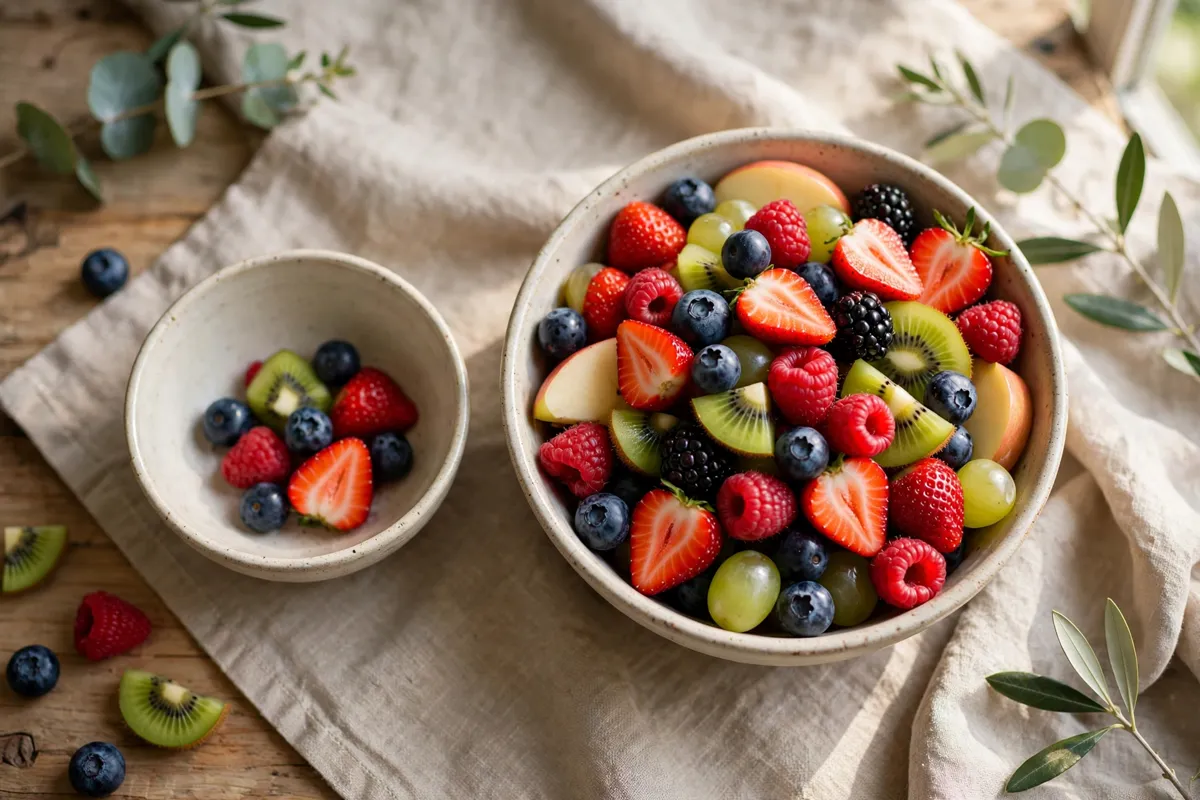
Because the USDA, scrupulously, has no entry for "a bowl of fruit," and neither does anyone else. FoodData Central prices fruit per 100g and per cup, with each fruit's cup carefully weighed — 152g for diced watermelon, 150g for sliced banana, 125g for chopped apple, 165g for orange sections. A bowl enters the calculation only when someone declares how many cups it holds, and any article that quotes a per-bowl figure without that declaration is hiding its most important assumption.
Two cups is the right working definition for three reasons. It matches the physical reality of a standard cereal or soup bowl filled with cut fruit, neither heaped nor scant. It matches how fruit bowls are actually eaten — as a meal-sized breakfast or a shared-but-mostly-personal dessert, not as a side garnish. And it keeps the arithmetic transparent: every figure in this article is exactly double the per-cup values established from the USDA entries, so you can audit or rescale it instantly. If your bowl is a small one-cup ramekin, halve everything here; if it is a three-cup serving bowl you finish alone, add half again. The method scales; only the declaration matters.
What Does a Two-Cup Bowl of Each Fruit Contain?
Priced fruit by fruit, a two-cup bowl spreads across the same threefold range as the cups it doubles. Watermelon: 2 × 45.6 = 91.2 calories, from a fruit that is 30 calories per 100g and over ninety percent water. Strawberries: 2 × 48.6 = 97.2. Cantaloupe: 2 × 54.4 = 108.8. Apple: 2 × 65.0 = 130.0. Orange: 2 × 80.8 = 161.6. Grapes: 2 × 104.2 = 208.4. Banana: 2 × 133.5 = 267.0 — a bowl that is now a real meal component, carrying banana's 22.84g of carbohydrate per 100g in a 300g serving.
The mixed figure deserves its derivation on the record: an equal-parts blend of watermelon, strawberry, cantaloupe, apple and orange cups averages 58.9 calories per cup, and two such cups are 117.8 — the 118 in the short answer. Blends including banana or grapes pull the average upward, so a tropical-style bowl should be priced nearer its dominant fruit than the generic mix.
- Two-cup bowl, watermelon: about 91 calories
- Two-cup bowl, strawberries: about 97 calories
- Two-cup bowl, cantaloupe: about 109 calories
- Two-cup bowl, apple: about 130 calories
- Two-cup bowl, orange: about 162 calories
- Two-cup bowl, grapes: about 208 calories
- Two-cup bowl, banana: about 267 calories
- Two-cup bowl, equal-parts mixed fruit: about 118 calories
How Do Toppings and Additions Change the Bowl?
A bowl of fruit rarely stays only fruit, and the additions price separately. Yogurt dolloped over the top, granola scattered for crunch, honey drizzled for shine — each is a food with its own entry, and each can quietly rival the fruit itself, particularly the concentrated ones. The fruit underneath, even a banana-heavy bowl at 267, is a modest base; the risk sits in handfuls added by eye. The same layering logic prices blended fruit in how many calories are in a fruit smoothie, where the additions are liquid rather than scattered, and the light-fruit strategy behind a melon-heavy bowl is the one behind what is the lowest-calorie fruit smoothie. The defence is the same as everywhere in this series: price the bowl in layers, fruit first from this page's table, then each addition from its own entry, and let the calorie counter hold the running total. Fried plantain gets the same treatment, with its calories counted in full.
Two additions deserve specific fairness. A squeeze of citrus or a scattering of berries "for garnish" genuinely is negligible — a few calories inside the noise. And the fruit's own juice at the bottom of the bowl is not an addition at all: it left the fruit, and it was already counted in the fruit's weight. What is not negligible is dried fruit folded into a fresh bowl for texture: raisins run 299 calories per 100g against fresh fruit's 30 to 89, so a small handful changes the bowl's character in a way fresh fruit never could. The fruit-bowl investigation in how many calories are in one cup of fruit sets the per-cup foundations this page doubles, and sweetened, syrup-packed fruit — a different product from fresh — should always be priced from its own label rather than from any figure here. A raisin gets the same treatment, with its calories counted in full.
How Should You Estimate a Bowl You Are Served Elsewhere?
Count cups with your eyes, then name the fruit. A restaurant fruit bowl is usually built in a vessel you can compare against a cup measure you know: picture the fruit decanted into measuring cups, and you have the multiplier. Then ask which fruit dominates. Mostly melon and berries: price the cups at roughly 50. A balanced mix: 59 a cup. Mostly banana or grapes: 100-plus a cup. Multiply cups by the rate, and your estimate lands within a small margin of the weighed truth.
Cafeteria and buffet fruit salads are the mixed case at scale, and the 59-per-cup average was built for them. Where the salad is dressed or syrupy, add a margin — the dressing is an unlisted ingredient — but for plain fresh mixtures the average is dependable. Athletes and dieters who eat a fruit bowl daily will find it worth one act of measurement: fill your own bowl at home, weigh the fruit once, and convert your bowl into cups permanently. After that, the bowl stops being a question and becomes one of the best-known quantities in your diary.
Common Mistakes to Avoid
Do not quote any per-bowl figure — including this article's 118 — without its cup definition attached; an undeclared bowl size is how fruit calories get understated by half. Do not price a banana-based bowl at the mixed average: at 267 against 118 for two cups, the gap is larger than many snacks. Do not count dried fruit folded into the bowl at fresh-fruit rates; raisins at 299 per 100g belong to another category entirely. Do not forget toppings as separate lines — yogurt, granola and honey are foods, not presentation. And do not assume a bigger bowl is a problem to hide: a three-cup watermelon bowl is still only about 137 calories, so the honest count often flatters the eater.
Final Thoughts
A bowl of fruit contains about 118 calories when the bowl is the standard two cups, filled with a mixture of common fruits — 91 for watermelon at the lightest, 267 for banana at the heaviest, every figure derived openly from USDA per-cup values. Define your bowl once, in cups, and the question never needs asking again: multiply the cups by the fruit's rate, add the toppings as their own lines, and log it in the calorie counter with confidence.
People Also Ask
Which Fruit Has the Fewest Calories?
Watermelon has the fewest calories of the common fruits: 30 calories per 100 grams in USDA FoodData Central, and 45. 6 calories per cup diced. Strawberries run it closest at 32 per 100g and 48.
How Many Calories Are in a Raisin?
One single raisin contains about 1. 6 calories. That tiny figure is a derivation from USDA FoodData Central's raisin entry (FDC ID 168165), which lists raisins at 299 calories per 100 grams and records that 50 raisins weigh 26 grams — so one raisin weighs about 0.
How Many Calories in a Double-Double® Burger?
A Double-Double® Burger at In-N-Out has 610 calories on its own, with 34 grams of protein, 42 grams of carbohydrates, 34 grams of fat, 3 grams of fiber, 10 grams of sugar and 1,670 milligrams of sodium. That is the burger by itself, before fries and before a drink. Add a standard side and a soda and the same order becomes 610 + 370 + 180 = 1,160 calories, which is why the honest answer to this question is always…
How Many Calories in a Turkey & Provolone?
A Regular #7 Turkey & Provolone at Jersey Mike's is 820 calories, with 45 grams of protein, 66 grams of carbohydrates, 41 grams of fat and 1,976 milligrams of sodium. That is the tracked figure for the Regular size in the Jersey Mike's data on this site, served as listed, and it is the number the rest of this article uses. It makes the Turkey & Provolone the lowest-calorie cold sub on the menu at 820, but it is still…