Chicken Protein Calculator: The Short Answer
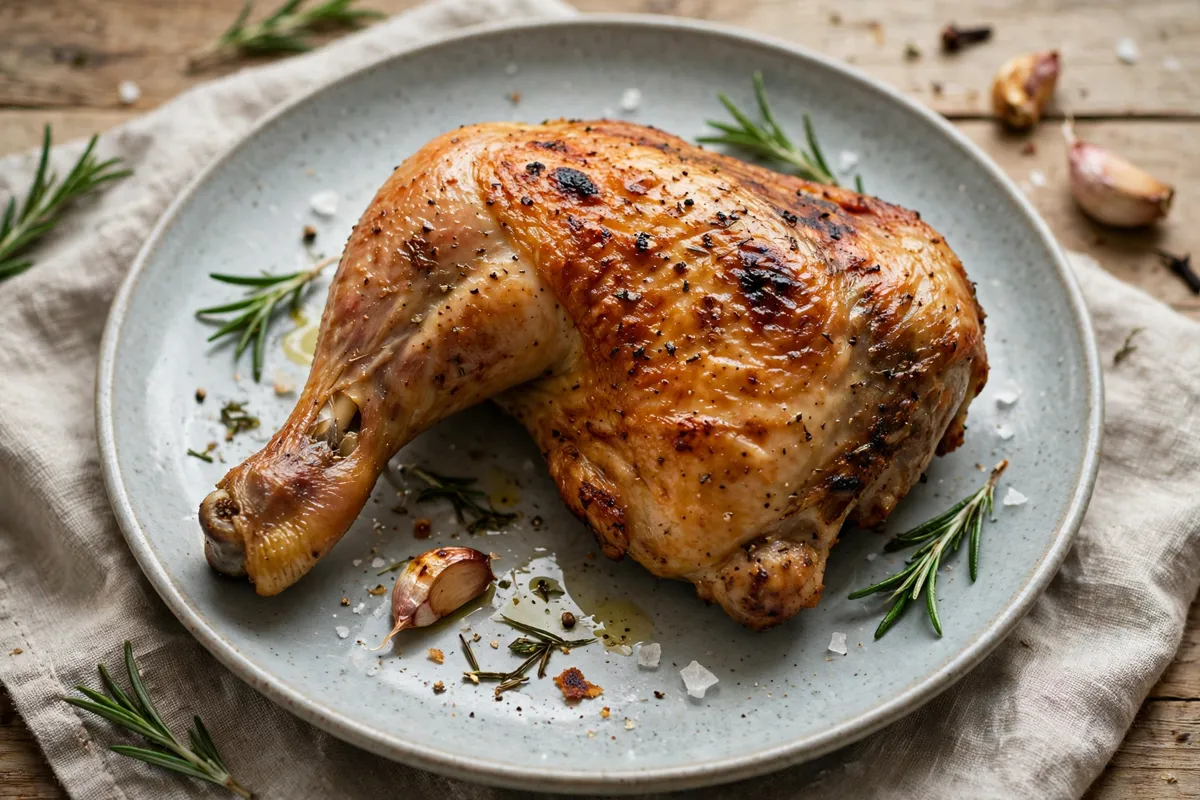
A chicken leg has either about 149 calories or about 346 calories, depending on what you mean by "leg" — and this article will not pretend otherwise. A drumstick alone, the familiar hand-held piece at 96 grams of meat, contains 148.8 calories; a whole leg — drumstick, thigh and back joined, at 199 grams of meat — contains 346.3 calories. Both figures come from their own USDA entries, so the calories in a chicken leg start with resolving the word itself.
That ambiguity is not a quirk of language; it is how chicken is actually sold and served. One shop's "leg quarter" is a whole leg with part of the back, one recipe's "leg" is a drumstick, and a child's plate defines leg by what fits in a fist. This article prices both pieces precisely, explains why their per-100g rates also differ slightly, and shows how to tell which one is in front of you before you log it. The chicken protein calculator carries both cuts — pick the one that matches your plate.
Short Answer
If by leg you mean the drumstick only: 148.8 calories and 23.3g of protein for the standard 96g piece (155 calories per 100g). If you mean the whole leg — drumstick plus thigh plus back: 346.3 calories and 48.2g of protein for the standard 199g piece (174 calories per 100g). The two differ by about 200 calories, so naming the piece correctly is the entire answer.

What Exactly Is a Whole Leg?
USDA's whole-leg entry (FDC ID 172380) describes the leg as butchers cut it: "leg, meat only, cooked, roasted," where the leg portion is the drumstick, the thigh and the back section taken together — the piece sold as a leg quarter when part of the back stays attached. Its standard portion is 199g of meat, and per 100g it lists 174 calories, 24.22g of protein, 7.8g of fat, 99mg of sodium and 269mg of potassium. Multiply the portion: 199 × 1.74 = 346.3 calories, 199 × 0.2422 = 48.2g of protein.
The drumstick entry (FDC ID 172376) covers only the lower section — "dark meat, drumstick, meat only, cooked, roasted" — with a standard portion of 96g of meat and a per-100g profile of 155 calories, 24.24g of protein, 5.7g of fat and 128mg of sodium. Its portion maths: 96 × 1.55 = 148.8 calories, 96 × 0.2424 = 23.3g of protein. Two respectable pieces of chicken, two different entries, and a shared name in everyday speech. The whole leg is essentially a drumstick that brought its thigh along — which is why the protein totals, 48.2g against 23.3g, differ by slightly more than double: the whole leg carries a thigh's worth of meat in addition to the drumstick's.
Why Do the Two Pieces Price Differently Per 100 Grams?
Even gram for gram, the pieces are not interchangeable: 174 calories per 100g for whole leg meat against 155 for drumstick meat, with fat at 7.8g against 5.7g per 100g. The whole leg's meat includes thigh meat, and thigh meat is the fattier dark meat — its own entry reads 179 calories and 8.15g of fat per 100g. Blending drumstick meat (leaner) with thigh and back meat (fattier) produces the in-between leg figure. Protein per 100g, by contrast, is a virtual tie: 24.22g for leg, 24.24g for drumstick. The pieces deliver protein at the same rate and differ in energy because they differ in fat.
That makes the leg question a clean illustration of a rule that runs through the whole bird: on a per-100g basis, chicken parts separate themselves mainly by fat, not by protein. Breast is the extreme case — 31.02g of protein and only 3.57g of fat per 100g — which is why it wins the protein-density contest examined in the chicken protein deep-dive guide, while the dark-meat pieces cluster together on protein and spread out on fat.
How Can You Tell Which Piece You Have?
Look at the joint. A drumstick is a single bone with a knob of meat at one end — one section, one bone, eaten from the hand. A whole leg has two sections with a joint between them: the drumstick below, the thigh above, often with a flap of back meat at the top. If your piece bends in the middle, it is a whole leg. If it is the size of a child's fist and a short handle, it is a drumstick.
Weight confirms what the eye suggests. Cooked meat from a drumstick lands near 96g on the USDA basis; finding 150g or more of meat on your piece means the thigh is present and the whole-leg entry is the honest price. Restaurants and rotisserie counters add a third case — the leg quarter, which is the whole leg with additional back attached. Price it as the whole leg and add the extra back meat by weight at the leg's per-100g rate if there is a substantial amount of it. The pattern to copy is always the same: identify the piece, weigh its meat, apply its own rate. Pieces that arrive sauced or breaded, of course, carry that addition separately — the rates here are for plain roasted meat only.
How Do the Two Pieces Fit a Meal Differently?
The drumstick at 148.8 calories is a component: one of two or three pieces on a plate, a child's main portion, or the protein in a light lunch alongside substantial sides. Two drumsticks (192g of meat) price at 297.6 calories with 46.6g of protein — close to a whole leg's territory on protein (48.2g) at fewer calories (297.6 against 346.3), because two drumsticks are all drumstick meat at the leaner per-100g rate, while the whole leg's extra weight is fattier thigh and back meat.
The whole leg at 346.3 calories is a centrepiece in itself: 48.2g of protein is most of many people's day, and the piece needs only modest sides to become a complete dinner. Confusing the two in a log is a 200-calorie error in either direction — the largest single-word error in this entire series of articles, which is why this piece of vocabulary is worth the whole article spent on it. How the leg's protein total compares with the breast's very different route to a similar number is the subject of protein in chicken thigh versus chicken breast, where dark meat's per-piece generosity is weighed against white meat's per-gram density.
Common Mistakes to Avoid
The defining mistake is logging a whole leg as a drumstick, or the reverse — a roughly 200-calorie error from one ambiguous word. Do not price leg meat at the thigh's rate (179 per 100g) or the drumstick at the leg's (174); each piece has its own entry and they are not rounding distance apart. Do not weigh the piece bone-in and log the full weight as meat; the portions here, 96g and 199g, are meat weights. Do not assume a leg quarter is just a leg — the attached back adds meat that belongs in the weight. And if the skin is eaten, remember both entries are meat only: the skin you ate is extra, fattier weight that these rates do not cover.
Final Thoughts
A chicken leg is 148.8 calories if it is a drumstick and 346.3 calories if it is the whole leg — drumstick, thigh and back together. The word is ambiguous, the entries are not, and the joint in the middle of the piece tells you which one you hold. Identify the piece, weigh its meat, and price it from its own rate: 155 per 100g for drumstick meat, 174 for whole-leg meat. When in doubt, the chicken protein calculator lets you enter the piece and the weight separately, which is exactly the distinction this question turns on.
People Also Ask
How Many Calories Are in a Whole Chicken?
A whole chicken has about 715 calories for the edible meat and skin of a modest bird. That figure is USDA's bone-removed portion — 299 grams of roasted meat and skin — priced from the whole-chicken entry (FDC ID 171450) at 239 calories per 100 grams, which gives 714. 6 calories.
How Much Protein Is in 4 Ounces of Chicken Breast?
Four ounces of chicken breast contain 35. 2 grams of protein. That is the derived USDA figure for 113.
How Many Calories Does a Person Burn Per Day?
A person burns roughly 1,400 to 3,200 calories per day in total, depending on body size and activity: basal metabolic rate accounts for about 60 to 70% of it, everyday movement and exercise most of the rest, and digesting food roughly 10%. Your personal total — your TDEE — is calculated by multiplying your Mifflin-St Jeor BMR by an activity factor of 1. 2 to 1.
How Can You Burn 2,000 Calories a Day?
Almost everyone already burns 2,000 calories a day in total — a mid-sized woman's maintenance is about 1,900 to 2,100, so her ordinary living clears the mark without any special effort. The harder question people usually mean is how to burn 2,000 calories through exercise alone, and the honest answer is that it takes roughly five to seven hours of sustained activity, which is a labourer's working day or an endurance event — not a daily habit.