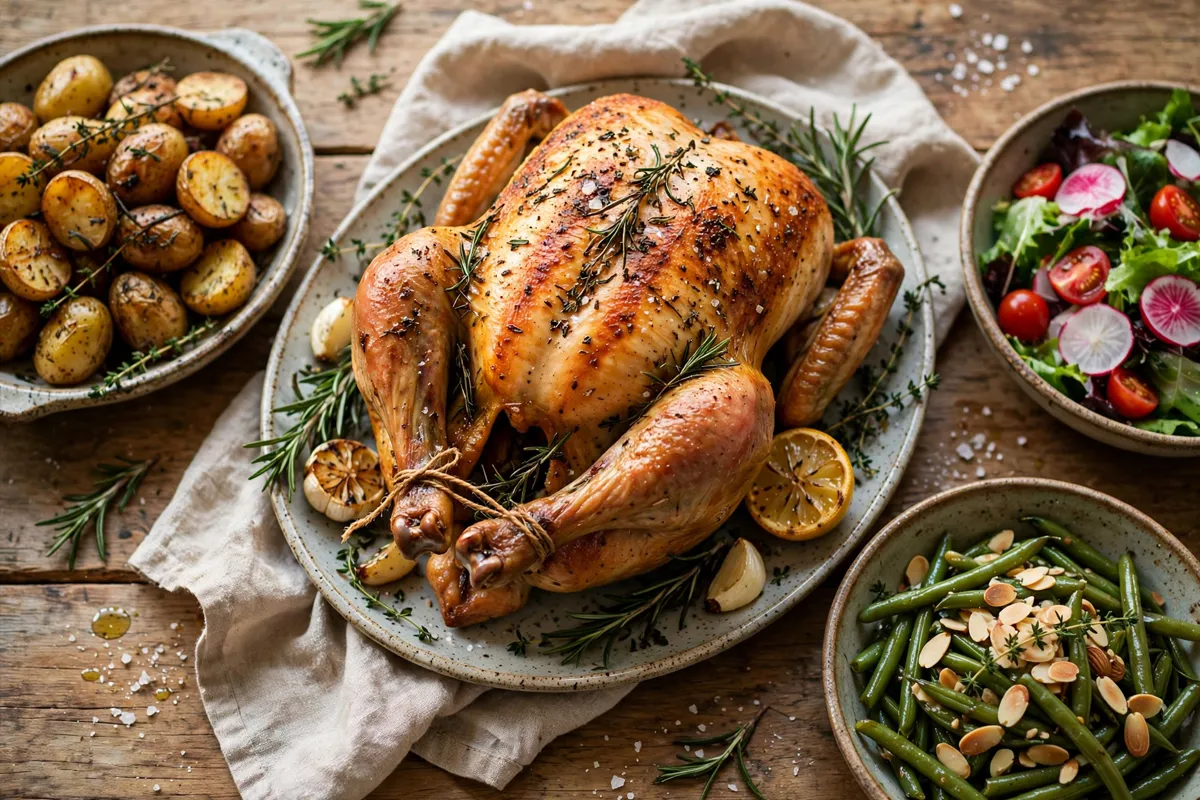
Chicken Protein Calculator: The Short Answer
A whole chicken has about 715 calories for the edible meat and skin of a modest bird. That figure is USDA's bone-removed portion — 299 grams of roasted meat and skin — priced from the whole-chicken entry (FDC ID 171450) at 239 calories per 100 grams, which gives 714.6 calories. The calories in a whole chicken, honestly stated, are a rate times an edible weight, because USDA publishes no single whole-bird gram weight: birds differ, and so do the totals.
This is the largest unit in the chicken series and the one where method matters most. A whole chicken is not eaten as a homogeneous food; it is carved into parts with different rates, eaten with or without skin, and rarely finished by one person at one meal. This article sets out the two whole-chicken entries (with skin, and meat only), shows how to scale to a bird of any size, and explains how the carved pieces reconcile with the whole-bird total. The chicken protein calculator prices the individual cuts once the bird is apart.
Short Answer
Roasted whole chicken, meat and skin together, contains 239 calories per 100g of edible meat; USDA's bone-removed portion of 299g therefore contains 714.6 calories. Meat only, skin removed, the rate is 190 calories per 100g. To price your bird: weigh the cooked meat you will actually eat (plus skin, if eaten) and multiply — there is no official weight for "one whole chicken."
Why Is There No Single Calorie Count for a Whole Chicken?
Every other article in this series could point to a weighed USDA portion: a half breast at 86g, a thigh at 116g, a drumstick at 96g. A whole chicken defeats that approach, because the bird's size is the variable — a small roaster and a large one differ by more than the meat on two breasts. The dataset's honest solution is to give rates and one reference portion. For meat and skin, roasted (FDC ID 171450), the portions listed are 3 ounces (85g), a cup of diced meat (140g), and a "chicken, bone removed" portion of 299g — the edible yield the analysts worked with, giving 714.6 calories and 81.6g of protein.
Treat 299g as an example, not a definition. Your bird's edible cooked weight is found the only reliable way: carve it, weigh the meat (and the skin you will eat), and apply 239 calories per 100g to that total. A bird yielding 400g of meat and skin prices at 956 calories (400 × 2.39); one yielding 250g prices at 597.5 (250 × 2.39). The rate is constant; the yield is yours to measure. The same reference-portion logic governs the protein version of this question in the chicken protein essentials guide, where whole-bird totals are built from the same 299g anchor.
What Changes When the Skin Comes Off?
USDA publishes the whole bird both ways, and the gap between the entries is the price of the skin across an entire chicken:
Removing the skin before eating cuts the rate by 49 calories per 100g and nearly halves the fat rate, while protein per gram actually rises — the skin was diluting it. On the 299g reference portion, the same edible weight eaten skinless would price at 568.1 calories (299 × 1.90) against 714.6 with skin: a difference of about 147 calories riding on a decision made at the carving board. In practice a skinless bird also weighs less, since the skin itself is part of the 299g — so the real-world saving is the rate difference applied to slightly fewer grams. Either way, "whole chicken" without a skin verdict is an incomplete question, and the two entries exist precisely so the verdict can be priced.
- Meat and skin, roasted (171450): 239 calories, 27.3g protein, 13.6g fat per 100g
- Meat only, roasted (171054): 190 calories, 28.93g protein, 7.41g fat per 100g
How Do the Carved Pieces Add Up?
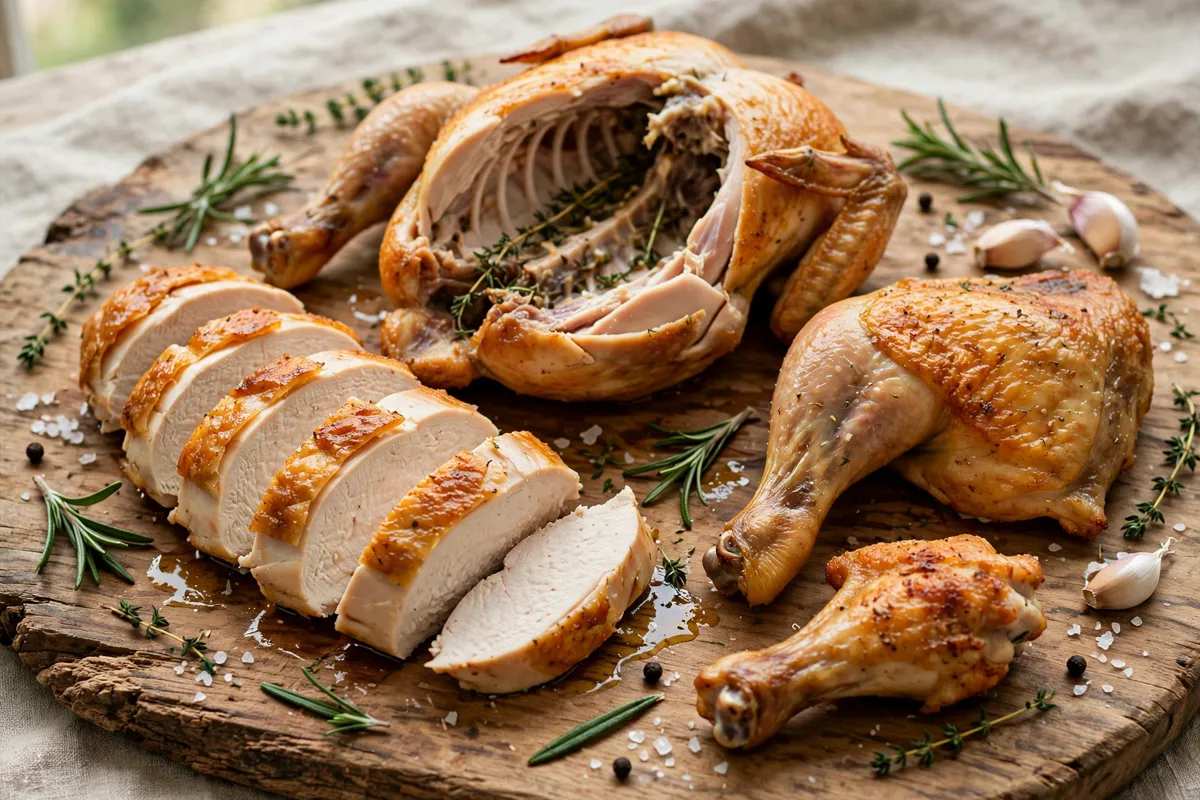
Carve the bird and the parts carry their own rates, which should reconcile with the whole-bird figure — an audit worth doing once, because it shows where a chicken's calories actually live:
The whole bird with skin averages 239 per 100g — higher than every skinless part — because the average includes the skin itself and the fattier meat beneath it. The breast is the bird's bargain: the largest single block of meat at the lowest rate. The wings are the reverse, rich per gram but small. A household that divides a chicken by preference — breast to one plate, legs to another — is also dividing its calories unevenly, and the rates above let that division be seen clearly. Whoever takes the skin, crisped and seasoned, takes a disproportionate share of the 714.6; that is not a warning, just the arithmetic of the bird made visible. For the protein side of the carve-up, what part of the chicken carries the most protein per 100g ranks the same pieces on the protein rate instead.
- Breast meat, skinless: 165 calories per 100g — the leanest large share of the bird
- Wing meat: 203 calories per 100g (FDC ID 172392), the richest rate per gram, but wings contribute little total weight
- Thigh meat, skinless: 179 calories per 100g
- Drumstick meat: 155 calories per 100g
- Whole-leg meat: 174 calories per 100g
How Does a Whole Chicken Fit Across Meals?
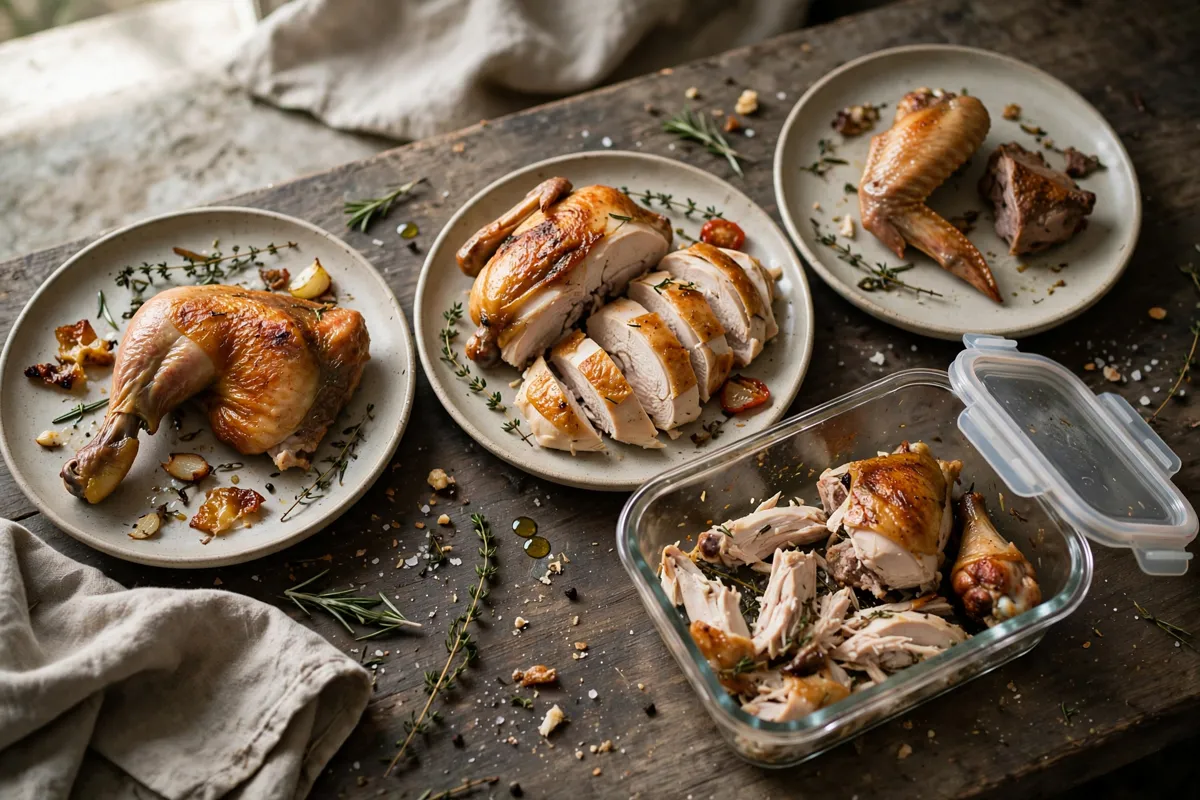
Few whole chickens are eaten at one sitting by one person, so the useful frame is the bird across a household and a few days. At the reference size, 714.6 calories and 81.6g of protein divide like this:
That last comparison is the leftover cook's dilemma in one line: the same cup measure, a 68.6-calorie difference and a protein reversal, decided entirely by whether the skin went into the dice. However the bird is divided, the discipline is constant — weigh the edible portion, choose the entry that matches its skin state, and multiply. A roasted bird eaten across three days is three weighings, not one guess repeated.
- Quarter of the reference bird (about 75g of meat and skin): roughly 179 calories (714.6 ÷ 4) and about 20.4g protein
- Half the bird (149.5g): 357.3 calories and 40.8g protein
- A cup of diced cooked meat and skin (140g): 334.6 calories (140 × 2.39) and 38.2g protein (140 × 0.273)
- A cup of diced meat only (140g, skinless basis): 266.0 calories and 40.5g protein — fewer calories and more protein than the with-skin cup
Common Mistakes to Avoid
Do not log a whole chicken by its raw purchase weight — the bird loses water in roasting and the bone, which is a large share of a whole bird's weight, carries no calories at all; only the edible cooked yield belongs in the multiplication. Do not price skinless meat at the with-skin rate of 239, or skin-on eating at the meat-only 190; the 49-calorie-per-100g gap is the largest rate error available in this series. Do not assume the 299g reference portion is your bird — it is an example yield, and bigger birds yield proportionally more. Do not forget the skin eaten as snacks during carving; it is part of the bird and part of the 239 rate's logic. And do not double-count: meat logged by the piece on day one must not reappear as an undifferentiated cup of leftovers on day two at a second full price.
Final Thoughts
A whole roasted chicken is 239 calories per 100g of edible meat and skin — 714.6 calories on USDA's 299g bone-removed reference portion — or 190 per 100g with the skin removed and set aside. There is no single whole-bird number because there is no single whole-bird size; there is a rate, a scale, and a carving board, and together they give an exact answer for the bird in front of you. Carve it into parts and the chicken protein calculator prices each one from its own entry.
People Also Ask
How Much Protein Is in 4 Ounces of Chicken Breast?
Four ounces of chicken breast contain 35. 2 grams of protein. That is the derived USDA figure for 113.
How Much Protein Is in 8 Ounces of Chicken Breast?
Eight ounces of chicken breast contain 70. 4 grams of protein. That is the derived figure for 226.
How Can You Burn 2,000 Calories a Day?
Almost everyone already burns 2,000 calories a day in total — a mid-sized woman's maintenance is about 1,900 to 2,100, so her ordinary living clears the mark without any special effort. The harder question people usually mean is how to burn 2,000 calories through exercise alone, and the honest answer is that it takes roughly five to seven hours of sustained activity, which is a labourer's working day or an endurance event — not a daily habit.
Is Burning 200 Calories a Day Good?
Yes — burning an extra 200 calories a day is good: it adds up to 1,400 calories a week, which by the standard approximation of about 3,500 calories per pound predicts roughly 0. 4 pounds of fat loss a week, or about 20 pounds over a year, if your eating stays exactly at your old maintenance. Two hundred is also about what 5,000 extra steps delivers for a mid-sized adult — a genuinely achievable daily habit.