Calorie Counter: The Short Answer
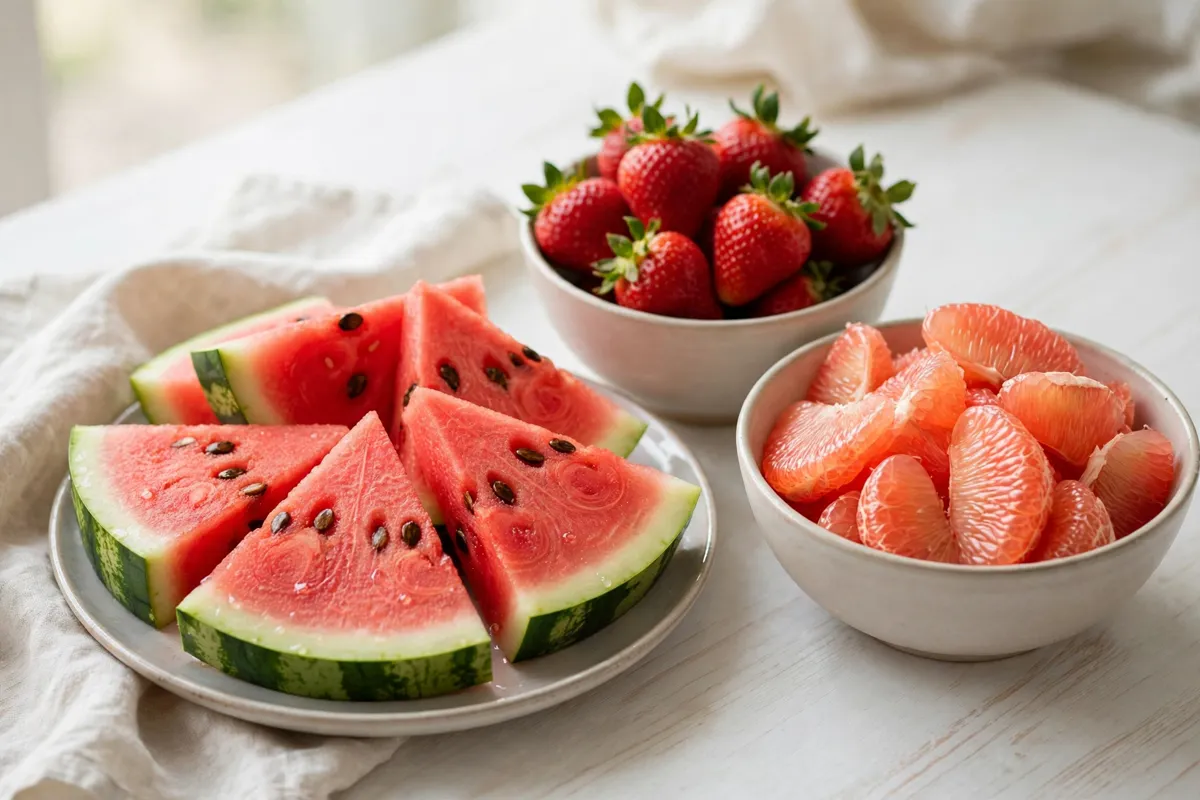
Watermelon has the fewest calories of the common fruits: 30 calories per 100 grams in USDA FoodData Central, and 45.6 calories per cup diced. Strawberries run it closest at 32 per 100g and 48.6 per cup. Watermelon wins for the simplest of reasons — it is more than ninety percent water, so a serving of it is mostly a serving of the one substance with no calories at all.
"Lowest calorie" is a more useful question than it first appears, because volume is what makes a diet bearable: the fruit with the fewest calories per bite lets you eat the most food for a fixed budget. This article ranks the common fruits properly — per 100g and per cup, since the two views differ slightly — and then puts the ranking to honest use. All figures come from the USDA fruit entries; once you know them, the calorie counter handles the day's totals.
Short Answer
Watermelon: 30 calories per 100g (FDC 167765) and 45.6 calories per cup diced (152g). It beats strawberries (32 per 100g, 48.6 per cup) and cantaloupe (34 per 100g, 54.4 per cup) — the only other common fruits in the low thirties — and it is less than half the density of grapes (69 per 100g) and barely a third of banana (89 per 100g).
What Does the Full Ranking of Common Fruits Look Like?
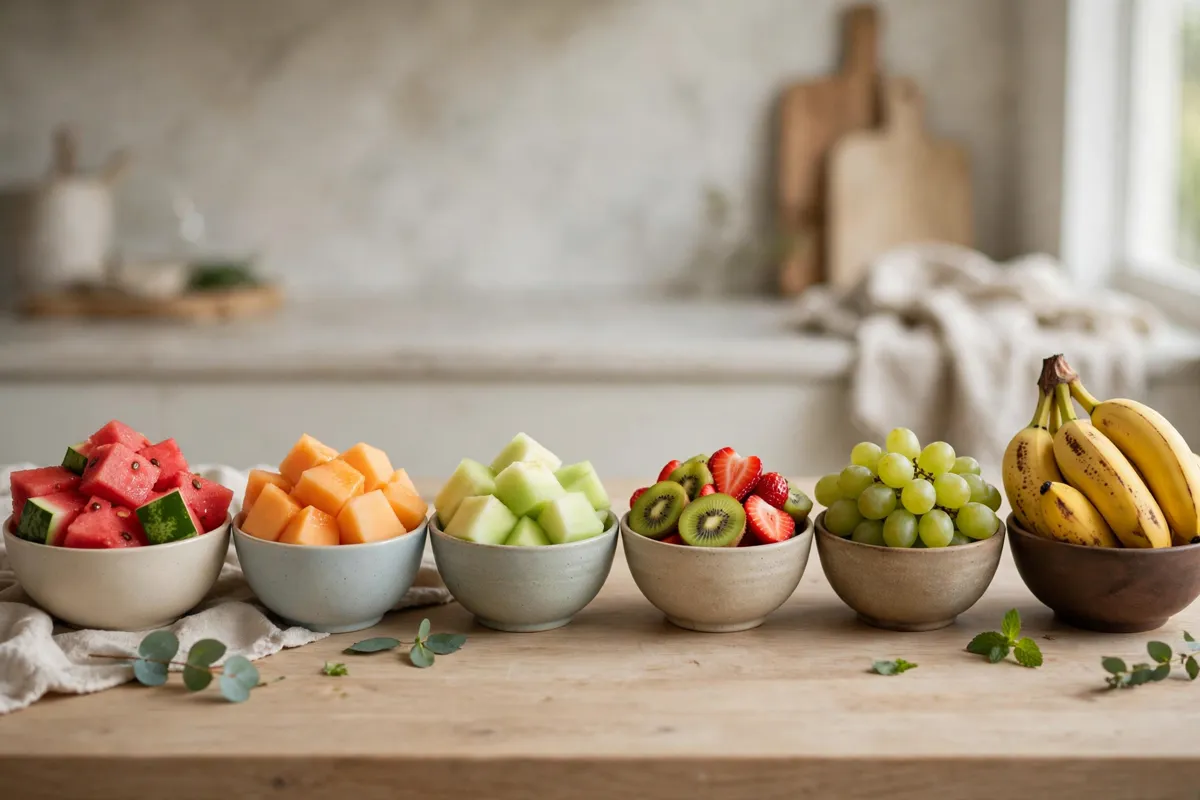
From the USDA entries for seven everyday fruits, lightest to heaviest per 100g: watermelon 30, strawberries 32, cantaloupe 34, orange 49, apple 52, grapes 69, banana 89 calories. Per cup — each fruit's own USDA cup weight — the order survives intact: watermelon 45.6 (152g cup), strawberries 48.6 (152g), cantaloupe 54.4 (160g), apple 65.0 (125g), orange 80.8 (165g), grapes 104.2 (151g), banana 133.5 (150g). The two rankings agreeing is itself informative: cup weights only range from 125g to 165g, so they never overturn the density ranking set by the per-100g figures.
Notice the cliff in the middle of the table. Three fruits — the two melons and the strawberry — live in the low thirties, and then the ranking jumps by half again to orange at 49. That structure matters more than the single winner: there is a class of very light fruits, and watermelon is first among near-equals rather than a freak outlier. Any of the top three can carry the "eat a large bowl" role in a diet, and the detailed per-cup workings behind these numbers are laid out in how many calories are in one cup of fruit. A bowl of fruit gets the same treatment, with its calories counted in full.
- Watermelon: 30 kcal per 100g · 45.6 per cup
- Strawberries: 32 kcal per 100g · 48.6 per cup
- Cantaloupe: 34 kcal per 100g · 54.4 per cup
- Orange: 49 kcal per 100g · 80.8 per cup
- Apple: 52 kcal per 100g · 65.0 per cup
- Grapes: 69 kcal per 100g · 104.2 per cup
- Banana: 89 kcal per 100g · 133.5 per cup
Why Is Watermelon So Low — What Is in the Other 70 Percent?
Water, and very little else that carries energy. Watermelon's USDA profile per 100g is 7.55g carbohydrate, of which 6.2g is sugar, 0.61g protein, 0.15g fat and 0.4g fibre — and arithmetic leaves the rest, over 91 percent of the fruit, as water. Price the composition: even if every gram of its carbohydrate were sugar-priced energy, the total could only reach the low thirties — which is where the published 30 sits. A fruit cannot go much lower than watermelon without ceasing to be fruit at all; the floor is set by the sugar that makes it taste like something, and watermelon runs close to that floor.
Strawberries tell the same story with a fibrous twist: 7.68g carbohydrate and only 4.89g sugar per 100g, with 2.0g fibre — five times watermelon's fibre, and a figure that stands out in the survey of how much fiber is in common fruits and vegetables — which is why they taste less sweet while landing only 2 calories higher. Cantaloupe (8.16g carbohydrate, 7.86g sugar, 0.9g fibre, and a notable 267mg potassium per 100g) completes the light trio. The heavier fruits are heavier for mirror-image reasons: banana packs 22.84g carbohydrate per 100g with much less water, and grapes concentrate 15.48g of sugar into a small, dense package. Density rankings of fruit are, in the end, water-content rankings read backwards.
Does "Fewest Calories" Mean Watermelon Is the Best Fruit to Eat?
It means watermelon is the best fruit for volume per calorie — a specific and genuinely valuable title. If the goal is a large, sweet, satisfying portion inside a tight budget, a two-cup bowl of watermelon at about 91 calories is close to unbeatable among fruits, and a strawberry or cantaloupe bowl at 97 to 109 performs nearly as well. For appetite management, that is real strategy, not trivia.
But calories are one column of a longer table. Banana, the heaviest fruit here, brings 358mg potassium and 2.6g fibre per 100g and a portability no melon matches; grapes bring their own virtues in a form people actually snack on slowly. A diet built only on the lightest fruits would be a worse diet, merely a lighter one. The ranking's proper use is tactical: know the light class for the moments when volume matters — evening snacks, deficit days, the bowl that accompanies a rich main course — and eat the rest of the fruit world on its other merits the rest of the time. The site applies this thinking at the level of whole drinks and dishes in pieces like what is the lowest-calorie fruit smoothie; the principle scales from a glass to a fruit bowl unchanged.
How Do You Use the Light Fruits Without Fooling Yourself?
Three disciplines keep the advantage real. First, weigh the claim: "fewest calories" is a per-100g and per-cup statement, and it survives only while portions stay comparable — a mixing bowl of watermelon eaten absent-mindedly is still a mixing bowl, at 30 calories per hundred grams of however many grams that turns out to be. Second, watch the company: watermelon with sweetened yogurt or a sugar dusting is no longer the fruit in the table, and dried watermelon — water removed, sugar concentrated — belongs to the raisin category of density, not the fresh one. Third, remember juice inverts everything: pressing a light fruit removes its fibre and concentrates its servings, so juice from a light fruit is not a light drink in the way the whole fruit is a light food.
Used with those disciplines, the light trio earns its place. They are the fruits you can serve generously to a table that includes someone counting every calorie, the fruits that fill the gap between dinner and bedtime, and the fruits that make a fruit salad's average — about 59 calories a cup for the standard mixture — as low as it is.
Common Mistakes to Avoid
Do not crown watermelon and then eat it in unlimited quantities on the theory that it is "basically zero": 30 per 100g is low, not nothing, and a kilogram of it is 300 calories. Do not compare fruits per piece — a grape and a melon wedge are not units — when the meaningful comparisons are per 100g and per cup, where the ranking above holds. Do not assume all melons and berries are equal: strawberries at 32 and grapes at 69 per 100g are both "small fruits," separated by a factor of two. Do not extend the title to dried or juiced forms, where water removal reverses the entire ranking. And do not let "fewest calories" become "only fruit worth eating" — the heaviest fruit on this list is still a nutritious food at 89 calories per 100g.
Final Thoughts
Watermelon has the fewest calories of the common fruits — 30 per 100g, 45.6 per cup — because it is over ninety percent water with a modest 6.2g of sugar, finishing just ahead of strawberries and cantaloupe in a clear light class. Use the trio when volume matters, eat the rest of the fruit world for its other virtues, and log whichever you choose in the calorie counter at its true figure rather than a hopeful one.
People Also Ask
How Many Calories Are in a Raisin?
One single raisin contains about 1. 6 calories. That tiny figure is a derivation from USDA FoodData Central's raisin entry (FDC ID 168165), which lists raisins at 299 calories per 100 grams and records that 50 raisins weigh 26 grams — so one raisin weighs about 0.
How Many Calories Are in Fried Plantain?
Fried plantain contains about 399 calories per cup — 398. 8, precisely, from USDA FoodData Central's entry for yellow plantains, fried, Latino restaurant style (FDC ID 168200). That entry gives 236 calories per 100 grams, and its cup portion weighs 169 grams, so the cup works out to 398.
How Many Calories in a Turkey & Provolone?
A Regular #7 Turkey & Provolone at Jersey Mike's is 820 calories, with 45 grams of protein, 66 grams of carbohydrates, 41 grams of fat and 1,976 milligrams of sodium. That is the tracked figure for the Regular size in the Jersey Mike's data on this site, served as listed, and it is the number the rest of this article uses. It makes the Turkey & Provolone the lowest-calorie cold sub on the menu at 820, but it is still…
How Many Calories in a Cheesesteak?
A Wawa Cheesesteak (Shorti) is 640 calories. That is the figure in the Wawa calculator on this site for the Shorti size, with 34 grams of protein, 54 grams of carbohydrates, 32 grams of fat, 3 grams of fiber, 7 grams of sugar and 1,320 milligrams of sodium.