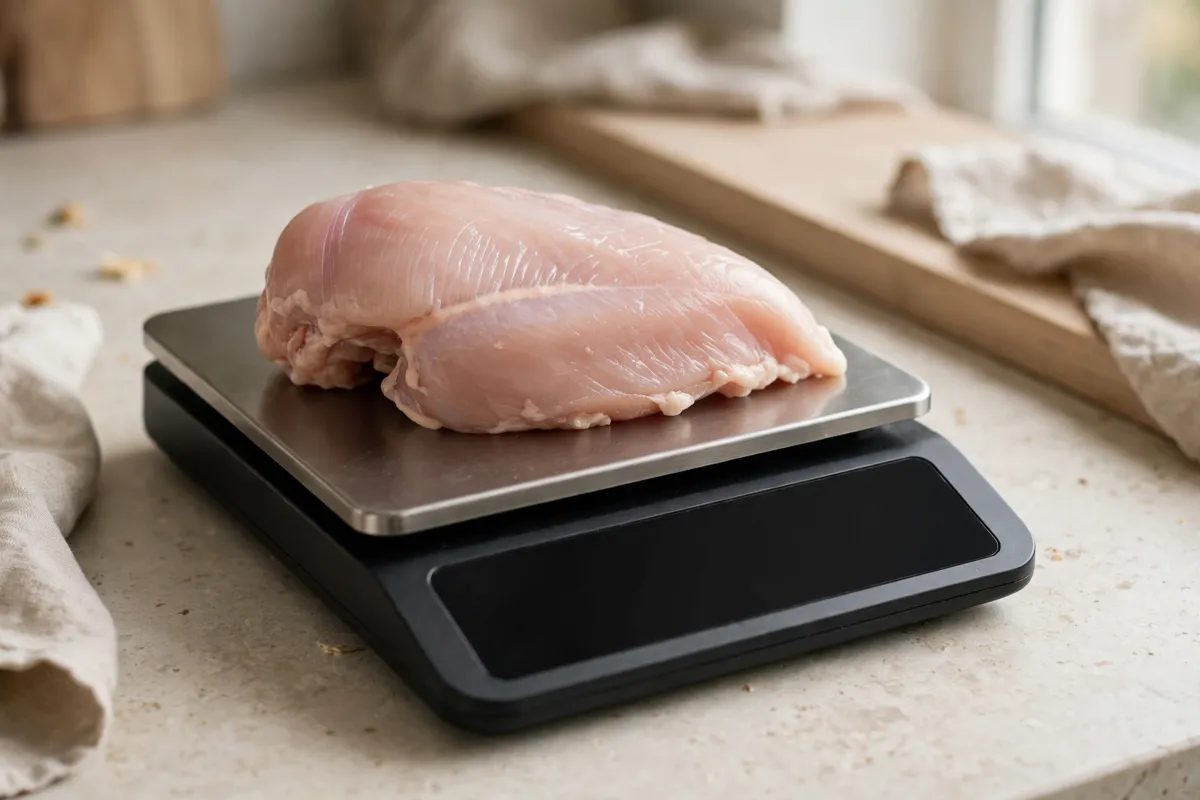
Chicken Protein Calculator: The Short Answer
An average chicken breast weighs 172 grams on the USDA's reference basis — the FoodData Central roasted breast entry (FDC ID 171477) sets one half breast, bone and skin removed, at 86 grams, so a whole breast portion is 172g (derived, 2 × 86g), deriving to 283.8 calories and 53.4g protein cooked. Retail breasts in modern shops are frequently larger than that reference, sometimes much larger, and this article separates the verified anchor from the kitchen reality so both can be used honestly.
That separation is the whole answer. The USDA figure is a portion definition from the reference entry, not a survey of today's meat counter, and presenting any single "average supermarket breast" weight as a USDA fact would be inventing data. What can be done — and is done below — is to price the scale itself: every 100 grams of cooked breast is 165 calories and 31.02g protein, so whatever your breast weighs, its nutrition is one multiplication away. The chicken protein calculator performs that multiplication at any weight you enter.
Short Answer
The USDA reference breast weighs 172g cooked (two 86g half-breast portions, FDC 171477), deriving to 283.8 calories and 53.4g protein. One half breast — the piece most people call "a chicken breast" at the table — weighs 86g by the same entry, at 141.9 calories and 26.7g protein. Shop breasts vary widely around the reference; weigh yours and scale at 165 calories per 100g.
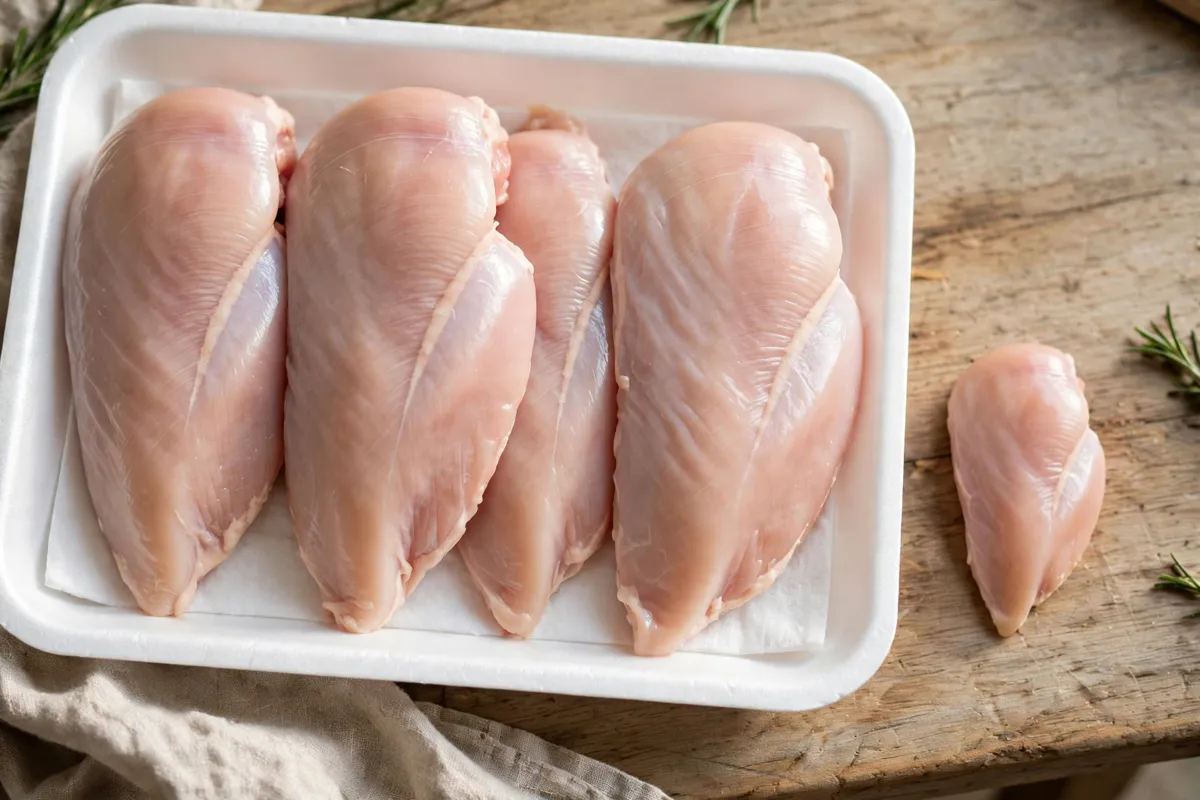
What Exactly Is the 86-Gram Half Breast?
The entry is "Chicken, broilers or fryers, breast, meat only, cooked, roasted" (FDC 171477), and its portion table lists 0.5 breast, bone and skin removed, at 86 grams. Two features of that line deserve emphasis. First, it is cooked weight — the entry describes roasted meat as eaten, water already lost in the oven — so the raw breast it came from weighed roughly a third more. Second, it is meat only: no bone, no skin, so the 86 grams are entirely edible meat, unlike a bone-in piece whose scale weight overstates what is eaten.
Doubling the half gives the 172-gram whole-breast reference (derived), and the ladder from the same entry prices every step around it: 100 grams at 165 calories and 31.02g protein; 140 grams (the entry's 1-cup chopped-or-diced portion) at 231.0 calories and 43.4g protein; 226.8 grams (8 ounces) at 374.2 calories and 70.4g protein; a pound (453.6g) at 748.4 calories and 140.7g protein. Against that ladder, any real breast finds its price by its weight alone. How many calories are in 1 pound of chicken breast works the top of the ladder for batch cooking.
Why Are Shop Breasts Often Bigger Than the Reference?
Because the reference is a standard portion, and the modern bird is not standard. The FDC portion reflects the reference bird the dataset was built around; commercial breeding and retail presentation have since pushed breast sizes up, and a single packaged breast fillet today commonly outweighs the 172g whole reference — sometimes approaching double it. This article deliberately attaches no invented gram figure to "the modern average": no USDA source logged here surveys current retail weights, and a made-up average would be worse than none. The labelled kitchen reality is a range of variation around the anchor, and the correct response to variation is a scale, not a better guess.
The practical consequences run in both directions. A cook who logs a large fillet as "one breast = 283.8 calories" may understate the meal by 100 to 200 calories; a cook who logs a small 86g half breast as a whole breast overstates by half. Both errors vanish under one habit: weigh the cooked meat once, in grams, and multiply by 1.65 for calories and 0.3102 for protein. Should I weigh chicken raw or cooked settles which side of the oven the weighing belongs on for these entries — the cooked side — and the raw-to-cooked shrink is roughly a quarter to a third of the raw weight, which is why the two weights must never be mixed.
How Do You Price a Breast of Any Weight?
The method is three steps and one multiplication table. Weigh the cooked, skinless meat in grams. Multiply grams by 1.65 for calories, by 0.3102 for protein grams, by 0.0357 for fat grams — the per-gram rates of entry 171477. Read the result as the portion's nutrition. Worked examples across the realistic range:
Notice what the table teaches: the difference between the smallest and largest realistic breast is about 270 calories and 51 grams of protein — an entire meal's worth of protein hiding inside the phrase "a chicken breast." No average, reference or modern, can absorb a spread that wide, which is why this series prices chicken by weight everywhere, including the chicken protein calculator, and treats piece counts as serving suggestions rather than measurements.
A shared fillet makes the method concrete. Take the large 250g fillet from the table — 412.5 calories and 77.6g protein whole — and cut it for two people: each half is 125 grams, deriving to about 206.3 calories (125 × 1.65) and about 38.8g protein (125 × 0.3102). Logged instead as "one reference breast each," the same two plates would be overstated by about 77 calories and 14.6 grams of protein apiece — the price of pricing a shared piece by its name rather than by its halves' weights.
- A small half breast at 86g: 141.9 calories, 26.7g protein, about 3.1g fat
- A 120g fillet: 198.0 calories (120 × 1.65), 37.2g protein (120 × 0.3102)
- The 172g reference whole breast: 283.8 calories, 53.4g protein
- A large 250g fillet: 412.5 calories (250 × 1.65), 77.6g protein (250 × 0.3102)
- An 8-ounce portion at 226.8g: 374.2 calories, 70.4g protein
Does the Weight Include Bone and Skin?
The reference weights do not — and this is the second great source of error. Entry 171477 is meat only, bone and skin removed, so its 86g and 172g are pure meat. A bone-in, skin-on breast piece on a scale weighs substantially more than its meat content, and logging the full scale weight at meat-only rates overstates calories and protein by the weight of bone and skin. The skin alone changes even the meat's own rate: breast roasted with skin (FDC 171075) runs 197 calories per 100g against the skinless 165, because the skin's fat permeates the portion as logged in that entry.
For bone-in pieces, the workable method is to weigh the meat you eat — after cooking, slipped off the bone — or to weigh the piece, eat it, and weigh the bones and skin left behind, logging the difference at the meat-only rate. It sounds fussy and takes ten seconds, and it converts the least reliable portion in home cooking ("one breast piece") into the most reliable (a gram weight). The same discipline serves every part: the thigh's reference is 116g skinless, the drumstick's 96g, each defined meat-only for the same reason.
Common Mistakes to Avoid
- Logging any shop breast as the 172g reference — modern fillets vary widely around it, and the spread is worth up to about 270 calories
- Quoting a single "modern average" gram weight as if a source published it — the verified anchor is the FDC portion; the rest is your scale's job
- Weighing bone-in, skin-on pieces at meat-only rates, which credits you with protein sitting in bone and skin you will not eat
- Mixing raw and cooked weights: the entries are cooked, and raw meat weighs roughly a quarter to a third more
- Splitting a large fillet "in half" by eye for two servings — halves of an irregular fillet are rarely halves by weight
Final Thoughts
An average chicken breast weighs 172 grams on the only verified basis available — the USDA reference of two 86-gram half breasts — deriving to 283.8 calories and 53.4g protein cooked and skinless. Real breasts scatter widely around that anchor, so treat the reference as the ladder's centre, weigh your own, and scale at 165 calories per 100g. The chicken protein calculator turns any weight you read off the scale into the full profile.
People Also Ask
How Many Ounces of Chicken Make One Serving?
One serving of chicken is 3 to 4 ounces cooked — the standard guidance range, and the USDA's own reference portions land inside it: the half-breast portion is 86 grams, about 3 ounces, deriving to 141. 9 calories and 26. 7g protein (FDC ID 171477).
How Many Chicken Thighs Should You Serve Per Person?
Serve 2 chicken thighs per person for a main course — one skinless thigh at the USDA portion of 116 grams delivers 28. 7 grams of protein at 207. 6 calories (derived from FDC ID 172388), so one thigh suits a light plate or a lunch portion, while two thighs deliver 57.
How Long Does It Take to Lose 30 Pounds?
Losing 30 pounds safely takes about 30 to 50 weeks for most people — roughly seven to twelve months — at a deficit of 300 to 500 calories a day and a loss rate of 0. 5 to 1% of body weight per week. A person starting at 250 pounds can be at the faster end of that range; someone starting at 160 pounds should expect the slower end, and both timelines are successes.
How to Calculate Your Weight-Loss Percentage?
To calculate your weight-loss percentage, divide the weight you have lost by your starting weight and multiply by 100: (starting weight − current weight) ÷ starting weight × 100. Losing 6 kg from a 90 kg start is (6 ÷ 90) × 100 = 6. 7% — and percentages matter because they are the fair way to compare progress between different-sized bodies and the unit the safe rate of 0.