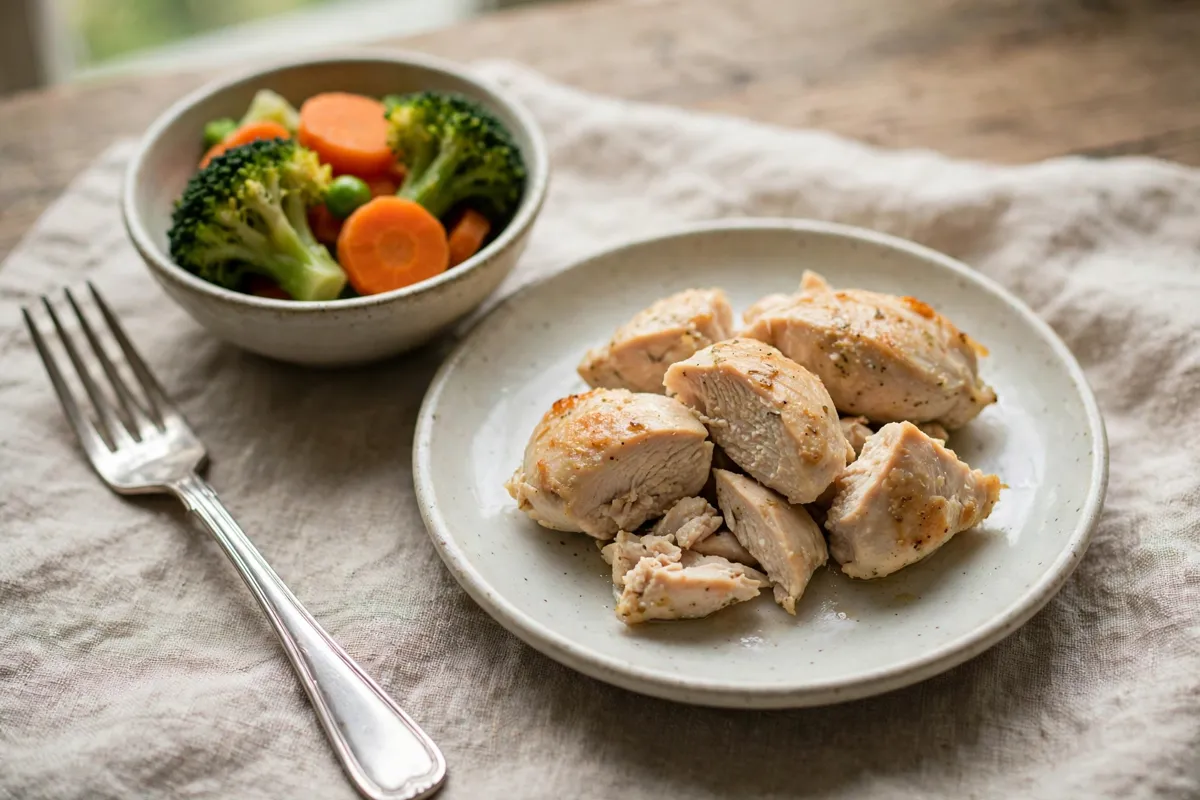
Chicken Protein Calculator: The Short Answer
Three ounces of chicken looks like a deck of playing cards — a portion of cooked meat (85.1 grams) about the size and thickness of a card deck, or the palm of an average hand without the fingers, deriving to 140.3 calories and 26.4g protein for breast meat (USDA FDC ID 171477). This article builds that visual from several angles — cards, palm, everyday objects — and prices what the portion delivers, so you can plate it accurately when no scale is near.
Visual portioning is an estimation skill, and it is honest about its error bars: an eye trained against a scale a few times plates within a comfortable margin, while an untrained eye routinely misses by half. The visuals below are the standard ones portion guides use, each tied back to the verified weight so the picture and the number correct each other. Once you know the weight, every portion converts in the chicken protein calculator.
Short Answer
3 ounces of cooked chicken is 85.1 grams — visually, a deck of playing cards in footprint and thickness, or your palm (fingers excluded). For breast meat it derives to 140.3 calories, 26.4g protein and about 3.0g fat (FDC 171477). It matches the USDA's own reference portions: the 86g half breast and the 85g 3-ounce portions listed across the part entries.
What Are the Reliable Visual Comparisons?
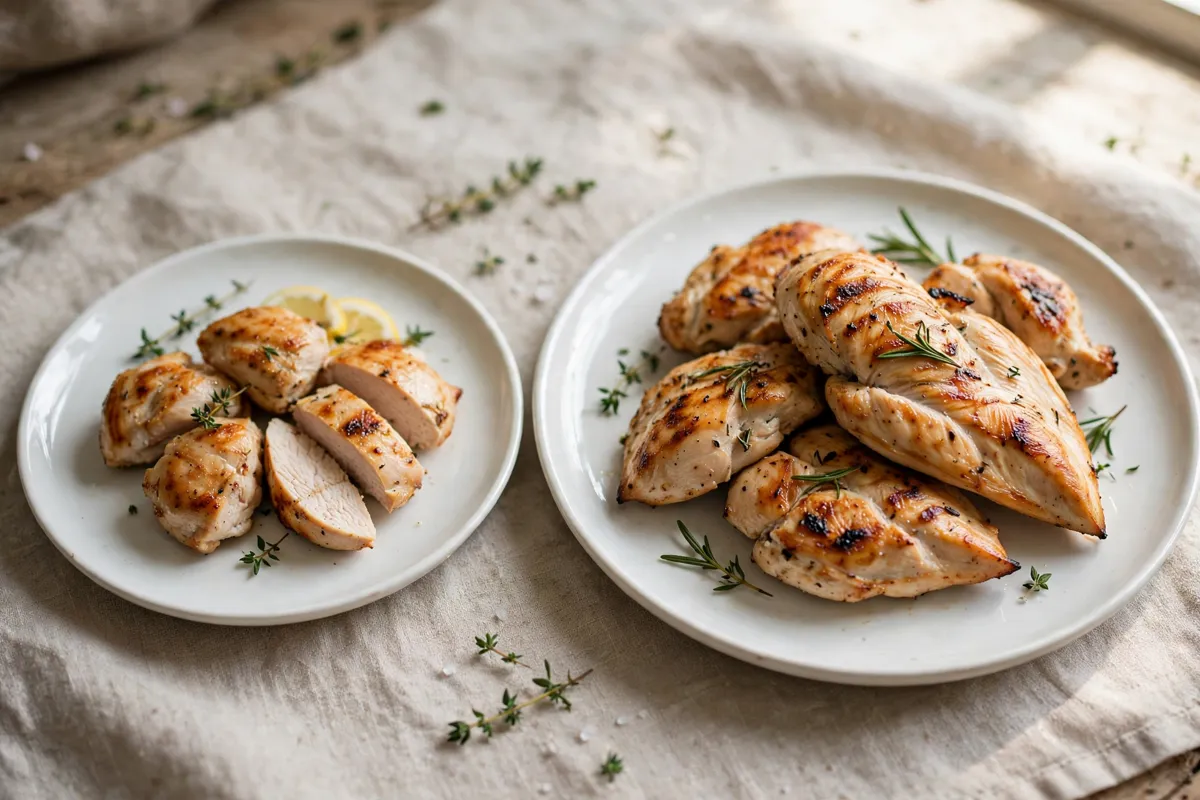
The deck of cards is the classic because its dimensions are fixed and familiar: a standard deck is roughly the footprint of a 3-ounce portion of sliced or flattened meat, and about its thickness when the meat is cut in a single layer. Spread 85 grams of cooked breast slices on a plate and they cover a card deck's outline — no more plate than that. The palm comparison personalises the same idea: the flat of your palm, heel to finger base, fingers not included, approximates 3 to 4 ounces for an average adult hand — 3 ounces at the smaller end, which is why the palm is usually quoted as the 3-to-4-ounce serving visual.
Other household anchors help at the table:
Each visual is an approximation wearing a number's clothing, and the number — 85.1 grams — is the one to calibrate against. Plate what looks like a deck, weigh it once or twice at home, and adjust the picture your eye keeps. After a few calibrations, the deck you imagine and the 85 grams on the scale become the same portion, which is the entire point of the exercise. Why do portion sizes matter explains what consistent estimation buys across a whole diet.
- A smartphone's face is nearer 4 to 5 ounces of meat coverage — size up from the deck, not down
- A chequebook or a standard bar of soap matches the deck's footprint closely enough for a second opinion
- A tennis ball describes volume better than flat meat portions — better used for scoops and diced piles
- Diced, 3 ounces of breast is a modest handful — noticeably less than a cup, since a full cup of diced breast weighs 140 grams (about 4.9 ounces)
What Does the 3-Ounce Portion Deliver Nutritionally?
From the breast entry, per 100 grams: 165 calories, 31.02g protein, 3.57g fat, 0g carbohydrate, 74mg sodium. Scaled to 85.1 grams: 140.3 calories, 26.4g protein, about 3.0g fat, about 63mg sodium, about 218mg potassium. Against a typical per-meal protein target of 30 to 40 grams, the 3-ounce portion is the floor's neighbour — a full anchor for a smaller meal, a supporting portion where beans, grains or dairy add their grams alongside. Against a 2,000-calorie day, it is 7% of the budget carrying about half of a 56-gram baseline protein day for a 70kg adult at 0.8g per kilogram — an efficiency few portions match.
Other parts at the same 3 ounces shift the delivery modestly. Thigh meat (85g is its own listed portion, FDC 172388) derives to about 152.2 calories and 21.0g protein — five fewer protein grams, twelve more calories, more fat at about 6.9g. The drumstick's 3-ounce equivalent derives from its entry (172376) to about 131.8 calories and 20.6g protein. The visuals do not change with the part — a deck is a deck — but the log entry must, which is why this series always names the cut beside the picture. The full calorie ladder around this portion is priced in how many calories are in 3 ounces of chicken.
How Do You Plate 3 Ounces Without a Scale?
Build the plate in three habits. First, use the deck as a template at serving time: cut or select meat to cover an imaginary deck's outline in a single, even layer — slices fanned across a salad should roughly tile that footprint, not mound above it. Second, correct for thickness: the deck comparison assumes the meat lies about as thick as the deck itself; a thick, uncut breast portion covering the same outline weighs more, sometimes 4 to 5 ounces, so butterfly or slice thick pieces before judging by footprint. Third, sanity-check against the piece in front of you: the USDA half breast is 86 grams — almost exactly 3 ounces — so half of a reference-size breast is the portion, and half of a large modern fillet is not; it may be 4 to 5 ounces, a fine serving that should be logged as what it is.
Diced and shredded servings judge by volume instead: 3 ounces of diced breast is about 0.6 of a cup (85.1 ÷ 140 grams per cup), a level two-thirds cup being the practical measure. In a restaurant, where portions run large, the visual works in reverse — the meat covering two decks is a 6-ounce portion deriving to about 280.7 calories and 52.8g protein of breast, and logging it as such turns a surprise into a plan. Every one of these estimates improves with one home calibration, and the chicken protein calculator converts whichever weight your calibration settles on.
When Is 3 Ounces the Right Portion — and When Is It Not?
Three ounces is right when the meal carries other protein, when the eater is smaller or less active, when chicken appears twice in the day and neither appearance needs to anchor alone, and when the meal's design is a tasting of several dishes rather than one centrepiece. It is the dataset's own reference scale — the 3-ounce portion appears across the part entries — because it suits the statistical middle of eaters and meals.
It is not enough when chicken is the meal's only protein and the target is 35 to 40 grams (choose 4 to 4.5 ounces of breast), when the eater is large or training hard, or when the "3 ounces" on the plate is actually a thick fillet portion misjudged by footprint. And it is more than needed in a wrap or salad where beans, cheese and grains quietly assemble 15 grams of protein around a 2-ounce chicken layer. The portion is a tool with a verified weight; the meal decides how much of the tool to use.
Common Mistakes to Avoid
- Including your fingers in the palm visual — the comparison is palm only, and fingers add a phantom ounce or two
- Judging a thick fillet by footprint alone: thickness is the hidden variable, and an uncut thick portion at deck footprint can weigh 5 ounces
- Treating a heaped dice pile as the level 0.6-cup the weight describes
- Logging thigh or drumstick portions at breast values — same look, roughly 5 fewer grams of protein at 3 ounces
- Never calibrating: the visuals are estimates until a scale has corrected them a few times
Final Thoughts
Three ounces of chicken looks like a deck of playing cards — 85.1 grams of cooked meat, palm-sized without the fingers — and delivers 26.4g protein at 140.3 calories from breast. Learn the picture once against a scale and it serves you at every table where a scale cannot go. The weight behind the picture converts at any size in the chicken protein calculator.
People Also Ask
How Many Calories Are in One Cup of Chicken?
One cup of cooked chicken breast contains 231 calories. That is USDA FoodData Central's own portion doing the work: the roasted chicken breast entry (FDC ID 171477) lists one cup, chopped or diced, at 140 grams, and at 165 calories per 100 grams the cup works out to 231 calories in one cup of chicken — along with 43. 4 grams of protein, which is why this particular cup is a fixture of meal-prep culture.
How Much Chicken Should You Prepare Per Person?
Prepare about 4 ounces of cooked chicken per person for a main course — roughly 113 grams — which means one standard chicken breast portion for every two people, or about half a pound of raw boneless chicken per person once cooking shrinkage is counted. Scaled up, how much chicken you should prepare per person is: one USDA whole-breast portion (172 grams cooked) generously serves one hungry adult or covers one adult plus a child; two breasts cover three to…
What Is a Balanced Diet?
A balanced diet is an eating pattern that provides all the nutrients your body needs, in the right proportions, from the five food groups — fruits, vegetables, grains, protein foods and dairy. On the USDA 2,000-calorie MyPlate pattern that means 2 cups of fruit, 2. 5 cups of vegetables, 6 ounce-equivalents of grains, 5.
What Are the Five Food Groups?
The five food groups are fruits, vegetables, grains, protein foods and dairy — the USDA MyPlate groups. On the 2,000-calorie MyPlate pattern the daily amounts are 2 cups of fruit, 2. 5 cups of vegetables, 6 ounce-equivalents of grains, 5.