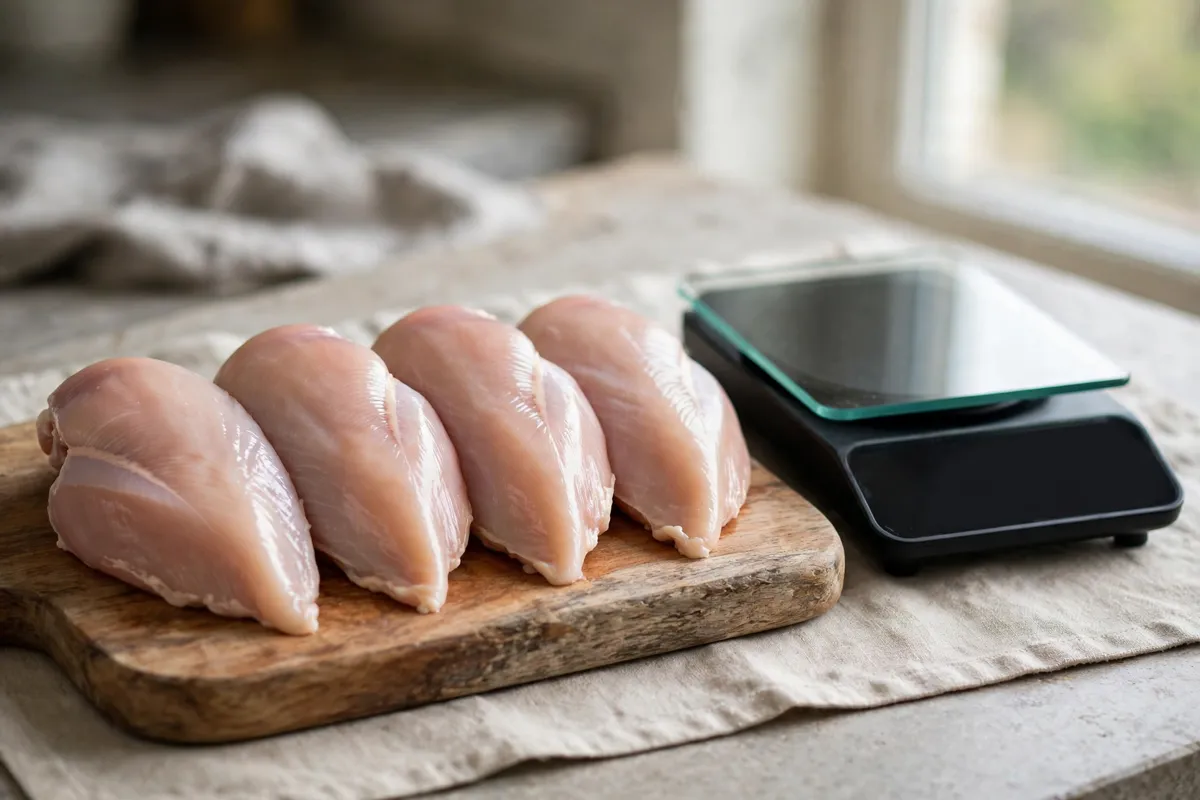
Chicken Protein Calculator: The Short Answer
One pound of cooked, boneless, skinless chicken breast has about 748 calories. The exact USDA-derived figure is 748.4 calories for 453.6 grams, worked from the roasted breast entry in USDA FoodData Central (FDC ID 171477), which lists 165 calories per 100 grams — so the calories in 1 pound of chicken breast are simply that per-100g rate multiplied by 4.536.
A pound is a meal-prep quantity, not a single serving, and that is exactly why this question matters: people buy chicken breast by the pound, cook it in a batch, and then need to know what the batch contributes to the week. This article shows where 748.4 comes from, how a pound divides into the portions you actually eat, what the same pound delivers in protein and fat, and the weighing mistakes that make a pound come out wrong on paper. You can check any weight of your own in the chicken protein calculator once you know the per-100g starting point.
Short Answer
A pound (453.6g) of cooked, boneless, skinless chicken breast contains 748.4 calories, 140.7g of protein and about 16.2g of fat, derived from the USDA roasted breast entry at 165 calories and 31.02g of protein per 100g. Weighed raw, or cooked with the skin on, the same shopping-basket pound gives a different answer, because both the weight and the per-100g rate change.
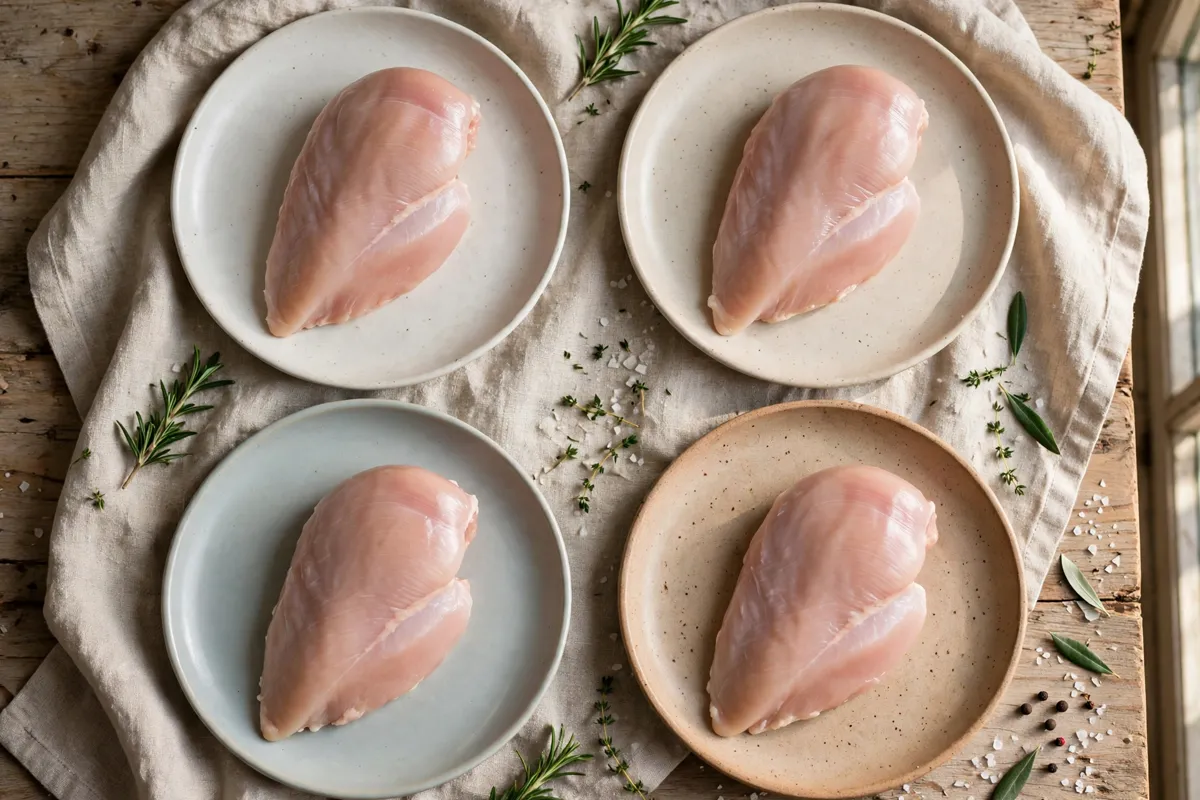
Where Does the 748.4 Figure Come From?
USDA FoodData Central's entry for chicken breast, meat only, cooked and roasted (FDC ID 171477) lists 165 calories, 31.02g of protein, 0g of carbohydrate and 3.57g of fat per 100 grams. One pound is 453.6 grams, so the pound's calories are 453.6 × 1.65 = 748.4. The protein follows the same way: 453.6 × 0.3102 = 140.7g. Nothing else is hiding in the number — breast meat carries no carbohydrate at all on this entry, so every calorie in the pound comes from its protein and its modest fat.
That transparency is worth using. Because the whole calculation is one multiplication, you can audit any other source against it: if a label or an app gives a wildly different figure for plain cooked breast, it is usually pricing a different thing — raw meat, skin-on meat, or meat with a sauce or coating already included. The site's breakdown of calories in 100 grams of chicken breast walks through the same base entry in the other direction, starting from 100g and scaling up.
How Does a Pound Divide Into Portions You Actually Eat?
Nobody sits down to a pound of chicken breast, so the useful question is what the pound becomes across a day or a week of meals. The USDA entry's own portion sizes make the division clean:
That four-way split is why the pound is such a convenient prep unit. Cook a pound on Sunday and you hold four measured lunches at 187.1 calories each, or two generous dinners at 374.2. The arithmetic stays honest only if the cooked pound is divided by weight, not by eye: four piles that look equal can easily differ by an ounce each, and an ounce of this meat is 46.8 calories, so eyeballing can move 40–50 calories between portions without anyone noticing.
- One half breast (the FDC portion, 86g) = 141.9 calories and 26.7g protein — a pound holds a little over five of these
- One whole standard breast (172g, two FDC half portions) = 283.8 calories and 53.4g protein
- A 4-ounce serving (113.4g) = 187.1 calories and 35.2g protein — the pound divides into exactly four of these, and 4 × 187.1 = 748.4 confirms the total
- An 8-ounce serving (226.8g) = 374.2 calories and 70.4g protein — exactly half the pound, on both numbers
What Else Does the Pound Deliver Besides Calories?
Protein is the headline: 140.7g across the pound is more than many people target in an entire day, delivered with only about 16.2g of fat (453.6 × 0.0357, from the entry's 3.57g per 100g). The entry also lists 74mg of sodium and 256mg of potassium per 100g, which scale to roughly 336mg of sodium and 1,161mg of potassium across the full pound — modest sodium for over 450 grams of meat, because plain breast is unprocessed and unsalted until you season it yourself.
Set the pound beside the day it has to fit into. As four 4-ounce portions spread across four meals or four days, each appearance costs 187.1 calories — a light, protein-heavy building block that leaves most of a meal's budget for grains, vegetables and fats. Eaten as two 8-ounce portions, each costs 374.2 calories and delivers 70.4g of protein in one sitting, which suits someone concentrating protein into fewer, larger meals. The pound itself does not change; only the portioning decision does. Working out how much chicken a protein target actually requires is the subject of how much chicken you need for 100g of protein — a pound of breast overshoots that 100g milestone by about 40g.
Does It Matter Whether the Pound Was Weighed Raw or Cooked?
It matters enormously, and it is the single biggest source of error with this question. The 748.4 figure prices a pound of cooked meat, because the USDA entry describes meat after roasting. Chicken breast loses water as it cooks, so a pound of raw breast becomes noticeably less than a pound on the plate — and if you log the cooked plate-weight against a raw-weight assumption, or the raw purchase-weight against this cooked entry, the two errors compound.
The clean habits are simple. If you buy a pound raw and cook the whole batch, weigh the cooked batch once, then log portions of the cooked weight against the cooked entry: the batch total is still anchored to the meat you bought, and each portion is priced correctly. If you cook a single breast, weigh it cooked and use the cooked figures. What you must not do is take the raw "1 lb" printed on the packet, eat the cooked meat, and record 748.4 calories — you ate less than a cooked pound, so you ate fewer calories than that. The deeper version of this trap, with the maths for converting between the two states, is covered in weighing chicken raw or cooked.
How Do Other Cooking Methods Change the Same Pound?
The 748.4 figure belongs to dry-heat cooking: the roasted entry is USDA's dry-heat breast entry, and there is no separate grilled or baked breast entry in the dataset, so those methods share this basis. Moist heat prices lower per gram. The stewed breast entry (FDC ID 171478) lists 151 calories per 100g, because meat simmered in liquid takes up water as it cooks; a cooked pound produced that way would come out lower per 100g of finished meat. Frying prices higher: the fried breast entry (FDC ID 171078), meat only with no breading, lists 187 calories per 100g, reflecting fat taken up and water driven off in the pan.
Skin changes the rate too. Breast roasted with its skin (FDC ID 171075) lists 197 calories per 100g against 165 skinless — the skin carries fat, and a pound that keeps it is a different food from the pound this article prices. The lesson is not that one method is "right," but that "a pound of chicken breast" is incomplete as a question until the cooking method and the skin are specified. State both, and the per-100g rate — and therefore the pound — follows.
Common Mistakes to Avoid
The classic mistake is logging a raw packet pound as a cooked pound, which overstates the meal by the whole cooking loss. Second is assuming the skin makes little difference: at 197 versus 165 calories per 100g, a skin-on pound carries roughly a fifth more energy. Third is dividing a cooked batch by eye into "equal" portions and logging each as exactly a quarter — weigh the portions, because an ounce is 46.8 calories. Fourth is importing a calorie figure for breaded or sauced chicken and applying it to plain breast; plain breast has 0g of carbohydrate, so any entry showing significant carbs is pricing a coating or a sauce, not the meat. Finally, do not average the raw and cooked answers together as a compromise — pick the entry that matches the state of the meat you weighed, every time.
Final Thoughts
One pound of cooked, boneless, skinless chicken breast is 748.4 calories and 140.7g of protein, from a base rate of 165 calories per 100g that you can verify against USDA FoodData Central in one multiplication. Divided into four 4-ounce portions it becomes four 187.1-calorie building blocks; kept whole in your planning, it is one of the leanest ways to buy protein by weight. Weigh it in the state you log it, keep the skin decision explicit, and run your own batch weights through the chicken protein calculator for the exact portion on your plate. Large boneless, skinless chicken breast gets the same treatment, with its calories counted in full.
People Also Ask
How Many Calories Are in Half a Chicken Breast?
Half a chicken breast has about 142 calories. Precisely, the USDA portion for half a breast — 86 grams of cooked, boneless, skinless meat — works out to 141. 9 calories, from the roasted breast entry in USDA FoodData Central (FDC ID 171477) at 165 calories per 100 grams.
How Many Calories Are in Two Chicken Breasts?
Two chicken breasts have about 568 calories. The precise figure is 567. 6 calories for two standard whole breasts — 344 grams of cooked, boneless, skinless meat — derived by doubling the USDA roasted breast entry (FDC ID 171477), where one 172-gram breast provides 283.
What Is a Calorie Deficit?
A calorie deficit is the state of eating fewer calories than your body burns — your intake sits below your maintenance calories, so your body covers the gap from stored energy, mostly body fat. A typical working deficit is 300 to 500 calories a day: eat 2,000 while burning 2,400 and the 400-calorie daily gap, repeated, is what produces weight loss at roughly 0. 8 pounds a week.
How to Calculate a Calorie Deficit?
To calculate a calorie deficit, subtract your planned intake from your maintenance calories: deficit = TDEE − intake, where TDEE comes from the Mifflin-St Jeor equation times your activity factor. Choose a deficit of 300 to 500 calories a day — for example, maintenance of 1,943 minus an intake of 1,500 gives a deficit of 443, predicting a little under a pound of fat loss a week.