Chicken Protein Calculator: The Short Answer
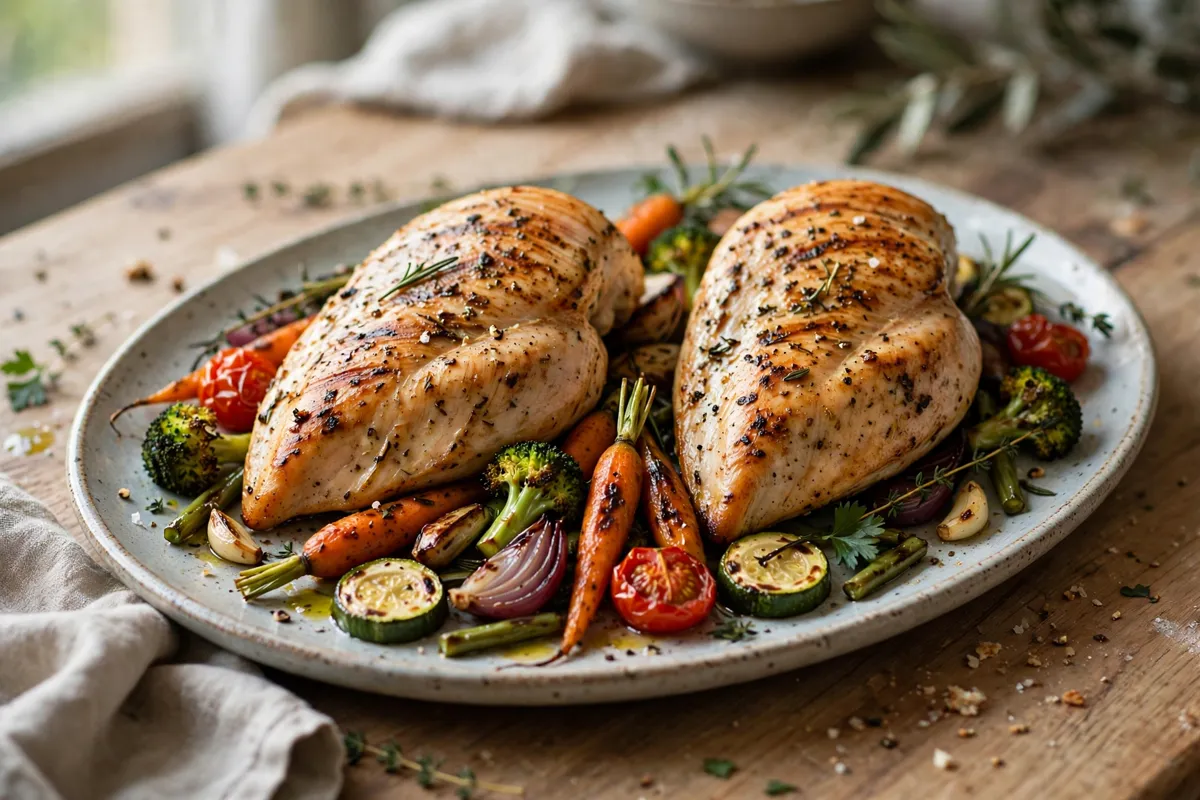
Two chicken breasts have about 568 calories. The precise figure is 567.6 calories for two standard whole breasts — 344 grams of cooked, boneless, skinless meat — derived by doubling the USDA roasted breast entry (FDC ID 171477), where one 172-gram breast provides 283.8 calories. So the calories in two chicken breasts are a straightforward doubling, provided the breasts are the standard size and cooked the same way.
"Two breasts" turns up in three different situations — a recipe written for a family, a meal-prep batch, and the occasional very committed single serving — and the answer behaves slightly differently in each. This article does the doubling honestly, shows how two breasts divide across people and days, compares the same two breasts under other cooking methods, and flags the size trap that makes real-world pairs of breasts drift away from 567.6. Any non-standard weight can be run through the chicken protein calculator using the same per-100g rate.
Short Answer
Two standard cooked chicken breasts (172g each, 344g total) contain 567.6 calories and 106.7g of protein. That is exactly twice one breast's 283.8 calories and 53.4g of protein, because both come from the same USDA entry at 165 calories and 31.02g of protein per 100g. Two unusually large breasts will exceed this — the rate per gram never changes, only the grams do.
How Is the Two-Breast Figure Built?
Start with the portion USDA actually publishes: half a breast, bone and skin removed, is 86g (FDC ID 171477). A whole breast is two of those halves, 172g, and its numbers are 172 × 1.65 = 283.8 calories and 172 × 0.3102 = 53.4g of protein. Two whole breasts are 344g, giving 344 × 1.65 = 567.6 calories and 344 × 0.3102 = 106.7g of protein. Every step is the same multiplication by the per-100g rate, which is why the figure is trustworthy — and also why it is fragile. Change any input, the size of the breasts or the cooking entry, and the output moves in direct proportion.
It is worth pausing on the protein total. At 106.7g, two breasts deliver, in two pieces of meat, more protein than the 100g milestone that many high-protein meal plans are built around — the planning question explored in how much chicken you need for 100g of protein, where the answer turns out to be a little under two standard breasts. If you have cooked two breasts, you have already passed that milestone before anything else joins the plate. How much to allow for each diner is worked out in chicken per person.
How Do Two Breasts Divide Across People and Days?
The same 567.6 calories read very differently depending on the split:
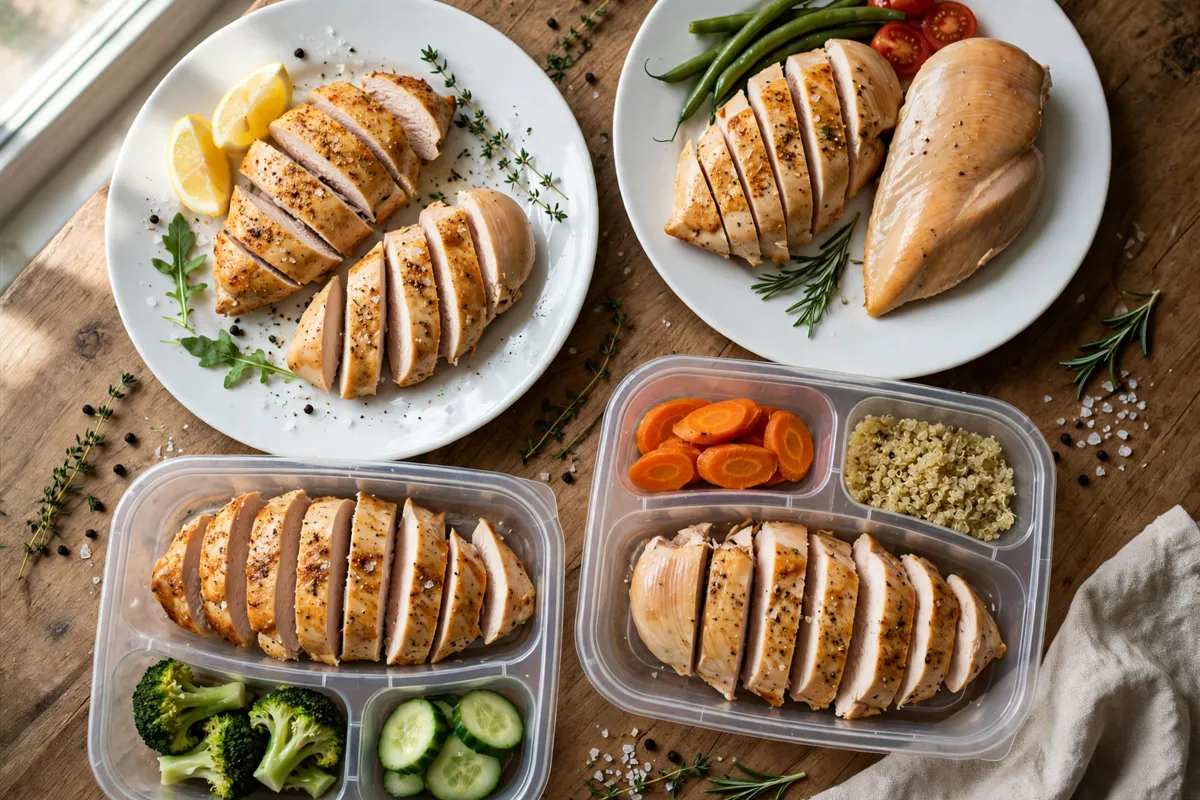
The family-dinner split is the one recipes assume: two breasts stretched across four plates as half-breast portions, with the rest of each plate — grains, vegetables, sauces — carrying most of the meal's calories. The one-sitting version is not absurd, but it is a lot of one food: 344 grams of meat, with only about 12.3g of fat (344 × 0.0357) and no carbohydrate at all, so the meal's balance has to come entirely from what accompanies it. Meal preppers live in the third row: two breasts cooked together, eaten as two measured meals, with the batch weighed once and split by scale rather than by guesswork. On dividing cooked batches fairly between portions, the worked examples in the chicken protein portions guide are built around exactly this kind of batch arithmetic.
- Two people, one breast each: 283.8 calories and 53.4g protein per person
- Four people, half a breast each: 141.9 calories and 26.7g protein per person
- One person, two sittings: 283.8 calories per meal, 106.7g protein across the day
- One person, one sitting: the full 567.6 calories and 106.7g protein at once
What If the Two Breasts Are Cooked Differently?
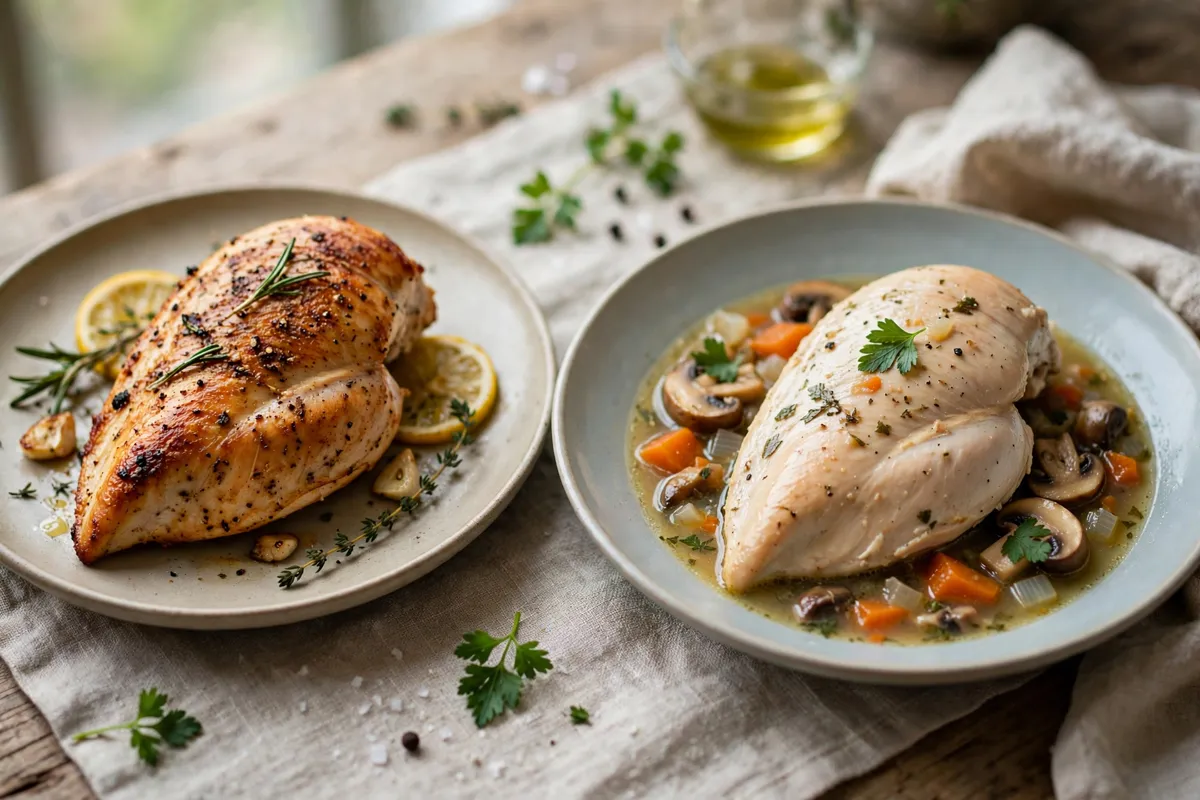
The 567.6 figure assumes roasting — USDA's dry-heat entry, which also stands in for grilling and baking, since the dataset publishes no separate entries for those methods. Under moist heat the per-100g rate falls: the stewed breast entry (FDC ID 171478) lists 151 calories per 100g, so 344g of stewed breast meat prices at about 519 calories (344 × 1.51) — lower per gram because the meat holds absorbed cooking water. Fried breast (FDC ID 171078), meat only and unbreaded, lists 187 calories per 100g, putting the same 344g at about 643 calories (344 × 1.87). Skin kept on during roasting prices from 197 calories per 100g (FDC ID 171075), which would take two skin-on breasts of the same meat weight higher still.
Notice what stays constant through all four versions: the protein barely moves relative to the calories. Stewed meat carries 28.98g of protein per 100g, roasted 31.02g, fried 33.44g — frying concentrates protein per gram by driving off water even as it adds fat calories. This is why "two chicken breasts" can honestly be answered anywhere across a band of roughly 520 to 645 calories once method enters the picture, and why the method belongs in the question. Whether cooking method genuinely changes the protein you get, beyond this per-gram concentration effect, is examined in does cooking method change chicken protein.
Why Do Real Pairs of Breasts Drift From 567.6?
Because retail breasts are not standardised at 172g cooked. The 172g whole breast is the USDA portion basis, a reference size — actual supermarket breasts, especially from large birds, frequently run heavier, and a pair of them cooked can total 450g or more. At the same 165-per-100g rate, 450g of cooked breast is 742.5 calories, a difference of about 175 calories from the headline figure with no change in the food itself, only in the size of the pieces.
The defence is weighing the pair, or the cooked batch, rather than counting pieces. "Two breasts" is a count; calories follow weight. Two small breasts at 140g each (280g total) price at 462 calories, two standard ones at 567.6, two large ones above 700 — a range wide enough to matter in anyone's day. The count tells you how many pieces are in the pan. Only the scale tells you what they cost.
What Else Do Two Breasts Bring to the Table?
Calories and protein dominate the question, but the pair carries the entry's micronutrient profile with it too. At 74mg of sodium per 100g, two standard breasts contribute about 255mg of sodium (344 × 0.74) — low for 344g of meat, because plain breast is unprocessed and carries no added salt until you season it. Potassium runs the other way: at 256mg per 100g, the pair provides about 881mg (344 × 2.56). Fat stays modest at about 12.3g across both breasts, and carbohydrate is zero. Read as a whole, the two breasts are a large amount of protein wrapped in a small amount of everything else — which is precisely their appeal in a prep batch, and precisely why the foods cooked alongside them decide whether the meals built on them stay balanced.
Common Mistakes to Avoid
Do not double a half-breast figure and call it two breasts: two halves are one breast (283.8 calories), and the error halves the log entry. Do not assume the two breasts in a packet are twins — weigh the pair together, since a large and a small breast average out only on the scale, not in a per-piece guess. Do not log the raw packet weight against the cooked entry; the pair loses water in the oven and the cooked weight is what the 165-per-100g rate describes. Do not carry the roasted figure over to fried or breaded chicken, where the per-100g rate is higher. And do not forget that two breasts eaten across two days are two meals of 283.8 — logging the whole 567.6 on day one corrupts two days' records at once.
Final Thoughts
Two standard cooked chicken breasts contain 567.6 calories and 106.7g of protein — a clean doubling of the 283.8-calorie single breast, derived from 165 calories per 100g in USDA FoodData Central. Split four ways they are a light family protein; eaten by one person they are a full day's protein milestone in a single food. The number is only ever as good as the weight behind it, so weigh the pair and scale from the per-100g rate, or let the chicken protein calculator do the multiplication for the exact grams in your pan.
People Also Ask
How Many Calories Are in a Large Boneless, Skinless Chicken Breast?
A large boneless, skinless chicken breast typically has between about 281 and 374 calories. That range comes from scaling the USDA roasted breast entry (FDC ID 171477, 165 calories per 100 grams) across the sizes large retail breasts actually reach — roughly 170 to 227 grams of cooked meat, which is 6 to 8 ounces. Anyone asking how many calories are in a large boneless, skinless chicken breast deserves that honest range first, because USDA publishes no official "large breast"…
How Many Calories Are in a Grilled Chicken Breast?
A grilled chicken breast has about 284 calories at the standard size. That figure — 283. 8 calories for a 172-gram cooked breast — comes from USDA's roasted breast entry (FDC ID 171477, 165 calories per 100 grams), because USDA publishes no separate grilled entry: its roasted entry is the dry-heat entry, and grilling is dry-heat cooking.
Is a 1,000-Calorie Deficit Too Much?
For most people, yes — a 1,000-calorie deficit is too much: it is double the standard 300 to 500 recommendation, it predicts about two pounds of loss a week, and that rate only stays within the safe 0. 5 to 1% of body weight per week for someone weighing at least about 200 pounds. For a smaller person maintaining on 1,900 calories, a 1,000 deficit means eating 900 — below every safe floor.
Is 1,400 Calories Enough?
Whether 1,400 calories is enough depends entirely on your maintenance: for a smaller, sedentary woman maintaining on about 1,650 calories a day, 1,400 is a gentle 250-calorie deficit and plenty; for an active woman or almost any man, it is a steep cut that lands near or below the safe floors of 1,200 for women and 1,500 for men. The number alone answers nothing — the comparison does.