Chicken Protein Calculator: The Short Answer
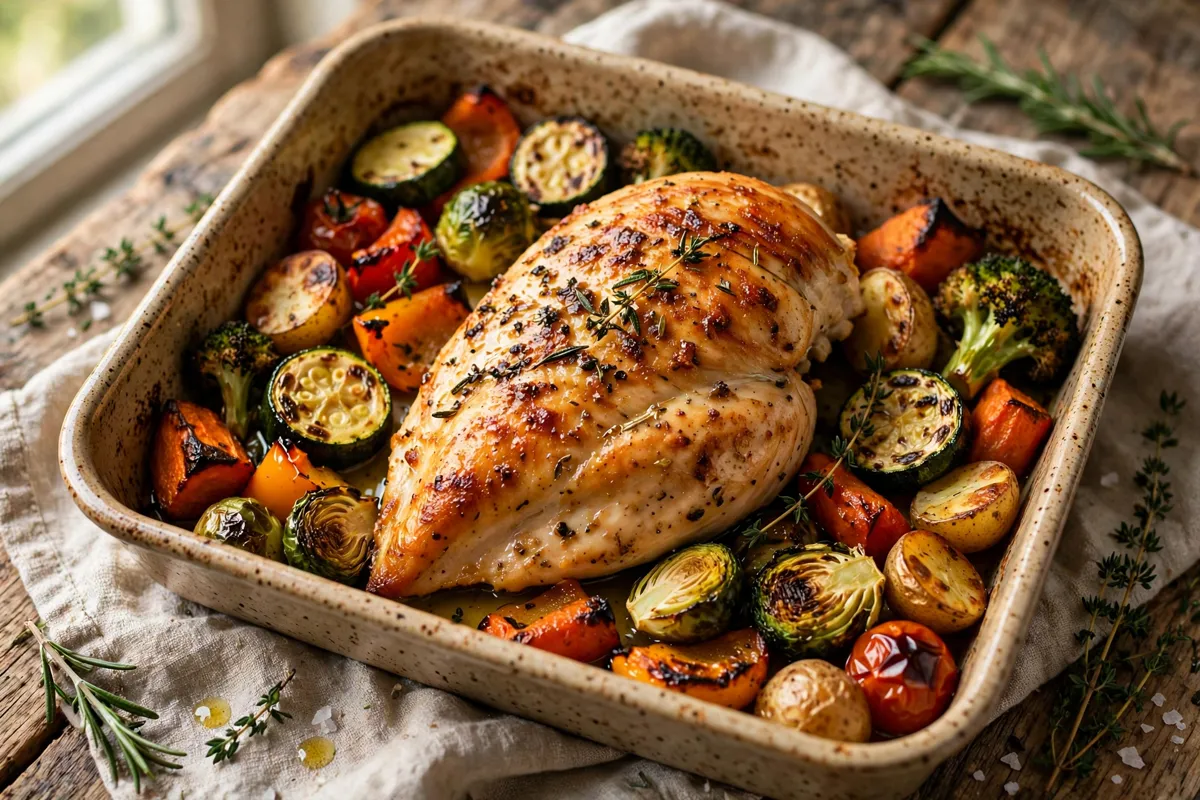
A baked chicken breast has about 284 calories at the standard size — 283.8 calories for a 172-gram cooked, boneless, skinless breast. Like grilling, baking has no separate entry in USDA FoodData Central; the figure comes from the roasted breast entry (FDC ID 171477) at 165 calories per 100 grams, because roasting is the dataset's dry-heat measurement and a home oven is dry heat. The calories in a baked chicken breast are therefore the roasted numbers, reached by the oven route.
Baking has its own practical wrinkles that grilling does not: juices pool in the dish, breasts bake covered or uncovered, and the skin question is decided before the tray goes in rather than at the table. This article works through the baked answer portion by portion, then spends its time on those oven-specific details — what the juices mean for the meat's weight, what covering the dish does and does not change, and how skin-on baking reprices the same bird. Your own tray weights can be checked in the chicken protein calculator.
Short Answer
A standard baked chicken breast (172g cooked, skinless) contains 283.8 calories and 53.4g of protein on the USDA roasted basis of 165 calories per 100g. A half breast (86g) is 141.9 calories; a 4-ounce portion is 187.1; each cooked ounce is 46.8 calories. Baking covered or uncovered does not earn a different entry — the meat's cooked weight is what the rate applies to.
Why Does the Oven Inherit the Roasted Entry?
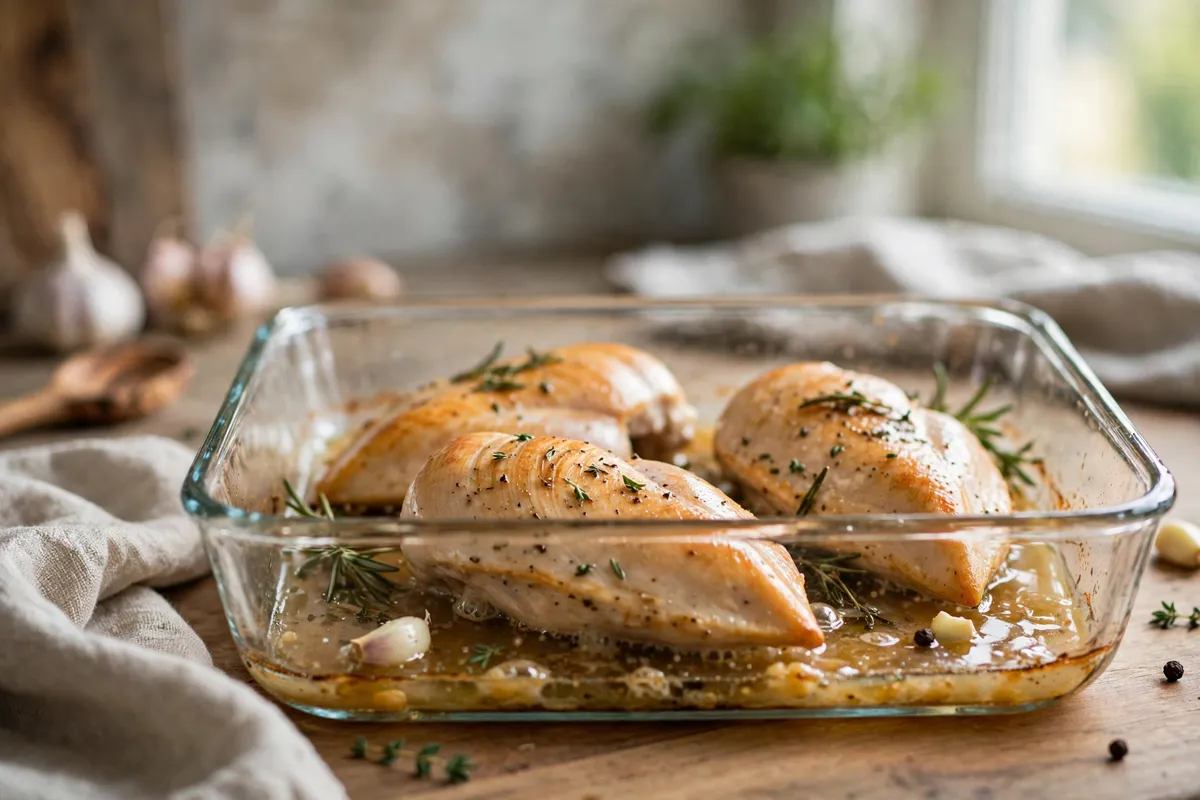
"Roasted" in the USDA dataset names a method family, not a restaurant technique: meat cooked uncovered in dry oven heat. A home cook who puts a skinless breast on a tray at a high temperature is performing exactly that, whatever the recipe card calls it. The analysis behind the entry (FDC ID 171477) — 165 calories, 31.02g protein, 3.57g fat and 0g carbohydrate per 100g of cooked meat — describes the meat that comes out of dry heat, and baked breast is that meat.
It helps to see the whole family at once. USDA gives breast meat three cooked treatments: roasted at 165 calories per 100g, stewed at 151, fried at 187. Baking, grilling and air-cooking all belong to the first column; simmering and poaching to the second; the pan with added fat to the third. When a recipe site quotes a baked-specific number far from 165 per 100g, it is usually pricing something else — a breading, a sauce, a raw weight — rather than the plain baked meat. The base entry's own story is told in calories in 100 grams of chicken breast.
What Are the Calories at Each Baked Portion?
Baked breasts are portioned in two common ways — by the piece and by the slice — and the entry prices both:
The cup measure is the baked breast's second life: yesterday's baked breast, diced into pasta, soup or salad, is logged by the cup far more often than by the piece. At 231.0 calories per cup, two cups folded into a family pasta dish contribute 462 calories of chicken across the pot (2 × 231.0) before pasta, oil or cheese enter the reckoning — a useful order of operations when a recipe's total has to be divided honestly among servings. The piece measures govern the night it is baked; the cup measure governs the leftovers, and both come from the one entry.
- Half a breast, 86g = 141.9 calories and 26.7g protein
- 4 ounces, 113.4g = 187.1 calories and 35.2g protein
- A whole standard breast, 172g = 283.8 calories and 53.4g protein
- 8 ounces, 226.8g = 374.2 calories and 70.4g protein
- 1 cup chopped or diced, 140g = 231.0 calories and 43.4g protein
What Do the Juices in the Baking Dish Mean?
A baked breast sits in, and sheds, liquid. That liquid is mostly water with dissolved protein and the meat's small fat content in suspension, and its existence explains the weighing rule for baked meat: weigh the meat, not the meat plus its juices, unless you actually consume the juices as part of the dish. The 165-per-100g rate describes the cooked meat itself. If the juices go over rice or vegetables that you eat, a small share of the tray's nutrition travels with them — but the bulk of what left the meat was water, which is why cooked weight, not raw weight, remains the number to log.
Covering the dish changes texture more than nutrition. A covered breast steams in its own moisture and may finish a few grams heavier than an uncovered one that dried at the edges; an uncovered breast concentrates slightly. Both are still dry-heat-oven meat for pricing purposes, because the dataset draws its line between the oven family and the simmering family — the stewed entry at 151 calories per 100g is for meat cooked submerged in liquid, not for a breast that baked in a centimetre of its own juice. If your breast genuinely poached in stock, the stewed basis is the better match; if it baked on a tray, covered or not, the roasted basis stands. The borderline is discussed from the protein side in does cooking method change chicken protein. A grilled chicken breast gets the same treatment, with its calories counted in full.
How Does Skin-On Baking Reprice the Same Breast?
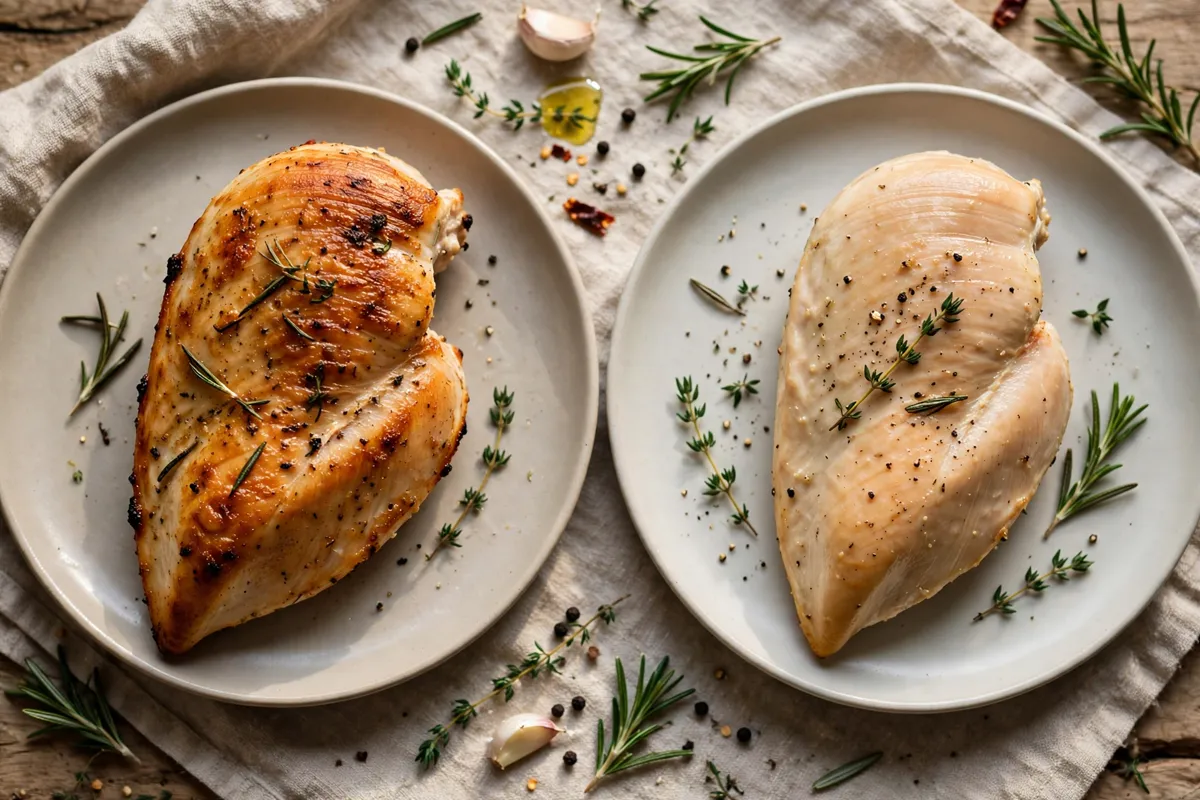
Deciding to bake with the skin on moves the meat to a different entry entirely: breast roasted with skin (FDC ID 171075) lists 197 calories, 29.8g of protein and 7.78g of fat per 100g, against the skinless 165, 31.02g and 3.57g. The skin more than doubles the fat rate and lifts calories by about a fifth, while slightly diluting protein per gram. A standard 172g breast baked and eaten with its skin therefore prices near 339 calories (172 × 1.97) rather than 283.8.
The middle path — bake with skin on for moisture, remove it before eating — prices closest to the skinless entry, since the analysis follows the meat actually eaten, with a small allowance of uncertainty for fat that migrated into the surface. Log what you eat: skin eaten, skin-on entry; skin discarded, skinless entry. That single discipline resolves most baked-chicken logging disputes without any new data.
Common Mistakes to Avoid
Do not use a raw breast's weight with the cooked rate — a breast that went into the oven at 220g raw does not carry 220 × 1.65 calories; weigh it out of the oven. Do not weigh the meat swimming in its dish juices and log the combined weight as meat. Do not reach for the stewed entry just because the dish was covered; stewed means submerged and simmered. Do not price a skin-on baked breast at 165 per 100g. And do not assume a sauce-heavy baked recipe inherits the plain figure — the plain meat has 0g of carbohydrate, so a sweet glaze or a creamy topping is an additional food, with its own entry, on top of the 283.8.
Final Thoughts
A baked chicken breast is a roasted chicken breast for nutrition purposes: 283.8 calories at the standard 172g, 141.9 for a half, 231.0 for a cup of the diced leftovers, all at USDA's dry-heat rate of 165 calories per 100g. The oven's real variables are cooked weight, skin, and what else shares the dish — manage those three and the number is settled. Enter your tray's actual weights in the chicken protein calculator whenever a breast runs larger or smaller than standard.
People Also Ask
How Many Calories Are in a Roasted Chicken Breast?
A roasted chicken breast has 283. 8 calories at the standard size — a 172-gram cooked, boneless, skinless breast. This is the one chicken-breast answer that needs no stand-in or substitute entry: USDA FoodData Central's roasted breast entry (FDC ID 171477) lists the meat itself at 165 calories per 100 grams, so the calories in a roasted chicken breast are read straight from the source entry that anchors this whole series.
How Many Calories Are in a Boiled Chicken Breast?
A boiled chicken breast has about 143 calories for a half-breast portion. The figure comes from USDA's stewed breast entry (FDC ID 171478) — 143. 4 calories for its 95-gram half-breast portion — because USDA publishes no entry literally named "boiled": its stewed entry is the moist-heat entry, and boiling is moist-heat cooking.
Is 3,000 Calories a Day Too Much?
Three thousand calories a day is too much for most adults — a sedentary woman maintaining on 1,700 would be eating 1,300 calories above her needs, a surplus that predicts well over two pounds of gain a week at first — but it is not too much for a tall, heavily training man whose maintenance genuinely reaches 3,100 to 3,300. As with every round number, the verdict lives in the comparison with your own maintenance.
How Many Calories Should Breakfast Contain?
Breakfast should contain roughly 20 to 25% of your daily calories — about 400 to 500 calories on a 2,000-calorie day, about 350 to 400 on a 1,600-calorie weight-loss target, and about 500 to 625 on a 2,500-calorie day. The right breakfast is a share of your total, not a fixed number, which is why the same eggs-and-toast plate can be perfect for one person and half a diet day for another.