Chicken Protein Calculator: The Short Answer
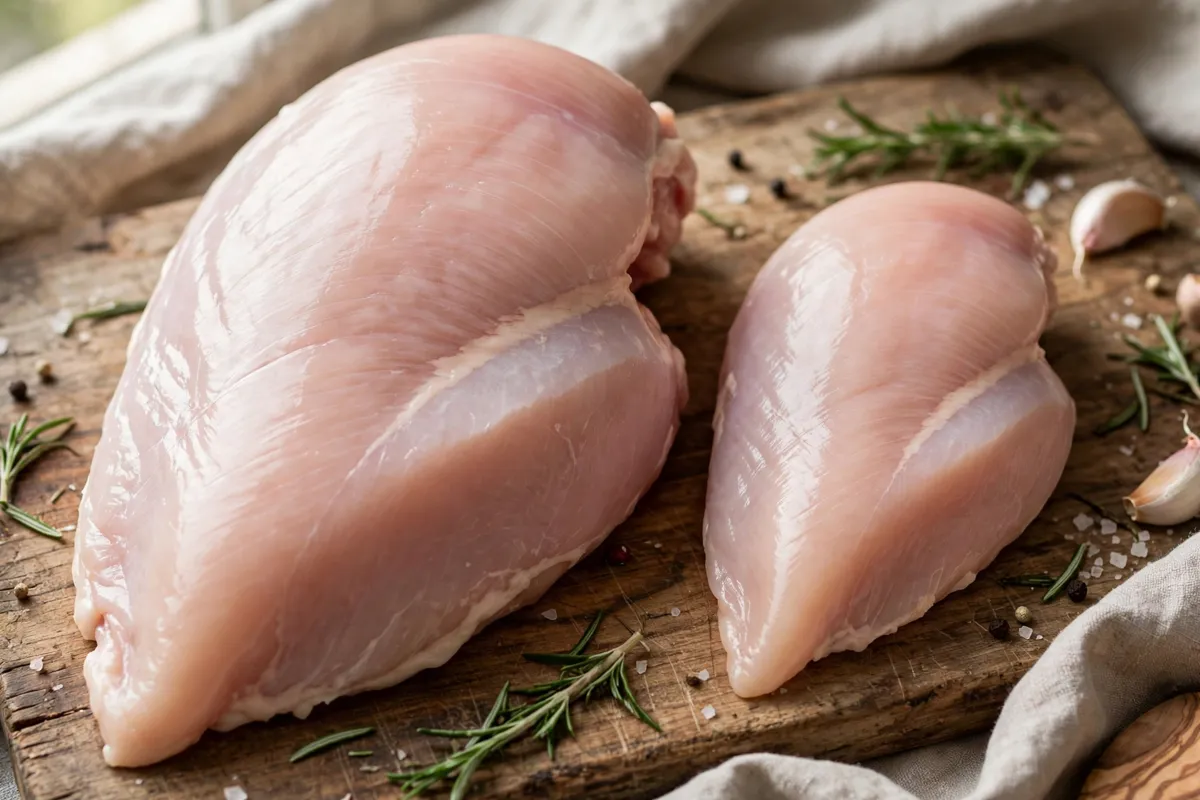
A large boneless, skinless chicken breast typically has between about 281 and 374 calories. That range comes from scaling the USDA roasted breast entry (FDC ID 171477, 165 calories per 100 grams) across the sizes large retail breasts actually reach — roughly 170 to 227 grams of cooked meat, which is 6 to 8 ounces. Anyone asking how many calories are in a large boneless, skinless chicken breast deserves that honest range first, because USDA publishes no official "large breast" weight to give a single number from.
That absence is not a gap in this article; it is the central fact of the question. The only breast portion USDA defines is the standard half breast at 86g. Everything larger is arithmetic, not lookup. This article shows the scaling openly, weight by weight, explains how a large breast compares with the standard one, and gives you the weighing habit that turns the range into an exact answer for the breast on your own board. For a precise figure at any weight, the chicken protein calculator applies the same rate instantly.
Short Answer
There is no USDA "large chicken breast" portion, so there is no single official calorie count for one. Scaled from the standard entry at 165 calories per 100g, a large boneless, skinless breast of about 170g cooked meat (6 oz) has 280.7 calories, and one of about 227g (8 oz) has 374.2 calories. Weigh yours cooked, multiply its grams by 1.65, and you have its exact figure on the same basis as every other answer here.
Why Does USDA Not Publish a "Large" Breast Weight?
FoodData Central describes foods by analysis and by weighed portions it has defined, and for roasted chicken breast (FDC ID 171477) the defined portions are a cup of chopped meat at 140g and half a breast, bone and skin removed, at 86g. A whole standard breast is therefore 172g. The dataset simply contains no portion called "large breast" — retail sizing language like "large," "jumbo" or "family pack" belongs to packaging, not to the nutrient database, and two shops can sell visibly different breasts under the same word.
This matters because a single invented "large breast" weight would smuggle a guess into what looks like a database answer. The honest method is the one used throughout this series: state the per-100g rate, state the weight you are applying it to, and show the multiplication. The standard-size version of this discipline is laid out in calories in 100 grams of chicken breast, where the base rate itself is the whole subject.
How Do the Calories Rise With Size?
Because the rate never changes, the answer is a straight line. Working up from the standard breast through the sizes a large retail breast commonly reaches, cooked and skinless:
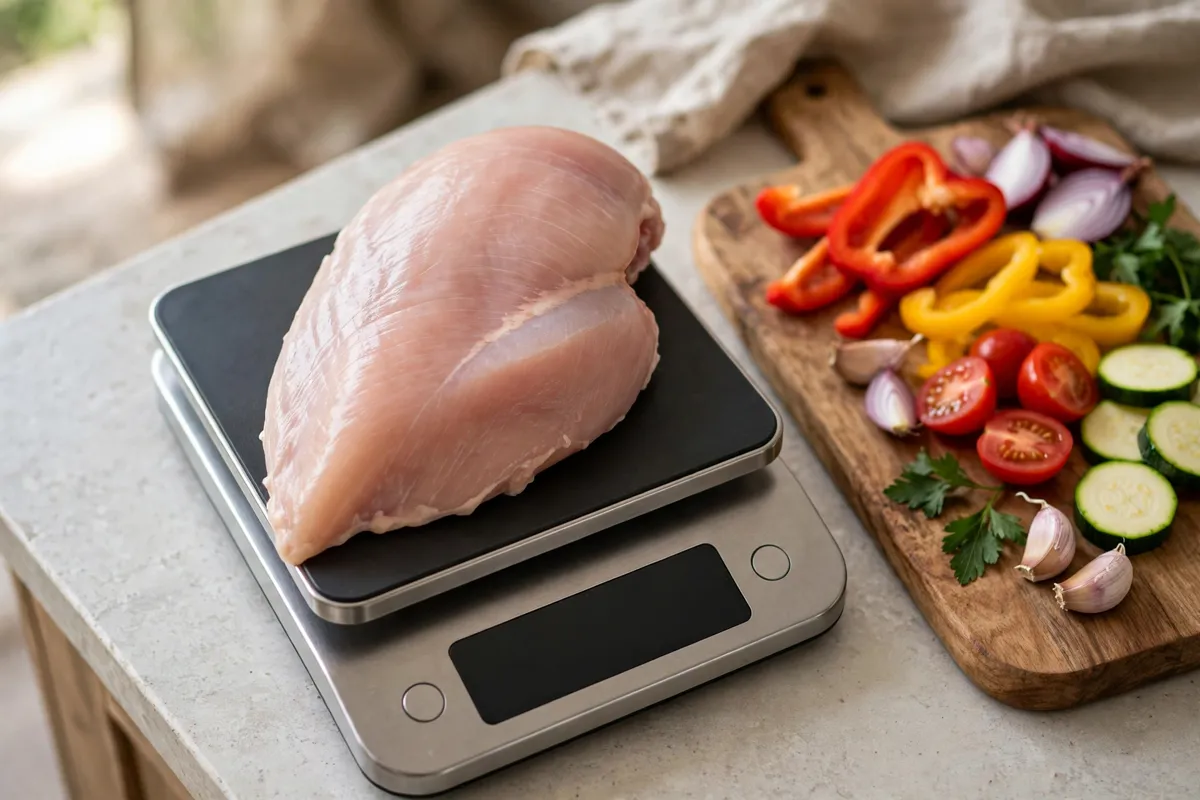
Read the line the other way and it becomes a diagnostic. If the breast on your plate prices near 281 calories, it was a standard-sized piece whatever the packet called it. If it prices near 374, you ate a breast a third larger than standard, with a third more protein as the compensation. Many people who feel chicken breast "doesn't fill them up" at standard portions are, on weighing, eating the 86g half portion (141.9 calories) and expecting the large breast's effect; the scale usually explains the mystery in one weighing.
- Standard whole breast, 172g = 283.8 calories and 53.4g protein
- 6 ounces, 170.1g = 280.7 calories and 52.8g protein — effectively the standard breast restated in ounces
- 7 ounces, 198.5g = 327.4 calories and 61.6g protein
- 8 ounces, 226.8g = 374.2 calories and 70.4g protein
- Each additional ounce (28.35g) adds 46.8 calories and 8.8g protein
Why Are Retail Breasts So Much Bigger Than the Standard?
The 172g cooked standard reflects the portion basis of the database, not a law of chicken anatomy. Modern broiler birds are raised larger than the birds behind older portion conventions, and breasts are sold as they come from the bird — a pack of two can easily hold pieces whose cooked weights differ from each other by 50g or more. Trimming also plays a part: a breast weighed with its tenderloin section attached carries more grams than the same breast with that strip removed, and both are honestly sold as one breast.
The practical consequence is that piece-counting fails at exactly the sizes this question asks about. "One large breast" can mean 280 calories in one kitchen and 375 in another, a gap of nearly 100 calories — the size of a snack — hidden inside a single word. This is the recurring theme of weighing chicken raw or cooked: the state and the weight are the data; the piece name is just packaging.
Does Skinless Still Hold at Large Sizes?
Yes — the question specifies boneless and skinless, which is what keeps the 165-per-100g rate valid at any size. Size alone multiplies the standard rate; it does not change it. The two ways a large breast escapes the range in this article are the two the title excludes. Cooked with its skin on, breast meat prices from a different entry (FDC ID 171075) at 197 calories per 100g, so a 200g skin-on breast would come to 394 calories (200 × 1.97) rather than the 330 its skinless twin would give. And a breast weighed raw will cook down to less meat, so its cooked calories are lower than its raw weight suggests — the raw grams must never be multiplied by the cooked rate.
Boneless matters less to the maths than people expect, since nobody eats the bone and the entry is already meat-only; it matters to the weighing, because a bone-in piece on the scale inflates the gram count with weight that carries no calories at all. Strip the bone and skin away, weigh what remains after cooking, and the straight line from the table above is your answer.
What Is the Smartest Way to Serve a Large Breast?
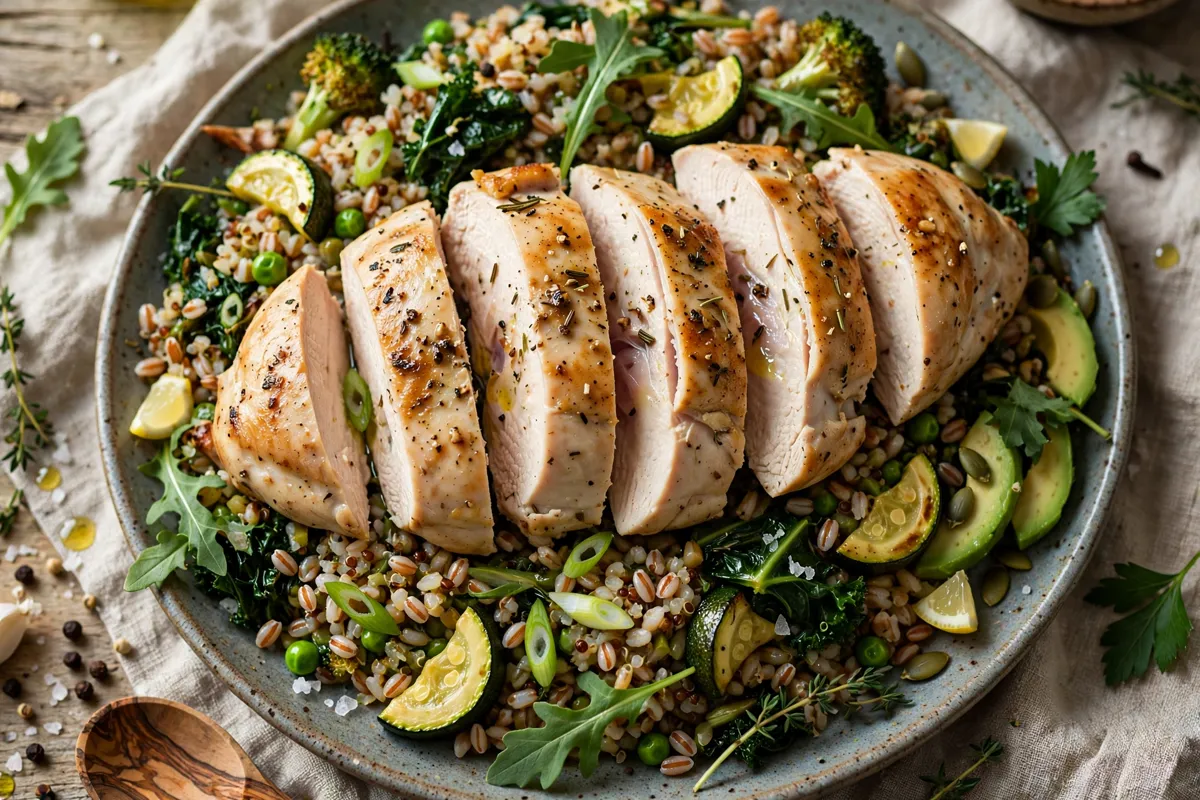
Treat size as a portioning opportunity rather than a problem. An 8-ounce cooked breast (374.2 calories, 70.4g protein) sliced across the grain divides into two 4-ounce servings of 187.1 calories and 35.2g of protein each — two measured meals from one piece of meat, with the second slice holding well for the next day. Halved the other way, the same breast covers two plates tonight as the protein for two people, each getting a portion close to the standard whole breast's smaller cousin, the 86g half portion at 141.9 calories, once vegetables and grains fill out the plates. Large breasts also butterfly well: cut horizontally into two thinner cutlets, each cooks faster and more evenly, and each prices by its own cooked weight on the same 165-per-100g line. Size stops being a logging hazard the moment the knife and the scale, rather than the piece count, decide the portions.
Common Mistakes to Avoid
The biggest mistake is searching for a single official "large breast" calorie figure and trusting whichever site invents one — no such USDA figure exists, and any lone number without a stated weight is a guess wearing a lab coat. Second is logging a large breast as a standard one: at 8 ounces instead of the standard 172g, the log understates the meal by about 90 calories and 17g of protein. Third is weighing the breast raw and applying the cooked rate of 165 per 100g, which overstates it. Fourth is forgetting that "boneless, skinless" is doing real work in the title — a skin-on or bone-in weighing breaks both ends of the calculation. State the cooked, edible weight, and the ambiguity disappears.
Final Thoughts
A large boneless, skinless chicken breast has about 281 to 374 calories, depending on whether its cooked meat weighs closer to 170g or 227g — because USDA defines no "large" portion, the range, derived openly from 165 calories per 100g, is the truthful answer. The breast in your kitchen has one exact figure, and it takes ten seconds on a scale to find it. Weigh it cooked, multiply by 1.65, or enter the weight in the chicken protein calculator and let it do the scaling.
People Also Ask
How Many Calories Are in a Grilled Chicken Breast?
A grilled chicken breast has about 284 calories at the standard size. That figure — 283. 8 calories for a 172-gram cooked breast — comes from USDA's roasted breast entry (FDC ID 171477, 165 calories per 100 grams), because USDA publishes no separate grilled entry: its roasted entry is the dry-heat entry, and grilling is dry-heat cooking.
How Many Calories Are in a Baked Chicken Breast?
A baked chicken breast has about 284 calories at the standard size — 283. 8 calories for a 172-gram cooked, boneless, skinless breast. Like grilling, baking has no separate entry in USDA FoodData Central; the figure comes from the roasted breast entry (FDC ID 171477) at 165 calories per 100 grams, because roasting is the dataset's dry-heat measurement and a home oven is dry heat.
Is 1,400 Calories Enough?
Whether 1,400 calories is enough depends entirely on your maintenance: for a smaller, sedentary woman maintaining on about 1,650 calories a day, 1,400 is a gentle 250-calorie deficit and plenty; for an active woman or almost any man, it is a steep cut that lands near or below the safe floors of 1,200 for women and 1,500 for men. The number alone answers nothing — the comparison does.
Is 2,000 Calories a Day Good?
Two thousand calories a day is good for some people and wrong for others: it is maintenance for a mid-sized, moderately active woman, a sensible weight-loss intake for a larger or active man, and a slow surplus for a small sedentary woman. The figure comes from food labels, where 2,000 calories a day is the reference value used to calculate percentages — a labelling convention, not a health recommendation for your body.