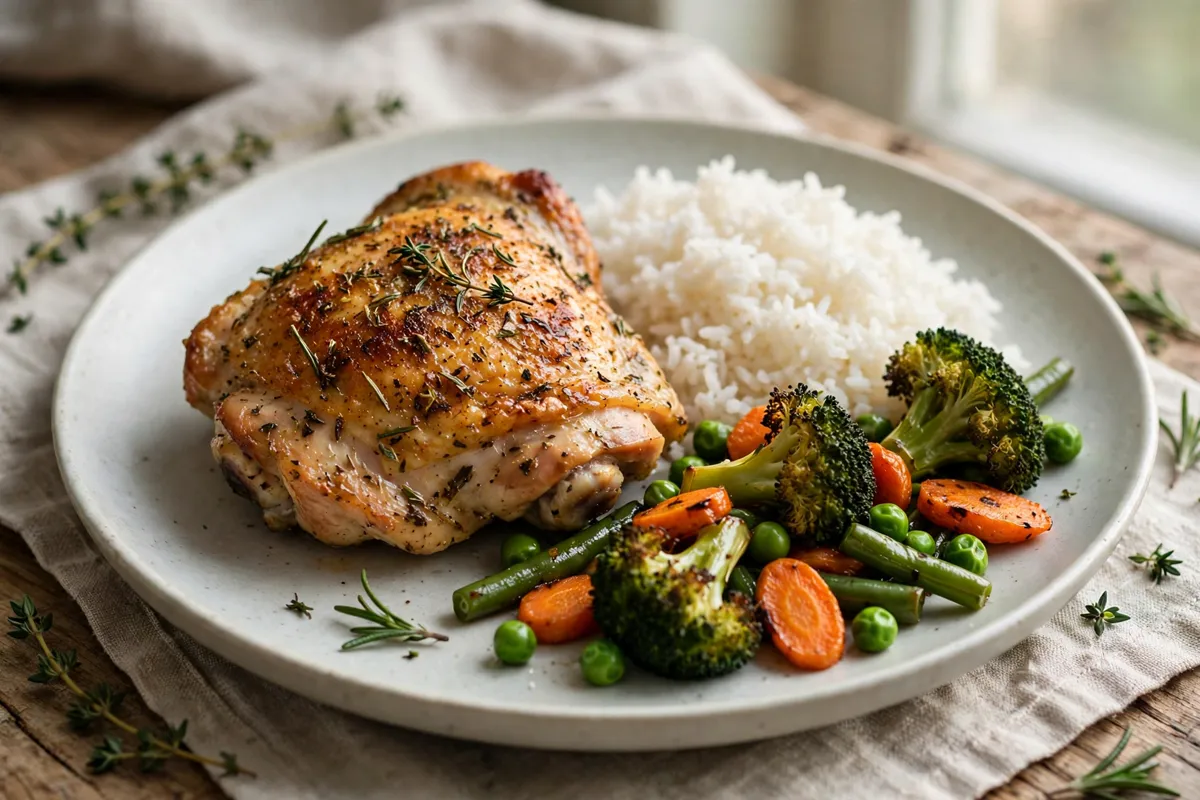
Chicken Protein Calculator: The Short Answer
A chicken thigh has about 208 calories. The precise figure is 207.6 calories for one skinless thigh of 116 grams, from USDA's roasted thigh entry (FDC ID 172388), which lists 179 calories per 100 grams of cooked meat. So the calories in a chicken thigh depend first on whether the skin is on — the standard answer here is the skinless piece — and the 116-gram portion is the size USDA actually weighed.
Thighs are where chicken stops being a single number. The thigh is dark meat, fattier and more forgiving than breast, sold bone-in and boneless, skin-on and skinless, in pieces that vary far more than breasts do. This article prices the standard piece, maps the variation around it, and puts the thigh honestly beside the breast it is so often swapped for — including the comparison worked out in protein in chicken thigh versus chicken breast. The chicken protein calculator prices thigh by weight once you know which basis you are on.
Short Answer
One skinless chicken thigh (116g of cooked meat) contains 207.6 calories and 28.7g of protein. Per 100g, roasted thigh meat contains 179 calories, 24.76g of protein and 8.15g of fat. A thigh eaten with its skin comes from a larger, fattier piece — USDA lists the with-skin thigh portion at 137g — and prices higher than this headline figure.

Which Thigh Does the 207.6 Figure Describe?
FDC ID 172388 is "Chicken, broilers or fryers, thigh, meat only, cooked, roasted." Meat only again means skin removed, and its weighed portions are the anchor for everything here: 3 ounces at 85g, one thigh without skin at 116g, and one thigh with skin at 137g. The 116g figure is meat weight — what is left of a typical thigh once bone and skin are gone — and it is the portion the 207.6 calories price: 116 × 1.79 = 207.6, with protein at 116 × 0.2476 = 28.7g.
The with-skin portion's extra 21 grams (137 versus 116) is instructive even without a separate skin-on analysis in this series: a fifth or so of a skin-on thigh's edible weight is skin and its attached fat, which is why the skin decision moves a thigh's calories more, proportionally, than almost any cooking choice. If you roast thighs skin-on and eat the skin, weigh the meat and skin together and know that the skinless rate of 179 per 100g understates what you ate; if you discard the skin, the meat-only entry is your price. Bone, as always, is weighed by nobody's dinner: it comes out before the meat reaches the scale, and the 116g basis already assumes it is gone.
How Does the Thigh Compare With the Breast?
Per 100g of cooked meat, the two cuts read like different foods wearing the same name:
The thigh carries 14 more calories per 100g and more than double the fat rate, while delivering about four-fifths of the breast's protein per gram. Swapping breast for thigh at equal cooked weight — 116g of each, say — moves a meal from 191.4 calories (116 × 1.65) to 207.6 and trades about 7.3g of protein (36.0g in the breast portion versus 28.7g in the thigh) for the thigh's richer flavour and its tolerance for longer cooking. Neither cut is "the healthy one" in any simple sense: the thigh's extra fat is exactly what keeps it moist in a braise or on a grill long after a breast would dry, and its calories are still modest beside most other meats. The swap is a trade, and now it is a priced trade. The mistakes people make pricing it are collected in the chicken protein mistakes guide, where cut-swapping without repricing earns its own entry.
- Breast (roasted, skinless): 165 calories, 31.02g protein, 3.57g fat
- Thigh (roasted, skinless): 179 calories, 24.76g protein, 8.15g fat
What Do One, Two and a Plateful of Thighs Cost?
Thighs are rarely eaten singly, so the multiples matter:
Two thighs deserve attention as a meal: 415.3 calories with 57.4g of protein is a substantial, satisfying centrepiece that still leaves room in most days, and it outperforms a whole standard breast on protein (57.4g versus 53.4g) while costing about 132 more calories (415.3 versus 283.8) — the fat difference between the cuts, paid openly. For a family pack, the arithmetic scales by total cooked meat weight: a kilogram of boneless skinless thigh meat is ten times the per-100g line, 1,790 calories and 247.6g of protein, divided by the scale among whoever eats it.
- One thigh, 116g = 207.6 calories and 28.7g protein
- Two thighs, 232g = 415.3 calories and 57.4g protein
- A 3-ounce portion, 85g = about 152 calories (85 × 1.79) and about 21.0g protein (85 × 0.2476) — the diet-plan serving, smaller than a whole piece
- Per 100g = 179 calories and 24.76g protein, the rate for any boneless, skinless weight
Why Do Thigh Sizes Vary More Than Breast Sizes?
A breast is one large muscle with a fairly predictable range; a thigh's meat yield depends on the size of the bird, how much of the hip end came away with the piece, and how the butcher trimmed it. Bone-in thighs from a value pack can carry well over 116g of meat each once the bone is out, while small thighs from a young bird carry less. The 116g portion is a reference, not a census.
The working rule is the same one this series applies everywhere: the rate (179 per 100g, skinless and roasted) is sturdier than any piece count. Weigh the cooked meat you serve — for bone-in thighs, weigh after the bone comes out, or weigh a representative cooked piece's meat and multiply by the count — and the calories follow the grams. Guessing "about a thigh" with a cut whose pieces swing this widely is how a log quietly absorbs a 100-calorie error.
What Else Does a Thigh Bring Besides Calories?
The thigh entry's remaining lines complete the picture: 106mg of sodium and 269mg of potassium per 100g, against the breast's 74mg and 256mg. In one standard thigh that is about 123mg of sodium (116 × 1.06) and about 312mg of potassium (116 × 2.69). The sodium gap is worth knowing for anyone tracking it — dark meat runs a little saltier by nature, before any seasoning — while the potassium is a small credit in the thigh's favour. Neither changes the calorie story, but both are part of why the two cuts are not interchangeable in a careful log even when a meal treats them as swaps.
Common Mistakes to Avoid
Do not price a thigh at breast numbers; the cuts differ by 14 calories and 6.26g of protein per 100g, in opposite directions. Do not log a skin-on thigh at the skinless rate — the skin portion alone is 21 of the 137 grams in a with-skin piece, and it is the fattiest part. Do not weigh bone-in thighs whole and log the full weight as meat. Do not assume two thighs from the same pack match; weigh the batch. And do not repeat the claim that dark meat is "fattening" as if the entry supported it: at 179 calories per 100g skinless, a thigh is leaner than many foods nobody questions — it is simply less lean than a breast, by a measured, manageable margin.
Final Thoughts
A skinless chicken thigh is 207.6 calories and 28.7g of protein at the standard 116g portion, and 179 calories per 100g at any weight. It trades some of the breast's protein density for more than double the fat rate and a far more forgiving texture, at a cost of 14 calories per 100g. Price it as its own cut — skin decision stated, bone out, cooked weight on the scale — and the chicken protein calculator will give you the exact figure for the thighs in front of you.
People Also Ask
How Many Calories Are in a Chicken Leg?
A chicken leg has either about 149 calories or about 346 calories, depending on what you mean by "leg" — and this article will not pretend otherwise. A drumstick alone, the familiar hand-held piece at 96 grams of meat, contains 148. 8 calories; a whole leg — drumstick, thigh and back joined, at 199 grams of meat — contains 346.
How Many Calories Are in a Whole Chicken?
A whole chicken has about 715 calories for the edible meat and skin of a modest bird. That figure is USDA's bone-removed portion — 299 grams of roasted meat and skin — priced from the whole-chicken entry (FDC ID 171450) at 239 calories per 100 grams, which gives 714. 6 calories.
How Many Calories Should a Meal Contain?
A meal should contain roughly a quarter to a third of your daily calories if you eat three meals a day — about 500 to 650 calories per meal on a 1,800-calorie day and about 600 to 800 on a 2,400-calorie day. The calculation is simply your daily target divided by your meal pattern, with snacks and drinks subtracted first if you have them.
How Many Calories Does a Person Burn Per Day?
A person burns roughly 1,400 to 3,200 calories per day in total, depending on body size and activity: basal metabolic rate accounts for about 60 to 70% of it, everyday movement and exercise most of the rest, and digesting food roughly 10%. Your personal total — your TDEE — is calculated by multiplying your Mifflin-St Jeor BMR by an activity factor of 1. 2 to 1.