Chicken Protein Calculator: The Short Answer
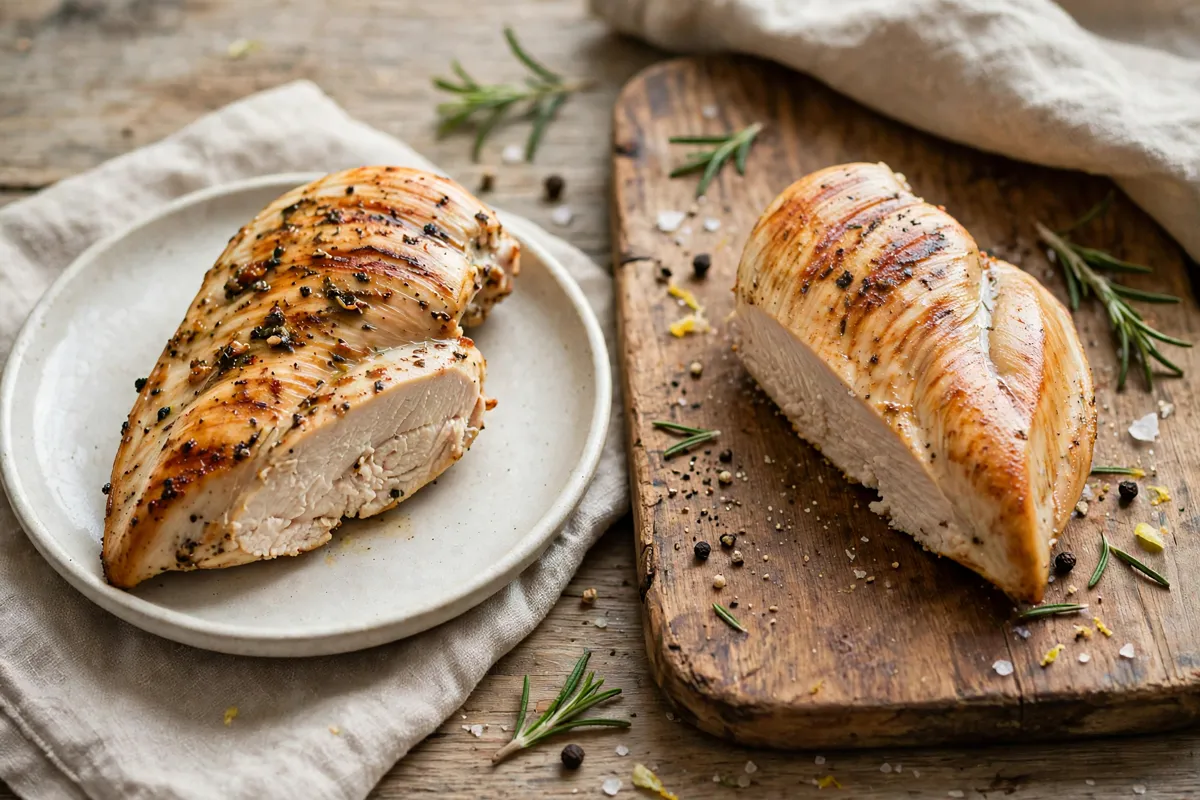
Half a chicken breast has about 142 calories. Precisely, the USDA portion for half a breast — 86 grams of cooked, boneless, skinless meat — works out to 141.9 calories, from the roasted breast entry in USDA FoodData Central (FDC ID 171477) at 165 calories per 100 grams. When people ask how many calories are in half a chicken breast, this 86-gram portion is the standard answer the data supports.
The phrase "half a chicken breast" sounds self-explanatory until you stand in a kitchen: half of what size of breast, weighed when, with the skin on or off? This article pins down the portion the USDA actually defines, shows how it relates to a whole breast and to ounce servings, and explains why the stewed version of the same half portion weighs more yet lands at almost the same calories. For any other weight of breast, the chicken protein calculator scales the same entry for you.
Short Answer
Half a chicken breast, as USDA defines the portion — 86g of cooked meat with bone and skin removed — contains 141.9 calories and 26.7g of protein. A whole breast on the same basis is exactly double: 172g, 283.8 calories and 53.4g of protein. If your half breast weighs much more than 86g cooked, it is half of a larger-than-standard breast, and its calories scale up gram for gram.
Why Is the Standard Half Breast 86 Grams?
FoodData Central does not guess at portion sizes; it publishes weighed portions for each entry. For roasted breast meat (FDC ID 171477), one listed portion is "0.5 breast, bone and skin removed" at 86 grams. That makes the whole standard breast 172 grams — two halves of 86. Those two numbers, 86 and 172, are the reference points behind almost every chicken-breast answer on this site, including the protein answer in how much protein is in one chicken breast, which has to untangle the same half-versus-whole naming problem from the protein side.
The gram anchors under both portions are the same ones examined from the per-100g side in calories in 100 grams of chicken breast, where the 165-calorie rate itself is the subject.
Retail chicken, of course, does not read the USDA tables. Supermarket breasts are often far larger than 172g raw, which means half of one, cooked, can weigh well over 86g. The portion figure is therefore best used as a measuring unit rather than a promise about your particular chicken: weigh your half, and if it comes to 120g cooked, its calories are 120 × 1.65 = 198, not 141.9. The 141.9 belongs to the 86g portion, wherever that portion comes from — half a standard breast, or a weighed 86g slice cut from a bigger one.
How Does Half a Breast Compare With Ounce Servings?
Eighty-six grams is a whisker over 3 ounces, and the ounce table for the same entry shows how close the two habits of measuring land:
So if a recipe or a meal plan speaks in ounces and your kitchen speaks in breasts, "half a breast" and "3 ounces" can be treated as the same serving for logging purposes; the difference is 1.6 calories. The gap that does matter is the jump to 4 ounces, the portion many meal plans default to, which adds about 45 calories and 8.5g of protein over the half breast. Knowing which of the two your plan intends is worth more than any rounding debate.
- 3 ounces (85.1g) = 140.3 calories and 26.4g protein — nearly identical to the 86g half-breast portion
- 4 ounces (113.4g) = 187.1 calories and 35.2g protein — about a third more than the half portion
- Half a breast (86g) = 141.9 calories and 26.7g protein
- A whole breast (172g) = 283.8 calories and 53.4g protein — two half portions, exactly
What Changes If the Half Breast Is Stewed, Fried or Skin-On?
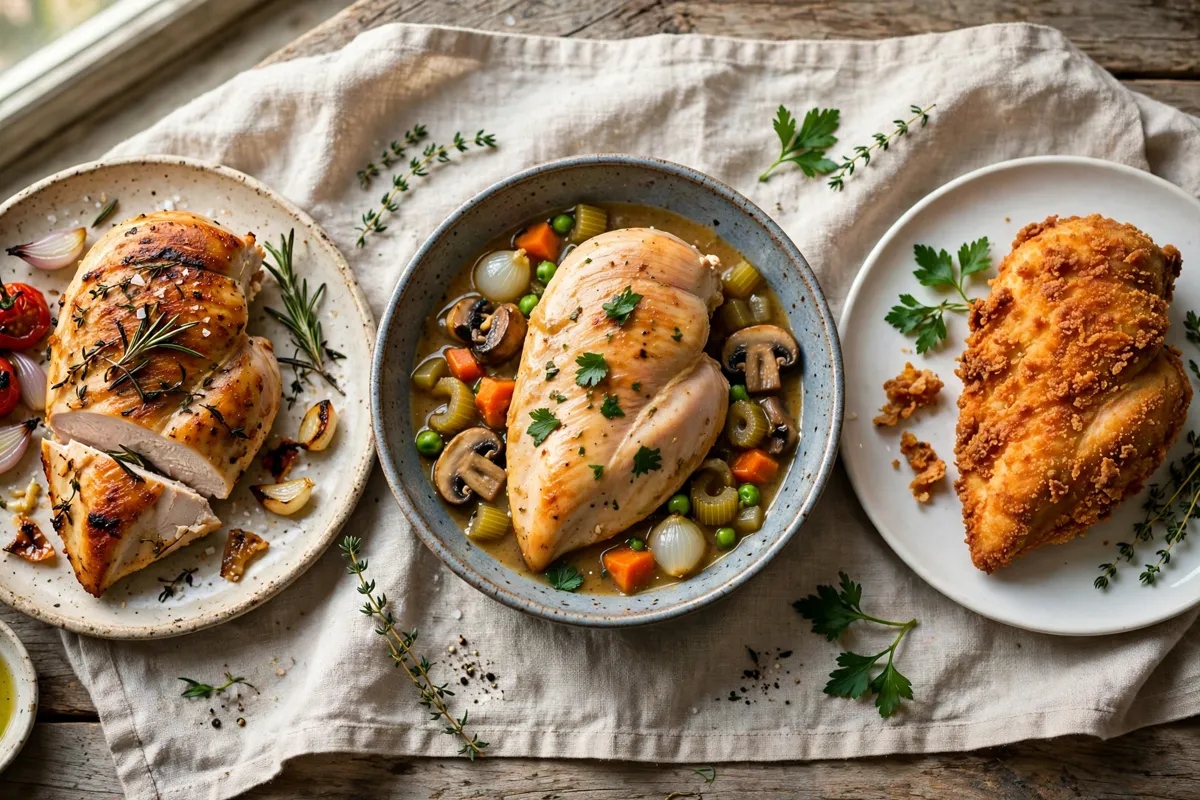
The 141.9 figure is for roasted, skinless meat. USDA publishes the same cut under other treatments, and the half-portion story changes in an instructive way. The stewed breast entry (FDC ID 171478) lists its half-breast portion at 95 grams — heavier than the roasted 86g, because meat simmered in liquid absorbs water — yet that heavier portion works out to 143.4 calories, almost the same as the roasted half. The stewed meat is more dilute: 151 calories and 28.98g of protein per 100g against the roasted 165 and 31.02g. More water per bite, fewer calories per gram, and the two effects nearly cancel at the portion level.
Frying pushes the other way. The fried breast entry (FDC ID 171078), meat only and unbreaded, lists 187 calories per 100g, so an 86g half portion fried would price above the roasted one. Skin is the largest lever of all: breast roasted with skin (FDC ID 171075) runs at 197 calories per 100g against 165 skinless, so a skin-on half portion carries roughly a fifth more energy than the headline figure. None of these variants changes the meat's zero carbohydrate content in any meaningful way — only the fried entry shows even a trace, at 0.51g per 100g — but they move the calorie answer enough that "half a breast" should always travel with its cooking method attached.
How Does Half a Breast Fit Into a Meal?
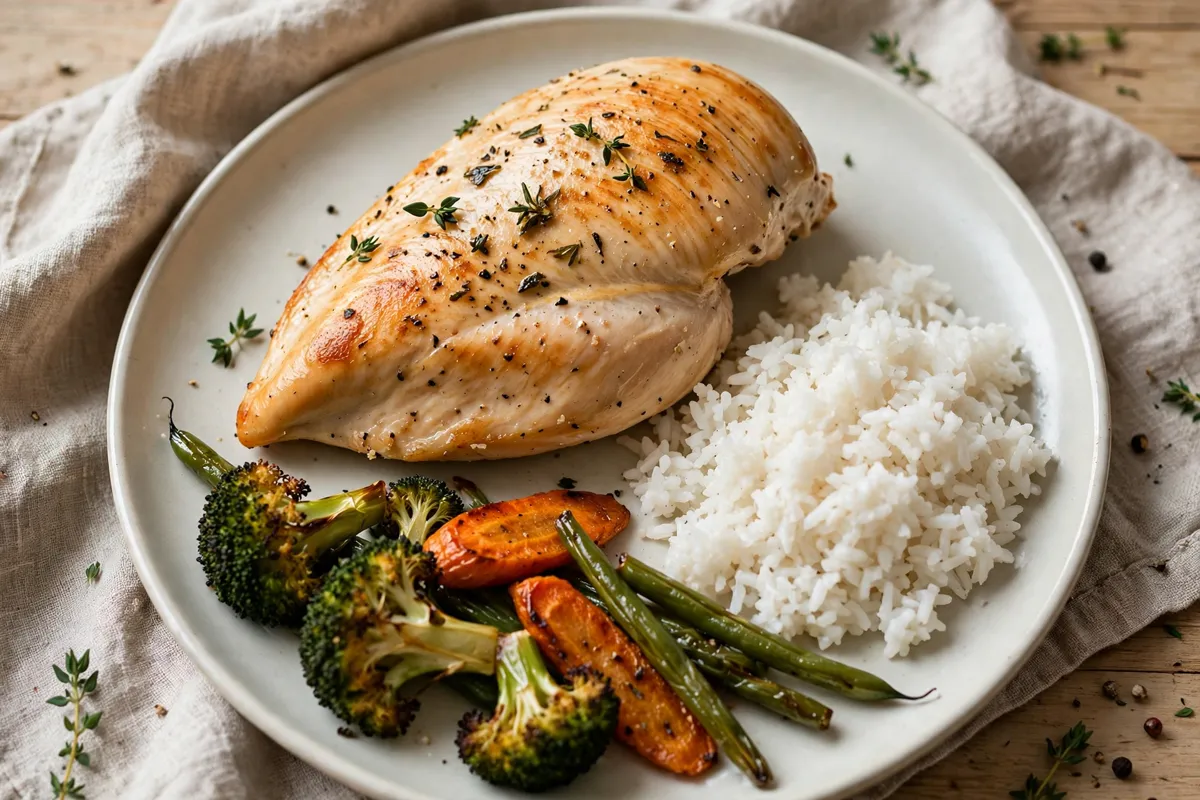
At 141.9 calories with 26.7g of protein, the half breast is a light meal's protein anchor rather than a full meal by itself. Pair it with the rest of the plate and the arithmetic stays friendly: the chicken contributes the protein and a small amount of fat (the entry's 3.57g per 100g scales to about 3.1g in this portion), while grains, vegetables and any sauce or dressing supply most of the remaining calories. That division of labour is precisely why the half portion is so common in practice — it covers a solid share of a meal's protein for a modest calorie cost, leaving room to build the rest of the plate around appetite rather than around the meat.
For someone eating two protein-centred meals a day, a half breast at each delivers 53.4g of protein for 283.8 calories across the day — the same totals as one whole breast, because it is one, just split in two sittings. The chicken protein calculator lets you test the other splits: a whole breast at one meal, or 4-ounce portions instead of halves, each with its own protein-per-calorie trade-off made explicit.
- Half breast at lunch and dinner: 283.8 calories, 53.4g protein across the day
- One whole breast at a single meal: 283.8 calories, 53.4g protein in one sitting
- Two 4-ounce portions instead: 374.2 calories, 70.4g protein across the day
Common Mistakes to Avoid
The most frequent error is treating "half a breast" as a fixed calorie value regardless of the breast. Half of a very large retail breast can weigh 140g or more cooked — over 230 calories — so the portion name is not a substitute for the scale. Second is mixing states: the 86g portion is cooked weight, and a raw half breast of 86g cooks down to less meat and fewer calories than 141.9. Third is forgetting the skin: a skin-on half portion prices from a 197-per-100g entry, not the 165 headline rate. Fourth is assuming stewed or poached chicken is "lighter" per portion in a meaningful way — its portion is heavier with absorbed water and lands at 143.4 calories, essentially tied with roasted. Weigh the portion, name the method, and the number follows.
Final Thoughts
Half a chicken breast means, in USDA terms, 86 grams of cooked, skinless meat: 141.9 calories and 26.7g of protein. It is effectively a 3-ounce serving, exactly half of the 172g standard whole breast, and a practical building block that anchors a meal's protein for a small calorie cost. If your half weighs more than 86g, scale from 165 calories per 100g rather than borrowing the headline number — and the chicken protein calculator will do that scaling for any weight you put on the scale.
People Also Ask
How Many Calories Are in Two Chicken Breasts?
Two chicken breasts have about 568 calories. The precise figure is 567. 6 calories for two standard whole breasts — 344 grams of cooked, boneless, skinless meat — derived by doubling the USDA roasted breast entry (FDC ID 171477), where one 172-gram breast provides 283.
How Many Calories Are in a Large Boneless, Skinless Chicken Breast?
A large boneless, skinless chicken breast typically has between about 281 and 374 calories. That range comes from scaling the USDA roasted breast entry (FDC ID 171477, 165 calories per 100 grams) across the sizes large retail breasts actually reach — roughly 170 to 227 grams of cooked meat, which is 6 to 8 ounces. Anyone asking how many calories are in a large boneless, skinless chicken breast deserves that honest range first, because USDA publishes no official "large breast"…
How to Calculate a Calorie Deficit?
To calculate a calorie deficit, subtract your planned intake from your maintenance calories: deficit = TDEE − intake, where TDEE comes from the Mifflin-St Jeor equation times your activity factor. Choose a deficit of 300 to 500 calories a day — for example, maintenance of 1,943 minus an intake of 1,500 gives a deficit of 443, predicting a little under a pound of fat loss a week.
Is a 1,000-Calorie Deficit Too Much?
For most people, yes — a 1,000-calorie deficit is too much: it is double the standard 300 to 500 recommendation, it predicts about two pounds of loss a week, and that rate only stays within the safe 0. 5 to 1% of body weight per week for someone weighing at least about 200 pounds. For a smaller person maintaining on 1,900 calories, a 1,000 deficit means eating 900 — below every safe floor.