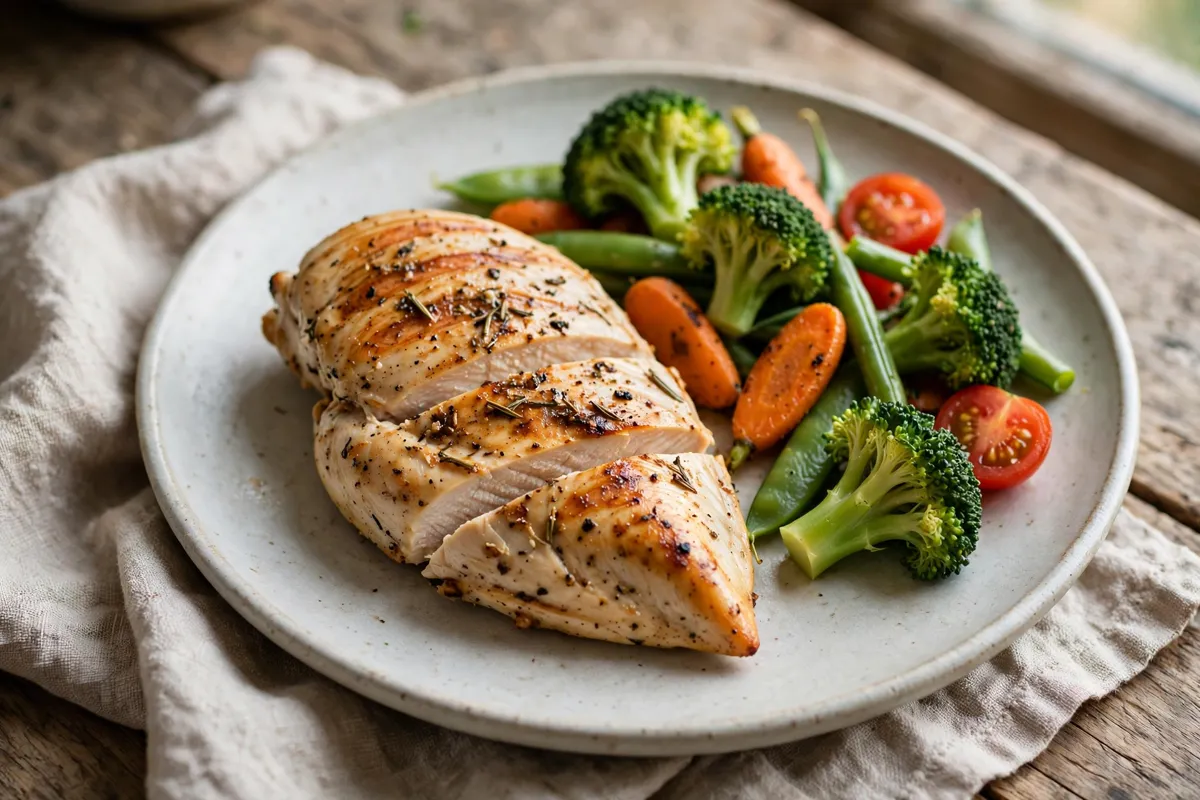
Chicken Protein Calculator: The Short Answer
Three ounces of chicken contain about 140 calories — 140.3, derived from USDA FoodData Central's roasted chicken breast entry — with 26.4 grams of protein. The basis, stated openly as it must be for any plain "chicken" question, is boneless, skinless breast, meat only, cooked roasted (FDC ID 171477): 165 calories and 31.02g protein per 100g, scaled to the 85.1 grams that three ounces weigh.
Three ounces is not an arbitrary size. It is the reference portion of a generation of diet advice — the deck-of-cards portion, the amount used as the standard serving on countless labels and plans — which makes its exact price worth settling. This article settles it on the breast basis, compares the other cuts at the same weight, and shows how the famous visual comparisons hold up. The chicken protein calculator converts any other weight from the same entry.
Short Answer
About 140 calories in 3 ounces of chicken breast (140.3 for 85.1g at 165 calories per 100g), with 26.4g protein, 0g carbohydrate and about 3.0g fat (from the entry's 3.57g fat per 100g). Other cuts at three ounces: thigh meat about 152 calories, drumstick meat about 132, wing meat about 173 — the breast sits in the middle on calories and first on protein.
Why Is Three Ounces the Portion Everyone Quotes?
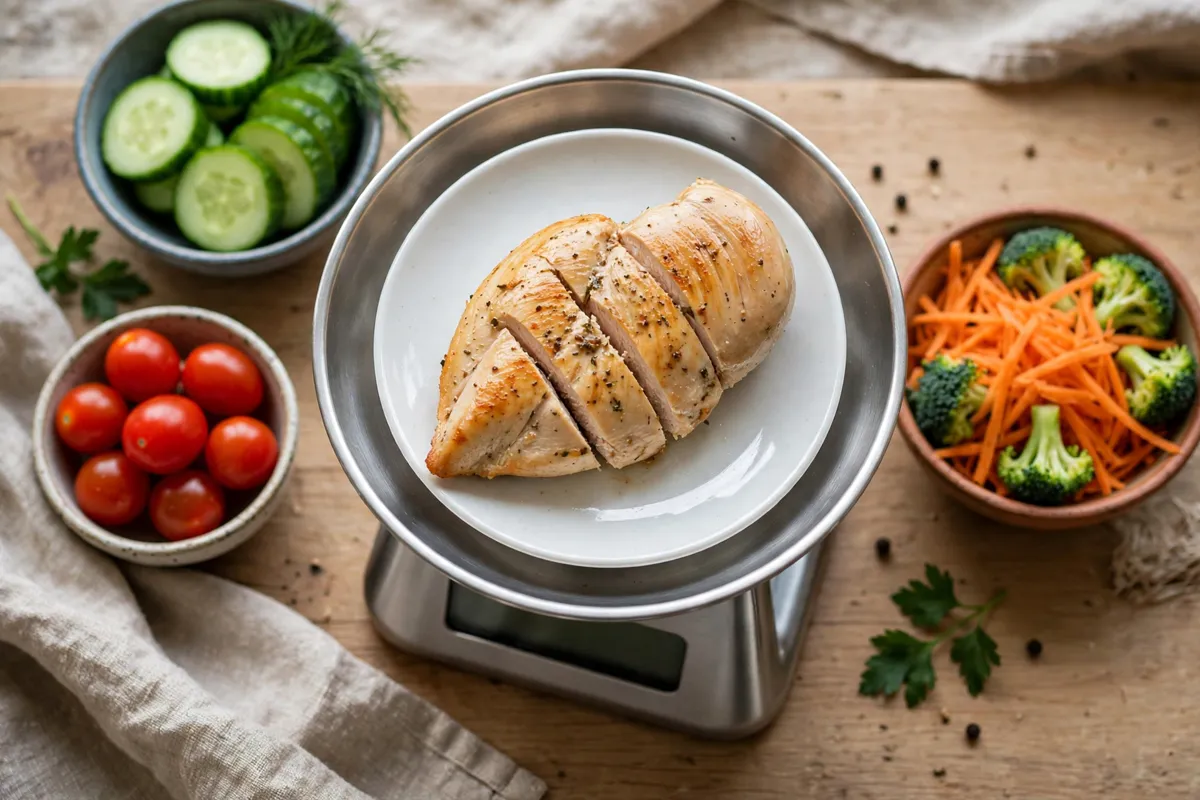
Because American dietary guidance built its protein servings around it. Three ounces of cooked meat became the textbook serving — the size of a deck of playing cards, the palm of an average hand — and decades of labels, diet books and restaurant comparisons inherited the convention. The USDA's own portion data quietly agrees with the tradition: its standard half-breast portion for the roasted breast entry is 86g, which is three ounces to within a gram (85.1g). Your three-ounce portion is, for practical purposes, exactly half a standard cooked chicken breast.
That equivalence makes three ounces the most useful anchor in the whole chicken series. A whole breast portion in the reference data is two of these (172g, about 284 calories); the four-ounce restaurant portion is this plus a third; the two-ounce salad portion is this minus a third. Learn 140.3 and 26.4g of protein once, and the neighbouring sizes become mental arithmetic rather than fresh lookups. The protein-first view of the same portion family is developed in how much protein is in 100 grams of chicken breast — 100g being the metric cousin of this portion at 165 calories and 31.02g protein. 2 ounces of chicken gets the same treatment, with its calories counted in full.
How Do the Other Cuts Price at Exactly Three Ounces?
Scaling each USDA entry to 85.1g: breast 140.3 calories with 26.4g protein and about 3.0g fat. Thigh meat (179 per 100g) gives about 152.2 calories with about 21.1g protein and roughly 6.9g fat — the dark meat premium paid in fat. Drumstick meat (155 per 100g) gives about 131.9 calories with about 20.6g protein, the lightest of the three on calories because its leanness surprises people who file all dark meat together. Wing meat (203 per 100g) gives about 172.7 calories with about 25.9g protein — protein nearly matching the breast's, at the price of the wing's higher fat share (8.13g per 100g).
Two lessons live in that table. First, the spread across cuts at this size is only about 40 calories from lowest to highest — meaningful across a daily habit, trivial across a single meal. Second, protein and calories do not rank the cuts in the same order: the breast wins both the protein contest and the protein-per-calorie contest, but the wing beats the thigh on protein while costing more calories. Which cut is "best" at three ounces depends on which column you are optimising, a trade-off priced in full in how much protein is in chicken thigh versus chicken breast. Skin rewrites the table entirely — breast with skin roasted runs 197 per 100g, about 167.6 calories for three ounces — and is the first thing to check when a real plate's number looks wrong.
Does the Deck of Cards Actually Weigh Three Ounces?
Roughly, in the hands it was designed for — and the imprecision is worth understanding rather than dismissing. The comparison was a volume metaphor: a portion the size and thickness of a deck of cards occupies about the volume of 85g of cooked meat. For an average adult's palm-sized portion of breast, sliced or whole, the metaphor lands within about half an ounce either way, which is within 25 calories — good enough for a restaurant estimate, not good enough for a weighed meal plan.
Hands, however, vary more than decks do. A large hand's palm portion can be four ounces; a small hand's, two and a half. The visual method's real value is as a fallback where no scale exists, calibrated by a few weeks of weighing at home until your hand knows what your scale taught it. The site's portion-visualisation work, including how to calculate protein in raw versus cooked chicken, returns to the same discipline: visuals for the road, weights for the record. And record the cooked weight — three ounces raw cooks down to roughly two and a quarter cooked ounces (about 105 calories), the commonest silent error in chicken diaries everywhere.
How Does a Three-Ounce Portion Fit a Day's Protein?
Very efficiently. At 26.4g of protein for 140.3 calories, this portion delivers nearly a fifth of its weight as protein and covers the per-meal protein aim most plans set for an average adult in a single, modest serving. Two such portions across a day — lunch and dinner — provide about 52.8g before breakfast, dairy or grains contribute anything, which is why chicken breast in three-ounce units is the load-bearing wall of so many meal plans.
Its calorie price is equally cooperative: 140 calories is a small claim on a 2,000-calorie day (seven percent) for the day's single most useful nutrient delivery. That ratio — protein per calorie — is the entire case for the breast's popularity, and it is why the chicken protein calculator defaults to this entry when a plan is being built. The portion's modesty is also its point: three ounces leaves room on the plate, and in the budget, for the vegetables, grains and fats that make a meal a meal rather than a protein delivery device.
Common Mistakes to Avoid
Do not log three raw ounces at the cooked figure: raw breast loses about a quarter of its weight in cooking, so three raw ounces are roughly 105 cooked calories, not 140. Do not carry the breast's 140.3 to skin-on chicken — the same weight with skin is about 168. Do not treat the deck-of-cards estimate as a weighed fact when precision matters; it is a fallback with a half-ounce error bar built in. Do not forget that marinades, brines and cooking oils are separate entries: the 140.3 prices plain roasted breast, and a sweet or oily preparation adds its own line. And do not assume the portion is too small to matter — repeated daily, a misjudged three ounces is the difference between a plan that works on paper and one that works on the body.
Final Thoughts
Three ounces of chicken contain about 140 calories on the reference basis — breast, boneless and skinless, roasted: 140.3 calories, 26.4g protein, in the 85.1 grams that match the USDA's own half-breast portion. It is the standard serving for a reason: big enough to anchor a meal's protein, small enough to leave the day flexible. Weigh it cooked, mind the skin, and scale to any other size in the chicken protein calculator.
People Also Ask
How Many Calories Are in 4 Ounces of Chicken Breast?
Four ounces of chicken breast contain about 187 calories — 187. 1, derived from USDA FoodData Central's roasted breast entry (FDC ID 171477) — with 35. 2 grams of protein.
How Many Calories Are in 5 Ounces of Chicken Breast?
Five ounces of chicken breast contain about 234 calories — 233. 9, derived from USDA FoodData Central's roasted breast entry (FDC ID 171477) — with 44. 0 grams of protein.
What Is the Best Calorie Tracker App?
The best calorie tracker app is the one with a large verified food database, barcode scanning and a free tier you can actually live on — because the app you keep using beats the "best" app you abandon in week two. For most people that means trying two or three leading trackers for a week each and keeping the fastest one.
How Many Calories Should I Eat Per Day?
Most adults need roughly 1,600 to 2,800 calories per day to maintain their weight, and your own number comes from one calculation: work out your basal metabolic rate with the Mifflin-St Jeor equation, then multiply it by an activity factor to get your maintenance calories. There is no single correct intake for everyone — a small, sedentary woman and a tall, physically active man can differ by more than 1,000 calories a day and both be eating exactly right for…