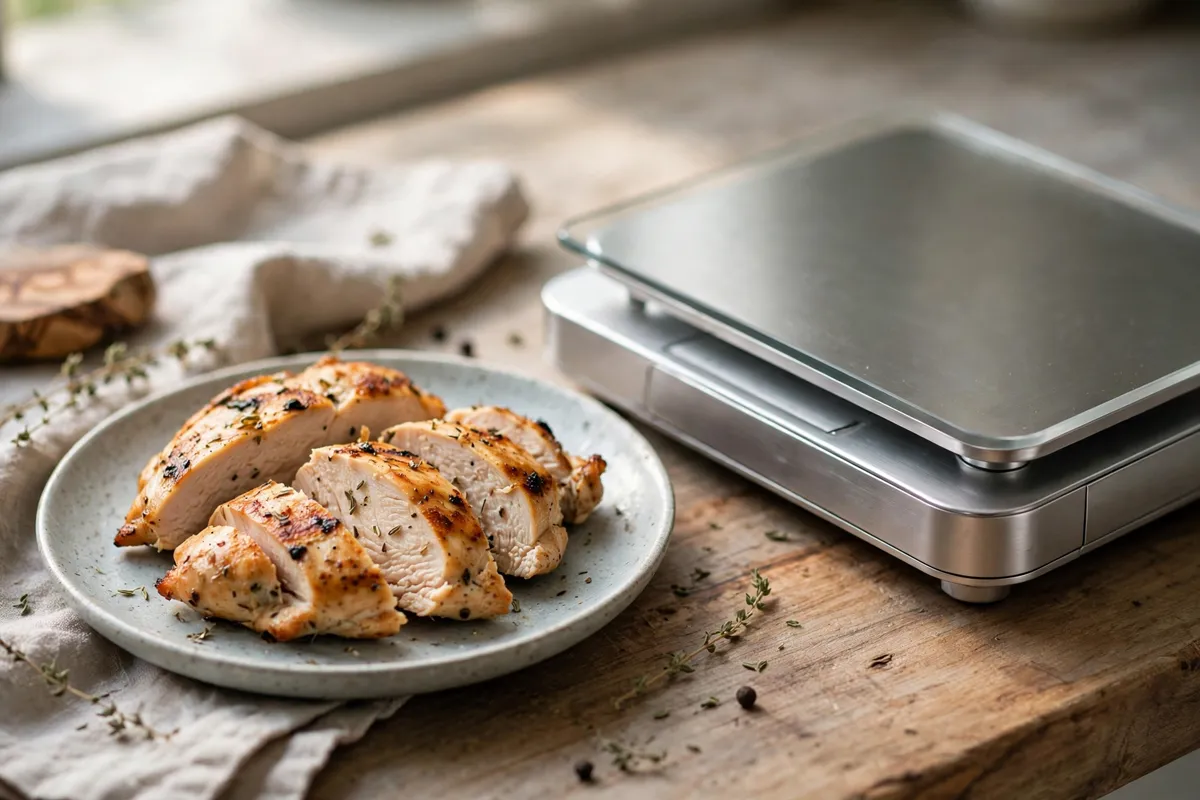
Chicken Protein Calculator: The Short Answer
Two ounces of chicken contain about 94 calories — 93.6, derived from USDA FoodData Central's roasted chicken breast entry — with 17.6 grams of protein. That figure assumes the cut most people mean by "chicken" in a calorie question: boneless, skinless breast, meat only, cooked roasted (FDC ID 171477), which runs 165 calories and 31.02g protein per 100g. Two ounces is 56.7 grams, and 56.7 × 1.65 gives the 93.6.
Naming the cut matters, because "chicken" covers parts that differ: the same two ounces of roasted thigh meat run about 102 calories, and of wing meat about 115. This article prices the breast basis openly, shows the other cuts for comparison, and explains what a small two-ounce portion is actually for in a meal. The chicken protein calculator scales any cut and weight; here is the smallest common portion, worked in full.
Short Answer
About 94 calories in 2 ounces of chicken breast (93.6 for 56.7g at 165 calories per 100g), with 17.6g protein, 0g carbohydrate and about 2.0g fat (derived from the entry's 3.57g fat per 100g). If your two ounces are thigh meat instead, expect about 102 calories; wing meat, about 115. Skin, breading and frying all push the figure up from the breast baseline.
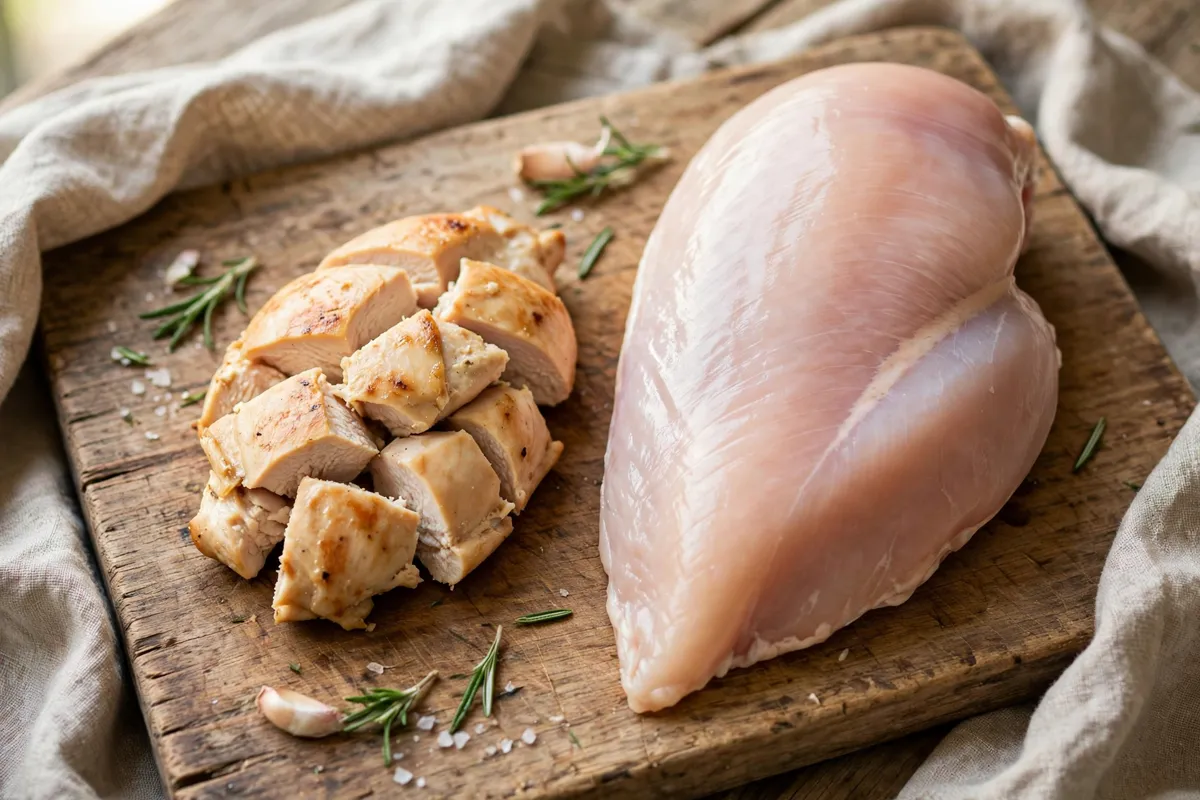
Why Does This Article Price the Breast — and What If Yours Is Different?
Because breast is the reference cut of calorie counting: it is the leanest common cut, the one diet plans mean when they say "chicken," and the USDA's most-used chicken entry. Its profile per 100g — 165 calories, 31.02g protein, 0g carbohydrate, 3.57g fat, 74mg sodium, 256mg potassium — is the anchor from which the whole ounce series on this site is derived, and stating it openly lets you swap the anchor if your chicken is different.
The swaps, from the same USDA dataset: roasted thigh meat (FDC 172388) runs 179 calories per 100g, so two ounces (56.7g) come to about 101.5 calories with about 14.0g protein — fewer calories' worth of protein, because thigh carries 8.15g fat per 100g against the breast's 3.57g. Drumstick meat (172376) runs 155 per 100g, so two ounces are about 87.9 calories. Wing meat (172392) runs 203 per 100g, so two ounces are about 115.1. Skin changes everything it touches: breast roasted with its skin (171075) is 197 per 100g before any other change. The lesson is not that one cut is correct; it is that "2 ounces of chicken" is a question with a family of answers spanning roughly 88 to 115 calories, and the breast's 93.6 is the member of the family worth memorising because it is the one meal plans are written in. The protein differences between the cuts are explored in how much protein is in chicken thigh versus breast.
What Is a Two-Ounce Portion Actually For?
Two ounces is a supporting portion, not a centrepiece — roughly a third of a typical chicken breast portion (the USDA's half-breast portion weighs 86g, about three ounces) and about the amount of chicken in a hearty salad, a wrap, a sandwich filling or a stir-fry serving where vegetables and grains share the plate. At 17.6g of protein it is far from trivial: it covers a substantial share of a smaller adult's per-meal protein aim and turns a side dish into a meal.
Think of the two-ounce unit as the dieter's and the meal-prepper's ruler. It is the amount that upgrades a soup, the amount diced through a pasta portion, the amount a child's serving often is. Pricing it precisely matters because small portions repeat: a two-ounce understatement of chicken across two meals a day is not large per meal, but the protein overstatement of the reverse error quietly inflates a week's targets. The chicken protein calculator exists for this scaling work — enter the ounces you served, get the protein and calories on the breast basis, and adjust the cut if yours differs. For the visual side of the same portion, the method in how to calculate protein in raw versus cooked chicken settles the weighing question that comes next.
Should the Two Ounces Be Weighed Raw or Cooked?
Cooked, for these figures — the USDA entry behind them is a cooked, roasted entry, and its 165 per 100g describes chicken as eaten. Cooking drives water out of chicken, concentrating everything: raw breast weighs more for the same protein, so two ounces weighed raw deliver less chicken — and fewer calories — than two ounces weighed cooked. The shrinkage is roughly a quarter of the weight for typical roasting, which means a portion intended to be two cooked ounces should start at roughly 2.7 raw ounces on the scale.
This single distinction is responsible for more chicken-logging error than every cut difference in this article combined, because recipes usually state raw weights and databases usually state cooked values. Pick one state, know which one your number describes, and the 93.6 figure is dependable. The site's dedicated walkthrough, should I weigh chicken raw or cooked, works the conversion for the common portion sizes, this two-ounce one included.
How Does the Two-Ounce Portion Behave Across a Whole Day?
Small portions are where diaries are won quietly, because they repeat. A cook who dices chicken through a salad at lunch and a pasta at dinner may eat two two-ounce portions a day without ever sitting down to "a chicken meal" — 187.2 calories and 35.2g of protein in aggregate, the protein of a full four-ounce serving delivered in instalments. Tracking those instalments at their true 93.6 each, rather than rounding them away as garnish, is often the difference between a protein target that mysteriously fails and one that was met all along by food nobody counted.
The same portion is also the natural unit for children, for lighter appetites, and for the first meal after illness or fasting, where a full serving is more than the moment wants. In each case the arithmetic is identical and the portion's dignity is the point: two ounces of chicken breast is a real, priceable quantity of food — 56.7 grams, 17.6g of protein — and treating it with the same respect as the larger sizes is what makes a food diary a record instead of a story.
Common Mistakes to Avoid
Do not use the breast figure for skin-on or breaded chicken: skin alone lifts the per-100g value from 165 to 197, and breading adds carbohydrate the breast basis counts as zero. Do not weigh raw and log cooked — the water loss in cooking is about a quarter of the weight, and the mismatch flows straight into your totals. Do not round two ounces down to "about fifty calories" because the portion looks small; at 93.6 it is a real line in the day. Do not assume dark meat matches the breast figure: thigh runs about 8 calories higher per two ounces and wing about 21 higher, gaps that matter when dark meat is your daily habit. And do not forget sauces and cooking fats, which are separate foods with separate entries — the chicken's 93.6 prices the chicken only.
Final Thoughts
Two ounces of chicken contain about 94 calories on the standard basis — boneless, skinless breast, roasted, at 93.6 calories and 17.6g protein for the 56.7 grams — with thigh, drumstick and wing versions spanning roughly 88 to 115. State the cut, weigh it cooked, and this smallest common portion becomes a reliable building block: the salad upgrade, the wrap filling, the stir-fry share. Scale any other weight in the chicken protein calculator, and the same USDA basis follows you up the sizes.
People Also Ask
How Many Calories Are in 3 Ounces of Chicken?
Three ounces of chicken contain about 140 calories — 140. 3, derived from USDA FoodData Central's roasted chicken breast entry — with 26. 4 grams of protein.
How Many Calories Are in 4 Ounces of Chicken Breast?
Four ounces of chicken breast contain about 187 calories — 187. 1, derived from USDA FoodData Central's roasted breast entry (FDC ID 171477) — with 35. 2 grams of protein.
How to Calculate Calories in a Recipe?
To calculate calories in a recipe, add the calories of every ingredient in the full amount you use, then divide the total by the number of servings. A chilli made with ingredients totalling 1,600 calories that serves four people contains 400 calories per serving — no other step is required.
What Is the Best Calorie Tracker App?
The best calorie tracker app is the one with a large verified food database, barcode scanning and a free tier you can actually live on — because the app you keep using beats the "best" app you abandon in week two. For most people that means trying two or three leading trackers for a week each and keeping the fastest one.