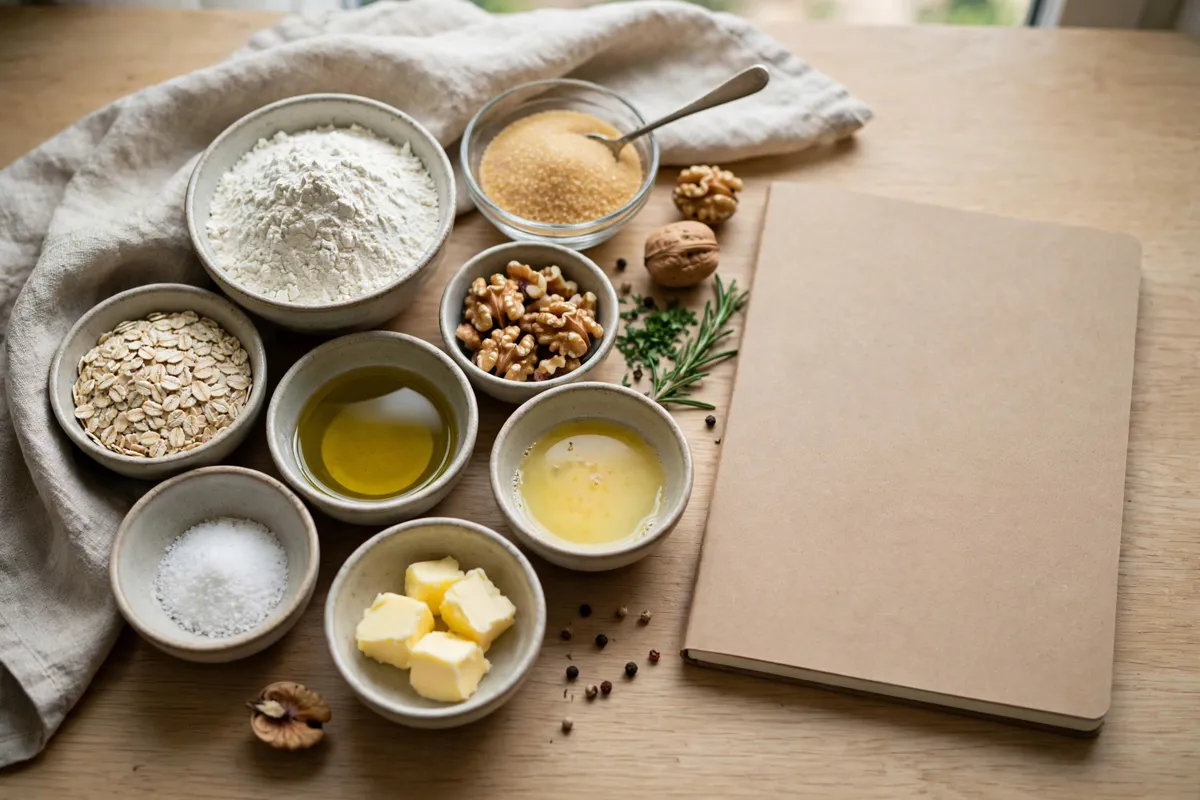
Calorie Counter: The Short Answer
To calculate calories in a recipe, add the calories of every ingredient in the full amount you use, then divide the total by the number of servings. A chilli made with ingredients totalling 1,600 calories that serves four people contains 400 calories per serving — no other step is required.
That is the whole method, and it is the same one used by recipe websites and meal-prep services. What separates an accurate figure from a fantasy is the quality of the inputs: real weights instead of "a tin" or "a handful," the cooking oil included, and a serving count that reflects how the dish is genuinely eaten. This article gives the step-by-step process, a complete worked example with the verified food values used by this site's calorie counter, the adjustment for dishes where portions are uneven, and the shortcuts that are safe to take once the full method feels familiar.
Short Answer
Calories per serving = total ingredient calories ÷ servings. Find each ingredient's calories for the exact amount and form (raw or cooked) you use, include oils, sauces and sweeteners, add everything for the whole dish, and divide. For uneven portions, weigh the finished dish and calculate calories per 100g instead: total calories ÷ total grams × 100.
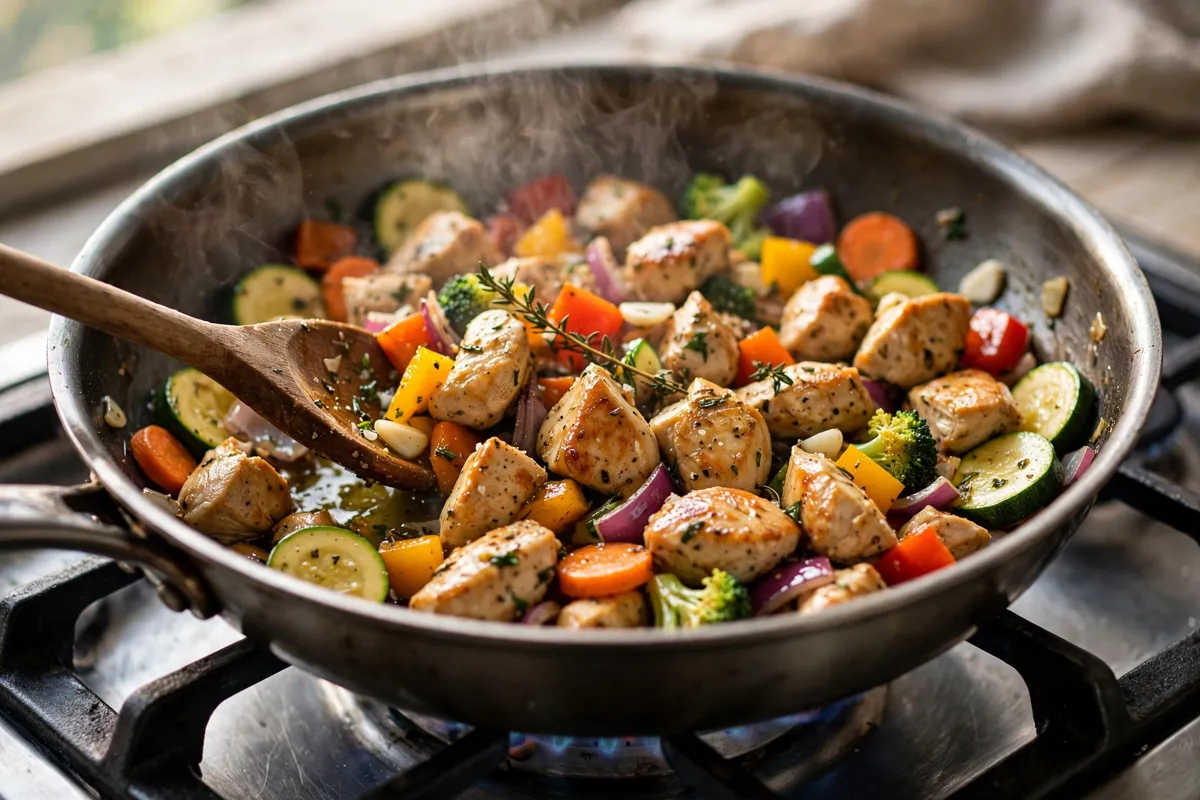
Step 1 — How Do You Gather the Calorie Value of Each Ingredient?
Use one reliable source consistently. This site's food list gives per-serving values for common foods: cooked chicken breast 165 calories per 100g, a large egg 78, cooked white rice 204 per cup, cooked brown rice 216 per cup, dry oats 154 per half cup, cooked broccoli 55 per cup, whole milk 149 per cup, almonds 162 per ounce, peanut butter 95 per tablespoon. Packaged ingredients carry labels — use the label, scaled to the amount you add: if the recipe uses half a 400g tin, take half the tin's total. Fresh ingredients without labels (an onion, a pepper) can be estimated from a database entry per 100g. What matters is matching the value's form to your amount: dry rice values with dry weights, cooked values with cooked weights. Mixing them is the single largest source of recipe error, larger than any rounding.
Step 2 — How Do You Work a Full Recipe, Start to Finish?
Take a simple chicken and vegetable soup that serves four. Ingredients: cooked chicken breast is not how soup cooks, so use the whole dish approach with the cooked dish weighed at the end — but for the ingredient sum, start from what goes in. Suppose the finished soup is built from 300g of chicken breast counted at its cooked value for simplicity once poached (300g × 165 per 100g = 495 calories), 2 cups of cooked white rice added at serving (408 calories), 2 cups of cooked broccoli (110), 1 cup of carrots (52), and 1 cup of whole milk stirred in (149). Ingredient total: 495 + 408 + 110 + 52 + 149 = 1,214 calories for the pot. Divided by four servings: about 304 calories per serving. Now the checks. Was oil used to start the soup? Two tablespoons would add roughly 240 calories — 60 per serving — and omitting it is a 20% understatement. Was the rice measured cooked? Yes, cups cooked, matching the value used. The calorie counting guide's worked examples runs the identical discipline on a packaged meal and a restaurant plate so you can see where home cooking is actually easier: you know what went in.
Step 3 — How Do You Divide a Recipe When Portions Are Never Equal?
Count per 100g. Weigh the empty pot, cook as usual, weigh the full pot, and subtract: that is the finished dish's weight. Divide the ingredient total by that weight and multiply by 100. If the 1,214-calorie soup weighs 1,600g finished, it carries about 76 calories per 100g. A ladle of 250g is therefore about 190 calories; a deep bowl of 400g is about 304. This method also survives second helpings, leftovers and family serving styles, because any amount converts through the same figure. It is the method meal-preppers rely on: cook once, weigh once, and five different lunchboxes are all calculated. The only requirement is a kitchen scale and thirty seconds — see also counting calories without a food scale for the honest limits of the no-scale alternatives before deciding you do not need one.
- Match each value's form (raw/dry or cooked) to the amount you record
- Include oil, butter, sauces, cheese and sugar as ingredient rows of their own
- Divide by servings actually eaten — or better, calculate per 100g of finished dish
- Save the calculation with the recipe so the next cook is already counted
Step 4 — Which Shortcuts Are Safe, and Which Are Not?
Safe shortcuts: skipping herbs, spices, garlic, lemon juice and other sub-5-calorie flavourings; rounding ingredient values to the nearest 5 calories; reusing last time's per-100g figure for the same recipe cooked the same way. Unsafe shortcuts: estimating meat by the piece when pieces vary; skipping the cooking fat because "most of it stays in the pan" (with roasting, frying and sauces, most of it does not); assuming a recipe's stated serving count is real; and copying a similar-looking recipe's calories from the internet when your ingredient amounts differ. Another unsafe habit is counting the main ingredients precisely and then adding cheese, dressings or a swirl of cream "by eye" at the end — finishing ingredients are calorie-dense by design. If a step feels tedious, remember you only perform it once per recipe; the written result serves every future repetition, which is the entire economy of the method.
Sauces, gravies and finishing touches deserve their own warning inside this step, because they are where careful cooks lose their accuracy at the final metre. A sauce is a recipe inside the recipe: total its ingredients separately — the oil or butter base, the flour, the milk or stock, the cheese — and add its total as one row of the main dish before dividing. Finishing touches added at the table (grated cheese, a drizzle of oil, a spoon of mayonnaise at about 95 calories per tablespoon of peanut-butter-like density for spreads of that family) belong to whoever's portion they land on rather than to the dish as a whole, so count them per portion when they are significant. None of this needs doing twice: once a sauce's per-tablespoon or per-ladle figure is calculated, write it on the recipe card and it serves every future serving.
Common Mistakes to Avoid
Mistake one is the raw-versus-cooked mix-up, responsible for most 30%-off recipe figures: grains roughly triple in weight as they absorb water, and meat loses about a quarter of its weight, so the wrong pairing distorts in both directions. Mistake two is a fantasy serving count — "serves six" daintily, eaten by three hungry people, halves the stated calories per portion on paper only. Mistake three is forgetting what went into the pan before the ingredients did: oil, butter, ghee. Mistake four is tasting-as-you-go amnesia: cooks' tastes of a rich dish can reach a small serving by themselves; either count a tasting allowance or taste from the portion you will eat. Mistake five is never updating the calculation when the recipe evolves. Your chilli is not the chilli you calculated if it now has an extra tin of beans and cheese on top.
Final Thoughts
Recipe calories are addition and division: honest ingredient values in the right form, the whole dish totalled, and the total divided by real servings or by the finished weight for a per-100g figure. Do it once, write it on the recipe, and home cooking becomes the most accurately counted food in your life rather than the least. Total your next recipe in the calorie counter as you cook it.
People Also Ask
How to Convert a Recipe?
To convert a recipe means two jobs: scaling it to a different number of servings and converting its units — for example, doubling a 4-serving soup to 8 servings turns 1 cup of cooked rice (204 calories) into 2 cups and 200g of chicken into 400g, with every ingredient multiplied by the same factor of 2.
What Is the Best Calorie Tracker App?
The best calorie tracker app is the one with a large verified food database, barcode scanning and a free tier you can actually live on — because the app you keep using beats the "best" app you abandon in week two. For most people that means trying two or three leading trackers for a week each and keeping the fastest one.
How Many Calories Are in Muffins and Bakery Items?
A Perkins Mammoth Muffin (Blueberry) has 650 calories on its own, with 10 grams of protein, 81 grams of carbohydrates, 33 grams of fat, and 42 grams of sugar. That single muffin costs more than a slice of Apple Pie at 370 calories and nearly as much as the Chocolate Silk Pie at 730 calories per slice — and this site's Perkins bakery data tracks only those three items, so the full bakery answer is a muffin at 650, an…
How Many Calories Are in an Italian Beef Sandwich?
The Italian Beef Sandwich (regular) at Portillo's is 690 calories. That is the short answer, for the regular size as listed in the Portillo's calculator on this site: 690 calories with 33 grams of protein, 59 grams of carbohydrates, 34 grams of fat, 0 grams of fiber, 3 grams of sugar and 1,237 milligrams of sodium. It is not a light sandwich, and it is not quite the heaviest sandwich on this menu either — it sits 10 calories above…