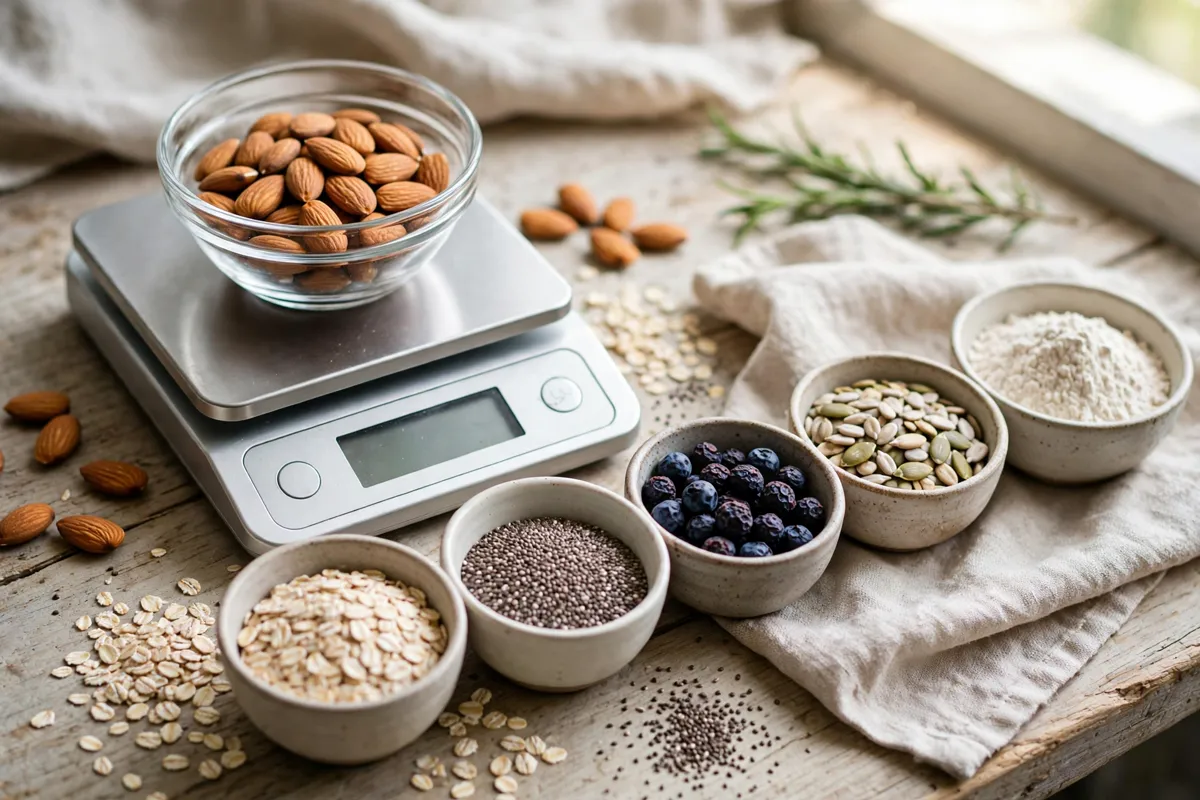
Calorie Counter: The Short Answer
To calculate nutrition facts for homemade food, list every ingredient with its weight, add up the calories, protein, carbs, fat, fibre, sugar and sodium for the whole dish, then divide by the number of servings. A soup totalling 1,200 calories across 4 servings is 300 calories per serving — every nutrient divides the same way.
Homemade food has no label to copy, so you build the label yourself from the ingredients. The method is bookkeeping, not chemistry: ingredient values are published for raw and cooked forms in databases and in tools like this site's own food list, your recipe quantities are known because you chose them, and the only real judgements are the serving count and how cooking changed the weights. This article works the method end to end — including a full worked dish using the verified values in the calorie counter — and covers the three places the maths usually goes wrong: water gained or lost in cooking, ingredients left behind in the pan, and servings that are never actually equal.
Short Answer
Weigh or measure each ingredient, find its nutrition per 100g or per common serving, scale to the amount you used, and add all ingredients together for the whole dish. Divide every total by the number of servings for per-serving facts. For the most accuracy, weigh the finished dish and divide the totals by portion weight instead of by a guessed serving count.
Step 1 — How Do You List and Weigh the Ingredients Correctly?
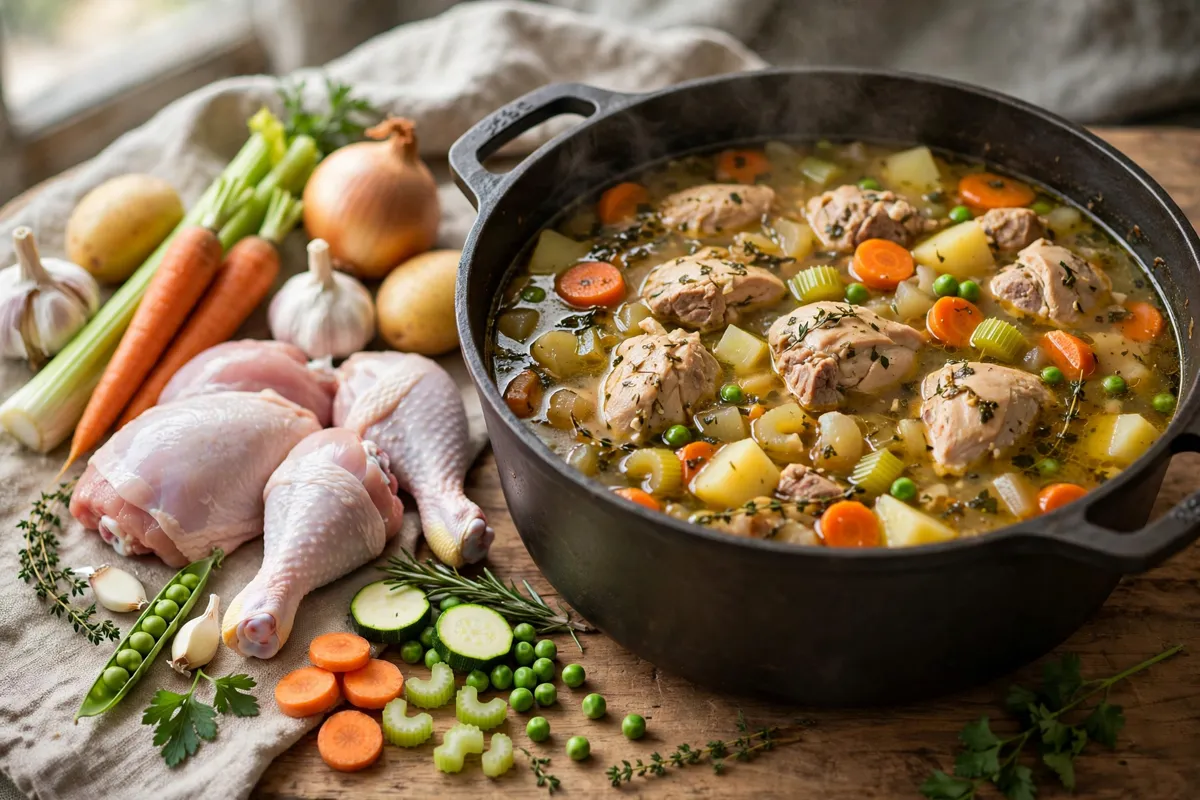
Write the recipe down as you cook, with weights, not intentions. "Chicken, 400g raw" is a usable record; "some chicken" is not. Use the form each database value describes: if the value you look up is for raw chicken, weigh raw; if it is for cooked, weigh the cooked portion. This site's food list uses cooked values for meats — cooked chicken breast at 165 calories and 31g protein per 100g — and dry values for grains like oats at 154 calories per half cup dry. Record cooking fats separately and honestly: oil in the pan is an ingredient even though it never appears on the plate, at about 9 calories per gram of fat. Record sauces, cheese, sugar and the handful of nuts as well. Small ingredients under about 5 calories — herbs, spices, a squeeze of lemon — can reasonably be skipped; oils and sweeteners never can. The nutritional value of food is explained on its own page, in full.
Step 2 — How Do You Add Up a Whole Dish, With a Worked Example?
Build a simple table, one row per ingredient, one column per nutrient, and add the columns. Example: a chicken, rice and broccoli traybake for four. Cooked chicken breast, 400g: at 165 calories, 31g protein, 0g carbs, 4g fat per 100g, that row is 660 calories, 124g protein, 0g carbs, 16g fat. Cooked white rice, 2 cups: at 204 calories, 4g protein, 44g carbs per cup, that row is 408 calories, 8g protein, 88g carbs, about 1g fat. Cooked broccoli, 2 cups: at 55 calories, 4g protein, 11g carbs, 5g fibre per cup, that row is 110 calories, 8g protein, 22g carbs, 10g fibre. One tablespoon of peanut-butter-style richness is not in this dish, but two tablespoons of cooking oil would add roughly 240 calories of fat and must be a row if used. Without oil the dish totals about 1,178 calories, 140g protein, 110g carbs, 17g fat. Divided by four servings: about 295 calories, 35g protein, 28g carbs, 4g fat per serving. The same row-and-divide method is rehearsed with smoothies in calculating calories in a homemade smoothie.
Step 3 — How Do You Handle Cooking Losses, Gains and Leftovers in the Pan?
Cooking changes weight, not nutrients — mostly. Rice and pasta gain water (a cup of cooked white rice at 204 calories started as roughly a third of that weight in dry rice), and meat loses water, which is why cooked values per 100g look more concentrated than raw. The safe rule: total the nutrients from the raw ingredients using raw values, because water has no calories; the dish's total calories are the ingredients' total, however the weight moves. Two exceptions need judgement. Fat or marinade left in the pan or on the grill never reaches the plate, so a dish drained of fat is slightly lighter than its ingredient sum. And boiling then discarding water — vegetables, pasta — carries a little of some nutrients away. For home purposes these are small corrections; note them, estimate conservatively, and move on. The bigger error is serving size: the honest fix is to weigh the whole finished dish, so a 1,178-calorie traybake weighing 1,200g is about 98 calories per 100g, and any portion can be weighed and scaled exactly.
- Totals come from ingredients, counted in the form (raw/cooked) your values describe
- Water gained or lost changes weight and concentration, not the dish's total calories
- Oil in the pan is an ingredient — record it as its own row
- Weigh the finished dish to convert totals into per-100g facts you can reuse for any portion
Step 4 — How Do You Divide the Dish Into Honest Servings?
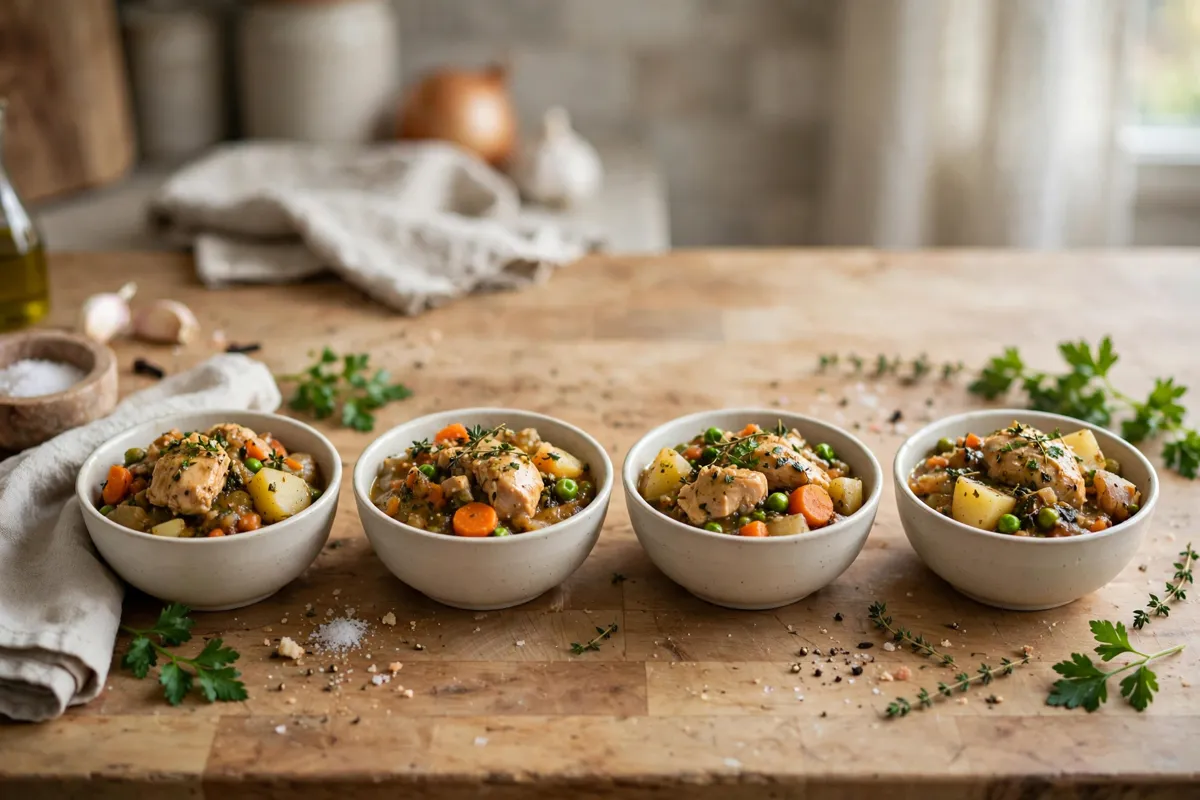
Decide the serving count by how the dish will actually be eaten, not by the recipe's hopeful claim. If a "serves six" casserole is eaten by four, calculate per serving as total ÷ 4. Portion before serving where you can — cut a bake into equal pieces, ladle stew into identical bowls — because free-served portions drift larger for the first people at the table. Leftovers are where your work pays off: because you know the whole dish's totals and, ideally, its finished weight, a leftover portion weighed at home converts instantly (weight ÷ total weight × total calories). Log the recipe once in the calorie counter or a notebook and every future cook of the same dish is already calculated. The calorie counting guide with worked examples shows the same discipline applied to restaurant and packaged meals for comparison.
One more situation deserves a method of its own: the mixed dish where ingredients cannot be separated afterwards, such as a stew, curry or bake. You cannot weigh the chicken in a served portion of stew, so the per-100g method is not a refinement here — it is the only honest route, and it is why the finished-dish weight matters so much. Weigh the pot empty and full, record both numbers on the recipe, and the stew's facts per 100g follow from its ingredient totals. If the dish reduces as it cooks — a slow curry losing a third of its water — the nutrients stay while the weight falls, which is exactly why the finished weight, not the raw ingredient weight, must be the divisor. Skipping that weighing is the difference between a stew calculated at its real concentration and one understated by the whole evaporation loss.
Common Mistakes to Avoid
The most common mistake is using cooked values for raw weights or the reverse — entering 400g of raw chicken against cooked-chicken values inflates protein and calories, because raw chicken is roughly a quarter water-weight that cooking removes. Second is forgetting the cooking medium: oil, butter and coconut milk have ended more calculations than any main ingredient. Third is dividing by the recipe's stated servings instead of the servings actually eaten. Fourth is ignoring marinades, breading and the sauce that goes over the top at serving. Fifth is calculating once and never again after changing the recipe — a swapped cheese or an extra cup of rice is a new dish nutritionally. Recalculate when the recipe changes, and write the new version beside the old one with its date.
Final Thoughts
Homemade nutrition facts are just careful addition: every ingredient weighted and valued in the right form, the columns totalled for the whole dish, and the totals divided by real servings — or better, by the finished dish's weight. Do it once per recipe and the work is never repeated. Start with tonight's dinner in the calorie counter, weigh as you cook, and keep the written version with the recipe.
People Also Ask
How to Calculate Calories in a Recipe?
To calculate calories in a recipe, add the calories of every ingredient in the full amount you use, then divide the total by the number of servings. A chilli made with ingredients totalling 1,600 calories that serves four people contains 400 calories per serving — no other step is required.
How to Convert a Recipe?
To convert a recipe means two jobs: scaling it to a different number of servings and converting its units — for example, doubling a 4-serving soup to 8 servings turns 1 cup of cooked rice (204 calories) into 2 cups and 200g of chicken into 400g, with every ingredient multiplied by the same factor of 2.
How Many Ounces of Chicken Make One Serving?
One serving of chicken is 3 to 4 ounces cooked — the standard guidance range, and the USDA's own reference portions land inside it: the half-breast portion is 86 grams, about 3 ounces, deriving to 141. 9 calories and 26. 7g protein (FDC ID 171477).
How Many Chicken Thighs Should You Serve Per Person?
Serve 2 chicken thighs per person for a main course — one skinless thigh at the USDA portion of 116 grams delivers 28. 7 grams of protein at 207. 6 calories (derived from FDC ID 172388), so one thigh suits a light plate or a lunch portion, while two thighs deliver 57.