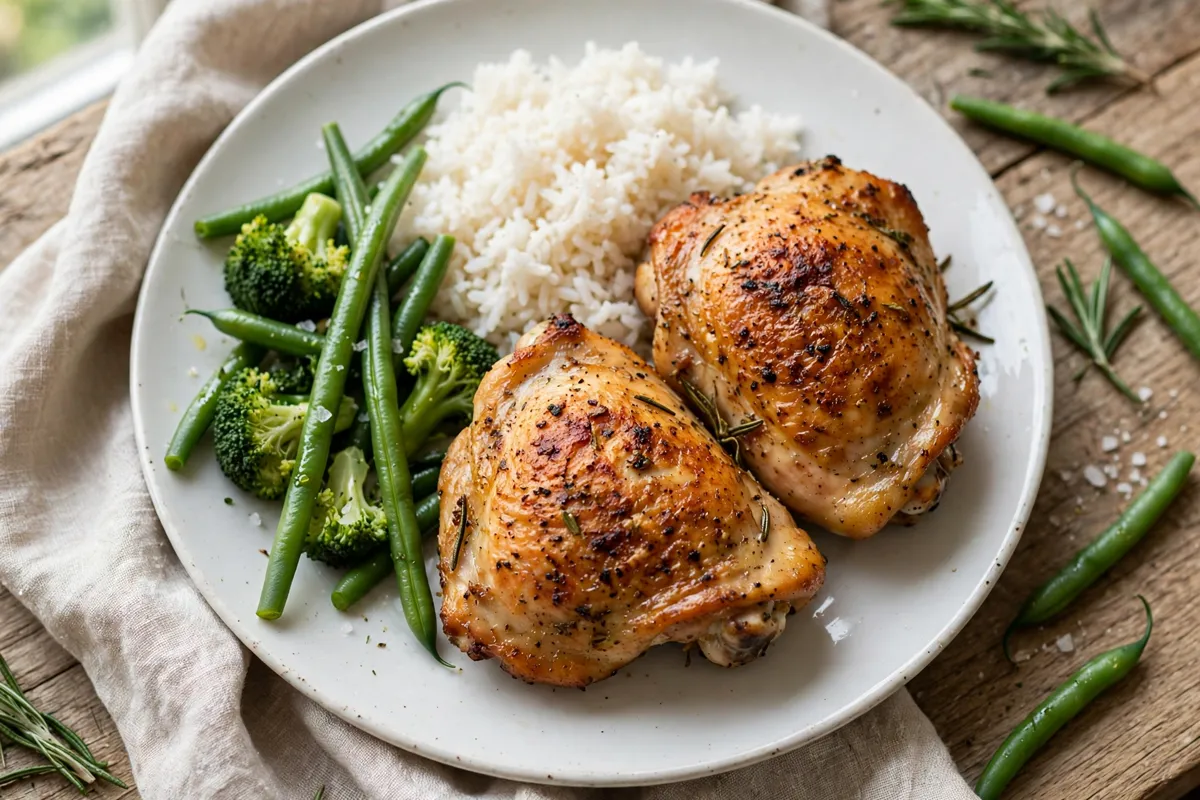
Chicken Protein Calculator: The Short Answer
Two chicken thighs contain 57.4 grams of protein. That is the derived total for two standard skinless thighs — 232 grams of cooked meat — from USDA's roasted thigh entry (FDC ID 172388) at 24.76 grams of protein per 100 grams. The protein in two chicken thighs, 57.4 grams, arrives with 415.3 calories, and it quietly beats a whole standard chicken breast on protein while costing more calories to do it.
Two thighs is the serving people actually eat — thighs are portioned by the pair on plates and in packs — so this total does more practical work than the single-thigh figure. This article builds the number from the single thigh, stages the comparison with the breast honestly in both directions, and shows how the pair behaves in a day's protein planning. The chicken protein calculator prices other counts and sizes at the same thigh rate.
Short Answer
Two skinless chicken thighs (116g of cooked meat each, 232g total) contain 57.4g of protein and 415.3 calories. That is exactly double one thigh's 28.7g of protein and 207.6 calories, because both come from the same entry at 24.76g of protein per 100g. Skin-on or bone-in weighing changes the inputs, not the rate.
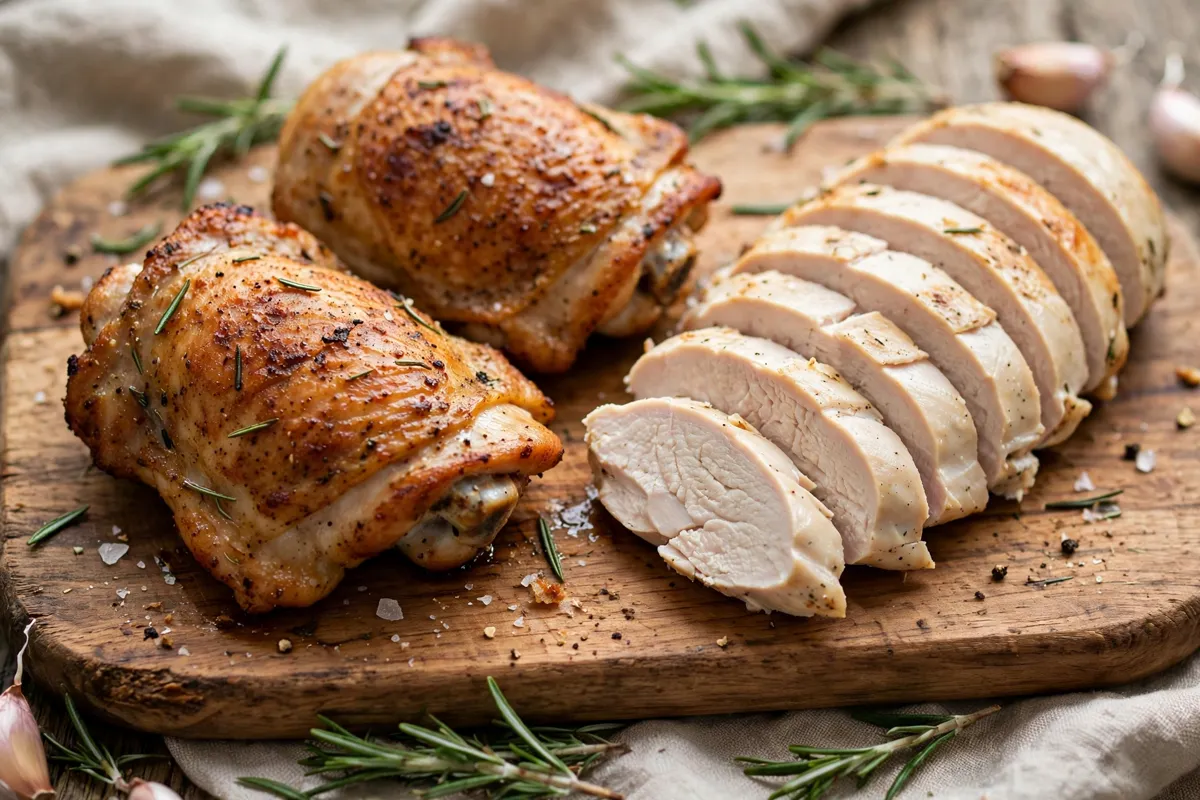
How Does the Two-Thigh Total Build From One?
One thigh, on the USDA portion basis, is 116g of meat providing 28.7g of protein (116 × 0.2476) and 207.6 calories (116 × 1.79). Two thighs are 232g of the same meat: 232 × 0.2476 = 57.4g of protein; 232 × 1.79 = 415.3 calories. Doubling is exact here because the meat is uniform — thigh meat does not vary across the pair the way a mixed portion of breast and leg would.
That uniformity makes the pair a reliable planning unit in a way single pieces of mixed cuts are not. A cook who serves two thighs per person knows the protein per plate to the gram before the oven is lit, subject only to the pieces matching the standard size. Where they do not — value packs with uneven thighs are the norm, not the exception — the batch weight rescues the arithmetic: weigh the cooked meat for the whole serving, and 0.2476 does the rest. The basis deserves restating once, because every figure in this article inherits it: the 116g portion is meat only — bone out, skin off, cooked by roasting — and a thigh eaten in any other state (skin on, or weighed with its bone) needs its input adjusted before the pair's total can be claimed.
How Do Two Thighs Compare With a Whole Breast?
This is the comparison that surprises both camps. Two thighs: 57.4g of protein, 415.3 calories. One whole standard breast: 53.4g of protein, 283.8 calories. The thighs win the protein line by 4.0g and lose the calorie line by 131.5 — the entire story of dark versus white meat in two rows. The breast delivers protein at 165 calories per 100g; the thigh at 179, with 8.15g of fat per 100g against the breast's 3.57g; across 232g of thigh meat those rate differences accumulate into the calorie gap, while the thigh's sheer meat weight (232g against 172g) carries its protein total past the breast's.
Neither row is the "winner" — they are two tools. The eater optimising protein per calorie takes the breast and it is not close. The eater who needs a satisfying, hard-to-ruin dinner that still delivers a milestone-level 57.4g of protein takes the thighs and pays 131.5 calories for the pleasure and the margin for cooking error. The fuller priced comparison, including equal-weight swaps, is in protein in chicken thigh versus chicken breast. That verdict is taken up directly in whether chicken thighs are healthy.
- Two thighs (232g meat): 57.4g protein, 415.3 calories
- One whole breast (172g meat): 53.4g protein, 283.8 calories
- Four thighs (464g meat): 114.8g protein, 830.4 calories — a family pack's protein, for reference
- Two breasts (344g meat): 106.7g protein, 567.6 calories — the white-meat pair, for the same reference
What Does the Pair Do in a Day's Protein Plan?
Against the milestones: 57.4g clears a 50g target with 7.4g to spare, in a single course of a single meal. Against a 100g day, the pair covers well over half, leaving 42.6g for the day's other meals and snacks — about a breast-and-a-half's worth of remaining room, or the protein of ordinary eating without another deliberate protein dish. Two pairs in a day (four thighs) would total 114.8g of protein at 830.4 calories of meat — a legitimate structure for a high-target eater who prefers dark meat, provided the rest of the day's calories are budgeted around it.
The planning caveat is the fat that travels with the pair: 232g of thigh meat carries about 18.9g of fat (232 × 0.0815), against the whole breast's roughly 6.1g. In a fat-aware plan — a keto split welcomes it, a low-fat template does not — that 18.9g is a real allocation, not a footnote. Protein plans that ignore the accompanying fat are how thigh-based days quietly overshoot their calorie ceilings while hitting their protein floors exactly as designed. The chicken protein mistakes guide files that under its most repeated error: pricing the nutrient you are chasing and forgetting the ones riding along.
Do Two Thighs Ever Not Equal 57.4 Grams?
Whenever the inputs move. Thighs from a large bird yield more than 116g of meat each, and the pair's protein rises gram for gram at the same 24.76-per-100g rate — a pair totalling 280g of meat provides 69.3g (280 × 0.2476). Skin-on eating adds the skin's weight — USDA lists the with-skin thigh portion at 137g against the skinless 116g — and while skin adds little protein, the meal's calories rise by more than the protein does, bending the pair's efficiency rather than its headline total. Bone-in weighing inflates the scale weight with protein-free grams.
And one more case: the pair that is not a pair of thighs at all, but a whole leg served as two sections — drumstick and thigh of one leg together price from the leg entry at 48.2g for the 199g piece, not from the thigh's rate twice. Names on a plate are worth checking against the joint test before the thigh maths is applied to them.
What Else Does the Pair Provide?
At portion scale, the thigh entry's other lines read: about 246mg of sodium (232 × 1.06) and about 624mg of potassium (232 × 2.69) across the pair. The potassium is a genuine contribution — dark meat is a respectable source — and the sodium, while roughly double what the same weight of breast would carry (the breast's rate is 74mg per 100g), remains modest for an unprocessed meat before your own seasoning is added. Both lines are worth the pair's eater knowing, because a two-thigh dinner is often a regular rotation meal, and regular meals are where quiet totals accumulate.
Common Mistakes to Avoid
Do not log two thighs at the breast's protein rate; at 31.02g per 100g the pair would falsely claim 72.0g, overstating the meal by 14.6g. Do not assume paired thighs in a pack are equal — weigh the serving's meat, especially from value packs. Do not price a drumstick-plus-thigh leg as two thighs; the whole leg has its own entry and total (48.2g). Do not let the protein victory over the breast hide the 415.3 calories and roughly 18.9g of fat that come with it. And do not stretch the skinless total over skin-on eating: discard the skin and 57.4g stands; eat it and the calories, at least, must be added.
Final Thoughts
Two chicken thighs contain 57.4g of protein and 415.3 calories — two standard 116g skinless thighs at 24.76g of protein per 100g. They out-deliver a whole standard breast on protein, cost about 132 more calories for the privilege, and cover a 50g target in a single serving. Price them as thighs, weigh them as a pair, and the chicken protein calculator will keep the count honest for any number of pieces.
People Also Ask
How Much Protein Is in Grilled Chicken Breast?
Grilled chicken breast contains 53. 4 grams of protein at the standard size. That is the figure for a 172-gram cooked breast, priced from USDA's roasted breast entry (FDC ID 171477) at 31.
How Much Chicken Breast Provides 30 Grams of Protein?
About 96. 7 grams of chicken breast provide 30 grams of protein. That is the derived amount — a little under 3.
How Many Calories Are in One Gram of Protein?
One gram of protein provides 4 calories. That single factor — 1 × 4 = 4 — is the figure food labels use for protein everywhere, and it scales in a straight line: 10 grams of protein is 10 × 4 = 40 calories, 30 grams is 30 × 4 = 120 calories, and 50 grams is 50 × 4 = 200 calories. If you know a food's protein grams, you already know exactly how many of its calories come…
How to Convert Grams of Protein Into Calories?
To convert grams of protein into calories, multiply the grams by 4. That is the whole method: 30 grams of protein is 30 × 4 = 120 calories, 12 grams is 12 × 4 = 48 calories, and 50 grams is 50 × 4 = 200 calories. Protein converts at 4 calories per gram — the same rate as carbohydrate, and well under fat's 9 — under the Atwater system that food labels use.