Chicken Protein Calculator: The Short Answer
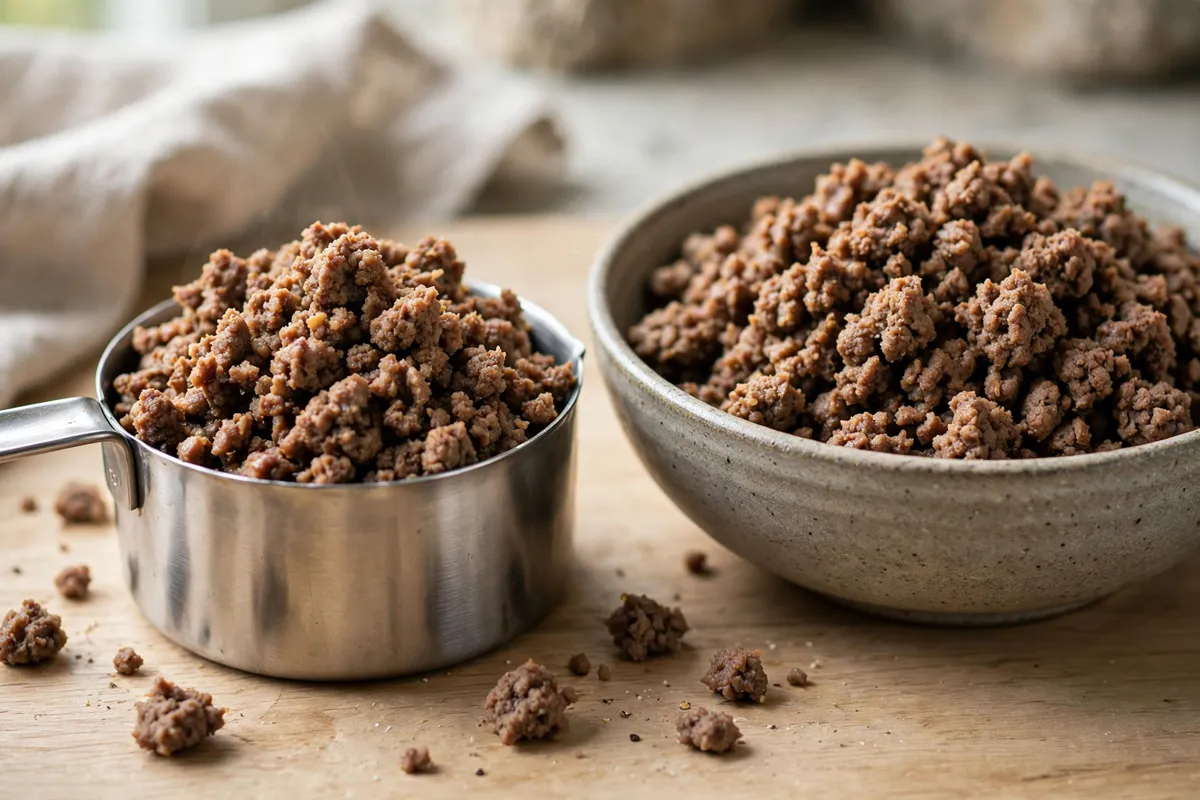
Half a cup of ground beef has no single verified protein figure, because USDA FoodData Central publishes no cup weight for cooked ground-beef crumbles — the verified anchor is 28.45 grams of protein per 100 grams for 90% lean ground beef crumbles, cooked pan-browned (FDC ID 171794). That per-100g figure is the honest answer to the half-cup question: any cup number depends on how large the crumbles are and how firmly the cup is packed, and this article works from the verified weight basis instead of inventing a cup weight.
That distinction matters more than it sounds. A loose scoop of fine crumbles and a firmly packed cup of coarse crumbles can differ by a third in weight, and protein follows weight exactly. What follows prices ground beef protein by weight — per 100 grams, per 3 ounces, per patty form — so you can weigh your own portion once and know its protein precisely, whatever cup it came out of. The same weight-first method runs through the chicken protein calculator, which prices every poultry portion the same way.
Short Answer
There is no USDA-verified protein figure for half a cup of ground beef, because neither ground-beef entry in FoodData Central publishes a cup gram weight. The verified figures are 28.45g protein per 100g for 90% lean crumbles, cooked pan-browned (FDC 171794), and 24.2g protein per 3 ounces (85g), derived from that entry. If your half cup happens to weigh 100 grams, it carries 28.45g of protein — but weigh it, because the cup itself guarantees nothing.
Why Does Ground Beef Have No Cup Portion in the Data?
Because a cup measures volume, and crumbled meat refuses to hold a fixed volume. Rice, flour and chopped vegetables settle into a cup in a fairly repeatable way; browned crumbles do not. Fine crumbles pack tightly with little air between them, coarse chunks leave gaps, drained meat sits differently from meat spooned straight from the pan with its juices, and a cook who presses the cup down adds still more. Faced with that spread, the USDA simply does not publish a cup weight for the crumbles entry (171794) or for the broiled patty entry (174031) — the portion table for both stops at weight-based servings such as 3 ounces.
That absence is information, not an oversight. It tells you that every half-cup protein figure quoted elsewhere rests on a cup weight somebody assumed, and different assumptions produce different answers. A source assuming a light, loose cup will quote a low figure; a source assuming a heavy, packed cup will quote a high one, and both will present the result as a fact about ground beef rather than a fact about their assumption. The way out is not a better guess — it is a scale, used once, to learn what your cup of your crumbles actually weighs. From that single weighing, the verified per-100g figure does the rest of the work permanently.
What Are the Verified Protein Figures for Ground Beef?
The headline entry is 90% lean ground beef crumbles, cooked pan-browned (FDC 171794): per 100 grams it carries 230 calories, 28.45g protein, 0g carbohydrate, 12.04g fat, 87mg sodium and 433mg potassium. Scaled to the entry's own 3-ounce portion (85g), that is 195.5 calories and 24.2g protein, derived. The cross-check entry, a 90% lean patty cooked broiled (FDC 174031), runs slightly leaner in protein terms per gram — 217 calories and 26.11g protein per 100g — because a formed patty loses a little more fat and moisture to the grill than loose crumbles do in the pan.
Leanness moves these numbers more than cooking style does. The 90% lean figures above describe meat that is nine parts lean to one part fat before cooking; fattier grinds carry more fat per 100 grams and correspondingly less protein, because fat displaces protein gram for gram in a fixed weight. That is why comparisons only mean anything at a stated leanness: the chicken protein calculator holds chicken breast at 31.02g protein per 100g, and ground beef at 90% lean sits just below it at 28.45g — close, but with roughly three times the fat (12.04g against 3.57g per 100g). Protein per calorie tells the same story more sharply: beef crumbles deliver about 12.4g of protein per 100 calories, chicken breast about 18.8g. For the head-to-head at equal weights, how much protein is in 100 grams of chicken breast prices the poultry side of that comparison.
How Do You Price Your Own Half Cup Accurately?
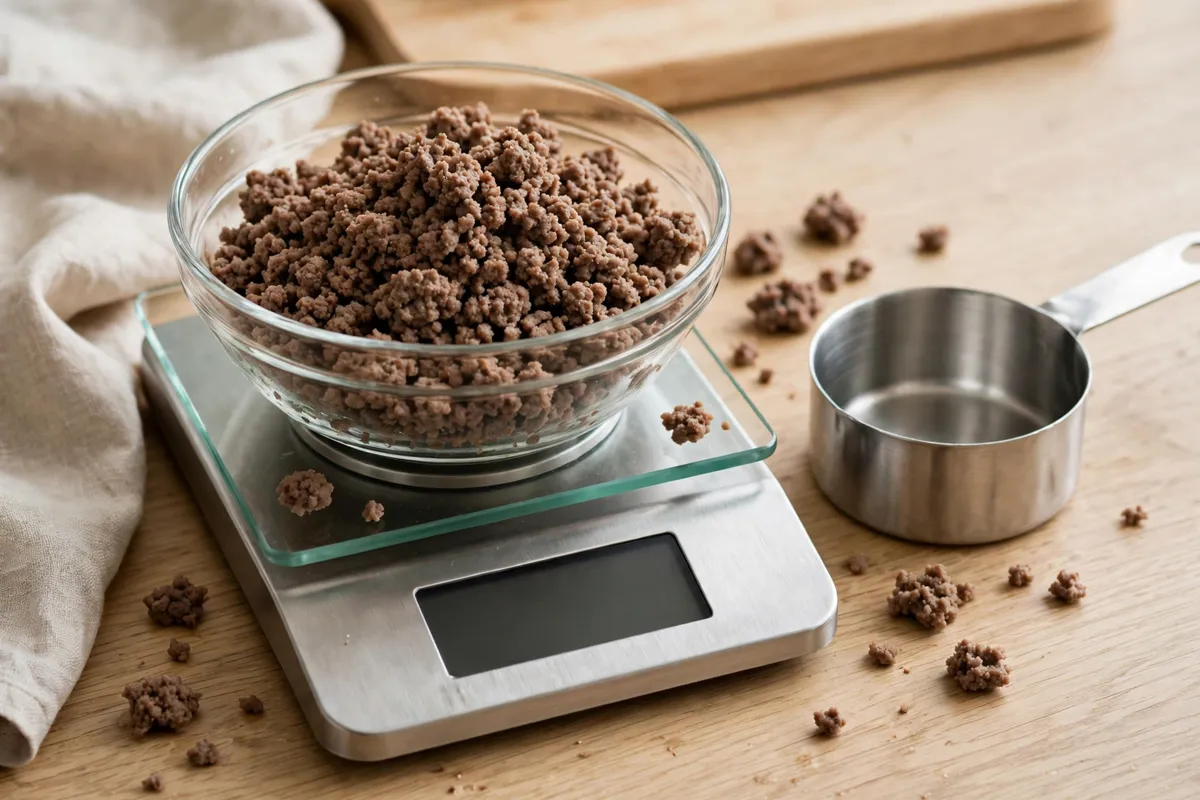
Weigh the portion once and multiply. Put the plate or bowl on a kitchen scale, add your half cup of crumbles, and read the grams. Then apply the verified rate: grams × 0.2845 gives protein grams, and grams × 2.30 gives calories, both from entry 171794. A half cup that weighs 85 grams — the 3-ounce equivalent — carries 24.2g protein and 195.5 calories. A half cup that weighs exactly 100 grams carries 28.45g protein and 230 calories. A generously packed half cup weighing 120 grams carries about 34.1g protein (120 × 0.2845) and about 276 calories.
A few habits make the weighing honest:
Once you have done this twice, the cup becomes reliable for you personally — which is the only reliability a cup of crumbles can honestly offer. The same weigh-then-convert discipline is what how to calculate protein in raw vs cooked chicken teaches for poultry, and it transfers to every minced or crumbled food in the kitchen.
- Weigh the meat drained, the way you will eat it — pan juices left behind are mostly fat and water, not protein
- Weigh after cooking, against this cooked entry; raw ground beef weighs more and prices differently
- Note your own cup's weight once and reuse it — your crumble size and packing style are consistent even if nobody else's are
- Log the gram weight, not the cup, so the record stays true if you change cups or spoons
How Does Ground Beef Protein Compare at the Table?
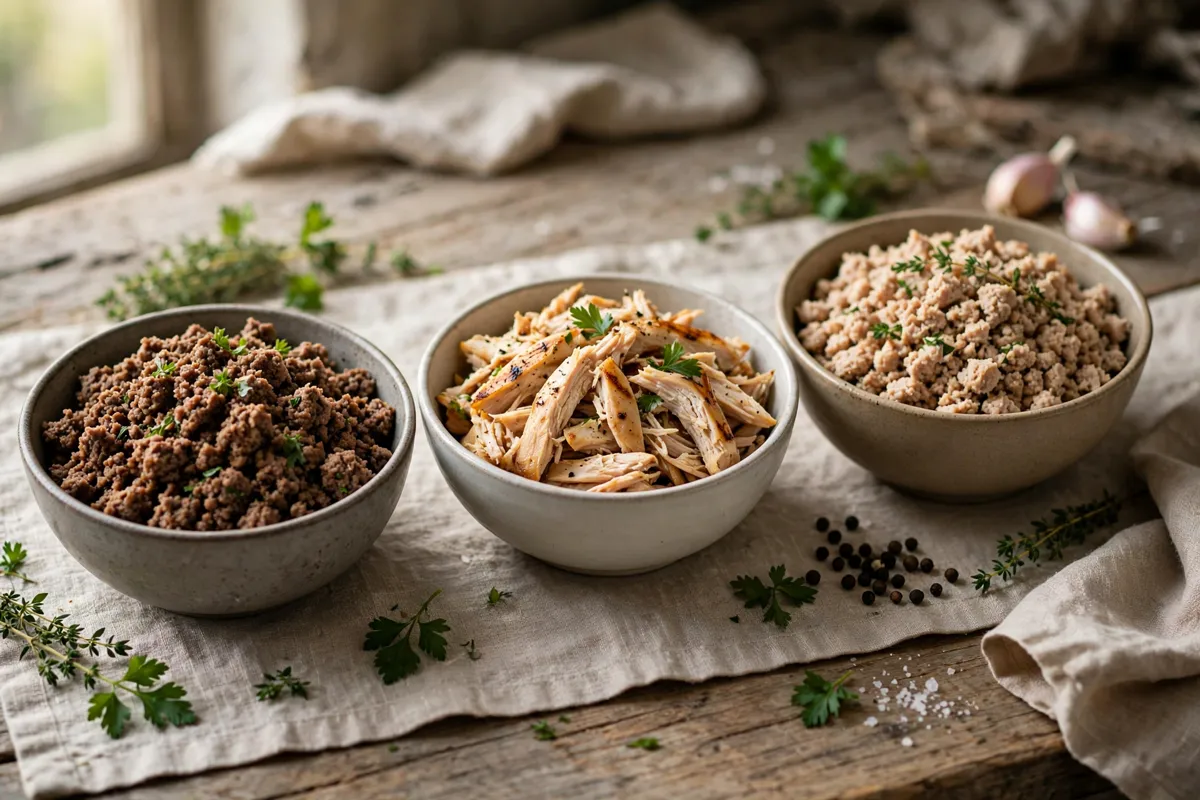
At equal cooked weights, the ranking among common proteins runs: chicken breast 31.02g per 100g, turkey breast 30.13g, sirloin steak 30.55g, ground beef crumbles (90% lean) 28.45g, and ground beef patty (90% lean, broiled) 26.11g. Ground beef is a genuinely strong protein food — a 3-ounce serving at 24.2g covers a large share of a meal's 30-to-40-gram target — but it earns that protein alongside 12.04g of fat per 100g, the highest fat load in this group, which is the real trade a cook is making when choosing crumbles over breast meat.
Where ground beef wins is practicality and flavour per effort: it browns in minutes, stretches across tacos, sauces and stuffed vegetables, and its fat carries flavour that lean breast meat cannot. The protein cost of choosing it is modest — about 2.6 fewer grams per 100g than chicken breast — while the calorie cost is the larger number: 230 against 165 per 100g. Neither fact argues for removing it; both argue for pricing it by weight, which is all this article asks.
Common Mistakes to Avoid
- Quoting a half-cup protein figure as a USDA fact — no cup weight exists in the data, so every such figure hides an assumption
- Logging crumbles against the raw-meat entry, which understates protein per gram because raw meat still holds its cooking water
- Comparing grinds without stating leanness — 90% lean at 28.45g per 100g is a different food, nutritionally, from a fattier grind
- Weighing with the pan juices included, then eating the meat drained — the scale and the plate must describe the same thing
- Assuming a patty and crumbles price identically — the broiled patty entry runs 26.11g per 100g against the crumbles' 28.45g
Final Thoughts
Half a cup of ground beef carries about 28.45 grams of protein if it weighs 100 grams, and 24.2 grams if it weighs 3 ounces — and the cup alone cannot tell you which. The verified anchor is 28.45g per 100g for 90% lean crumbles (FDC 171794); weigh your portion once, convert with that rate, and the question is answered permanently for your kitchen. The chicken protein calculator applies the same weight-first honesty to every portion it prices.
People Also Ask
How Much Protein Does Turkey Have?
Turkey breast has 30. 13 grams of protein per 100 grams, cooked and roasted, meat only (USDA FoodData Central FDC ID 171496) — one of the highest protein densities of any plain meat. Deli turkey slices are a different food on the same name: the prepackaged sliced entry (FDC 172941) carries 14.
How Much Protein Does Fish Have?
Fish has between 22. 83 and 25. 44 grams of protein per 100 grams in the two representative USDA entries — Atlantic cod at 22.
How Much Protein Is in a Poke Bowl?
A typical poke bowl carries about 30 to 36 grams of protein with one scoop of fish, and 50 grams or more with two scoops. In this site's Poke Bowl Calorie Calculator, a single-scoop bowl of white rice (240 calories, 4g protein), ahi tuna (110 calories, 26g protein), edamame (60 calories, 5g protein), cucumber (8 calories) and ponzu (15 calories, 1g protein) totals 240 + 110 + 60 + 8 + 15 = 433 calories and 4 + 26 +…
What Is the Lowest-Calorie Protein for a Poke Bowl?
Tofu is the lowest-calorie protein for a poke bowl at 80 calories per 4-ounce serving in this site's Poke Bowl Calorie Calculator — but it carries only 9 grams of protein, and the lowest-calorie protein that still behaves like a protein is cooked shrimp, at 85 calories with 20 grams of protein. Ahi tuna follows at 110 calories with 26 grams. Those three numbers, not the single winner, are the real answer: the leanest serving and the leanest useful serving…