Chicken Protein Calculator: The Short Answer
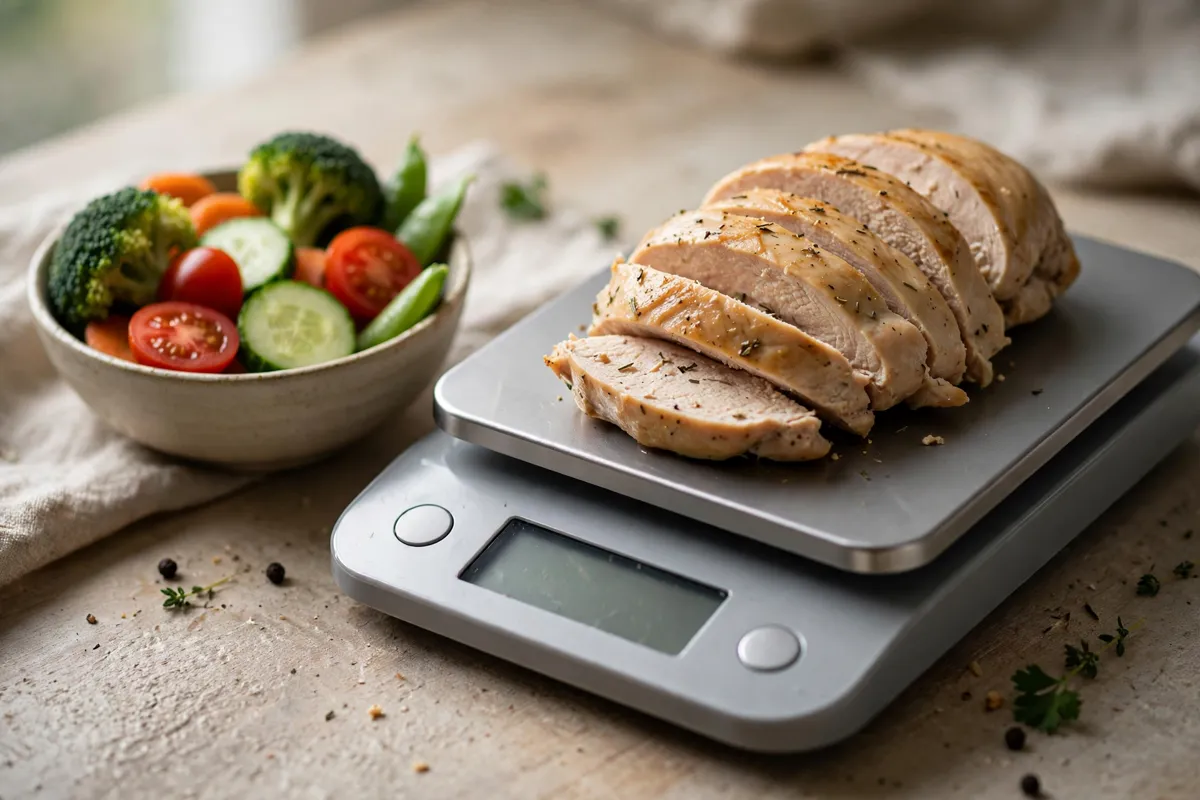
About 96.7 grams of chicken breast provide 30 grams of protein. That is the derived amount — a little under 3.4 ounces of cooked, boneless, skinless breast — worked from USDA's roasted breast entry (FDC ID 171477) at 31.02 grams of protein per 100 grams: 30 ÷ 0.3102 = 96.7. So the chicken breast that provides 30 grams of protein weighs about 97 grams cooked, roughly two-thirds of a standard whole breast, and carries about 160 calories with it.
Thirty grams is the most common single-meal protein target in circulation, which makes this the most practical calculation in the series: it converts a gram target into a weight of food you can put on a scale. This article shows the division openly, translates 96.7g into the portion language of halves, ounces and cups, and explains why the same 30g from other cuts or other cooking methods needs a different weight. The chicken protein calculator runs the same division for any target you give it.
Short Answer
You need 96.7g of cooked chicken breast — about 3.4 ounces — to get 30g of protein. That amount of breast contains about 159.6 calories (96.7 × 1.65, derived from the entry's 165 calories per 100g). It is a little more than one USDA half-breast portion (86g, 26.7g protein) and a little less than a 4-ounce serving (113.4g, 35.2g protein).
How Is the 96.7-Gram Figure Calculated?
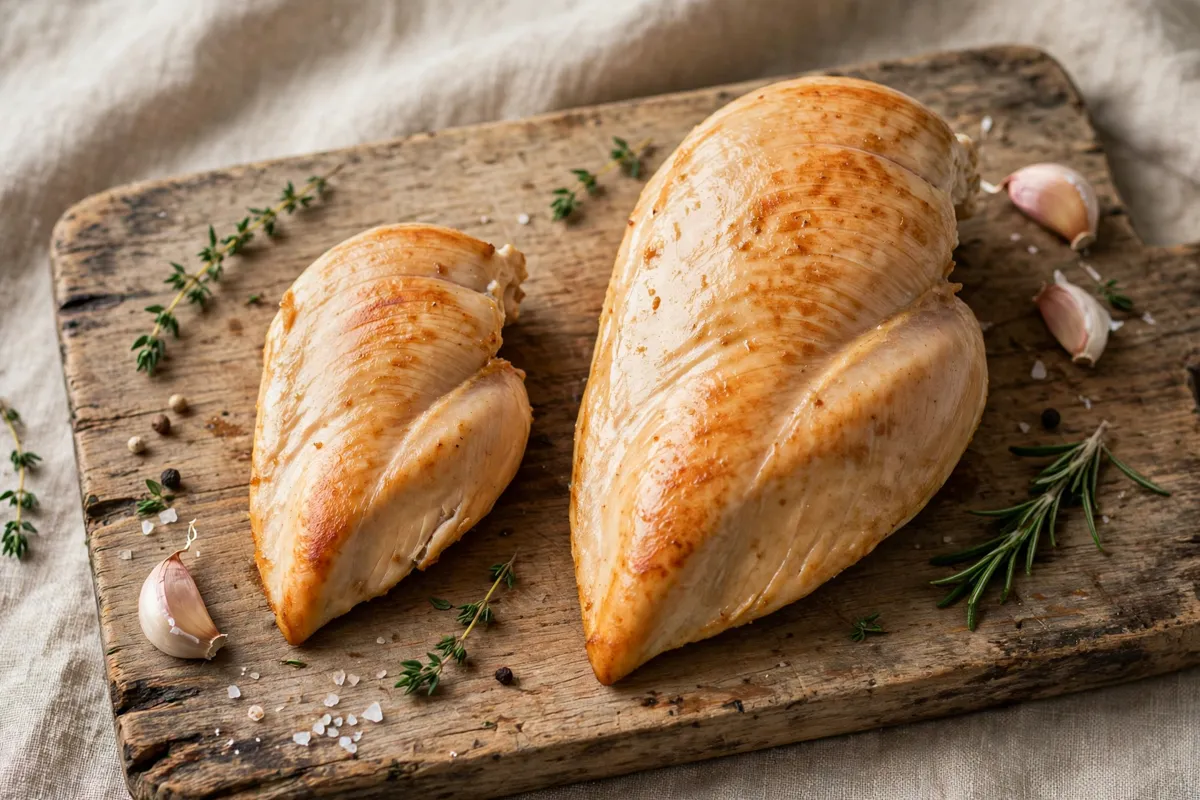
It is one division. The breast entry provides protein at a rate of 31.02g per 100g of cooked meat — or 0.3102g of protein in every gram of meat. To find the meat that holds 30g of protein, divide the target by the rate: 30 ÷ 0.3102 = 96.7g. Check it forwards: 96.7 × 0.3102 = 30.0g. The calories follow by the same weight at the calorie rate: 96.7 × 1.65 = 159.6 calories, with fat at 96.7 × 0.0357 = about 3.5g and carbohydrate at zero.
The reason this article can be so brief about its method is that the method is the whole subject. Every protein-target question — 30g, 50g, 100g — is the same division with a different numerator, and the chicken protein guide to portions for 100g of protein performs it at the largest common scale: 100 ÷ 0.3102 = about 322g of breast, a little under two standard whole breasts. Learn the shape of the calculation once, at the friendly size of 30g, and the entire family of questions answers itself at your kitchen scale.
What Does 96.7 Grams Look Like in Portions?
Ninety-six point seven grams is an awkward weight to picture, so here it is in the portion language the dataset speaks:
The practical reading: if your piece is a half breast, you are one good slice short of 30g; if it is a 4-ounce portion, you have cleared the target without needing the scale's precision at all. Most eaters aiming at 30g per meal will find the 4-ounce serving the livable answer — it forgives trimming, uneven pieces and the odd bite lost to the pan — while the exact 96.7g is the figure for meal-prep containers weighed to order. Either way, the near-miss at the half portion is the fact to remember, because "half a chicken breast" is casually treated as a 30g portion in countless plans, and it is 3.3g short of being one.
- One half-breast portion (86g) provides 26.7g protein — 3.3g short of the target; add a thick slice
- 3 ounces (85.1g) provides 26.4g protein — the same near-miss as the half portion
- The target weight itself (96.7g, about 3.4 oz) provides exactly 30.0g
- A 4-ounce serving (113.4g) provides 35.2g — clears the target by 5.2g
- Two-thirds of a standard whole breast (172g) is about 114.7g — the same overshoot territory as the 4-ounce serving
How Does the Same 30 Grams Look in Other Cuts?
Change the rate and the division changes. From each cut's own entry, the cooked meat needed for 30g of protein:
The breast's efficiency shows in the spread: the thigh route needs about 25% more meat on the plate for the same 30g, and at the thigh's calorie rate that meat costs about 217 calories (121.2 × 1.79) against the breast's 159.6. None of this forbids the thigh route — a thigh and a bit is a perfectly good 30g — but it prices the choice. The cut comparison behind these divisions is the subject of how much chicken you need for 100g of protein, where the same ranking holds at the larger target. The reverse calculation — how much breast makes a set protein target — is worked through in breast for 50g of protein.
- Breast at 31.02g per 100g: 96.7g of meat, about 159.6 calories
- Wing meat at 30.46g per 100g: about 98.5g of meat (30 ÷ 0.3046) — nearly the same weight, but roughly five wings' worth of picking to assemble it
- Whole chicken, meat only, at 28.93g per 100g: about 103.7g (30 ÷ 0.2893)
- Thigh meat at 24.76g per 100g: about 121.2g (30 ÷ 0.2476), roughly one standard thigh (116g, 28.7g) plus a bite
- Whole-leg meat at 24.22g per 100g: about 123.9g (30 ÷ 0.2422)
Does Cooking Method Change the Weight Needed?
Yes, through the water in the finished meat. On the stewed basis (FDC ID 171478, 28.98g of protein per 100g), 30g of protein needs 30 ÷ 0.2898 = about 103.5g of stewed breast — more meat by weight, because each gram is more dilute, though the whole-piece totals stay close to roasted, as the boiled-breast analysis showed. On the fried basis (FDC ID 171078, 33.44g per 100g), 30g needs only about 89.7g (30 ÷ 0.3344) of fried meat — less weight, because frying concentrated the protein — at a calorie cost per gram that runs the other way (187 per 100g against 165).
For grilled or baked breast, the roasted figure of 96.7g stands, since both price from the roasted entry. The method lesson is the series' refrain in target form: the protein target is fixed, but the weight that delivers it is a property of the finished meat in front of you — its cut, its method, its water. Divide by the rate of the meat you actually cooked.
How Does the 30-Gram Portion Fit a Full Day?
Built three times, the target structures a classic day: three meals anchored by 96.7g of breast each deliver 90g of protein from chicken alone (3 × 30), for about 478.8 calories of meat (3 × 159.6) — leaving the day's remaining protein to whatever else is eaten and the day's remaining calories largely free. Two such portions deliver 60g. The target's popularity is partly this arithmetic kindness: it is large enough to matter at every meal and small enough that the portion — a modest piece of breast, visually — never dominates the plate it anchors.
Common Mistakes to Avoid
Do not call a half breast a 30g portion; it is 26.7g, and a plan built on that error under-delivers at every chicken meal. Do not weigh 96.7g raw and claim the target — raw meat cooks down, and the cooked yield delivers less than 30g. Do not divide by the wrong cut's rate: 96.7g of thigh meat provides only about 24.0g of protein (96.7 × 0.2476), a 6g shortfall wearing the breast's number. Do not forget that a breaded piece's weight includes coating, so 96.7g of it is less than 96.7g of meat. And do not chase the decimal in daily life — the exact figure matters for containers and calculations; at the table, the 4-ounce serving's honest overshoot serves the target better than a trimmed 96.7g served grudgingly.
Final Thoughts
Thirty grams of protein lives in 96.7g of cooked chicken breast — about 3.4 ounces, a slice more than a half-breast portion, a slice less than the standard 4-ounce serving, and about 160 calories all in. The calculation is one division by the breast's rate of 0.3102g of protein per gram, and it generalises to every target and, with each cut's own rate, to every part of the bird. Set the target, divide by the right rate, weigh the result: the chicken protein calculator exists to make that three-step habit instant.
People Also Ask
How Much Chicken Breast Provides 50 Grams of Protein?
About 161. 2 grams of chicken breast provide 50 grams of protein. That is the derived amount — roughly 5.
How Much Protein Is in a 6-Ounce Steak?
A 6-ounce steak contains 52. 0 grams of protein. That is the derived figure for 170.
How Many Calories Are in 100g of Protein, Carbs and Fat?
Per 100 grams of the pure macronutrient, protein has 400 calories, carbohydrate has 400 calories, and fat has 900 calories. The three conversions are 100 × 4 = 400 for protein, 100 × 4 = 400 for carbohydrate, and 100 × 9 = 900 for fat. Those are the figures for the nutrients themselves — and no ordinary food matches any of them, because real foods are mixtures of macros plus water.
How Much Protein Should a High-Protein Salad Have?
A salad that is meant to be a meal should carry 25 to 40 grams of protein — the same per-meal target as any other lunch, with no discount for being served cold on leaves. In food terms, that is 100 to 130 grams of grilled chicken, which delivers 31 to 40 grams; a can of tuna at 25 to 30 grams; or a properly stacked plant build, such as 150 grams of firm tofu plus a half-cup of lentils…