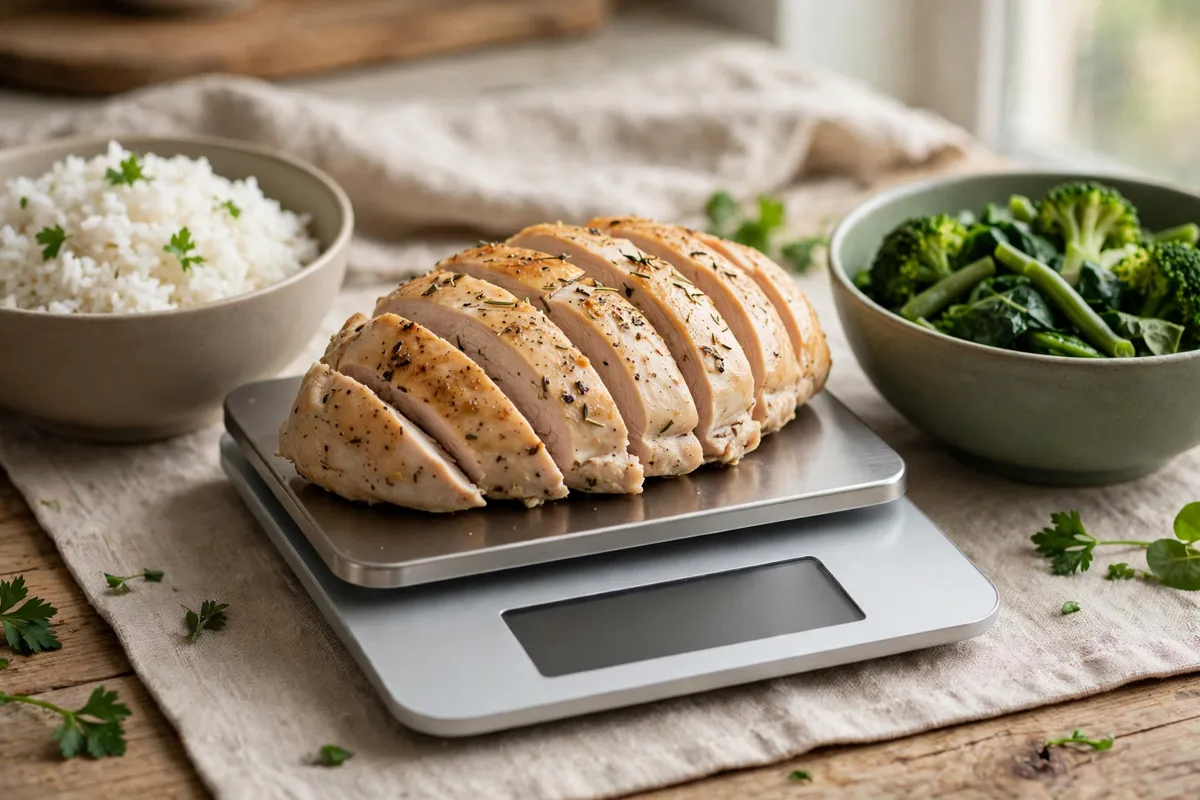
Chicken Protein Calculator: The Short Answer
About 161.2 grams of chicken breast provide 50 grams of protein. That is the derived amount — roughly 5.7 ounces of cooked, boneless, skinless breast — from USDA's roasted breast entry (FDC ID 171477) at 31.02 grams of protein per 100 grams: 50 ÷ 0.3102 = 161.2. The chicken breast that provides 50 grams of protein, in other words, is very nearly one whole standard breast, and it brings about 266 calories along with the protein.
Fifty grams is the ambitious meal target — the centrepiece number for high-protein eating patterns — and this calculation has a satisfying answer, because the required weight lands within a few grams of the most recognisable portion in the whole series. This article performs the division, shows the near-coincidence with the standard breast and where it breaks, and prices the same 50g from other cuts for the eaters who will not be using breast. The chicken protein calculator runs the identical division for any target.
Short Answer
You need 161.2g of cooked chicken breast — about 5.7 ounces — to get 50g of protein. That portion contains about 266.0 calories (161.2 × 1.65, derived). A whole standard breast (172g) provides 53.4g, slightly more than the target; a 5-ounce serving (141.8g) provides 44.0g, slightly less. The 50g line runs right through the standard breast.
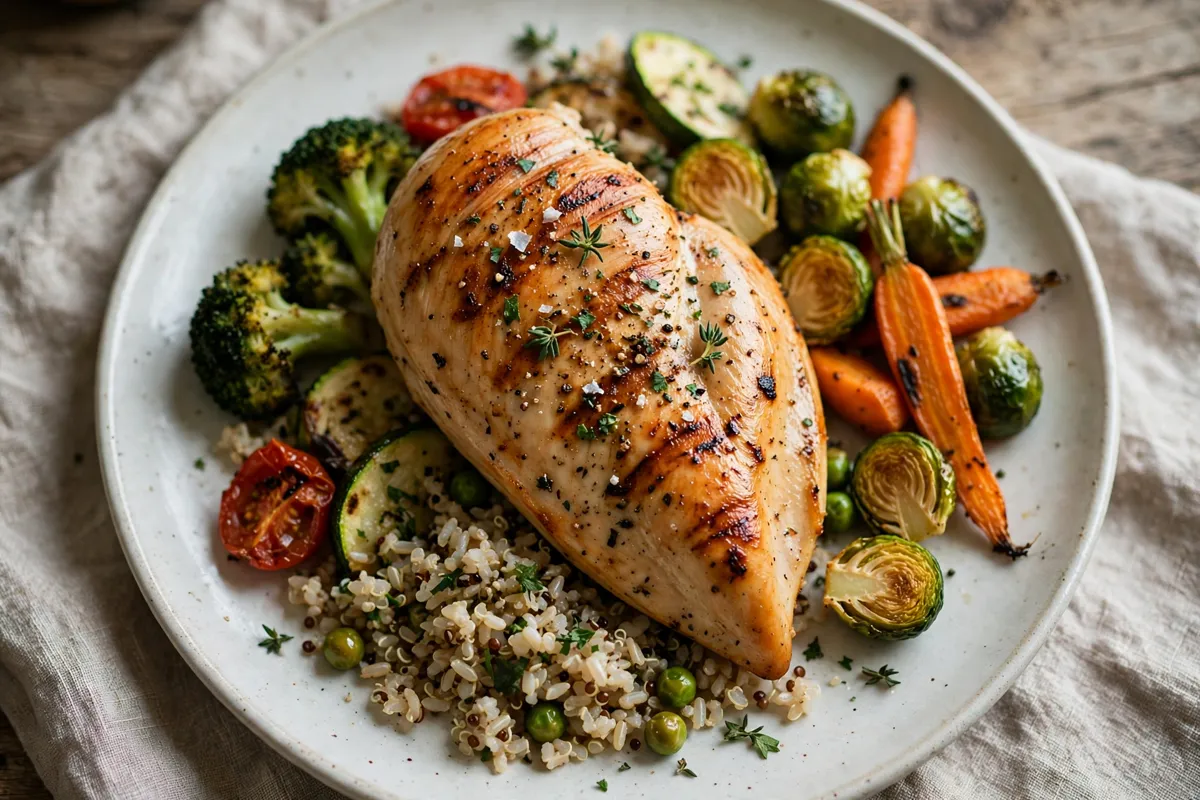
How Is the 161.2-Gram Figure Calculated?
By the same single division as every target question: the target divided by the meat's protein rate. Breast meat provides 0.3102g of protein per gram (31.02g per 100g, FDC ID 171477). So 50 ÷ 0.3102 = 161.2g of meat. Verified forwards: 161.2 × 0.3102 = 50.0g. The accompanying nutrients at that weight: 161.2 × 1.65 = 266.0 calories, and 161.2 × 0.0357 = about 5.8g of fat, with carbohydrate at zero as always for plain breast.
Set this division beside its smaller sibling and the family resemblance is clear: 30g of protein needs 96.7g of breast, 50g needs 161.2g, and 100g needs about 322.4g (100 ÷ 0.3102) — the arithmetic spine of the chicken protein portions guide for 100g of protein, which builds whole days out of these divisions. The targets scale linearly because the meat is uniform; nothing about the chicken changes between a 30g eater and a 100g eater except the weight on the scale. That linearity is what makes breast meat so plan-able, and it is worth stating plainly in an area of nutrition full of curves and caveats: here, twice the target is exactly twice the chicken.
Why Does the Answer Land on One Whole Breast?
Because the standard breast was, in effect, built at this size. The whole standard breast is 172g — two USDA half portions of 86g — and provides 53.4g of protein. The 50g requirement is 161.2g. The difference between the target weight and the standard breast is 10.8g of meat, about a mouthful: trim a thick slice from a standard breast and what remains is a 50g portion; serve the breast whole and you have overshot the target by 3.4g.
That near-coincidence is genuinely useful at the table. A plan calling for 50g of protein at dinner translates, without scales or apps, to "one whole chicken breast" — with the understanding that retail breasts run larger than standard, so a big one overshoots further (an 8-ounce breast provides 70.4g) and a small one may not arrive. The coincidence also marks the boundary of single-piece eating: targets up to about 50g can be met by one recognisable piece of chicken; targets beyond it require either a large breast, a second piece, or a second protein food joining the plate. Meal design gets simpler once that boundary is visible — below it, think in pieces; above it, think in weights and combinations.
What Does the Same 50 Grams Cost in Other Cuts?
The division, rerun at each cut's own rate:
The leg line is the near-miss worth remembering: the largest single dark-meat piece, eaten whole, does not quite reach 50g. The breast is the only standard single piece that clears the target alone — the quantitative reason it dominates high-protein meal design, explored from the daily-total side in how much chicken you need for 100g of protein, where the breast's rate advantage compounds across a whole day's target. The reverse calculation — how much breast makes a set protein target — is worked through in breast for 30g of protein.
- Breast at 31.02g per 100g: 161.2g of meat, about 266.0 calories
- Wing meat at 30.46g per 100g: about 164.2g of meat (50 ÷ 0.3046) — near the breast's weight, but assembled from roughly eight wings (8 × 6.4g = 51.2g)
- Whole chicken, meat only, at 28.93g per 100g: about 172.8g (50 ÷ 0.2893)
- Thigh meat at 24.76g per 100g: about 201.9g (50 ÷ 0.2476), at about 361 calories (201.9 × 1.79) — roughly a thigh and three-quarters, since one standard thigh provides 28.7g
- Whole-leg meat at 24.22g per 100g: about 206.4g (50 ÷ 0.2422) — just over one whole standard leg (199g), which provides 48.2g and falls 1.8g short
Does the Cooking Method Move the 50-Gram Weight?
Through water, yes. On the stewed basis (FDC ID 171478, 28.98g of protein per 100g), 50g of protein requires 50 ÷ 0.2898 = about 172.5g of stewed breast — a figure that lands almost exactly on the standard whole breast's weight, a coincidence of dilution: the stewed piece is heavier per portion and lighter per gram. On the fried basis (FDC ID 171078, 33.44g per 100g), 50g requires about 149.5g (50 ÷ 0.3344) of fried meat, with calories at the fried rate of 187 per 100g making that the expensive route to the same protein.
Grilled and baked breasts use the roasted division — 161.2g — unchanged. The skin-on breast (29.8g of protein per 100g, FDC ID 171075) would need about 167.8g (50 ÷ 0.298) and carry the skin's fat with it. In each case the target is constant and the weight is the variable, and the variable is set by the finished meat's water and fat — the same lesson, now at the size where a single piece of chicken is the whole answer.
How Does the 50-Gram Portion Split Across Two Meals?
Not every 50g day wants its 50g at once, and the target weight divides as cleanly as it was built: half of 161.2g is 80.6g of breast, providing exactly 25.0g of protein (80.6 × 0.3102) at about 133.0 calories (80.6 × 1.65). Two such portions — one at lunch, one at dinner — reach the same 50g total through two ordinary-looking servings of about 2.8 ounces each, neither of which resembles a "high-protein meal" on the plate. Targets are totals, and the division shows how quietly a 50g day can be assembled.
Common Mistakes to Avoid
Do not assume any single breast delivers 50g: a half breast delivers 26.7g, barely half the target, and the whole standard breast's 53.4g is the piece that clears it. Do not weigh 161.2g raw; the cooked yield falls short of the weight and the protein. Do not run the division at the breast's rate for a plate of thighs — 161.2g of thigh meat provides only about 39.9g of protein (161.2 × 0.2476), a 10g shortfall in breast clothing. Do not forget a breading's weight inside the 161.2g; coating is not meat and dilutes the rate. And do not round the target weight down to 150g for convenience and still log 50g — 150g of breast provides 46.5g (150 × 0.3102), and the 3.5g difference belongs in the log.
Final Thoughts
Fifty grams of protein live in 161.2g of cooked chicken breast — about 5.7 ounces, a slice under one whole standard breast, and about 266 calories in total. It is the only common protein target that a single standard piece of chicken clears on its own, which is why the whole breast and the 50g meal are so often mentioned in the same breath. Divide the target by the rate of the meat you cooked, weigh what the division returns, and the chicken protein calculator will confirm the figure for your exact portion.
People Also Ask
How Much Protein Is in a 6-Ounce Steak?
A 6-ounce steak contains 52. 0 grams of protein. That is the derived figure for 170.
How Much Protein Is in One Pound of Steak?
One pound of steak contains 138. 6 grams of protein. That is the derived total for 453.
How Much Protein Should a High-Protein Salad Have?
A salad that is meant to be a meal should carry 25 to 40 grams of protein — the same per-meal target as any other lunch, with no discount for being served cold on leaves. In food terms, that is 100 to 130 grams of grilled chicken, which delivers 31 to 40 grams; a can of tuna at 25 to 30 grams; or a properly stacked plant build, such as 150 grams of firm tofu plus a half-cup of lentils…
How to Calculate Protein Requirements for TPN?
Protein in TPN is ordered as amino acids in grams per day, not as a calorie target first: typically 1. 2–2. 0g per kg of body weight, which is 60 × 1.