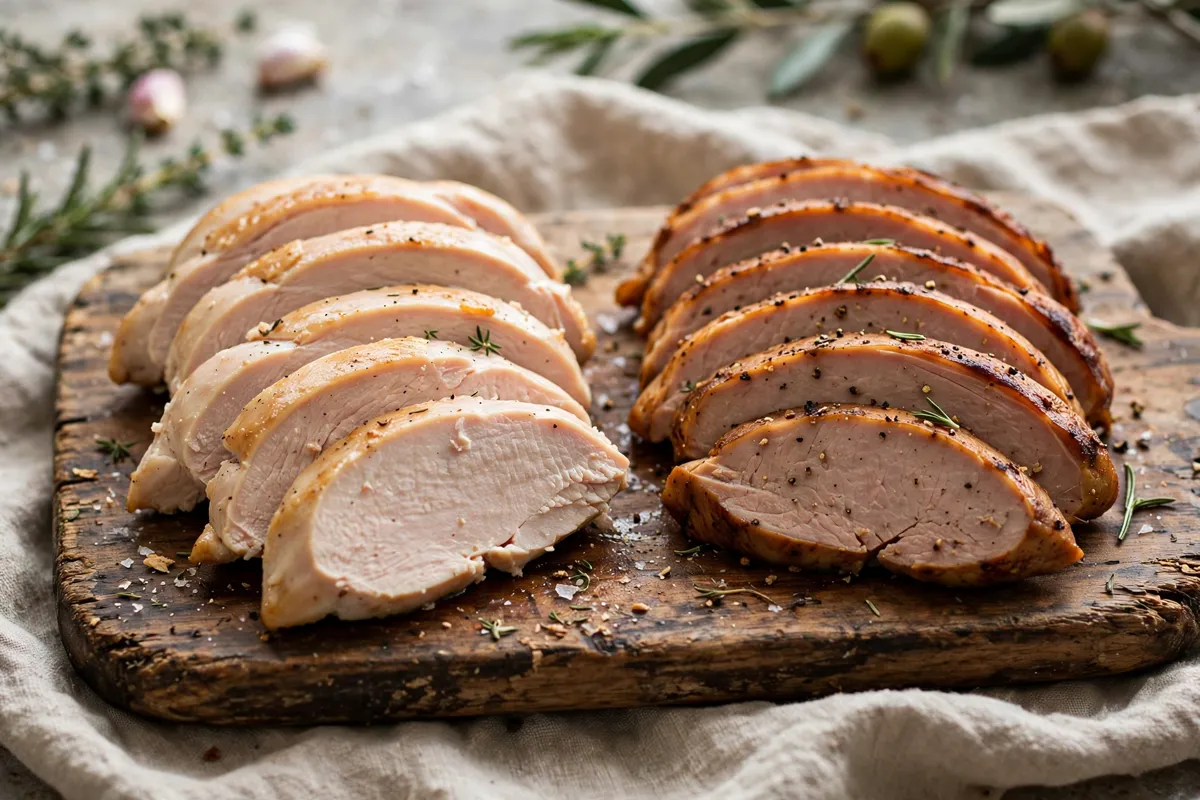
Chicken Protein Calculator: The Short Answer
Chicken has more protein than turkey — by a hair: chicken breast carries 31.02 grams of protein per 100 grams (USDA FDC ID 171477) against turkey breast's 30.13 grams per 100 grams (FDC ID 171496), both cooked, roasted and meat only. The gap is 0.89 grams per 100g, small enough that fat, calories and price may matter more to your choice than the headline itself. Turkey breast is leaner (2.08g fat against 3.57g per 100g) and slightly lighter in calories (147 against 165), so this near-tie has a real second round.
Comparisons this close are where sloppy data does the most damage: a figure borrowed from a skin-on entry, a raw entry or a deli product can flip the apparent winner. This article holds every variable constant — breast, meat only, cooked roasted, per 100 grams — and then works the tie at serving size, per calorie, and per protein target. Both birds convert at any weight in the chicken protein calculator.
Short Answer
Chicken breast has more protein: 31.02g per 100g against turkey breast's 30.13g — a difference of 0.89g, or about 3%. Turkey breast counters with less fat (2.08g against 3.57g per 100g), fewer calories (147 against 165 per 100g) and slightly more protein per calorie: about 20.5g per 100 calories against chicken's 18.8g.
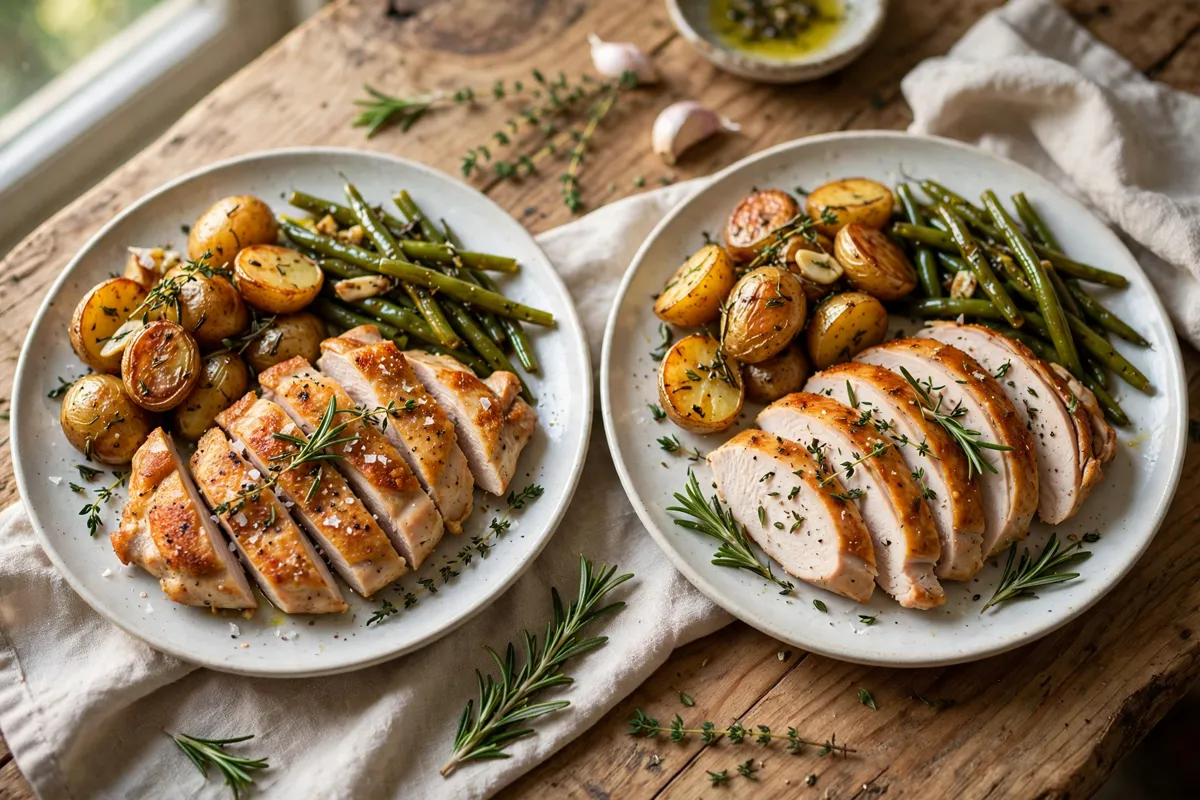
What Are the Full Numbers, Side by Side?
Chicken breast, meat only, cooked roasted (FDC 171477), per 100 grams: 165 calories, 31.02g protein, 0g carbohydrate, 3.57g fat, 0g fiber, 74mg sodium, 256mg potassium. Turkey breast, meat only, cooked roasted (FDC 171496), per 100 grams: 147 calories, 30.13g protein, 0g carbohydrate, 2.08g fat, 0g fiber, 99mg sodium, 249mg potassium. Read across the rows and the birds trade blows: chicken takes protein and sodium (74mg against 99mg), turkey takes fat, calories and protein efficiency, and potassium is a near-tie (256mg against 249mg).
The fat difference deserves a sentence of its own, because it explains the calories. Turkey breast's 1.49g fat advantage per 100g accounts for roughly 13 of the 18-calorie gap (fat at 9 calories per gram), with the small protein difference making up most of the rest. In other words, turkey is not a different kind of food — it is the same lean breast meat with a slightly leaner composition, and chicken is the same food with a slightly denser protein pack. How much protein is in chicken thigh vs chicken breast shows a within-bird gap several times larger than this entire cross-species contest, which puts the 0.89g in perspective: cut choice matters more than species choice. Turkey's protein is worked out on its own page.
How Does the Tie Play Out at Serving Size?
At the standard 3-ounce serving (85g), chicken breast derives to 140.3 calories and 26.4g protein; turkey breast derives to 125.0 calories and 25.6g protein. The protein gap at the plate is 0.8 grams — less than a bite of either bird — while the calorie gap is 15.3, small but real, and it compounds across a week of lunches. At the larger reference portion of 172 grams (the whole-breast basis used for chicken), chicken derives to 283.8 calories and 53.4g protein; turkey at the same weight derives to about 252.8 calories and 51.8g protein: a 1.6g protein difference against a 31-calorie difference.
Per protein target, the weights nearly merge. Thirty grams of protein takes about 97 grams of chicken breast (30 ÷ 0.3102 × 100) or about 100 grams of turkey breast (30 ÷ 0.3013 × 100) — a 3-gram difference in portion weight that no kitchen scale user will ever notice, priced at about 160 calories for chicken and about 147 for turkey. Fifty grams of protein takes about 161 grams of chicken or about 166 grams of turkey. Whoever wins your shopping decision, the plate barely knows the difference; the chicken protein calculator converts both birds at any of these weights.
When Does Turkey Win, and When Does Chicken?
Turkey wins when the plan is calorie-led. Its protein-per-calorie rate — about 20.5g per 100 calories, the best among the plain meats in this dataset — suits strict deficits, and its leanness leaves more of the plate's fat budget for dressings, cheeses and cooking oils chosen deliberately. Turkey also wins the leftover format: a roasted breast slices at home into sandwiches that keep the full 30.13g density, something no deli product matches.
Chicken wins on protein density outright, on sodium (74mg against 99mg per 100g), and in most kitchens on availability, price per kilo and recipe range — chicken breast is the default lean protein of weeknight cooking for practical reasons the data supports rather than contradicts. Chicken also wins the dark-meat undercard on protein: its thigh runs 24.76g per 100g, a figure the dataset's turkey coverage here does not contest, since this comparison is breast against breast by design. The honest verdict is that the species question is nearly settled by the tie itself — choose by cut, price and preference, and let does dark meat have less protein guide the within-bird decisions that actually move the numbers.
What About Deli and Ground Forms?
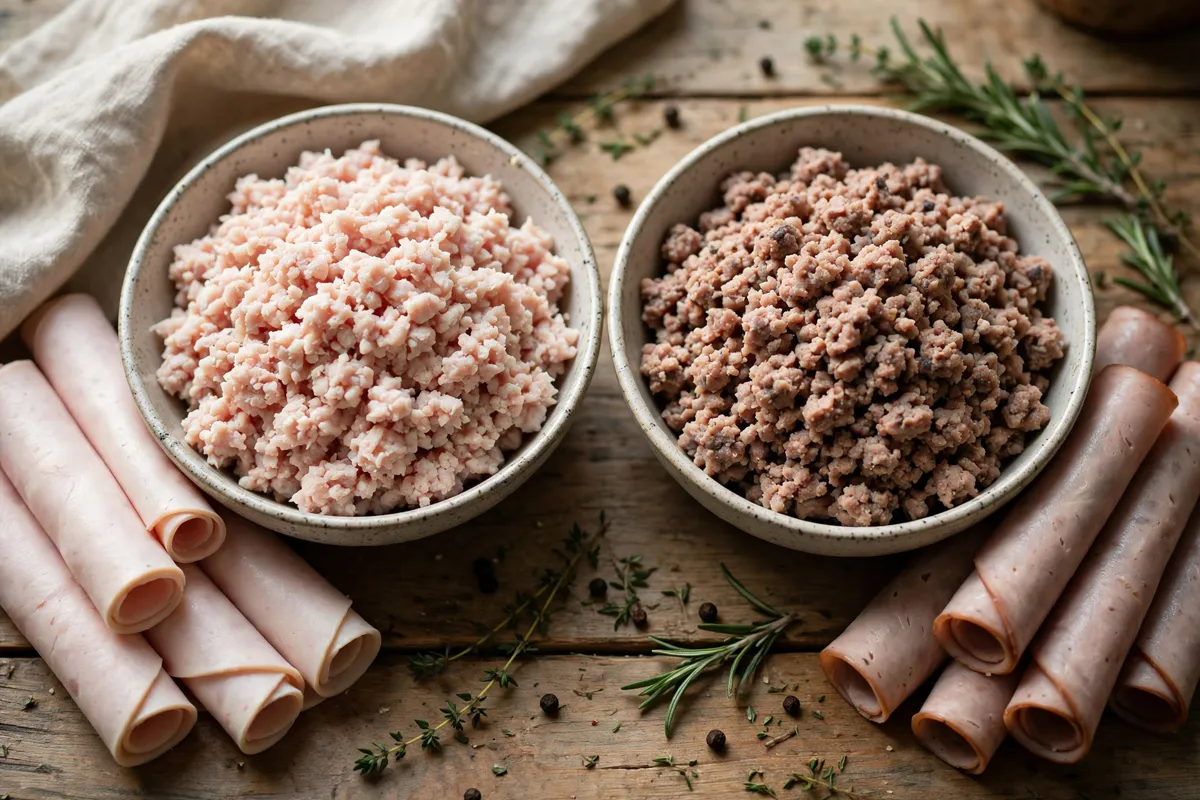
Form changes the food more than species does. Deli turkey slices (FDC 172941) carry only 14.81g protein per 100g with 898mg sodium — less than half the density of either roast breast, and nine times turkey breast's sodium. A sandwich logged as "turkey" at breast values but built from deli slices overstates protein by roughly half, whichever bird the eater had in mind. Ground forms follow the same rule: a ground product's protein follows its lean percentage, so a lean ground turkey and a lean ground chicken land near each other, both below whole breast, both priced by their own labels rather than by species loyalty.
The principle generalises beyond poultry: within any protein family, the entry — cut, form, skin, processing — moves the numbers further than the animal does. Breast beats thigh by about 6 grams per 100g inside one chicken; roasting beats deli-slicing by about 15 grams per 100g inside one turkey. Species, at 0.89 grams, is the smallest lever on the table.
Does the Verdict Change Across a Whole Week?
Barely — and that is itself the finding worth having. A week of lunches built on 4-ounce breast portions gives, from chicken, about 246.4g protein across seven meals (7 × 35.2g) at about 1,309.7 calories; from turkey, about 239.4g protein (7 × 34.2g, derived from 30.13g per 100g at 113.4g) at about 1,166.9 calories. The weekly difference is roughly 7 grams of protein — one bite's worth, spread over seven days — against roughly 143 calories, which is one modest snack. A planner who chooses turkey for the week has traded a bite of protein for a snack's worth of calories; a planner who chooses chicken has done the reverse. Both trades are defensible, neither is dramatic, and rotating the two birds across the week captures most of both advantages while ending the monotony that actually breaks protein plans. The tie, examined at every scale from 100 grams to seven days, stays a tie with different tiebreakers.
Common Mistakes to Avoid
- Comparing chicken breast with turkey dark meat, or any mismatched cuts — the 0.89g verdict is breast against breast only
- Quoting deli turkey at roast values: 14.81g against 30.13g per 100g is not a rounding difference
- Counting skin-on portions at meat-only values — both entries here are meat only, and skin shifts the balance to fat
- Declaring a winner without the axis: chicken wins density, turkey wins protein per calorie, and both claims are true
- Weighing one bird raw and the other cooked — both entries describe cooked meat
Final Thoughts
Chicken has more protein than turkey by 0.89 grams per 100 grams — 31.02g against 30.13g — the closest contest in this comparison series, and turkey answers with fewer calories and less fat. Treat it as a tie broken by your constraints, not a crown: density and sodium point to chicken, efficiency and leanness point to turkey, and cut choice outweighs species everywhere. Both birds scale by weight in the chicken protein calculator.
People Also Ask
Which Has More Protein, Chicken or Steak?
Chicken breast has more protein than steak — narrowly: 31. 02 grams per 100 grams for cooked chicken breast (USDA FDC ID 171477) against 30. 55 grams per 100 grams for broiled top sirloin steak, lean only (FDC ID 168634).
How Much Protein Is in a Turkey Sandwich?
A turkey sandwich has about 16. 8 grams of protein in its USDA submarine form — the 6-inch turkey breast sandwich entry (FDC ID 170706) derives to 270. 5 calories and 16.
How Much Protein Should a Snack Contain?
A snack that is meant to hold you should contain 10 to 20 grams of protein. Below 10 grams, the snack is a treat that returns as hunger within the hour; above 20 grams, it is a meal that breaks the snack budget. Inside the band, the quality check is protein's share of the snack's calories: at or above about 25 percent marks a genuine protein snack.
Which Fast Food Restaurants Have the Highest Protein Meals?
On the menu this article can actually price, the highest-protein single meal is McDonald's Double Quarter Pounder with Cheese, at 48 grams of protein for 740 calories. The next single items are well behind it: the Quarter Pounder with Cheese at 30 grams of protein for 520 calories, and the Crispy Chicken Sandwich at 27 grams for 470 calories. If protein is the reason you are choosing a fast food meal, those three items — in that order — are…