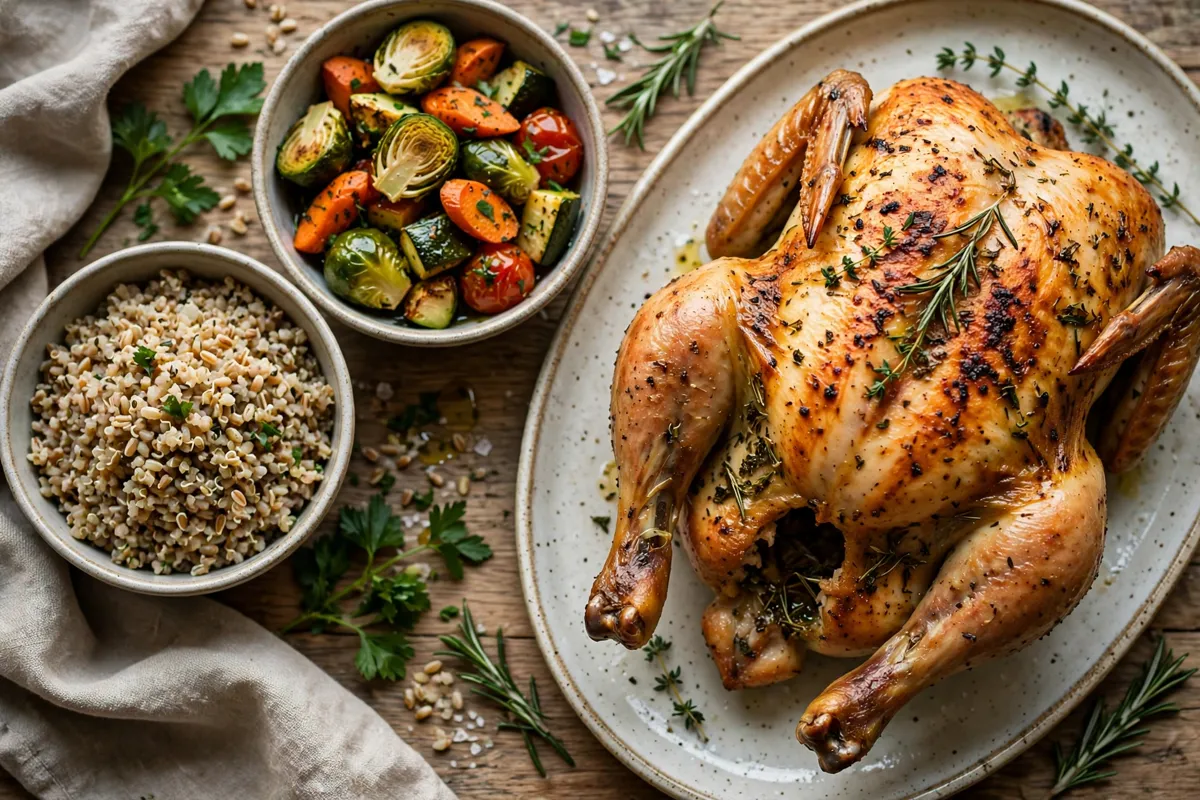
Chicken Protein Calculator: The Short Answer
Half a chicken contains about 40.8 grams of protein. That figure is derived openly: USDA's whole-chicken entry (FDC ID 171450, meat and skin, roasted) lists a bone-removed edible portion of 299 grams providing 81.6 grams of protein, and half of that portion — 149.5 grams of meat and skin — provides exactly half, 40.8 grams. The protein in half a chicken, that is, starts from the one whole-bird portion the dataset actually weighs, because no "half chicken" portion exists as its own entry.
Half chickens are real menu items — the rotisserie half, the grilled half at a barbecue place — so the question is practical, not pedantic. But a half chicken is a mixed portion: breast, thigh, drumstick and wing in one serving, with skin, priced by a whole-bird average rather than by any cut's own rate. This article shows the derivation in full, gives the skinless version of the same half, and explains how the mixed-portion average compares with assembling the same weight from single cuts. The chicken protein calculator prices the individual pieces once the half is carved.
Short Answer
Half a chicken, taken as half of USDA's 299g bone-removed reference portion (149.5g of meat and skin), contains 40.8g of protein and 357.3 calories. Eaten skinless, the same amount of meat prices from the meat-only entry at 28.93g of protein per 100g, giving about 43.2g of protein (149.5 × 0.2893, derived) at a lower calorie cost. Your bird's size moves both figures in proportion to its edible weight.
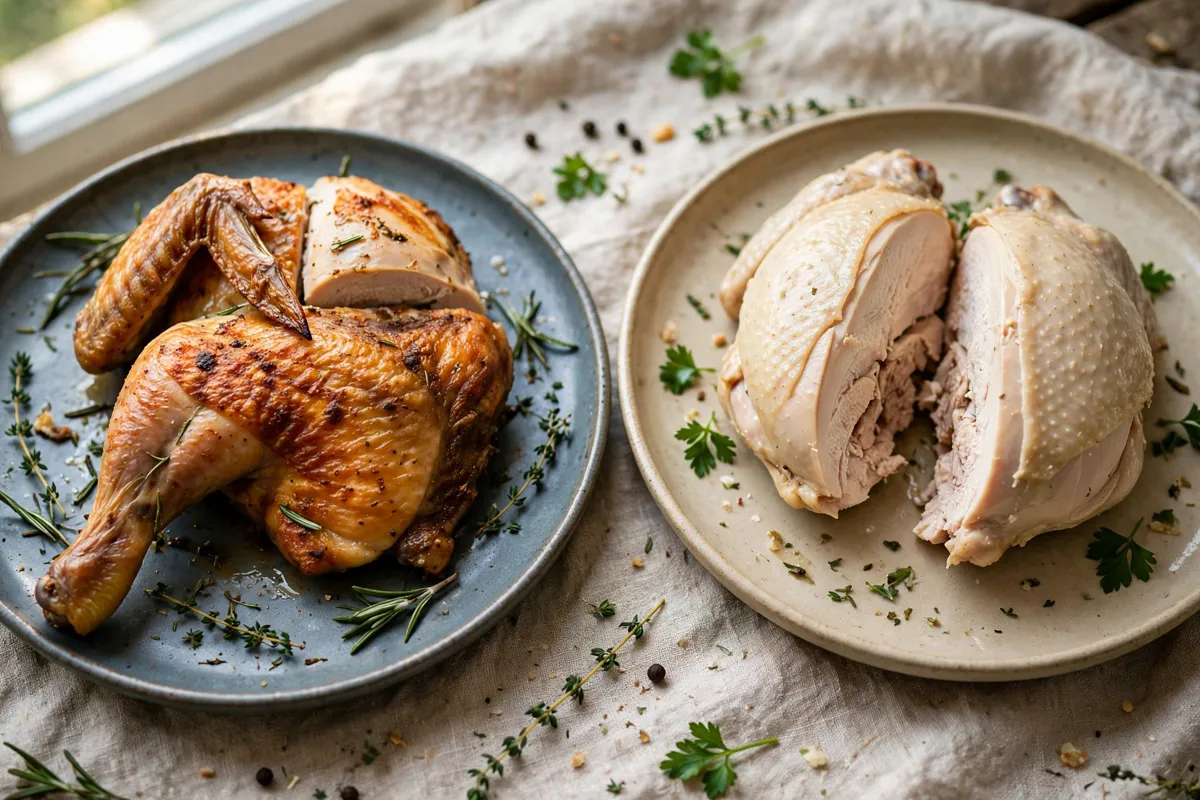
How Is the Half-Chicken Figure Derived?
The derivation has three steps, each from the whole-chicken data. Step one: the with-skin entry (FDC ID 171450) lists 27.3g of protein per 100g of roasted meat and skin. Step two: its bone-removed reference portion is 299g — the edible yield the analysts worked with — giving 299 × 0.273 = 81.6g of protein for that whole edible portion. Step three: half a chicken is half of the edible bird, 299 ÷ 2 = 149.5g, and 149.5 × 0.273 = 40.8g of protein, with calories halving the same way: 714.6 ÷ 2 = 357.3.
Two honesty notes belong with the arithmetic. First, 299g is a reference yield, not the weight of every chicken — a larger bird yields more meat, and its half provides proportionally more protein at the same 27.3g-per-100g rate. If your half chicken's meat and skin weigh 200g, its protein is 200 × 0.273 = 54.6g. Second, a real half is rarely an exact half of the meat: one side of the bird may carry slightly more breast or the split may favour one plate. The rate is the stable part; the weight is the measurement to take. This reference-portion method is the same one the chicken protein essentials guide uses when it scales whole-bird numbers to servings.
What Does the Skin Do to the Half's Protein?
USDA prices the whole bird two ways, and the half inherits both. With skin (171450): 27.3g of protein and 239 calories per 100g. Meat only (171054): 28.93g of protein and 190 calories per 100g. Applied to the same 149.5g half:
The skin verdict flips the half's efficiency completely: removing the skin raises the protein in the same weight of food while cutting about 73 calories. Note, though, that a skinless half also weighs a little less in practice — the skin's own grams leave with it — so the two lines describe the same edible weight for comparison, not two weighings of one plate. Either figure is respectable: 40.8g of protein in a served half chicken is more than a whole standard breast's larger cousins like the thigh (28.7g) deliver, and it arrives as a complete mixed meal rather than a single cut.
- Meat and skin, as served: 40.8g protein, 357.3 calories
- Meat only, skin removed before eating: about 43.2g protein (149.5 × 0.2893), and about 284.1 calories (149.5 × 1.90)
How Does a Half Chicken Compare With the Same Weight of Breast?
The mixed-portion average is the half's defining trait. Its with-skin rate, 27.3g per 100g, sits between the breast's 31.02g and the dark meats' cluster around 24.2–24.76g — exactly where a blend of the bird should sit, pulled up by the breast meat and wing meat (30.46g per 100g) and down by the thigh and leg, then diluted a little by the skin's fat. The same 149.5g assembled as pure breast meat would provide 46.4g of protein (149.5 × 0.3102) at 246.7 calories (149.5 × 1.65) — about 5.6g more protein for about 111 fewer calories than the skin-on half.
That gap is the price of variety, and for most eaters it is a price worth naming rather than avoiding: the half chicken delivers white and dark meat, skin and all textures, in one serving, at an efficiency between the bird's best and its richest parts. What it should never be is mislogged — a half chicken entered as "chicken breast" in a tracker inherits the breast's rate and overstates the meal's protein by those 5.6g while understating its calories by 111. Mixed portions get mixed rates; that is the entire discipline, and it is why protein in chicken thigh versus chicken breast insists on cut-specific numbers whenever the cut is known.
How Is a Served Half Chicken Usually Eaten?
Rarely all at once by one person, despite being sold as a single portion. The common patterns: one eater takes the breast and wing at lunch and the leg quarter at dinner — splitting the 40.8g into roughly its white-meat and dark-meat halves across the day; two people divide it, each taking about 20.4g of protein's worth (40.8 ÷ 2) alongside other dishes; or the meat is picked for later use, at which point it becomes cups of mixed meat best priced by the whole-bird rate — a 140g cup of meat and skin at 239 calories and 27.3g protein per 100g gives 334.6 calories and 38.2g of protein (140 × 0.273).
However it is divided, the accounting principle is constant: the half's protein total is fixed by its meat weight and skin verdict at the moment it is served, and later divisions partition that total rather than creating new numbers. Carve first, weigh the meat, choose the entry that matches the skin — the same three steps this series applies to the whole bird, halved.
Common Mistakes to Avoid
Do not price a half chicken at the breast's rate; the mixed portion averages 27.3g of protein per 100g with skin, not 31.02g. Do not assume your half weighs 149.5g — that is half of a reference yield, and a large bird's half carries more meat and more protein. Do not log the half's gross weight including bone; bone is a large share of a half chicken's scale weight and carries no protein. Do not give the skin-on eater the skinless line or the reverse; the two differ on both protein and calories. And do not double the half to check the whole unless the halves were truly equal — butchers' halves rarely are, and each half prices from its own meat weight.
Final Thoughts
Half a chicken contains 40.8g of protein on the reference basis — half of USDA's 299g edible portion, at the with-skin rate of 27.3g per 100g — or about 43.2g for the same weight eaten skinless. It is a genuinely mixed portion with a genuinely mixed rate, sitting between the breast's density and the dark meats' richness. Weigh the meat your half actually carries, settle the skin question, and apply the matching rate — or carve it and let the chicken protein calculator price the pieces one by one.
People Also Ask
How Much Protein Is in a Whole Chicken?
A whole chicken contains about 81. 6 grams of protein. That total belongs to USDA's bone-removed reference portion — 299 grams of roasted meat and skin — priced from the whole-chicken entry (FDC ID 171450) at 27.
How Much Protein Is in Two Chicken Thighs?
Two chicken thighs contain 57. 4 grams of protein. That is the derived total for two standard skinless thighs — 232 grams of cooked meat — from USDA's roasted thigh entry (FDC ID 172388) at 24.
How Many Grams of Protein, Carbs and Fat Should I Eat Daily?
The reference answer is 150 grams of protein, 200 grams of carbs and 67 grams of fat a day — that is the balanced 30/40/30 split at 2,000 calories, worked as 2,000 × 0. 30 = 600 calories of protein and 600 ÷ 4 = 150 grams. But the honest answer is that those grams belong to a reference person who does not exist, and your answer is scaled from your body weight and your calorie target.
How Much Protein Do You Need During Pregnancy?
You need about 70 to 80 grams of protein a day during pregnancy, which is roughly 1. 1 grams per kilogram of your body weight in the second half of pregnancy, and roughly 25 grams a day more than you needed before pregnancy. The pre-pregnancy reference figure is about 0.