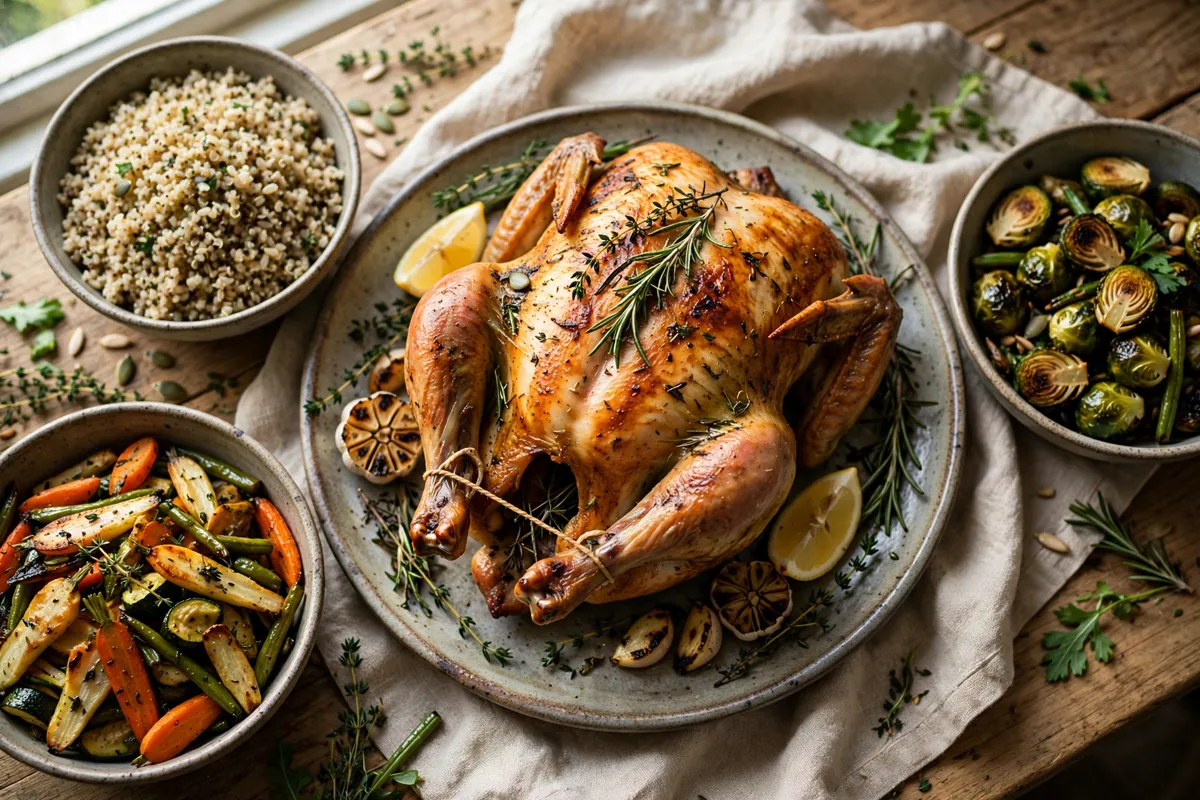
Chicken Protein Calculator: The Short Answer
A whole chicken contains about 81.6 grams of protein. That total belongs to USDA's bone-removed reference portion — 299 grams of roasted meat and skin — priced from the whole-chicken entry (FDC ID 171450) at 27.3 grams of protein per 100 grams. The protein in a whole chicken is therefore a rate applied to an edible weight, not a fixed property of the word "chicken": a bigger bird carries more meat and more protein, at the same rate.
Whole-bird questions are where protein accounting meets real cooking, because nobody eats a chicken as a homogeneous substance. It is roasted whole, carved into parts with different rates, shared, and finished as leftovers across days. This article sets out both whole-bird entries (with skin and meat only), shows how the carved parts reconcile with the whole-bird total, and gives the scaling rule for a bird of any size. Once the bird is carved, the chicken protein calculator prices each part from its own entry.
Short Answer
A whole roasted chicken's edible meat and skin contain 81.6g of protein on USDA's 299g bone-removed reference portion (714.6 calories). The rate is 27.3g of protein per 100g with skin, or 28.93g per 100g for meat only. Scale by your bird's edible cooked weight: protein = grams of meat × 0.273 (with skin) or × 0.2893 (skinless).
Why Is the Whole-Bird Answer a Rate Times a Weight?
Because the dataset refuses to invent a standard chicken. USDA publishes no "one whole retail chicken" gram weight — birds are sold across too wide a size range for a single weight to be honest. What it publishes instead is, for the with-skin roasted entry (FDC ID 171450), a per-100g profile — 239 calories, 27.3g protein, 13.6g fat, 82mg sodium, 223mg potassium — and weighed portions, among them a cup of diced meat at 140g and a "chicken, bone removed" portion at 299g. That 299g is the edible yield the analysts worked with, and it produces the headline: 299 × 0.273 = 81.6g of protein.
The scaling that follows is the article's real content. A bird yielding 400g of meat and skin provides 109.2g of protein (400 × 0.273) at 956 calories (400 × 2.39). A small bird yielding 250g provides 68.3g (250 × 0.273) at 597.5 calories. Between those, every real chicken finds its figure by the same multiplication — which is why butchers' birds, farm birds and rotisserie birds can all be answered from one entry. The reference-portion approach is the dataset's general solution to variable foods, and the chicken protein essentials guide applies it consistently to daily planning.
What Does the Meat-Only Entry Change?
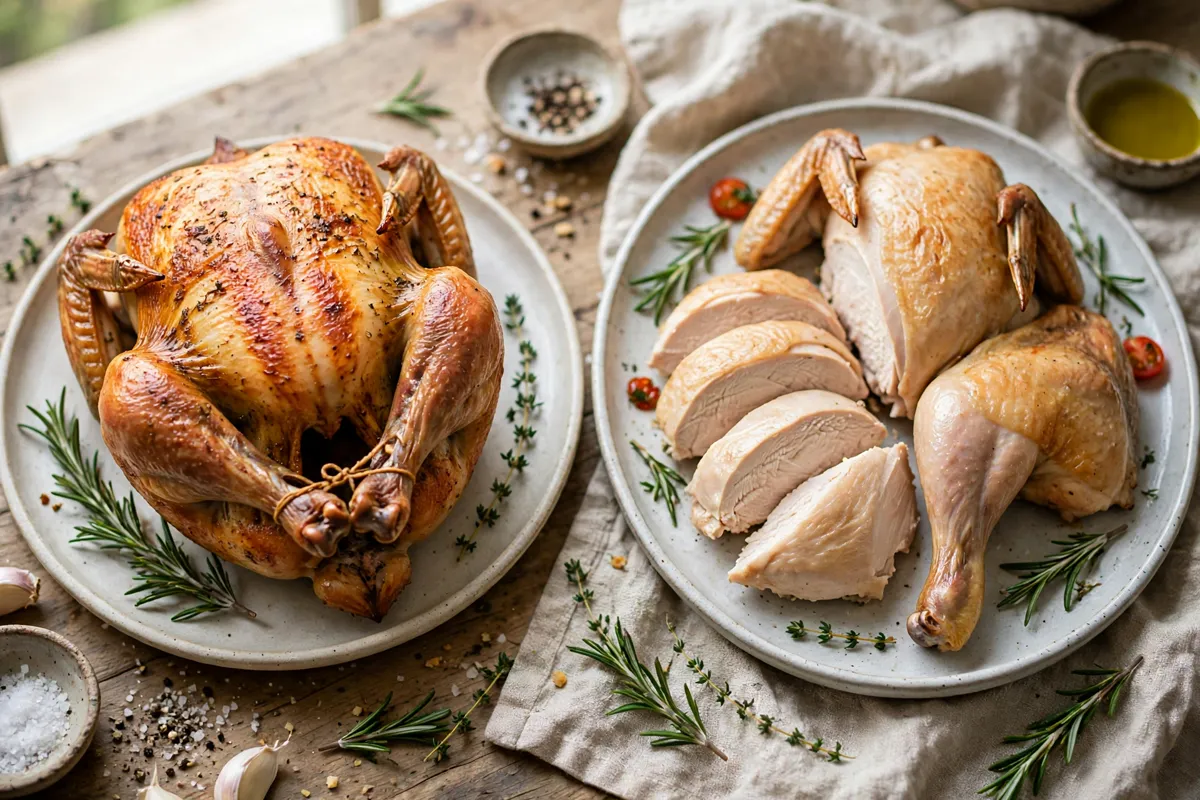
USDA also prices the bird skinless: "meat only, roasted" (FDC ID 171054) at 190 calories, 28.93g protein and 7.41g fat per 100g. Against the with-skin entry, removing the skin raises the protein rate by 1.63g per 100g and cuts the calorie rate by 49 — the skin was contributing fat and weight but very little protein, so the meat beneath it reads denser once the skin leaves the average.
On equal weights the comparison is striking: 299g eaten skinless would provide about 86.5g of protein (299 × 0.2893) at 568.1 calories, against the with-skin 81.6g at 714.6. More protein, about 147 fewer calories — from the same bird. In practice the skinless yield weighs less (the skin's grams are part of the 299g), so a real skinless carve gives somewhat less meat at the better rate; the two effects together still favour the skinless eater clearly on both lines. The cup measure makes it tangible: a 140g cup of diced meat only provides 40.5g of protein at 266.0 calories, the single most protein-efficient cup of chicken in the dataset. A household that roasts with the skin for the table's sake and removes it at the plate gets the with-skin cooking and, for the skin-discarders, the meat-only numbers — each eater logs the state they actually ate.
How Do the Carved Parts Reconcile With 81.6 Grams?
Carve the bird and every part carries its own rate, and the parts should sum back to roughly the whole — a cross-check that reveals where a chicken's protein actually sits:
The with-skin whole-bird rate of 27.3g sits below the meat-only blend (28.93g) because the skin joins the average. The carve-up also explains the bird's internal politics: whoever takes the breast takes the most protein per gram and per piece (53.4g for a standard breast), while the leg's defender can fairly note that a whole leg, at 48.2g, is not far behind as a single serving. The wing's 6.4g per piece, despite its elite rate, is a rounding item in the bird's total — density without mass. The full ranking and its reasoning live in the chicken protein deep-dive guide.
- Breast meat: 31.02g protein per 100g — the bird's densest source and its largest single block of meat
- Wing meat: 30.46g per 100g — nearly as dense, trivial in total weight at 6.4g per wing
- Whole-chicken average, meat only: 28.93g per 100g — the blend the breast pulls up and the dark meat pulls down
- Thigh meat: 24.76g per 100g
- Drumstick meat: 24.24g per 100g
- Whole-leg meat: 24.22g per 100g
How Does a Whole Chicken's Protein Spread Across Days?
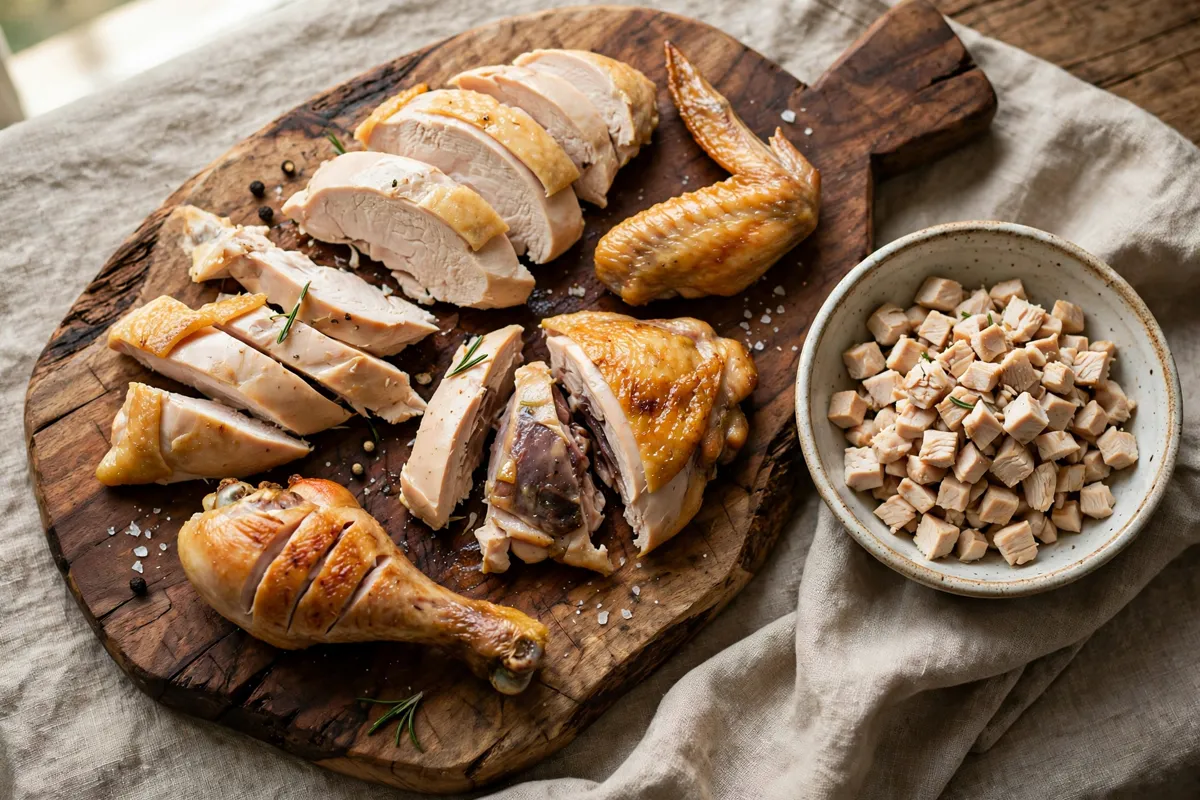
At the reference size, the bird's 81.6g typically lands like this in a real kitchen: a roast dinner where four people take roughly a quarter each — about 20.4g of protein per person from the chicken (81.6 ÷ 4), at about 179 calories of meat and skin (714.6 ÷ 4) — followed by a leftover day where the picked meat, perhaps a cup and a half of dice, anchors sandwiches or a soup. Priced as meat only in a 140g cup, those leftovers carry 40.5g of protein; the bird's second day can out-protein its first for whoever gets the leftovers bowl.
Planning with the whole bird in view changes shopping: one reference-size chicken is, in protein terms, about one and a half standard breasts (53.4g) plus a thigh (28.7g) — 82.1g by that assembly, close to the bird's own 81.6g, which is a reassuring sign that the part rates and the whole-bird rate are telling the same story. Buy the bird when the household will eat all of it across two days; buy parts when only the breast's efficiency is wanted. Either way, weigh the edible meat once carved, and the protein is known to the gram.
Common Mistakes to Avoid
Do not log a whole chicken by its raw purchase weight — bone and cooking loss mean the edible meat is a fraction of that figure, and only the edible weight earns the rate. Do not apply the breast's 31.02g-per-100g rate to the whole bird; the mixed average is 27.3g with skin, and the error overstates a reference bird's protein by about 11g. Do not use the with-skin total for a skinless carve or the reverse. Do not count the wings' contribution by their rate; count it by their 6.4g reality. And do not let leftovers escape the ledger — the bird's protein does not vanish when it becomes soup; it moves, and the cup measures exist to follow it.
Final Thoughts
A whole chicken contains about 81.6g of protein on USDA's 299g reference yield — 27.3g per 100g of meat and skin, 28.93g per 100g skinless — and your bird contains its own edible weight multiplied by the matching rate. The whole-bird figure and the carved parts reconcile, which is the dataset working as designed: one bird, several entries, no contradictions. Weigh what the carving board gives you, and price the parts in the chicken protein calculator or the whole by its rate, whichever matches how the chicken was eaten.
People Also Ask
How Much Protein Is in Two Chicken Thighs?
Two chicken thighs contain 57. 4 grams of protein. That is the derived total for two standard skinless thighs — 232 grams of cooked meat — from USDA's roasted thigh entry (FDC ID 172388) at 24.
How Much Protein Is in Grilled Chicken Breast?
Grilled chicken breast contains 53. 4 grams of protein at the standard size. That is the figure for a 172-gram cooked breast, priced from USDA's roasted breast entry (FDC ID 171477) at 31.
How Much Protein Do You Need During Pregnancy?
You need about 70 to 80 grams of protein a day during pregnancy, which is roughly 1. 1 grams per kilogram of your body weight in the second half of pregnancy, and roughly 25 grams a day more than you needed before pregnancy. The pre-pregnancy reference figure is about 0.
How Many Calories Are in One Gram of Protein?
One gram of protein provides 4 calories. That single factor — 1 × 4 = 4 — is the figure food labels use for protein everywhere, and it scales in a straight line: 10 grams of protein is 10 × 4 = 40 calories, 30 grams is 30 × 4 = 120 calories, and 50 grams is 50 × 4 = 200 calories. If you know a food's protein grams, you already know exactly how many of its calories come…