
Chicken Protein Calculator: The Short Answer
Chicken has 0 grams of fiber — the USDA entry for chicken breast, meat only, cooked roasted (FDC ID 171477), lists 0g fiber per 100 grams, and every other part entry logged here reads the same zero. Fiber is a plant structure, and no cut of chicken, prepared any plain way, contains it. This article explains why the zero is permanent, what it means for planning a day's fiber, and where the fiber in a chicken meal actually comes from.
The zero surprises people mainly because chicken is so often eaten inside fiber-carrying meals — wrapped, sandwiched, served over grains — that the meal's fiber gets mentally credited to its centrepiece. It belongs to the wrap, the bread, the beans and the vegetables. Separating the meat's contribution (protein, at zero fiber and zero carbohydrate) from the plate's contribution is the basic accounting skill behind every article in this series, and portions of the meat itself price out in the chicken protein calculator.
Short Answer
0 grams of fiber per 100 grams of chicken — breast (FDC 171477), thigh (172388), drumstick (172376), leg (172380), wing (172392), stewed, fried or whole, meat only or with skin: every logged entry reads 0g fiber. At any portion — a 172g breast, a 199g leg — the fiber total stays 0g. Fiber must come from the plant foods on the plate.
Why Does Chicken Contain No Fiber at All?
Fiber is the structural carbohydrate of plant cell walls — the part of grains, vegetables, fruit and legumes that human digestion cannot break down. Animal muscle has no cell walls of that kind; its structure is protein and connective tissue, and its carbohydrate store is effectively exhausted before cooking, which is why the same entries that read 0g fiber also read 0g carbohydrate. There is no preparation that adds fiber to plain meat, because fiber is not created by cooking — it can only arrive as an ingredient: a coating, a stuffing, a side.
This is a category fact, not a chicken defect, and it holds across the whole plain-protein field logged here: sirloin (FDC 168634), ground beef (171794), turkey breast (171496), cod (171956) and salmon (171998) all read 0g fiber per 100g as well. The meat aisle, land and sea, is a zero-fiber zone by construction. A diet's fiber is therefore entirely a plant-side project, and a protein anchor like chicken neither helps nor hinders it — it simply leaves the fiber budget to be built elsewhere on the plate. How much fiber is in common fruits and vegetables prices the side of the plate where the building happens.
What Does a Chicken Meal Need Alongside It for Fiber?
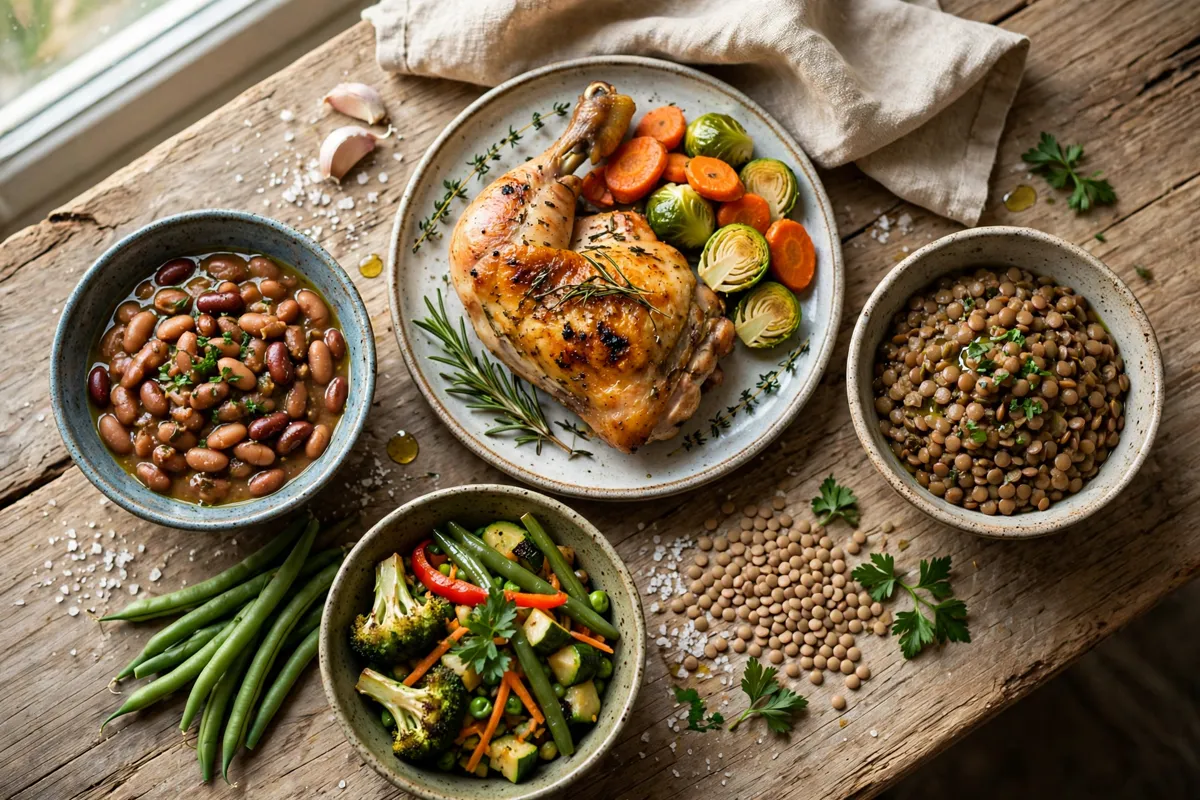
Work the plate in two columns. Column one, the chicken: a 4-ounce breast portion (113.4g) derives to 187.1 calories, 35.2g protein, 0g fiber. Column two, the plants, priced from the logged vegetable and legume entries: a cup of cooked broccoli (156g) carries 5.1g fiber at 54.6 calories; a cup of cooked black beans (172g) carries 15.0g fiber at 227.0 calories with 15.2g protein of its own (FDC 173735: 8.7g fiber per 100g); raw carrots carry 2.8g fiber per 100g, so a 61-gram medium carrot derives to about 1.7g fiber. A chicken plate built with beans and broccoli can carry 20 grams of fiber around a zero-fiber centre — the centre was never the problem.
The planning habit that follows is to assign each food its own job. Chicken's job is protein density: 31.02g per 100g at the breast. The plants' job is fiber, volume and micronutrients. Meals fail on fiber not when the chicken is chosen but when column two is an afterthought — a plain breast with a token garnish is a 0-to-2-gram fiber meal no matter how excellent its protein is. Which foods have the highest amount of fiber ranks the plant side by exactly the density this planning needs.
How Much Fiber Should the Rest of the Day Carry?
The site's fiber guidance, priced through the dietary fiber calculator's data, works in daily totals built entirely from plant foods, since the meat column contributes zero at every meal. The arithmetic of a chicken-centred day is therefore simple to audit: breakfast grains and fruit, lunch wrap and vegetables, dinner sides and legumes must sum to the day's target between them, because the three chicken portions in that day contribute 0 + 0 + 0.
A worked day shows the shape. Oats and fruit at breakfast, a bean-and-vegetable wrap at lunch, and a dinner of chicken breast with a cup of broccoli (5.1g) and a cup of black beans folded into rice (15.0g from the beans alone) — the dinner plate alone carries about 20 grams of fiber, all of it from column two. The chicken's 35.2g protein at that dinner neither adds to nor subtracts from the fiber column. How much fiber should you eat per day sets the daily target this plate arithmetic aims at, and the target is reachable precisely because legumes and vegetables are fiber-dense enough to carry a whole day between them.
Does Anything Done to Chicken Add Fiber?
Only ingredients added to it, each priced as its own food. A breading is a grain coating — it brings the flour's fiber along with its carbohydrate, in the small amounts a thin coating carries. A stuffing brings bread and vegetable fiber. A chicken dish simmered with beans or lentils shares the plate with genuinely fiber-rich foods, but the fiber still belongs to the legumes' line in the log, not the chicken's. Skin adds none: the meat-and-skin whole-chicken entry (FDC 171450) reads 0g fiber per 100g, as does every skin-on preparation in the data.
Processed chicken products follow the same rule — whatever fiber their labels show came from added plant ingredients such as coatings or fillers, at levels set by the recipe. The plain-meat zero is the dependable constant underneath all of it: weigh any plain portion, at any size, and the fiber line writes itself. The chicken protein calculator exists for the line that does change with weight — the protein.
How Do You Build Fiber Into a Chicken-Centred Day?
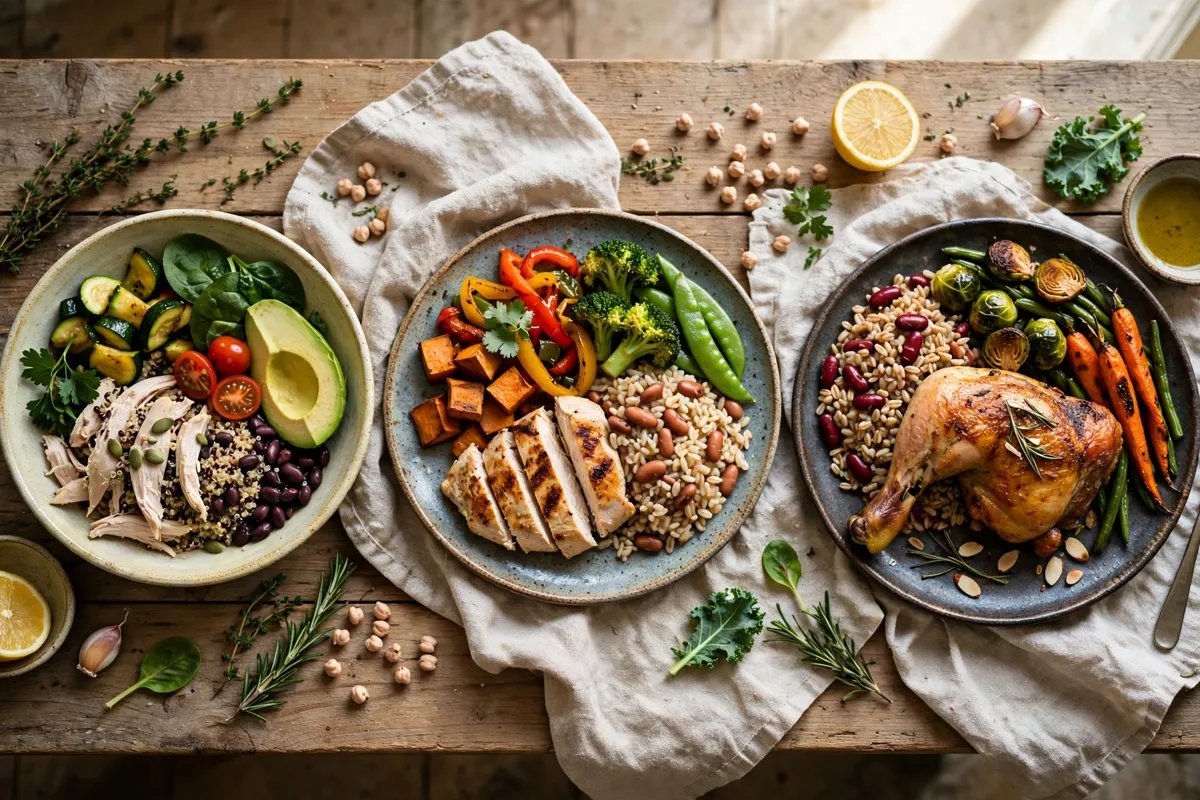
Treat the day as three plates, each with a plant assignment. At breakfast, grains and fruit carry the first share before chicken appears at all. At lunch, the chicken's vehicle does the work: a wrap, a whole-grain sandwich or a grain bowl turns the chicken's 0g into a fiber-bearing meal through its structure rather than its filling — the sandwich components logged in this series show bread contributing the plate's base while vegetables and beans add the serious grams. At dinner, assign one fiber anchor explicitly: a cup of black beans (15.0g fiber) or two cups of broccoli (10.2g fiber across 312g) beside the chicken portion closes most of any day's remaining gap in a single decision. The chicken never obstructs any of this — at 0g it is the neutral centre every one of these plates is built around — which is the constructive reading of the zero: it does not supply fiber, and it never competes with the foods that do.
Common Mistakes to Avoid
- Crediting a chicken wrap's or sandwich's fiber to the chicken — it belongs to the wrap, bread and vegetables
- Worrying that eating more chicken dilutes fiber intake — 0g added protein food does not displace fiber unless it displaces the plant sides themselves
- Expecting skin, bones-in cooking or a cooking method to create fiber — fiber is a plant cell-wall structure and no preparation generates it
- Logging a chicken-and-bean dish's fiber under chicken — the beans carry it (black beans: 8.7g per 100g) and deserve their own line
- Skipping column two: a day of plain chicken portions sums to 0g fiber no matter how many portions it holds
Final Thoughts
Chicken has 0 grams of fiber at every part, portion and plain preparation — a permanent category fact it shares with all plain meat and fish. Build the day's fiber from the plant column — broccoli at 5.1g a cup, black beans at 15.0g a cup — and let chicken do its own job, protein, at the weights priced in the chicken protein calculator.
People Also Ask
How Much Sodium Is in Chicken?
Plain chicken breast has 74 milligrams of sodium per 100 grams, cooked roasted and meat only (USDA FDC ID 171477) — a low figure that belongs to the plain meat alone. Chicken's sodium story is really two stories: the plain parts, which run from 74mg to 128mg per 100g depending on the cut, and the treated, brined and processed forms, where sodium climbs several-fold. This article prices both stories only from sourced figures, so you can see which chicken your…
How Much Potassium Is in Chicken Breast?
Chicken breast has 256 milligrams of potassium per 100 grams, cooked roasted and meat only (USDA FDC ID 171477) — a solid mid-field figure among plain proteins, below sirloin steak's 393mg and salmon's 628mg per 100g but well above deli-style poultry products' diluted profiles. A 6-ounce breast portion derives to 435mg of potassium. This article prices the figure at real portions and sets it honestly in the protein field.
What Is the Difference Between Soluble and Insoluble Fiber?
Soluble fiber dissolves in water to form a gel: it slows digestion, blunts blood-sugar rises and helps lower LDL cholesterol, and it is the type concentrated in oats, beans, apples and chia. Insoluble fiber does not dissolve: it adds bulk and speeds transit through the bowel, and it is the type concentrated in whole-wheat skins, vegetable peels and nuts. That behavior in water — gel versus bulk — is the whole difference, and everything else about the two types follows…
How to Reach Your Daily Fiber Goal Through Food?
Reach your daily fiber goal by building the day, not by chasing the number food by food: a realistic day of ordinary food totals just over 30 grams, past the 28-gram target, with no supplements and no special products. It runs like this — oats with raspberries at breakfast, 4 + 8 = 12 grams; a lentil soup or bean wrap at lunch, about 8 grams; an apple with its skin as the snack, 4. 4 grams; and vegetables plus…