MyPlate Plan Calculator: The Short Answer
To eat a balanced diet, build each day around the MyPlate amounts — half your plate fruits and vegetables, a quarter grains, a quarter protein foods, dairy alongside — and shop, cook and snack so those proportions happen by default. On a 2,000-calorie pattern the day holds 2 cups of fruit, 2.5 cups of vegetables, 6 ounce-equivalents of grains, 5.5 of protein and 3 cups of dairy.
Where the definition article asks what a balanced diet is, this one is purely practical: how a real day gets structured, how a week gets shopped, and how the proportions survive restaurants, busy evenings and a limited budget. No theory of nutrients — just the mechanics. The recurring tool is the plate itself: if most plates you serve roughly match the MyPlate visual, and your snacks and drinks do not quietly sabotage the day, you are eating a balanced diet in practice whatever the spreadsheets say. Your personal amounts — which differ from the 2,000-calorie reference if you are larger, smaller or more active — come from the MyPlate plan calculator; the routines below work at any level.
Short Answer
Run the day on rails: a protein-and-fruit breakfast, a half-vegetables lunch and dinner built on the plate visual, dairy in two or three planned appearances, whole grains as the default, and snacks chosen from the groups rather than from the vending machine. Shop once a week from a list organised by food group, and audit the week — not each day — against the group amounts.

How Do You Structure a Balanced Day, Meal by Meal?
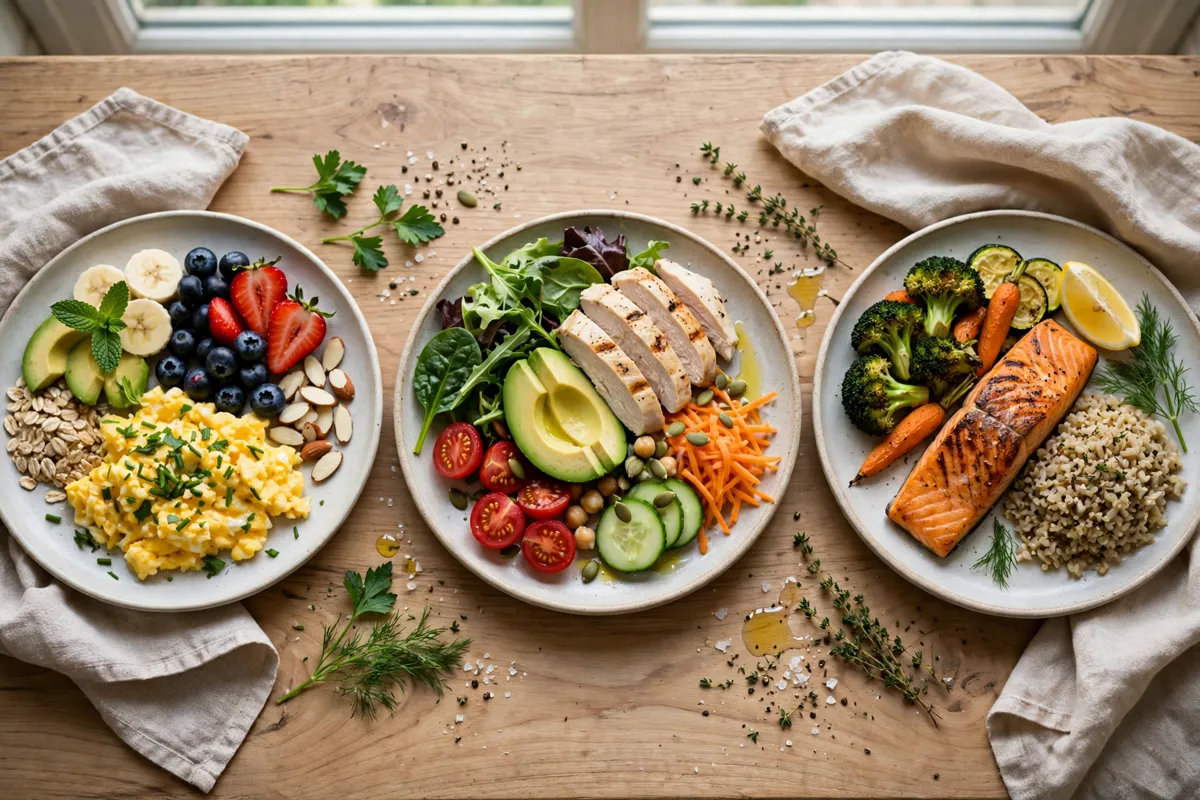
Breakfast does two jobs: protein foods and fruit land early, when they are otherwise easy to forget. Eggs with wholegrain toast and a piece of fruit, or Greek yogurt with oats and berries, both bank a protein serving, a grain serving and a fruit serving before 9am. Lunch is the vegetables' main shift: a salad, soup or sandwich built so vegetables are a visible quarter to half of it, with a protein anchor — chicken, tuna, eggs, beans — and a grain. Dinner follows the plate visual directly: half the plate vegetables (two kinds is an easy variety trick), a quarter protein, a quarter grains or starchy vegetables. Dairy is scheduled, not hoped for: milk with breakfast, yogurt as the planned snack, cheese inside a meal — three appearances reach the 3-cup pattern without effort. Drinks are the silent saboteur; water as the default keeps the day's design intact. The MyPlate examples guide lays out one such day in full, portion by portion.
How Do You Shop for a Balanced Week Without Thinking About It Daily?
Shop by group, in a fixed order, from a list written under five headings. Vegetables first, buying for roughly 2.5 cups per person per day and deliberately mixing subgroups across the week — dark greens, red and orange vegetables, beans and peas, starchy and other vegetables — because variety inside the group is what covers its nutrients. Fruits next, fresh plus frozen (frozen counts fully and wastes nothing). Grains: make at least half whole — oats, brown rice, whole wheat bread — remembering that one slice of bread or half a cup of cooked rice is one ounce-equivalent, so a 6-ounce-equivalent day is a modest pile, not a mountain. Protein foods: rotate the week's anchors — poultry, fish, eggs, beans or lentils, red meat, tofu — so no single source carries the week. Dairy last, in the forms you actually use. This list structure is the whole secret: if the trolley matches the groups, the week's meals almost cannot help matching them too. Portion amounts per person are worked out in calculating daily food portions with MyPlate.
How Do You Keep the Balance in Restaurants, Takeaways and Busy Evenings?
Order by the plate, not by the dish name. In any restaurant you can usually construct the visual: choose a protein main, ask for the vegetable side doubled and the fries or refined side swapped or shared, and treat bread baskets and sugary drinks as additions to the day rather than parts of the meal. Takeaway versions of home favourites work the same way — a burrito bowl, for instance, already separates rice, beans, protein and vegetables so you can see the proportions you are eating. For busy evenings, keep a balanced freezer fallback assembled from the groups: frozen vegetables, frozen fish or chicken portions, microwave rice and a yogurt in the fridge covers four groups in fifteen minutes, which beats the unbalanced emergency order it replaces. And keep perspective: the audit period is the week. One restaurant dinner does not unbalance a week whose other twenty meals ran on rails — the practical framing in building a balanced meal with the MyPlate method applies exactly here.
- Make half of every lunch and dinner plate vegetables and fruit — the visual does the counting
- Schedule dairy two or three times a day instead of hoping it appears
- Shop from a five-heading list; the trolley's shape becomes the week's shape
- Keep a four-group freezer fallback for busy evenings
How Do You Audit Your Week and Fix the Group That Keeps Slipping?
Once a week, score the pattern roughly: for each group, were you usually at, above or below your amounts? Perfection is not the standard; persistent absence is the signal. The groups that typically slip are vegetables (below), dairy (forgotten) and whole grains (crowded out by refined versions). Fix one slip at a time with a structural change, not willpower: vegetables slip → add a vegetable soup or salad as the standing starter at dinner; dairy slips → attach yogurt to the existing afternoon break; whole grains slip → change the default bread and rice you buy, so the swap happens at the shop, not at every meal. Re-audit after a fortnight. This boring loop — measure roughly, fix structurally, re-measure — is what "eating a balanced diet" actually consists of for people who sustain it for years. Your group amounts to audit against are printed by the MyPlate plan calculator for your profile.
One more structure does more work than any other on this page: the standing weekly shop. When the same five-heading list is bought at the same time each week, the balanced pattern stops depending on daily motivation entirely — the food is in the house, the plate visual is on the wall of your habits, and the only remaining decision is which of the planned meals tonight is. People imagine that eating well is a series of virtuous choices; in practice, for the people who sustain it, it is a small number of systems chosen once and repeated. Build the systems and the choices take care of themselves.
Common Mistakes to Avoid
Mistake one is trying to balance every single meal precisely and quitting by Thursday; balance is a weekly pattern, and meals are allowed to be lopsided if the days around them compensate. Mistake two is letting drinks and snacks live outside the system — a cola at about 140 calories and 39g of sugar, or daily crisps, can quietly outweigh careful plates. Mistake three is a protein-only shopping habit: a trolley of meat and protein products with token vegetables cannot produce a balanced week. Mistake four is skipping breakfast and then trying to fit five groups into two meals — possible, but the three-plus-snack structure exists because it makes coverage easy. Mistake five is changing everything at once. One structural fix per fortnight compounds; a total lifestyle overhaul usually lasts nine days.
Final Thoughts
Eating a balanced diet is a logistics problem with a simple shape: the plate visual at lunch and dinner, protein and fruit anchored at breakfast, dairy scheduled, a five-heading shopping list, a freezer fallback, and a five-minute weekly audit that fixes one slipping group at a time. Set your personal amounts in the MyPlate plan calculator, write the list by groups, and let the structure do the work your willpower was doing.

People Also Ask
What Are the Five Food Groups?
The five food groups are fruits, vegetables, grains, protein foods and dairy — the USDA MyPlate groups. On the 2,000-calorie MyPlate pattern the daily amounts are 2 cups of fruit, 2. 5 cups of vegetables, 6 ounce-equivalents of grains, 5.
What Are the Six Essential Nutrients?
The six essential nutrients are protein, carbohydrate, fat, vitamins, minerals and water — the substances your body needs from food and drink because it cannot make them, or cannot make enough of them, itself. The first three supply energy at 4, 4 and 9 calories per gram; the last three supply none, yet life depends on them just as completely.
How Many Macros Do I Need Each Day?
How many macros you need each day depends on your calorie target and split: on 2,000 calories with a balanced 30/40/30 split you need 150g protein, 200g carbs and about 67g fat daily. Change the calories or the split and all three gram numbers change with them.
How to Read a Nutrition Label?
To read a nutrition label, start with the serving size at the top, check the calories, then read fat, carbohydrate and protein in grams — and treat every number as "per serving" until you have multiplied by how much you will actually eat. A 200-calorie serving becomes 400 the moment the pack holds two servings and you finish it.