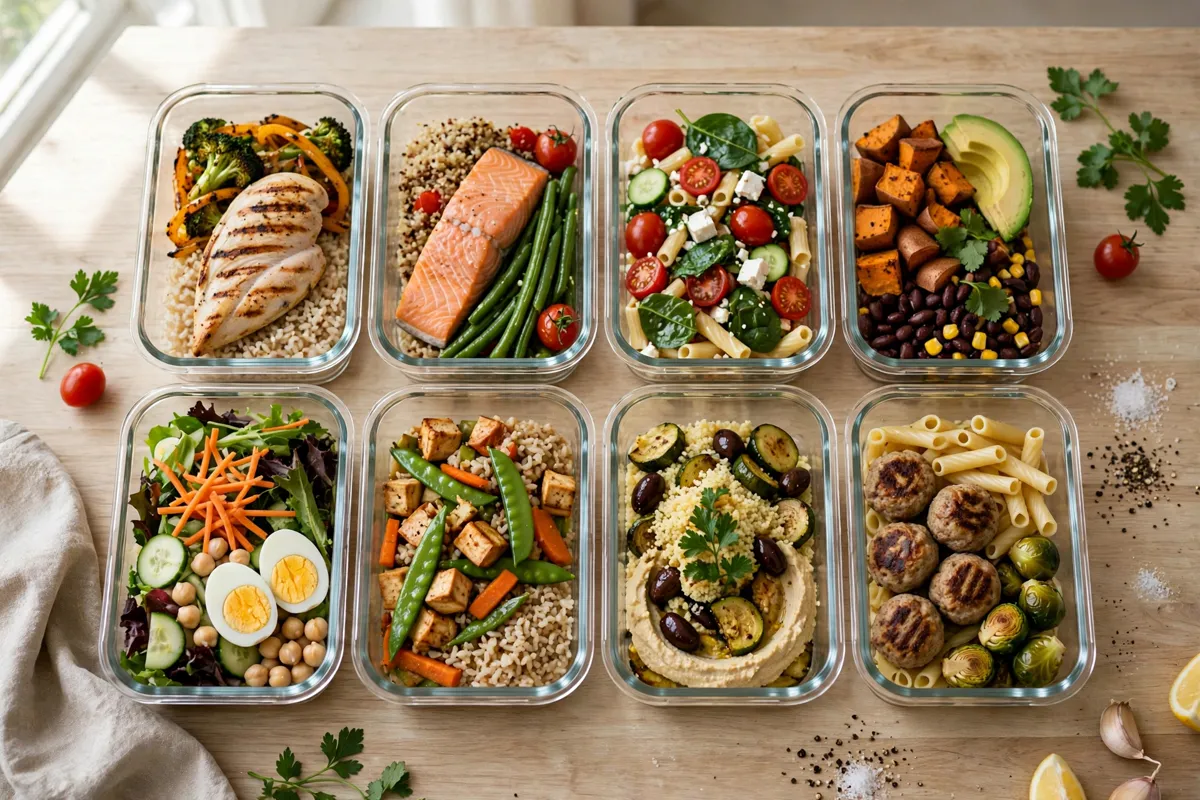
MyPlate Plan Calculator: The Short Answer
To create a meal plan, fix your calorie level and food-group amounts first, assign proteins and themes to the week's dinners, build lunches from leftovers and a short rotation, standardise breakfasts — then shop once from the plan. On a 2,000-calorie MyPlate pattern the plan must place 2 cups of fruit, 2.5 cups of vegetables, 6 ounce-equivalents of grains, 5.5 of protein and 3 cups of dairy across each day.
Planning works when it removes decisions rather than adding a second job. The method below is the one used by people who sustain planning for years: plan dinners properly, semi-plan everything else, keep breakfasts on rails, and let the plan bend — a plan that survives a swapped day is a plan; a plan that collapses is a poster. You will set the pattern up from your own calorie level using the MyPlate plan calculator, theme the week, write the list by food group, and build in the escape hatches (leftovers night, freezer night, eating-out night) that separate realistic plans from January ones.
Short Answer
Five moves make a meal plan: (1) get your calorie level and group servings, (2) choose the week's dinner proteins and themes, (3) fill lunches with planned leftovers plus two fallback combinations, (4) fix one or two breakfasts on rotation and planned snacks from the groups, (5) write the shopping list by group and schedule one flexible night. Review after a week and keep every meal that worked.
Step 1 — How Do You Set the Targets the Plan Must Hit?
A plan without amounts is a wish list. Take your calorie pattern — roughly 2,000 calories for a sedentary adult woman to about 3,000 for an active man at the reference ages, with your own figure from the MyPlate plan calculator — and its group servings, and write them at the top of the plan where every day can be checked against them. Then translate servings into kitchen units: 6 ounce-equivalents of grains is six slices of bread's worth across the day, or three cups of cooked rice; 5.5 ounce-equivalents of protein is, for example, a 100g portion of chicken breast (about 31g protein) plus an egg and a yogurt's worth across the day; 2.5 cups of vegetables is a large salad plus a cooked side. People who do this translation once stop experiencing the servings as abstract, because the plan now speaks in plates and portions. The translation method is the same one detailed in calculating daily food portions with MyPlate.
Step 2 — How Do You Plan the Week's Dinners Without Repeating Yourself to Death?
Assign proteins first, themes second. A workable week: chicken one night (a traybake), fish one night (salmon at about 208 calories per 100g with potatoes and greens), a legume night (lentil or black-bean based — beans bring about 15g of fibre per cooked cup), an egg-based night (frittata using the week's leftover vegetables), a red-meat or tofu night, one planned leftovers night, and one flexible night for eating out or a freezer rescue. Themes make the assigning faster each week — soup night, traybake night, curry night — because you are filling slots, not inventing meals. Write the side vegetables beside each main at planning time; vegetables chosen at 6pm in a supermarket queue are vegetables chosen badly. Cook grains in batches that serve two nights (rice tonight becomes fried rice or a lunch bowl tomorrow), and let one sauce or marinade repeat across two proteins to halve the thinking without repeating the meal.
Step 3 — How Do Lunches, Breakfasts and Snacks Fit the Plan?
Lunches are planned as a system, not as seven new meals: dinner leftovers on the days after the most portable dinners, plus two standing fallbacks you can assemble without thought — for instance a tuna, white-bean and salad box (tuna at about 26g protein per 100g) and a cheese, egg and vegetable plate. Breakfasts go on rails: one weekday default (oats with milk and fruit — half a cup of dry oats is about 154 calories — or eggs on wholegrain toast) and one weekend option. Snacks are chosen from the groups so they close gaps instead of opening them: the fruit serving you keep missing becomes the afternoon apple (about 95 calories), the dairy gap becomes the planned yogurt (about 100–149 calories depending on type). This gap-closing view of snacks is what turns a plan from a menu into a coverage system — the same logic as the day assembled in the MyPlate examples guide.
- Dinners: assign proteins, then themes; write the vegetables in at planning time
- Lunches: leftovers by design plus two standing fallback combinations
- Breakfasts: one weekday default on rails, no daily invention
- Snacks: assigned to close whichever group the day is short on
Step 4 — How Do You Shop and Prep So the Plan Survives the Week?
Write the shopping list under the five group headings, quantities checked against the plan's actual meals plus your standing breakfasts and snacks. Shop once, with one small midweek top-up for fresh items if needed. Prep the leverage points on the shopping day or the evening after: wash and chop the sturdy vegetables, cook the batch grain, portion the proteins you will cook first, and put the perishables in cooking order — fish before chicken before the hardy legumes and eggs. Store the plan where cooking happens, with the flexible night genuinely flexible: its job is to absorb birthdays, late meetings and plain reluctance, so the other six nights stay credible. At the week's end, spend three minutes marking what was eaten happily, what was eaten dutifully and what was quietly replaced — next week's plan starts from those marks, not from a blank page, and within a month you own a rotation of proven weeks.
Households with more than one eater need one extra mechanism: a shared skeleton with personal exits. Plan the dinners as written, then note against each one the small variations that keep everyone inside the same meal — a larger grain portion for the teenager in training, the sauce served on the side for the person who dislikes it, a bean-based version of the same dish for the vegetarian at the table built from the same base ingredients. This keeps the planning at one plan rather than splintering into parallel menus, which no planner sustains. It also keeps the shopping list single. The groups still govern: a variation is a portion change or a protein swap inside the same meal architecture, not a separate architecture, and the week's coverage survives because the skeleton does.
Common Mistakes to Avoid
Mistake one is planning seven novel dinners: novelty is expensive in time, ingredients and failure rate, and two new recipes a week is plenty for most households. Mistake two is planning without your actual week — the late shift, the children's match night, the dinner out — so the plan collides with reality by Wednesday. Plan around the calendar first. Mistake three is a shopping list written in recipe order instead of group order, which produces three half-used bunches of herbs and no vegetables for Thursday. Mistake four is ignoring quantities: a plan that says "chicken, rice, broccoli" without amounts cannot be shopped or checked against servings. Mistake five is no escape hatch: a plan with no leftovers night, no freezer night and no flexible night demands a perfect week, and perfect weeks are not a renewable resource.
Final Thoughts
A meal plan is a small system: personal calorie and group targets at the top, dinners assigned by protein and theme, lunches running on leftovers and fallbacks, breakfasts on rails, snacks closing group gaps, one honest shopping list, and one flexible night to keep the whole thing believable. Build the first week from your amounts in the MyPlate plan calculator, review it in three minutes on Sunday, and let each week inherit what worked.
People Also Ask
Why Do Portion Sizes Matter?
Portion sizes matter because nutrition scales with amount: the same rice is 204 calories at one cooked cup and about 408 at two, the same chicken is 165 calories at 100g and 248 at 150g. Every nutrient — and every calorie — on your plate is the per-serving figure multiplied by the portion you actually serve.
How Many Servings of Vegetables Should You Eat Daily?
You should eat about 2. 5 cups of vegetables a day on a 2,000-calorie pattern — the USDA MyPlate amount — with the exact target scaling from about 2 cups at lower calorie levels to 3 cups or more at higher ones. In practical terms that is a large salad at lunch plus a cooked vegetable side at dinner, most days.
How Long Does It Take to Lose 20 Pounds?
Losing 20 pounds safely takes about 20 to 40 weeks for most people — roughly five to nine months — at the recommended pace of 0. 5 to 1% of body weight per week, driven by a deficit of 300 to 500 calories a day. A larger person can reasonably reach it in about five months; a smaller person should plan on the better part of a year, because their safe deficit is smaller.
How Long Does It Take to Lose 30 Pounds?
Losing 30 pounds safely takes about 30 to 50 weeks for most people — roughly seven to twelve months — at a deficit of 300 to 500 calories a day and a loss rate of 0. 5 to 1% of body weight per week. A person starting at 250 pounds can be at the faster end of that range; someone starting at 160 pounds should expect the slower end, and both timelines are successes.