Calorie Counter: The Short Answer
Yes — for a wide range of adults, 1,600 calories a day is good for weight loss: it is the textbook target for anyone whose maintenance sits around 1,900 to 2,100 calories, creating a deficit of 300 to 500 a day and predicting roughly 0.6 to 1 pound of loss a week. It also keeps most women comfortably above the 1,200 floor and gives enough food volume to build genuinely satisfying meals.
But "good" is still a comparison, not a property of the number. This article tests 1,600 against three maintenance levels — one where it is perfect, one where it is maintenance in disguise, and one where it is an oversized cut — using full Mifflin-St Jeor examples, then covers how to build a day of eating that makes 1,600 feel sustainable. Find your own maintenance in the calorie counter and see which case is yours.
Short Answer
1,600 calories a day is good for weight loss when your maintenance is about 1,900–2,100: the resulting 300–500 deficit predicts roughly 0.6–1 lb per week at about 3,500 calories per pound. If your maintenance is near 1,650, 1,600 will barely move the scale; if it is 2,500 or more, 1,600 is a 900-plus deficit and unnecessarily hard. Judge it against your TDEE, never in isolation. That question is taken up directly in 2,000 calories a day.
When Is 1,600 Exactly the Right Target?
Take a 41-year-old woman, 72 kg and 164 cm, lightly active — school run on foot, two exercise classes a week. Her BMR: 720 + 1,025 − 205 − 161 = 1,379. Maintenance: 1,379 × 1.375 = 1,896, about 1,900. At 1,600 her deficit is 296 — effectively the 300 textbook minimum — predicting 296 × 7 = 2,072 calories a week, ÷ 3,500 ≈ 0.59 lb weekly, roughly two and a half pounds a month. Nudge intake to 1,500 and the deficit becomes 396, predicting about 0.79 lb a week. Her good range, in other words, is roughly 1,400–1,600, and 1,600 is its most livable edge: the version with a real breakfast, a normal family dinner and a small snack. A man with a similar maintenance — a smaller, older, sedentary man can maintain near 1,950 — gets the same verdict: 1,600 is a deficit of about 350 and above his 1,500 floor, so it works for him too. This is the population 1,600 was made for: mid-maintenance adults. The general framework behind the choice is the same one in how many calories to eat to lose weight.
When Is 1,600 Too Few — or Pointlessly Many?
Too many, first: a petite 52-year-old woman, 57 kg and 156 cm, sedentary. BMR: 570 + 975 − 260 − 161 = 1,124. Maintenance: 1,124 × 1.2 = 1,349. For her, 1,600 is a surplus of about 250 a day — she would slowly gain on the internet's favourite diet number. Her losing target is the 1,200 floor itself, with activity as the real lever. Too few: a 30-year-old man, 84 kg and 179 cm, moderately active. BMR: 840 + 1,119 − 150 + 5 = 1,814; maintenance 1,814 × 1.55 = 2,812. At 1,600 he runs a deficit of 1,212 — beyond the 1,000 line, predicting 2.4 lb a week on a 185 lb frame, which is about 1.3% of body weight weekly and past the safe rate, at an intake barely above the men's floor. His good target is 2,300–2,500. Three bodies, three verdicts on the same 1,600: gain, lose well, lose recklessly. The number inherited its reputation from the first case because mid-maintenance women are the largest dieting audience — not because the number is magic.
What Does a Good Day at 1,600 Calories Look Like?
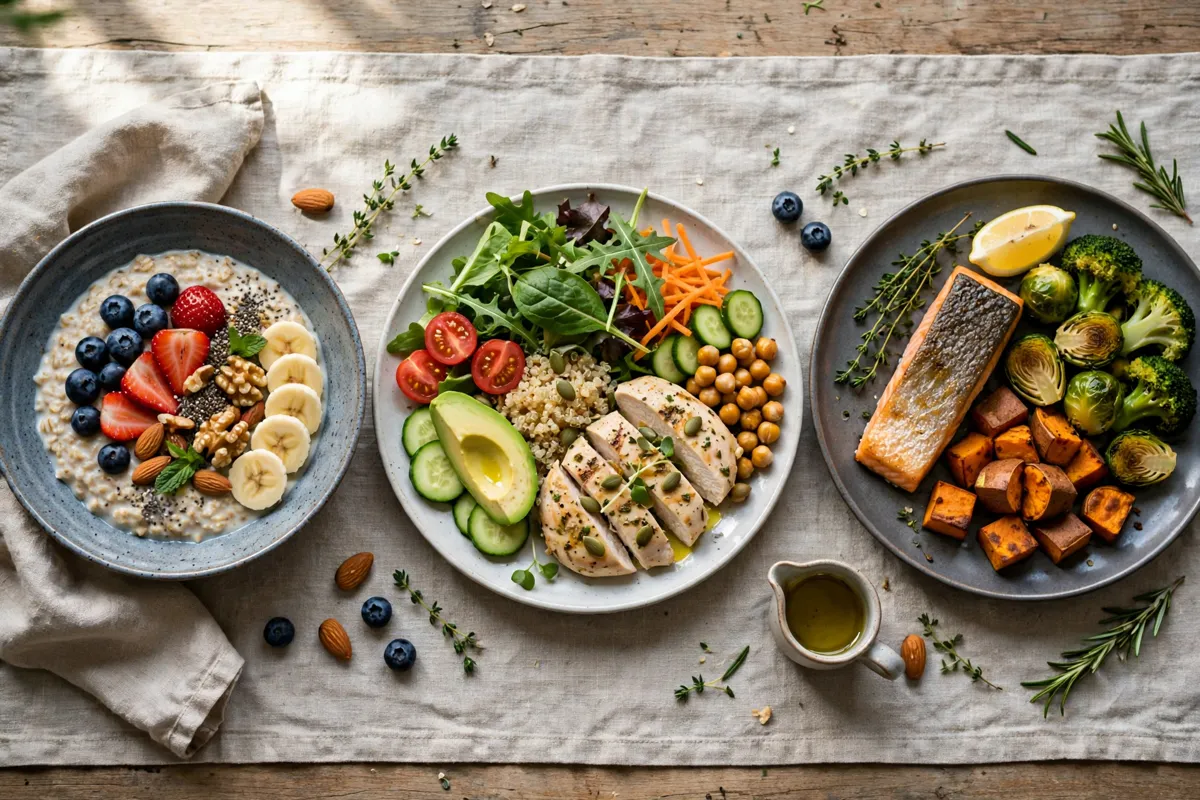
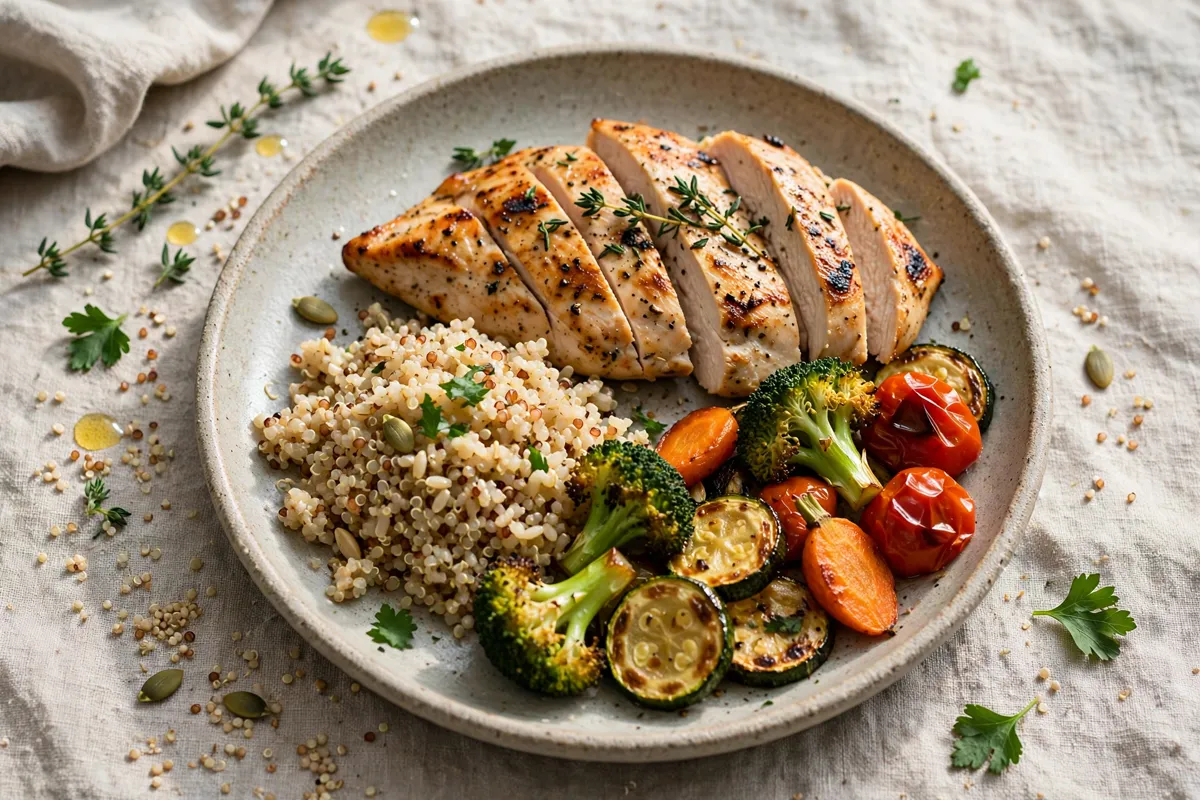
Structure is what makes 1,600 feel generous rather than mean. A common split is breakfast about 350, lunch about 450, dinner about 600, and 200 for snacks or drinks — proportions that keep hunger from ever becoming an emergency. Protein anchors each meal, because at 4 calories a gram it is the cheapest satiety you can buy: a day providing 100–120 g of protein spends 400–480 calories on the nutrient that protects muscle and blunts appetite, leaving over 1,100 for everything else. Vegetables and legumes add volume and fibre at low cost, so plates stay full-sized. The traps at this budget are invisible liquids and fats: a large milky coffee at 250 and two generous tablespoons of cooking oil at about 240 together consume nearly a third of the day without registering as eating. Cook measured, drink mostly calorie-free, and 1,600 behaves like a normal diet rather than a punishment. Meal sizing logic generally is covered in how many calories each meal should contain.
- Breakfast ~350: eggs or yoghurt, fruit, toast — protein early
- Lunch ~450: a full plate built on a palm-plus of protein, grains, vegetables
- Dinner ~600: the day's main meal, eaten with the family, not a diet plate apart
- Snacks/drinks ~200: planned, not grazed — one deliberate item, not five small ones
How Long Can You Stay at 1,600, and When Should It Change?
Stay while the trend matches the plan and life feels livable — for many people, months. Two scheduled changes apply. First, recalculation: every 5 kg lost lowers maintenance by roughly 50–85 calories (10 off BMR per kilo, scaled by activity), so after 10 kg the same 1,600 may be only a 150–250 deficit and the pace halves. That is progress changing the inputs, not a broken metabolism — rebuild the deficit by trimming toward maintenance minus 300 again, respecting the floors, or by adding activity. Second, the exit test: if loss runs faster than 1% of body weight per week for several weeks, or hunger, sleep and training deteriorate, 1,600 has become too low for your current body — eat 100–200 more. Judging by weekly averages over three-week windows keeps both decisions honest, a discipline the site returns to in counting calories every day.
How Does 1,600 Compare With Other Popular Targets?
Against 1,400, the other common women's figure: 1,600 is gentler by 200 a day — 1,400 calories a week, about 0.4 lb of predicted loss surrendered in exchange for noticeably easier hunger, training and social eating. For the mid-maintenance woman maintaining near 1,900, 1,400 is a firm 500 deficit while 1,600 is a mild 300 — both legitimate, chosen by temperament and timeline. Against 1,800: on that same maintenance, 1,800 is barely a deficit at all, which is why so many people report "eating healthily at 1,800 and losing nothing." The ladder only means anything relative to maintenance — 1,400, 1,600 and 1,800 are three rungs that different bodies experience as a hard cut, a standard diet, or no diet whatsoever.
Common Mistakes to Avoid
The most common mistake is adopting 1,600 because it worked for a colleague whose maintenance was 500 higher than yours — her moderate deficit is your severe one. Second, eating 1,600 as five 320-calorie grazes that never satisfy, instead of three real meals with protein; the arithmetic is identical and the experience is not. Third, letting weekends drift to 2,600 while weekdays hold 1,600: the weekly average becomes (1,600 × 5 + 2,600 × 2) ÷ 7 = 1,886, which on a 1,900 maintenance is no deficit at all. Fourth, refusing to adjust the number as you lose weight, then blaming a plateau on anything except a maintenance figure that has moved to meet you.
Final Thoughts
1,600 calories a day is good for weight loss precisely when it is 300–500 below your maintenance — the common case for mid-sized, lightly active women and smaller sedentary men — predicting about 0.6–1 lb a week with enough room to eat like a person. It is a surplus for the very small and sedentary, and a reckless cut for the large and active. Set it from your own TDEE in the calorie counter, structure the day around protein and real meals, and recalculate as you shrink.
People Also Ask
Is 2,000 Calories a Day Good?
Two thousand calories a day is good for some people and wrong for others: it is maintenance for a mid-sized, moderately active woman, a sensible weight-loss intake for a larger or active man, and a slow surplus for a small sedentary woman. The figure comes from food labels, where 2,000 calories a day is the reference value used to calculate percentages — a labelling convention, not a health recommendation for your body.
Is 3,000 Calories a Day Too Much?
Three thousand calories a day is too much for most adults — a sedentary woman maintaining on 1,700 would be eating 1,300 calories above her needs, a surplus that predicts well over two pounds of gain a week at first — but it is not too much for a tall, heavily training man whose maintenance genuinely reaches 3,100 to 3,300. As with every round number, the verdict lives in the comparison with your own maintenance.
Is Moe's Southwest Grill Good for Weight Loss?
Yes, Moe's Southwest Grill can work for weight loss, but only if you order from the lighter end of its tracked menu — the lowest-calorie entrée on this site's Moe's data is the Moo Moo Mr. Cow Kids Burrito at 480 calories, the lightest full-size entrée is the Close Talker Salad (Chicken) at 650 calories, and the Earmuffs Bowl (Chicken) is 690 calories. Start there and Moe's is a manageable lunch.
Is Sheetz Good for Weight Loss?
Sheetz can work for weight loss, but only as a place where you order the same few light builds on purpose — it is not a menu that helps you by default. The builds that work are real: a Turkey Sub (6-inch) at 430 calories with 24 grams of protein and only 15 grams of fat, a Shmuffin Breakfast Sandwich at 420 calories, and Chicken Stripz (5 pc) at 480 calories with 30 grams of protein. The builds that undo…