Calorie Counter: The Short Answer
Lunch should contain roughly 30 to 35% of your daily calories — about 600 to 700 calories on a 2,000-calorie day, about 480 to 560 on a 1,600-calorie weight-loss budget, and about 750 to 875 on a 2,500-calorie day. For most people lunch is either the largest meal or a close second to dinner, and sizing it deliberately is what stops the afternoon slump-and-snack cycle.
Breakfast gets the folklore and dinner gets the attention, but lunch is where diet days are quietly won or lost — it is the meal most often bought rather than made, eaten at a desk, or skipped until hunger makes the decisions. This article works the percentages, compares home, packed and bought lunches at the same calorie levels, and shows how protein and fibre at midday protect the rest of the day. Your daily total, from which the lunch share is taken, starts with maintenance — calculate it in the calorie counter.
Short Answer
Lunch = 30–35% of your daily target: roughly 480–560 calories at 1,600 a day, 600–700 at 2,000, 750–875 at 2,500. Build it on a clear protein source plus high-fibre carbohydrates and vegetables. If you eat a small breakfast, lunch can rise toward 40%; if you eat a large one, 25% may suffice. The split is adjustable; the daily total is not.
How Do You Calculate Your Lunch Calories?
Take your daily figure and multiply by 0.30 and 0.35 to get the band. On a 1,600 losing budget: 1,600 × 0.30 = 480 and 1,600 × 0.35 = 560. On 2,000 maintenance: 600–700. On 2,200: 660–770. On 2,800, for a large active man: 840–980 — a lunch that would be an entire diet day for someone else, and perfectly proportionate for him. Then adjust the band to your real pattern before treating it as a rule. A worker who eats a 250-calorie breakfast at 6 a.m. and dinner at 7 p.m. has a thirteen-hour gap for lunch to bridge, and should sit at or above the top of the band. Someone who brunches at eleven and dines at six needs far less at midday — 20–25% may be right. Shift workers should map the percentages onto their waking day rather than the clock: "lunch" is the middle meal of your active period, whenever that falls. The meal-split framework is the same one used in how many calories each meal should contain; lunch simply claims the largest or second-largest share in most workable patterns.
What Does a 550-Calorie Lunch Look Like?
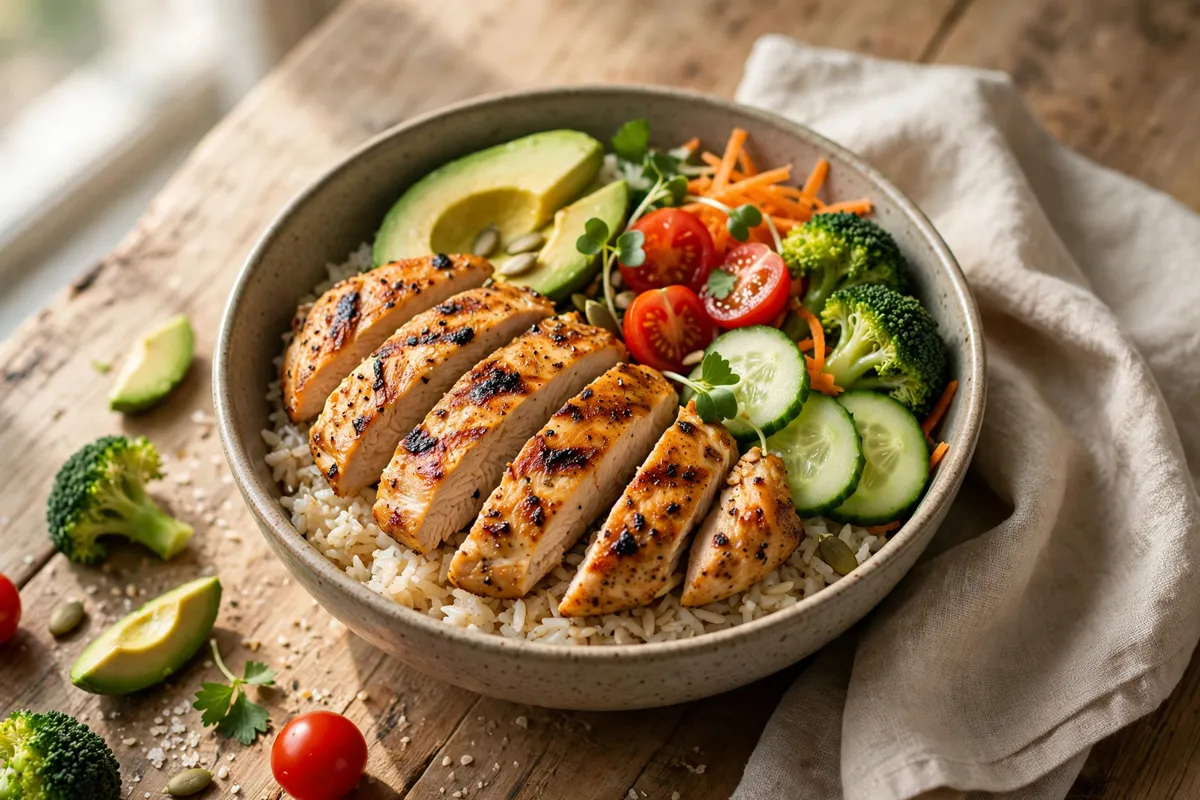
Three versions at the same number make the point that calories and satisfaction are different variables. Version one, made at home: a chicken and rice bowl — 120 g cooked chicken breast (about 200 calories, roughly 37 g protein at the standard values), 150 g cooked rice (about 195), a large portion of vegetables (about 60), and a tablespoon of a yoghurt-based dressing (about 40) — totals roughly 495–550, with protein near 40 g and fibre from the vegetables and any beans added. Version two, bought: a typical café sandwich plus crisps plus a sweetened drink can pass 800 before you notice — the sandwich alone is often 450–550, the crisps 150–200, the drink 140–250. The fix is not banning bought lunch but auditing the add-ons: water instead of the drink and fruit instead of crisps brings the same sandwich lunch back to about 550–620. Version three, the desk-drawer failure: two cereal bars and a latte at about 480 calories total but only 10 g of protein — the same calories as version one on paper, and hungry again by three o'clock. At any calorie level, protein and fibre decide whether lunch holds you; the day-level stakes are in how many calories to eat to lose weight.
Why Does an Undersized Lunch Backfire?
Because the deficit it creates gets repaid with interest. Eat 300 calories at midday on a 1,800 day and the arithmetic technically leaves 1,500 for later — but physiology collects the debt at 4 p.m., when willpower is lowest and the nearest food is vending-machine food. A 250-calorie snack raid plus a normal 700 dinner plus evening grazing quietly converts the "light lunch" day into the week's highest intake. The pattern is so common it deserves to be treated as the default prediction: lunches below about 25% of the day, in people who eat breakfast early, usually raise total intake rather than lower it. The opposite error exists too — the 1,000-calorie bought lunch on a 1,600 budget leaves 600 for breakfast, dinner and everything else, guaranteeing a miserable evening. Lunch works best in the boring middle: big enough to abolish afternoon hunger, small enough to leave dinner worth eating. If your afternoons are the problem, do not cut lunch further — grow it by 100–150 calories taken from the evening, and watch the snacking fall by more than that.
- 1,600/day → lunch 480–560 calories
- 1,800/day → lunch 540–630 calories
- 2,000/day → lunch 600–700 calories
- 2,200/day → lunch 660–770 calories
- 2,500/day → lunch 750–875 calories
How Should Lunch Change on Training Days?
Barely — and mostly in timing rather than size. If you train at lunchtime, split the meal: a smaller pre-session portion (a banana and yoghurt, about 200) and the remainder after, so the full 30–35% still lands inside the same few hours. If you train after work, lunch is your main fuelling opportunity and the top of the band makes sense, with carbohydrates taking a larger share of the plate than on a rest day. What should not change is the total philosophy: your activity factor in the maintenance calculation already prices your typical training week, so eating a second lunch "because gym" double-counts the session — the same caution the site gives about exercise calories in counting calories every day. The exception is genuinely exceptional days — a long hike, a tournament, a double session — where eating above the normal split is simply matching a day that is not normal.
How Many Calories Should Lunch Contain When Dinner Is the Unknown?
Sometimes lunch must be sized against an evening you cannot control — a work dinner, a family celebration, a restaurant booking without a menu in advance. The practical play is to hold lunch at the modest end of its band, around 28–30% of the day, and keep it protein-rich so you arrive at dinner satisfied rather than starving; a ravenous arrival typically costs more than the lunch you saved. Bank the difference deliberately: on a 1,800 day, a 520-calorie lunch instead of 620 leaves a 100-calorie cushion, and pre-deciding that dinner may run 150 over — funded also by a lighter breakfast — keeps the week intact. One planned flexible day costs a deficit almost nothing; the arithmetic of weekly averages absorbs it entirely.
Common Mistakes to Avoid
The most common mistake is the virtuous tiny lunch followed by the unexplained evening blowout, repeated daily while the dieter blames their evenings. The second is drinking lunch: a large sweet coffee or smoothie alongside a modest sandwich can double the meal unnoticed. Third, pricing bought lunches by their health halo — salads with fried toppings, creamy dressings and cheese can exceed the burger they replaced; check the numbers, not the branding. Fourth, skipping lunch entirely on busy days and arriving at dinner in a state where portion judgement is impossible. Fifth, sizing lunch from a colleague's budget: 600 calories is 35% of one person's day and 21% of another's, and only the percentage is transferable.
Final Thoughts
Lunch should contain about 30–35% of your daily calories — roughly 480–560 on a 1,600 budget, 600–700 on 2,000, and 750–875 on 2,500 — anchored by protein and fibre so it carries you to dinner without a 4 p.m. collapse. Adjust the share to your breakfast and your working pattern, keep bought-lunch add-ons audited, and remember the day's total comes first: calculate it in the calorie counter, then give lunch its proper third.
People Also Ask
How Many Calories Should a Meal Contain?
A meal should contain roughly a quarter to a third of your daily calories if you eat three meals a day — about 500 to 650 calories per meal on a 1,800-calorie day and about 600 to 800 on a 2,400-calorie day. The calculation is simply your daily target divided by your meal pattern, with snacks and drinks subtracted first if you have them.
How Many Calories Does a Person Burn Per Day?
A person burns roughly 1,400 to 3,200 calories per day in total, depending on body size and activity: basal metabolic rate accounts for about 60 to 70% of it, everyday movement and exercise most of the rest, and digesting food roughly 10%. Your personal total — your TDEE — is calculated by multiplying your Mifflin-St Jeor BMR by an activity factor of 1. 2 to 1.
What Is the Difference Between Calories and Kilocalories (kcal)?
On a food label, a calorie and a kilocalorie (kcal) are the same amount of energy wearing two different names: 1 kcal equals 1 food Calorie, exactly. The confusion exists because science uses "calorie" for a much smaller unit — 1 kcal is 1,000 of those small calories — and different countries print different names for the identical number. A European label reading 250 kcal and an American label reading 250 Calories describe precisely the same energy.
What Does a Calorie Measure?
A calorie measures energy — specifically heat energy. In its original scientific definition, one small calorie is the heat needed to raise the temperature of one gram of water by one degree Celsius, and the food Calorie (the kilocalorie, 1,000 small calories) is the heat needed to raise one kilogram of water by one degree. Everything a calorie has meant since — on labels, in diet plans, on gym machines — is that same heat measurement, scaled up and put…