MyPlate Plan Calculator: The Short Answer
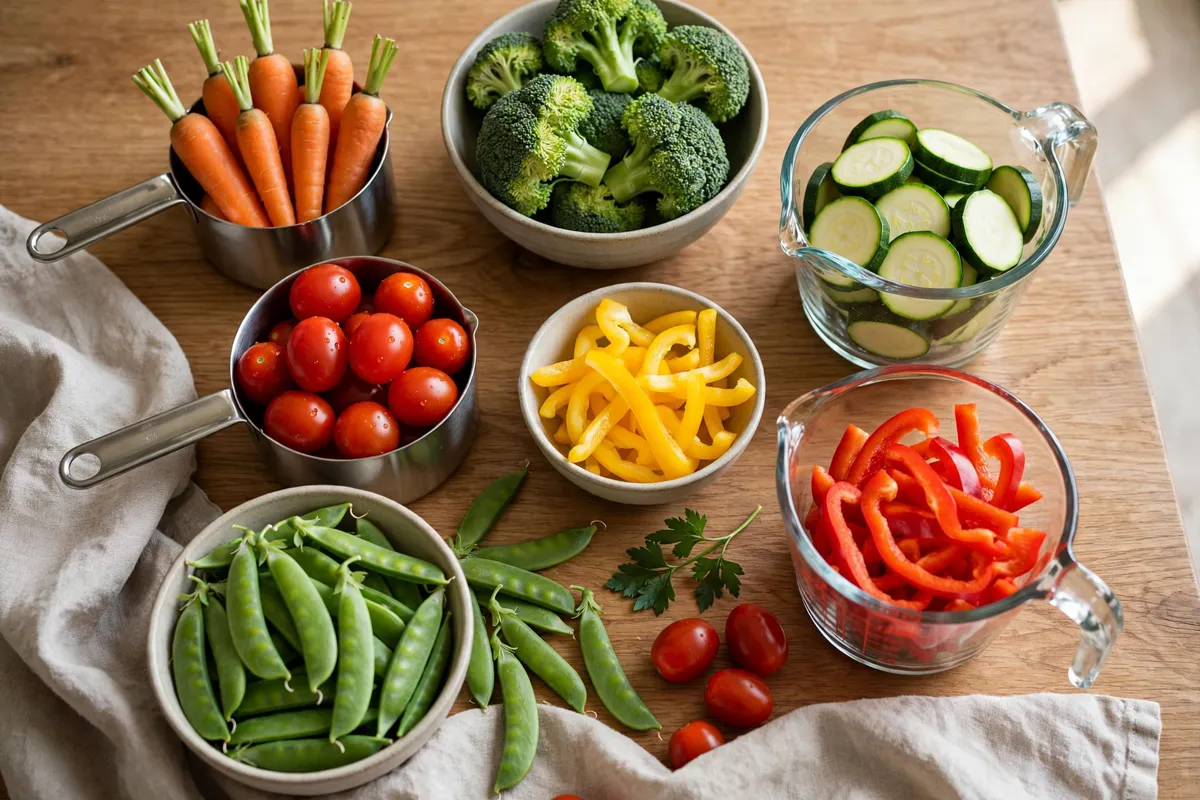
You should eat about 2.5 cups of vegetables a day on a 2,000-calorie pattern — the USDA MyPlate amount — with the exact target scaling from about 2 cups at lower calorie levels to 3 cups or more at higher ones. In practical terms that is a large salad at lunch plus a cooked vegetable side at dinner, most days.
Vegetables are the group guidance pushes hardest and the group most people under-eat, and the gap is usually a logistics problem rather than a taste problem: fresh vegetables need buying, storing, preparing and a plan. This article gives the amounts by calorie level, what counts as a cup across raw, cooked and juiced forms, which subgroups to rotate across the week and why, and a set of working habits that get 2.5 cups onto real plates. Values for individual vegetables come from this site's own food lists, and your personalised target — because it scales with your calorie pattern — is in the MyPlate plan calculator.
Short Answer
Aim for 2.5 cups of vegetables daily at 2,000 calories (about 2 cups at roughly 1,600 calories, about 3 cups at 2,400–2,800). One cup means a cup of raw or cooked vegetables, a cup of vegetable juice, or two cups of raw leafy greens. Spread it as roughly 1 cup at lunch and 1.5 cups at dinner, and rotate the subgroups weekly.
How Many Vegetables Is That Across Calorie Levels and Ages?
The MyPlate vegetable amount scales with the calorie pattern, because the pattern is a fixed proportion system. At the reference levels used on this site: a sedentary adult woman aged 19–30 sits near a 2,000-calorie pattern and 2.5 cups; an active woman or a moderately active man reaches patterns around 2,400–2,800 calories and about 3 cups; the largest patterns at about 3,000 calories carry roughly 3.5 cups. Children and smaller, less active adults sit lower, around 1.5–2 cups. Do not let the precision of the table hide the simplicity of the message: most adults should land between 2 and 3 cups, and almost nobody is harmed by reaching the top of their range, since vegetables are the lowest-density group in the pattern — a whole cup of cooked broccoli is about 55 calories, a cup of carrots about 52, a cup of raw spinach about 7. The binding constraint is not calories; it is habit, cost and preparation time, which the later sections address. Your exact figure, set by your age, sex and activity, comes from the MyPlate plan calculator.
What Counts as One Cup of Vegetables?
The measure is the cup-equivalent, and it adjusts for density. One cup-equivalent is: 1 cup of raw or cooked chopped vegetables (broccoli florets, carrot pieces, green beans, peppers), 1 cup of cooked beans, peas or lentils when you count them toward vegetables, 1 cup of vegetable juice, or 2 cups of raw leafy greens — leaves are mostly air, so the measure doubles. A medium sweet potato (about 103 calories) or a large ear of corn counts around a cup. Half-cup portions are the practical currency: a side dish is usually about half to one cup, a main-course salad two cups of leaves equalling one cup-equivalent plus its chopped additions. Keeping the leafy rule straight is the most common counting fix — a mountain of spinach that looks like three cups is one and a half cup-equivalents, still an excellent contribution, just honestly counted. The worked plate arithmetic appears in calculating daily food portions using MyPlate.
Which Vegetable Subgroups Should You Rotate Across the Week?
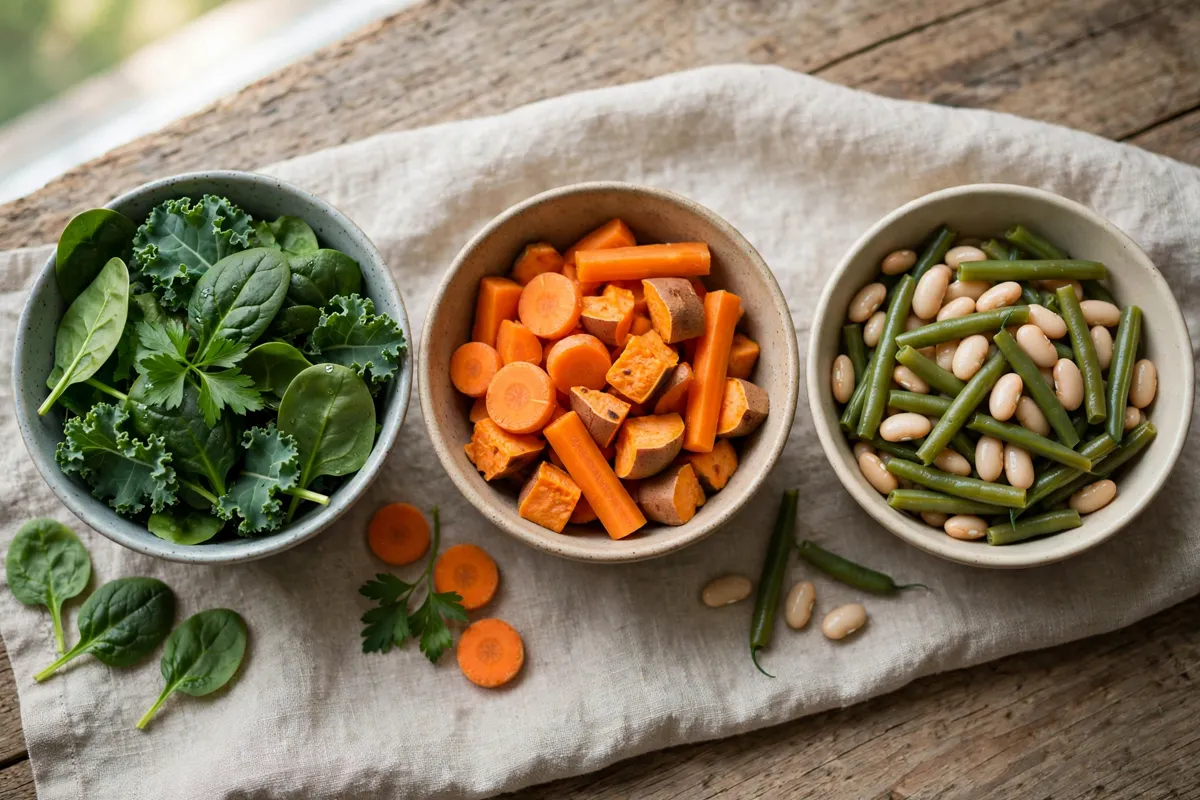
MyPlate divides vegetables into five subgroups and expects all of them across a week, because each carries a different nutrient signature. Dark-green vegetables — broccoli, spinach, kale, romaine — bring folate, vitamin K and iron-adjacent company. Red and orange vegetables — carrots, sweet potatoes, red peppers, tomatoes, squash — bring beta-carotene and vitamin C. Beans, peas and lentils bring fibre and protein in quantities no other vegetable approaches (cooked lentils and black beans around 15–16g of fibre per cup in this site's fibre listings). Starchy vegetables — potatoes, corn, green peas — bring energy and potassium and behave partly like grains on the plate. Other vegetables — green beans, cucumbers, onions, courgettes, mushrooms, cabbage — fill the rest with variety. A simple weekly rhythm covers them without a chart: something green daily, something orange most days, a bean or lentil dish once or twice, and starchy vegetables as the plate's energy anchor when a meal needs one. The plate-share context is in how much of your plate should be fruits and vegetables.
- Daily target: about 2.5 cups at 2,000 calories — scale 2 to 3.5 cups with your calorie level
- 1 cup-equivalent = 1 cup chopped raw or cooked, 1 cup juice, or 2 cups raw leafy greens
- Rotate all five subgroups weekly: dark-green, red/orange, beans-peas-lentils, starchy, other
- Vegetables are the pattern's lowest-density group — volume is a strategy, not a risk
How Do You Fit 2.5 Cups Into a Real Day?
Attach vegetables to structures that already exist. Breakfast: spinach or peppers in eggs, or a vegetable soup at the day's edges in the cuisines that already do this. Lunch: make one cup automatic — a salad, a soup, or the vegetable half of a sandwich and a side. Dinner: 1 to 1.5 cups as the plate's largest section, cooked one of three fast ways (roasted in a hot oven while the protein cooks, steamed in minutes, or stir-fried). Snacks: carrot and cucumber with a dip can carry half a cup painlessly. The enabling habits are unglamorous: frozen vegetables as the permanent backup (nutritionally comparable, zero waste, always present), a washed-and-ready box in the fridge, and vegetables written onto the shopping list in the plan rather than remembered in the shop. Cost is a fair objection, answered by the frozen aisle, by seasonal buying, and by the starchy and root vegetables that remain cheap year-round.
A word on budget and waste, since they are the objections that actually decide this target in most households. The cheapest vegetables per cup are usually the sturdiest: cabbage, carrots, onions, frozen peas and frozen mixed vegetables deliver the group's nutrients at a fraction of the cost of out-of-season salad items, and they keep. Fresh delicate vegetables should be bought in the quantity the next three or four days will genuinely use, and cooked into soups, sauces and frittatas on the day they start to fade rather than thrown away — the target is met by systems, not by aspirational shopping. Growing even one vegetable or herb at home, where space allows, also changes the psychology of the group: food you grew gets eaten.
Common Mistakes to Avoid
Mistake one is counting leafy greens cup for cup — two raw cups equal one cup-equivalent, and over-crediting salads is how many people believe they hit 2.5 cups at half that amount. Mistake two is living on one subgroup: a week of only salads misses the orange vegetables' contribution and the legumes' fibre entirely. Mistake three is counting potatoes as the vegetable at every meal and calling the group covered — starchy vegetables are one subgroup of five. Mistake four is juice as the main source: it counts cup for cup, but it strips the fibre that cooked and raw vegetables deliver (a cup of cooked broccoli carries about 5g), so it should be the exception. Mistake five is the all-or-nothing week: missing the target on two days and abandoning it, when the guidance is an average pattern — a bigger vegetable day after a thin one is the system working as designed.
Final Thoughts
About 2.5 cups a day at a 2,000-calorie pattern, counted honestly — leaves double, juice sparingly, all five subgroups across the week — and delivered by structure: a cup anchored to lunch, the plate's largest section at dinner, frozen backup in the freezer. Find your scaled amount in the MyPlate plan calculator and build this week's shopping list to match it.
People Also Ask
How to Determine Daily Reference Intakes (DRIs)?
You determine your Daily Reference Intakes (DRIs) by finding your age, sex and life-stage group in the tables published by the National Academies and reading off the reference value set for that group for each nutrient. The published DRI values for vitamin C, for example, set the Recommended Dietary Allowance at 90 milligrams a day for adult men and 75 milligrams a day for adult women, so the answer is never one number for everybody.
What Are Recommended Dietary Allowances (RDAs)?
Recommended Dietary Allowances (RDAs) are the average daily intake levels set to meet the nutrient needs of nearly all healthy people — 97 to 98 percent of them — in a defined age, sex and life-stage group. The RDA for protein illustrates the scale: 56 grams a day for adult men and 46 grams a day for adult women, both worked out from the underlying standard of 0. 8 grams per kilogram of body weight.
How to Calculate Your Weight-Loss Percentage?
To calculate your weight-loss percentage, divide the weight you have lost by your starting weight and multiply by 100: (starting weight − current weight) ÷ starting weight × 100. Losing 6 kg from a 90 kg start is (6 ÷ 90) × 100 = 6. 7% — and percentages matter because they are the fair way to compare progress between different-sized bodies and the unit the safe rate of 0.
How Much Potassium Is in Chicken Breast?
Chicken breast has 256 milligrams of potassium per 100 grams, cooked roasted and meat only (USDA FDC ID 171477) — a solid mid-field figure among plain proteins, below sirloin steak's 393mg and salmon's 628mg per 100g but well above deli-style poultry products' diluted profiles. A 6-ounce breast portion derives to 435mg of potassium. This article prices the figure at real portions and sets it honestly in the protein field.