Macro Calculator: The Short Answer
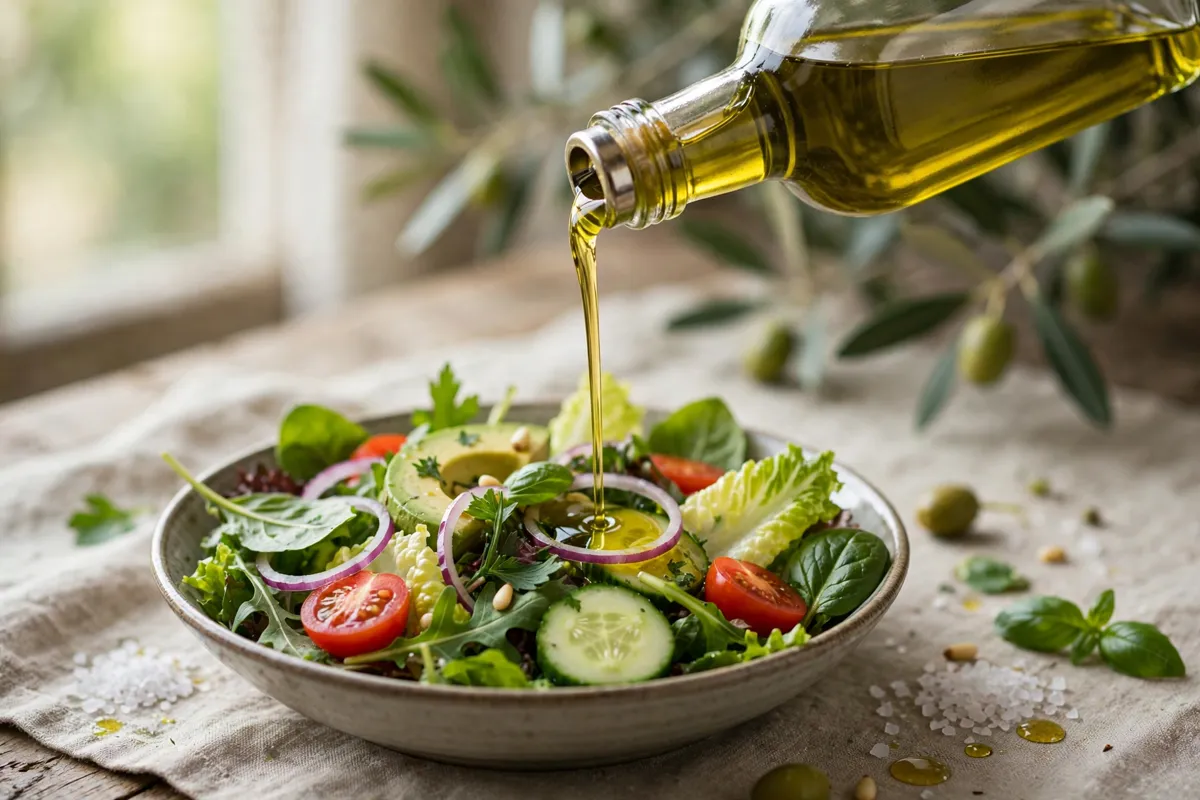
Monounsaturated fats are fats built from fatty acids that contain exactly one double bond in their carbon chain — the "mono" in their name — and they are the dominant fat in olive oil, avocados, and most nuts and seeds. Like every fat they provide 9 calories per gram, and olive oil is about 73 percent monounsaturated by USDA data, which is why it serves as the standard example of this fat family.
If saturated and polyunsaturated fats are familiar label words, monounsaturated fat is the quieter third member of the set, usually listed in the middle of the fat breakdown and rarely explained. This article explains it properly: how the single double bond defines the family, which foods supply it, how it behaves differently from its relatives, and how it fits inside a day's fat target. Your own fat grams and their share of a day's energy can be split out with the macro calculator, which is where these categories become personal numbers.
Short Answer
A monounsaturated fat is a fat whose fatty acids carry one double bond. It is liquid at room temperature in oil form, concentrated in olive oil, avocados, almonds, peanuts and many seeds, priced at 9 calories per gram like all fats, and generally regarded as a favourable fat to emphasise when it replaces saturated fat in the diet.
How Is a Monounsaturated Fat Different From Other Fats?
The classification of fats is pure chemistry. A fatty acid is a chain of carbon atoms; where neighbouring carbons share a double bond, the chain carries a kink at that point. Saturated fatty acids have no double bonds, so their chains pack tightly and the fat is typically solid at room temperature, as with butter. Monounsaturated fatty acids have one double bond and one kink — oleic acid, the main fatty acid in olive oil, is the textbook case — and the looser packing makes their oils liquid while keeping them comparatively stable. Polyunsaturated fatty acids have two or more double bonds, as in most seed oils and the long-chain fats of oily fish. These structural facts drive the practical ones: stability in storage and cooking, texture in food, and the different associations each family carries in dietary guidance. The energy arithmetic, however, ignores the distinctions entirely — how many calories are in one gram of fat is 9 for every family member, a point worth holding onto whenever a "lighter" oil is marketed as if its calories were lower.
Which Foods Provide Monounsaturated Fats?
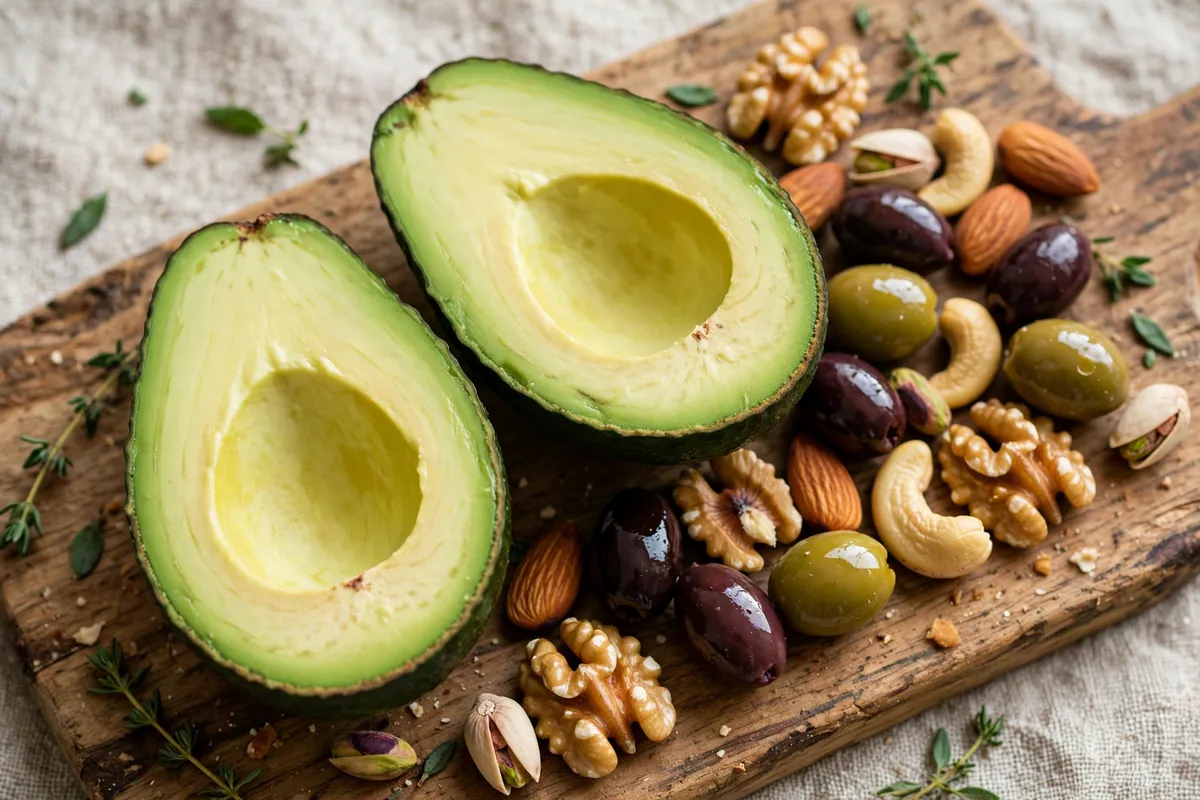
Olive oil leads the list and defines the category for most cooks: at about 73 percent monounsaturated fat by USDA data, a tablespoon delivers roughly 10 grams of monounsaturated fat within its 14 grams of total fat. Avocados are the standout whole food, with most of their fat monounsaturated, which is unusual among fruits. Among nuts, almonds, hazelnuts and peanuts carry monounsaturated fat as their largest fat fraction, and peanut butter inherits that profile; sesame and sunflower products vary by variety, with high-oleic versions bred specifically toward the monounsaturated profile. Animal foods contribute quietly too — the fat in chicken and eggs is a mixture in which monounsaturated fatty acids form a substantial share — so almost everyone eats some daily without trying. Building a day deliberately around the family usually means small swaps rather than additions: olive oil where a solid fat was planned, nuts where a refined snack was planned, avocado where a creamy spread was planned.
- Olive oil: about 73 percent monounsaturated — the benchmark source
- Avocados: monounsaturated fat is the largest share of their total fat
- Almonds, hazelnuts and peanuts: monounsaturated-led nut profiles
- High-oleic sunflower and safflower oils: bred toward the olive-oil pattern
- Eggs and chicken fat: mixed fats with a meaningful monounsaturated share
How Do Monounsaturated Fats Fit Into a Day's Fat Target?
Guidance is set for total fat first and fat families second. The published Acceptable Macronutrient Distribution Range places total fat at 20 to 35 percent of daily energy — on a 2,000-calorie pattern, roughly 44 to 78 grams of fat a day — and within that total, the consistent direction of dietary guidance is to keep saturated fat modest and let unsaturated fats, monounsaturated and polyunsaturated together, make up most of the remainder. In grams, that means a person eating 70 grams of fat a day might reasonably see the largest single share of it as monounsaturated, arriving through cooking oil, nuts, seeds and spreads rather than through a supplement or a special product. The swap logic matters more than any single food: replacing 10 grams of saturated fat with 10 grams of monounsaturated fat changes the fat profile at zero calorie cost, because both sides of the exchange are priced at 9 calories per gram. The worked shares behind these ranges are set out in what percentage of calories should come from fat, and the macro calculator converts your own calorie level into the gram range to aim at.
Does the Type of Fat Change How It Behaves in Cooking and Storage?
Partly, and the single double bond explains the behaviour. Oils rich in monounsaturated fat resist oxidation better than highly polyunsaturated oils, because each additional double bond is another point vulnerable to heat, light and air; that is one reason olive oil keeps well and has a long history as a cooking medium. At the same time, no oil is indestructible — prolonged very high heat degrades any fat, and storing oils away from light and heat preserves them regardless of family. Texture follows the same chemistry: monounsaturated-rich foods such as avocado and nut butters are soft and spreadable without being runny, sitting between solid saturated fats and thin polyunsaturated oils. None of this changes the nutritional bookkeeping — the label's total fat line already includes all families, and the monounsaturated line is a subdivision of it, not an addition to it. Reading that subdivision correctly is covered in the macro essentials guide to targets and daily limits, where the fat breakdown sits alongside the protein and carbohydrate ranges it must share a day with.
Common Mistakes to Avoid
The first mistake is treating "monounsaturated" as a synonym for "low calorie" — at 9 calories per gram these fats are exactly as energy-dense as butter, and pouring olive oil freely in the name of health is a reliable way to overshoot an energy target. The second is reading the monounsaturated line on a label as extra fat on top of the total; it is a part of the total fat figure, along with the saturated and polyunsaturated lines. Third is assuming a food belongs wholly to one family: nearly all natural fats are mixtures, and olive oil's remaining quarter includes saturated and polyunsaturated fractions. Fourth is adding monounsaturated foods on top of an unchanged diet rather than swapping them in — the favourable pattern in guidance is replacement of saturated fat, not simple addition. Fifth is dismissing animal foods as containing none; the fat in eggs and chicken carries a substantial monounsaturated share, and accuracy about mixtures beats slogans about categories.
Final Thoughts
Monounsaturated fats are the one-double-bond family: liquid, comparatively stable, concentrated in olive oil at about 73 percent, avocados, almonds and peanuts, and priced at the universal 9 calories per gram. Their value in a diet comes from proportion — forming the largest share of a fat intake that itself sits within 20 to 35 percent of energy. Check your own proportions with the macro calculator and the swaps become concrete.

People Also Ask
What Does Dietary Fat Do for Your Body?
Dietary fat gives your body its most concentrated energy supply at 9 calories per gram, the building material for every cell membrane, the raw stock for several hormones, and the carrier without which the fat-soluble vitamins A, D, E and K cannot be absorbed properly. Fat is therefore an essential nutrient with a workload, not merely a calorie source to be minimised — a body fed almost no fat begins to fail at tasks most people never connect with the…
How Do I Convert Macro Percentages to Grams?
To convert a macro percentage to grams, multiply your daily calorie target by the percentage to get that macro's calories, then divide by its energy density: 4 kcal per gram for protein, 4 for carbohydrate, and 9 for fat. At 2,200 kcal on a 40/30/30 split, that gives 2,200 × 0. 40 = 880 kcal of protein and 880 ÷ 4 = 220g of protein, 165g of carbohydrate, and about 73g of fat.
What Is the Healthiest Grain Bowl?
The healthiest grain bowl at Fresh Kitchen is Kale Slaw plus Grilled Chicken plus Green Beans plus Parmesan Broccoli: 90 + 190 + 60 + 110 = 450 calories, with 37 grams of protein, 27 grams of carbohydrates, 22 grams of fat, 9 grams of fiber, 8 grams of sugar and 1,270 milligrams of sodium. If you want it leaner still, drop the broccoli and the same core bowl is 90 + 190 + 60 = 340 calories with 32…
What Is the Healthiest Homemade Pizza?
The healthiest homemade-style pizza in this site's Papa Murphy's data is the Gourmet Vegetarian Slice (Large) at 280 calories per slice, with 11 grams of protein, 36 grams of carbohydrates, 10 grams of fat, 3 grams of fiber, 4 grams of sugar and 620 milligrams of sodium — per slice, Large size, crust as listed. It is the lowest-calorie pizza slice in the table, it has the lowest fat of any pizza slice tracked, and it ties for the highest…