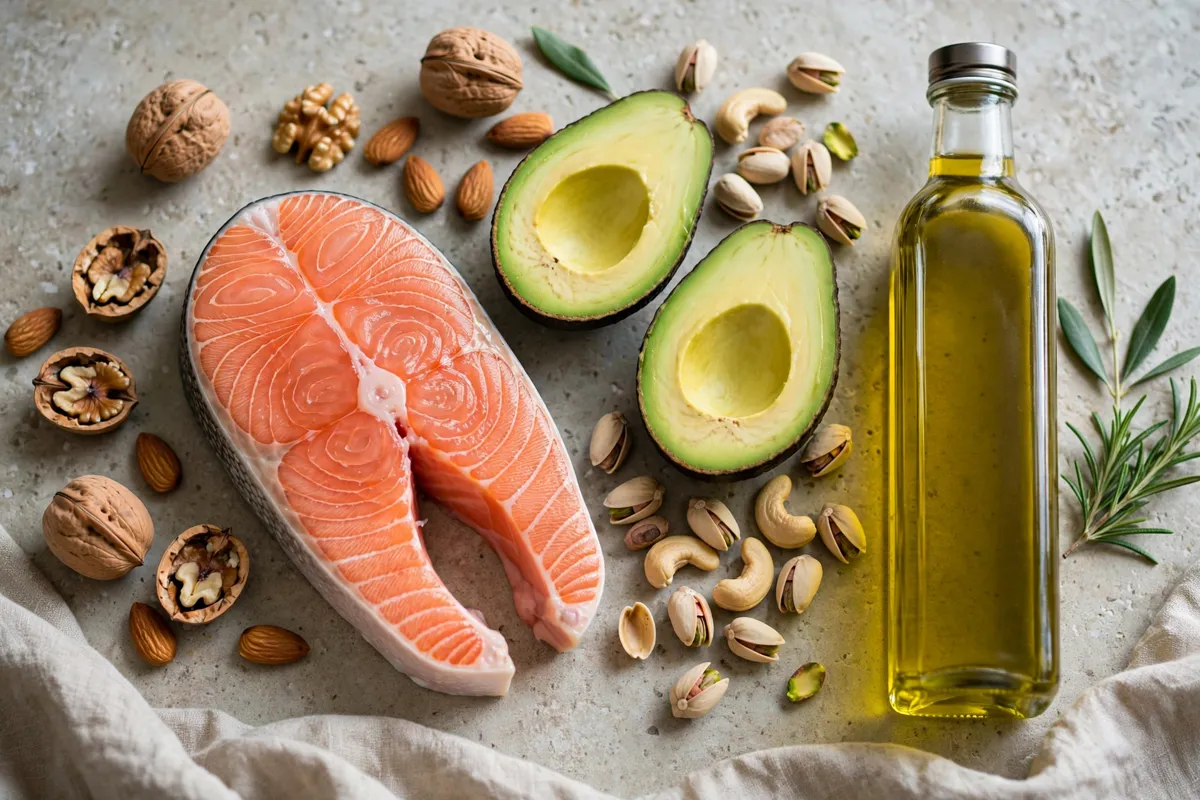
Macro Calculator: The Short Answer
Dietary fat gives your body its most concentrated energy supply at 9 calories per gram, the building material for every cell membrane, the raw stock for several hormones, and the carrier without which the fat-soluble vitamins A, D, E and K cannot be absorbed properly. Fat is therefore an essential nutrient with a workload, not merely a calorie source to be minimised — a body fed almost no fat begins to fail at tasks most people never connect with the fat on their plate.
That workload is the subject of this article. It takes fat's jobs one at a time — fuel and storage, structure and protection, vitamin transport, and the quieter roles in digestion and satisfaction — and shows what each job implies for how much fat a diet should carry and where it should come from. The amounts themselves, split against your protein and carbohydrate, can be worked out in the macro calculator; the purpose here is the reasoning underneath the amounts.
Short Answer
Fat fuels and stores energy at 9 calories per gram, builds cell membranes and nerve insulation, cushions organs and insulates against cold, supplies essential fatty acids the body cannot make, enables production of several hormones, and carries vitamins A, D, E and K from food into the body. Removing it wholesale impairs every one of those functions.

How Does Fat Work as the Body's Energy Store and Fuel?
No other nutrient stores energy as efficiently. A gram of stored fat holds 9 calories in a nearly water-free depot, while stored carbohydrate binds several grams of water per gram, so the same energy reserve held as carbohydrate would weigh several times more and make ordinary movement expensive. That efficiency is why the body banks its long-term surplus as fat and why fat, rather than carbohydrate, fuels low-to-moderate steady work and the long gaps between meals. The arithmetic of the depot is unforgiving in both directions: the density that lets a person carry weeks of energy in a modest tissue mass also means small daily surpluses accumulate invisibly, since 100 extra calories is barely 11 grams of stored fat. Understanding the store explains the strategy in how to calculate total calories from macronutrients — fat grams dominate a food's energy total so quickly because nature designed them to. Fat in the diet also slows the emptying of the stomach, which is part of why a meal containing fat sustains energy release longer than the same calories eaten as carbohydrate alone.
Why Does Fat Matter for Membranes, Hormones and Protection?
Every cell in the body is wrapped in a membrane built substantially from fatty acids, and the composition of that membrane — its fluidity, its signalling behaviour — reflects the fats available from the diet. The insulation around nerve fibres is likewise fatty, and its integrity underlies the speed of nerve conduction. Fat is also chemical raw material: cholesterol, itself obtained from food and made in the body, is the starting molecule for the steroid hormones and for vitamin D production, while certain fatty acids give rise to signalling compounds that help regulate inflammation and blood clotting. Around all of this sits the mechanical work — fat pads cushion organs against impact, and the layer under the skin insulates against heat loss. Two fatty acids are classed as essential because the body cannot synthesise them and membranes cannot be built properly without them; they must arrive in food, which alone settles the question of whether fat is optional. The daily gram amounts that cover these structural needs inside a full diet are set out in how many grams of protein, carbs and fat you should eat daily.
- Energy: 9 calories per gram, stored almost without water — the compact reserve
- Structure: fatty acids build every cell membrane and the insulation of nerves
- Chemistry: fat-derived molecules feed hormone production and cell signalling
- Protection: cushioning for organs and insulation for body temperature
How Does Fat Help You Absorb Vitamins A, D, E and K?
Vitamins A, D, E and K dissolve in fat, not in water, and that single chemical fact governs how they enter the body. In a meal, these vitamins leave the food and gather into the fat droplets present in the gut; the body absorbs those droplets — packaged and carried through the intestinal wall and onward in the bloodstream — and the vitamins travel with them. Eat the same vitamins in a nearly fat-free meal and a share of them simply passes through unabsorbed, because their vehicle never formed. This is the practical reason salads built from vitamin-rich vegetables deliver more of their A and K when dressed with oil than when eaten plain and dry, and why very-low-fat diets maintained over long periods are watched for fat-soluble vitamin shortfalls even when the diet's vitamin content looks adequate on paper. The vitamins themselves divide the work — A for vision and cell growth, D for calcium balance, E as an antioxidant protecting fats themselves, K for blood clotting — but they share the one delivery requirement. Planning meals so that vitamin-rich foods meet some fat at the same sitting is a small habit with a direct biochemical payoff.
What Does Fat Do for Digestion, Satisfaction and Flavour?
Fat is the slowest of the energy nutrients to leave the stomach, and that delay is functional: it steadies the arrival of the meal's energy, contributes to the hormonal signals of fullness, and is a large part of why a meal with adequate fat satisfies for hours while a fat-free meal of equal calories can leave a person hungry again quickly. Fat also carries flavour in the literal sense — many aromatic compounds in food dissolve in fat rather than water, so fat distributes taste through a dish and gives foods their characteristic richness and mouthfeel, which is why removing it changes a recipe's character far beyond its calorie line. These roles have a planning consequence that pure arithmetic misses: a diet cut so low in fat that meals stop satisfying tends to fail by compensation, as hunger drives extra eating elsewhere. The workable question is never whether to include fat but how much and which — the subject of how do I calculate my macros, where fat is sized after protein and total energy are set, precisely because its jobs set a floor beneath it.
Common Mistakes to Avoid
The first mistake is treating fat as a single-purpose villain whose only role is storage, then designing diets that undercut its structural and transport jobs. The second is assuming a fat-free version of a meal delivers the same vitamins as the original — the A, D, E and K in the ingredients depend on fat for absorption, so the label's vitamin content overstates what a fat-free preparation delivers. Third is forgetting that fat's benefits are dose-shaped: the body needs a dependable supply, not an unlimited one, and the same 9 calories per gram that makes storage efficient makes excess easy. Fourth is cutting fat while leaving total energy unexamined, then replacing it with refined carbohydrate and wondering why satisfaction and totals both worsen. Fifth is ignoring essential fatty acids entirely — they are the clearest proof in the whole subject that some fat is not a preference but a requirement.
Final Thoughts
Dietary fat is the body's energy reserve, membrane builder, hormone stock, organ cushion and the sole transport system for vitamins A, D, E and K — five jobs, one nutrient. A sound diet therefore does not ask how little fat it can survive on, but how to size and source fat so each job is covered within the energy budget. Put your own numbers to that question with the macro calculator.
People Also Ask
How Do I Convert Macro Percentages to Grams?
To convert a macro percentage to grams, multiply your daily calorie target by the percentage to get that macro's calories, then divide by its energy density: 4 kcal per gram for protein, 4 for carbohydrate, and 9 for fat. At 2,200 kcal on a 40/30/30 split, that gives 2,200 × 0. 40 = 880 kcal of protein and 880 ÷ 4 = 220g of protein, 165g of carbohydrate, and about 73g of fat.
Do I Need to Hit My Macros Exactly Every Day?
No. Macro targets are planning averages, not daily quotas, and a week that hits the protein number exactly only once can still land on it precisely: seven days of 140, 165, 150, 138, 160, 155, and 142 grams against a 150g daily target sum to 150 × 7 = 1,050g — the weekly target exactly. Aim at the number each day, judge yourself by the week's average, and keep each day inside a ±10% band (135–165g for that 150g target)…
What Is the Healthiest Homemade Pizza?
The healthiest homemade-style pizza in this site's Papa Murphy's data is the Gourmet Vegetarian Slice (Large) at 280 calories per slice, with 11 grams of protein, 36 grams of carbohydrates, 10 grams of fat, 3 grams of fiber, 4 grams of sugar and 620 milligrams of sodium — per slice, Large size, crust as listed. It is the lowest-calorie pizza slice in the table, it has the lowest fat of any pizza slice tracked, and it ties for the highest…
What Is the Healthiest Breakfast at a Restaurant?
On the Denny's menu tracked by this site, the healthiest full breakfast is the Fit Fare Loaded Veggie Omelette: 480 calories with 31 grams of protein, 24 grams of carbohydrates, 5 grams of fiber and 980 milligrams of sodium — the lowest sodium of any breakfast entrée on the menu. It is the only Denny's breakfast that leads on protein, fiber and sodium at the same time, which is what "healthiest" has to mean once you look past calories alone.